THE TRAIT APPROACH
As we begin to consider the trait approach to personality psychology, keep two points in mind. First, almost all research within the trait approach relies on correlational designs (see Chapter 3). If a person scores high on a measure of “dominance,” can we expect that the person will act in a dominant manner (relative to other people)? The statistical answer is the correlation between the dominance score and some separate indication of the relevant behavior.
More information
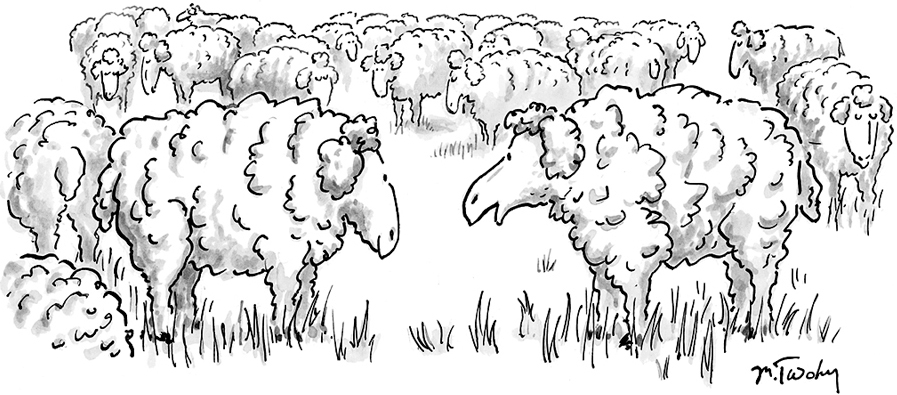
A comic shows a field of sheep all with a similar appearance due to their body shape and fluffy wool. One sheep tells another, “I love the little ways you’re identical to everyone else.”
“I love the little ways you’re identical to everyone else.”
The second notable aspect of the trait approach is that it focuses exclusively on individual differences. It does not attempt to measure how dominant, sociable, or nervous anybody is in an absolute sense; there is no zero point on any dominance scale or on any measure of any other trait. Instead, the trait approach seeks to measure the degree to which a person might be more or less dominant, sociable, or nervous than someone else. Technically, therefore, trait measurements are made on ordinal rather than ratio scales.2
This focus on comparisons is one of the great strengths of the trait approach. It is helpful for understanding and assessing how people differ. But as so often happens (remember Funder’s First Law), it must also be considered a weakness: The trait approach, by its very nature, is prone to neglect aspects of psychology common to all people, as well as the ways in which each person is unique. (Other approaches, considered later in this book, do focus on those aspects of human nature.)
The tension between thinking of people in terms of what they share versus how they differ is captured by the comment that every person is like all other people, like some other people, and like no other person.3 In other words, some psychological properties and processes are universal. Everyone, or nearly everyone, needs comfort, safety, stimulation, and connections with other people, for example. Other properties of people differ in ways that allow individuals to be grouped. People who are consistently cheerful, for instance, might be essentially alike in a way that allows them to be meaningfully distinguished from those who are gloomy (although they might still differ among themselves in other respects). Finally, each individual is unique and cannot really be compared with anyone else. Each person’s genetic makeup, past experience, and view of the world are different from those of anyone else who ever lived or ever will (Allport, 1937).
The trait approach comes in at the second or middle level of this analysis, while at the same time (necessarily) neglecting the other two. Because the trait approach is based on the ideas that all people are like some other people and that it is meaningful and useful to assess broad categories of individual differences, the approach assumes that in some real sense people are their traits. Theorists differ on whether traits simply describe how a person acts, are the sum of everything a person has learned, are biological structures, or are a combination of all of these concepts. But for every trait theorist, these dimensions of individual differences are the building blocks from which personality is constructed.
Which raises a fundamental problem.
Endnotes
-
A measurement is said to lie on an ordinal scale when its value reflects a rank order. For example, three racers earn values of 1, 2, and 3 if they place first, second, and third. There is no zero point on this scale (you can’t place “0th”), and the numbers 1 and 3 do not imply that the third-place runner was three times slower than the first-place runner. But they do tell you who won and who came in last. A measurement lies on a ratio scale if the scale has a true zero point and measurements can be compared in terms of ratios. For example, one runner might go 3 miles an hour, a second runner 2 miles an hour, and a third (rather slow) runner might go 1 mile an hour. These measurements are rational because it is possible to go 0 miles an hour (by standing still), and because the first runner can be said to be going three times faster than the third runner. Trait measurements are ordinal rather than rational because there is no such thing as “zero dominance,” for example, and if one person has a dominance score of 50 and another has a score of 25, this implies the first person is more dominant than the second but not necessarily twice as dominant, whatever that might mean. (See Blanton & Jaccard, 2006, for an interesting discussion of the difficulties in expressing psychological attributes in terms of numbers.)Return to reference 2
- Kluckhohn and Murray (1961, p. 53) famously said this but used “man” and “men” instead of “person” and “people.”Return to reference 3