❮❮
For a complete discussion of ethical guidelines in research, see Chapter 4.
A variable, as the word implies, is something that varies, so it must have at least two levels, or values. Take this headline: “Most students don’t know when news is fake.” Here, “knowing when news is fake” is the variable, and its levels are knowing when news is fake, and not knowing when news is fake. Similarly, the study that inspired the statement “Countries with more butter have happier citizens” contains two variables: per capita butter consumption (whose levels might go from 0 kilograms per year up to 2 kilograms per year) and the level of happiness (with levels ranging from 1, least happy, to 10, most happy). In contrast, if a study concluded that “15% of Americans smoke,” nationality is not a variable because everyone in the study is American. In this example, nationality would be a constant, not a variable. A constant is something that could potentially vary but that has only one level in the study in question. (In this example, “smoking” would be a variable, and its levels would be smoker and nonsmoker.)
The researchers in any study either measure or manipulate each variable. The distinction is important because some claims are tested with measured variables, while other claims must be tested with both measured and manipulated variables. A measured variable is one whose levels are simply observed and recorded. Some variables, such as height and IQ, are measured using familiar tools (a ruler, a test). Other variables, such as gender and hair color, are also said to be “measured.” To measure variables such as depression and stress, researchers devise a special set of questions to represent the various levels. In each case, measuring a variable is a matter of recording an observation, a statement, or a value as it occurs naturally.
In contrast, a manipulated variable is a variable a researcher controls, usually by assigning study participants to the different levels of that variable. For example, a researcher might give some participants 10 milligrams of a medication, others 20 mg, and still others 30 mg. Or a researcher might assign some people to take a test in a room with many other people and assign others to take the test alone. In both examples, the participants could end up at any of the levels because the researchers do the manipulating, assigning participants to be at one level of the variable or another.
Some variables cannot be manipulated—they can only be measured. Age can’t be manipulated because researchers can’t assign people to be older or younger; they can only measure what age people already are. IQ is another variable that can’t be manipulated. Researchers cannot assign some people to have a high IQ and others to have a low IQ; they can only measure each person’s IQ. Even if the researchers choose the 10% of people with the highest IQ and the 10% with the lowest IQ, it is still a measured variable because people cannot be assigned to the highest or lowest 10%.
❮❮
For a complete discussion of ethical guidelines in research, see Chapter 4.
Other variables cannot be manipulated because it would be unethical to do so. For example, in a study on the long-term effects of childhood trauma, researchers could not ethically assign children to “trauma experience” and “no trauma experience” conditions.
Some variables, however, can be either manipulated or measured, depending on the goals of a study. If childhood music lessons were your variable of interest, you could measure whether children already take music lessons, or you could manipulate this variable if you assigned some children to take music lessons and others to take something else (such as drama lessons). If you wanted to study butter consumption, you could measure this trait by recording how much butter different nations consume annually (perhaps in kilograms). You could also manipulate this variable in the short term if you assigned some willing volunteers to consume a large (versus small) quantity of foods rich in butter.
Each variable in a study can be referred to in two ways. When researchers are discussing their theories and when journalists write about their research, they use more abstract names, called constructs or conceptual variables. When testing hypotheses with empirical research, they create operational definitions of variables, also known as operational variables, or operationalizations. To operationalize a concept of interest means to turn it into a measured or manipulated variable.
For example, a researcher’s interest in the construct “coffee consumption” could be operationalized as a structured question in which people tell an interviewer how often they drink coffee. Alternatively, the same construct might be operationalized by having people use an app in which they record everything they eat or drink for a period of time. Table 3.1 explains the ways variables can be defined.
How Do Researchers Describe Variables?
|
Way of describing a variable |
Definition |
Example 1 |
Example 2 |
|
Construct, conceptual variable |
The name of the concept being studied |
“Satisfaction with life” |
“Perseverance” (in young children) |
|
Conceptual definition |
A careful, theoretical definition of the construct |
“A person’s cognitive evaluation of his or her life” (Diener et al., 1985) |
“The ability to push through when confronted with . . . obstacles” (White et al., 2017) |
|
Operational definition, operationalization |
How the construct is measured or manipulated in an actual study |
Five questionnaire items on the Satisfaction with Life scale, answered on a scale of 1 (strongly disagree) to 5 (strongly agree). An example item is “All in all, I am satisfied with my life” |
How long a child will choose to engage in a slow-paced, boring activity that involves pressing a button when they see a picture of cheese on a screen and not pressing it when they see a cat on the screen |
Sometimes this operationalization step is simple and obvious. For example, a researcher interested in a conceptual variable such as “weight gain” in laboratory rats would probably just weigh them. A researcher who is interested in the conceptual variable “income” might operationalize this variable by asking each person about their total income last year. In these two cases, the researcher can operationalize the conceptual variable of interest straightforwardly.
Other times, the concepts researchers wish to study are harder to operationalize because they are difficult to see, touch, or feel. Examples are personality traits, states such as “argumentativeness,” and behavior judgments such as “attempted suicide.” The abstract nature of these conceptual variables does not stop psychologists from operationalizing them; it just makes studying them a little harder. In such cases, researchers might develop creative or elegant operational definitions to capture the variable of interest. See Table 3.2 for some examples.
Describing Variables: Examples
|
Variable name (conceptual variable) |
Operational definition (one possibility) |
Levels of this variable |
Is the variable measured or manipulated? |
|
Car ownership |
Researchers asked people to circle “I own a car” or “I do not own a car” on their questionnaire. |
2 levels: own a car or not |
Measured |
|
Expressing gratitude to romantic partner |
Researchers asked people in relationships the extent to which they agree with items such as “I tell my partner often that s/he is the best.” |
7 levels, from 1 (strongly disagree) to 7 (strongly agree) |
Measured |
|
Exposure to disinformation |
Researchers assigned participants to hear false information either one time or two times. |
2 levels: hearing the false information once or twice. |
Manipulated |
|
What time children eat dinner |
Using a daily food diary, researchers had children write down what time they ate dinner each evening. |
Researchers divided children into two groups: those who ate dinner between 2 P.M. and 8 P.M., and those who ate after 8 P.M. |
Measured |
In journal articles, variables are usually referred to at the conceptual level. So to discover how the variable “school achievement” was operationalized, you need to ask: How did the researchers measure “school achievement” in this study? To determine how a variable such as “childhood trauma” was operationalized, ask: How did researchers measure “childhood trauma” in this research? Figure 3.2 shows how the first variable might be operationalized.
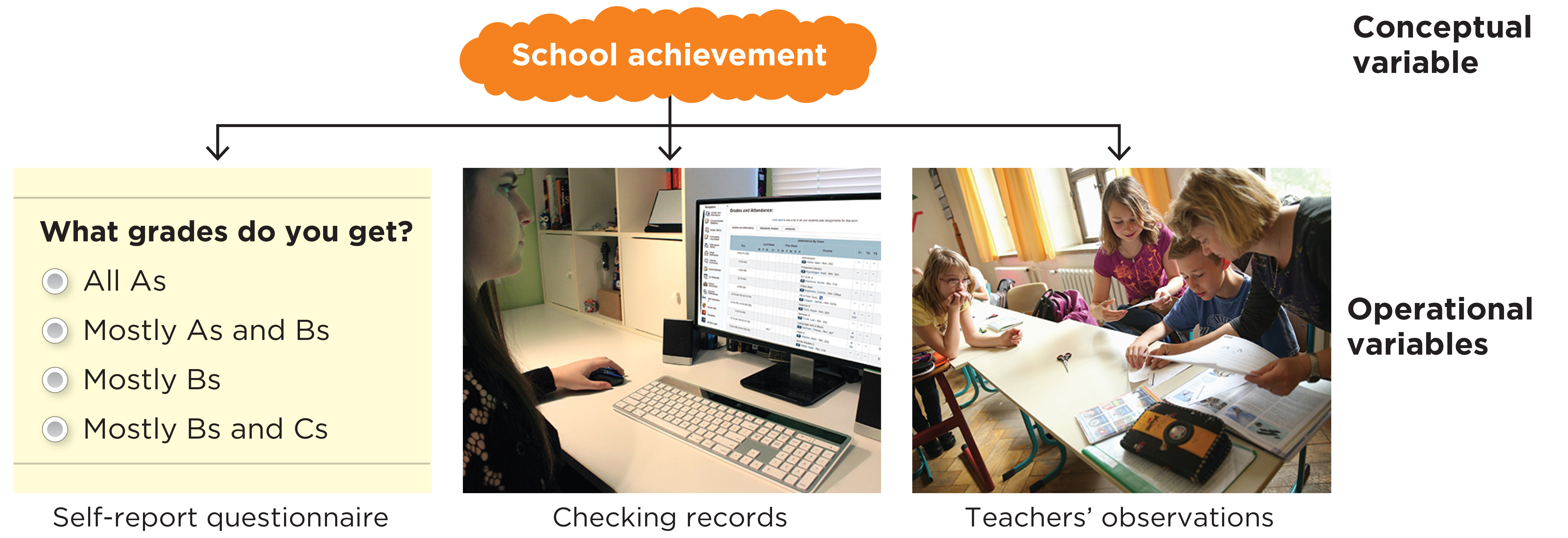
Figure 3.2
Operationalizing “school achievement.”
A single conceptual variable can be operationalized in a number of ways.

1. See p. 56. 2. See p. 57. “History of trauma” is probably not a manipulated variable, but “level of eye contact” might be manipulated if researchers assigned some people to make regular eye contact with a conversation partner and other people to look away from a conversation partner. 3. See pp. 57–59.