INDEPENDENT-GROUPS DESIGNS
Although the minimum requirement for an experiment is that researchers manipulate one variable and measure another, experiments can take many forms. One of the most basic distinctions is between independent-groups designs and within-groups designs.
Independent-Groups Versus Within-Groups Designs
In the norms poster and baby persistence studies, there were different participants at each level of the independent variable. In the poster study, some participants saw a norms poster and others saw a flu shot poster. In the persistence study, some babies were in the effort condition and others were in the no-effort condition. Both of these studies used an independent-groups design, in which separate groups of participants are placed into different levels of the independent variable. This type of design is also called a between-subjects design or between-groups design.
In a within-groups design, or within-subjects design, each person is presented with all levels of the independent variable. For example, one study manipulated head position, showing a man with his head tilted up, down, or neutral. The researchers used a within-groups design, asking each participant to rate all three faces—one tilted up, one tilted down, and one in a neutral position (Witkower & Tracy, 2019).
Two basic forms of independent-groups designs are the posttest-only design and the pretest/posttest design.
Posttest-Only Design
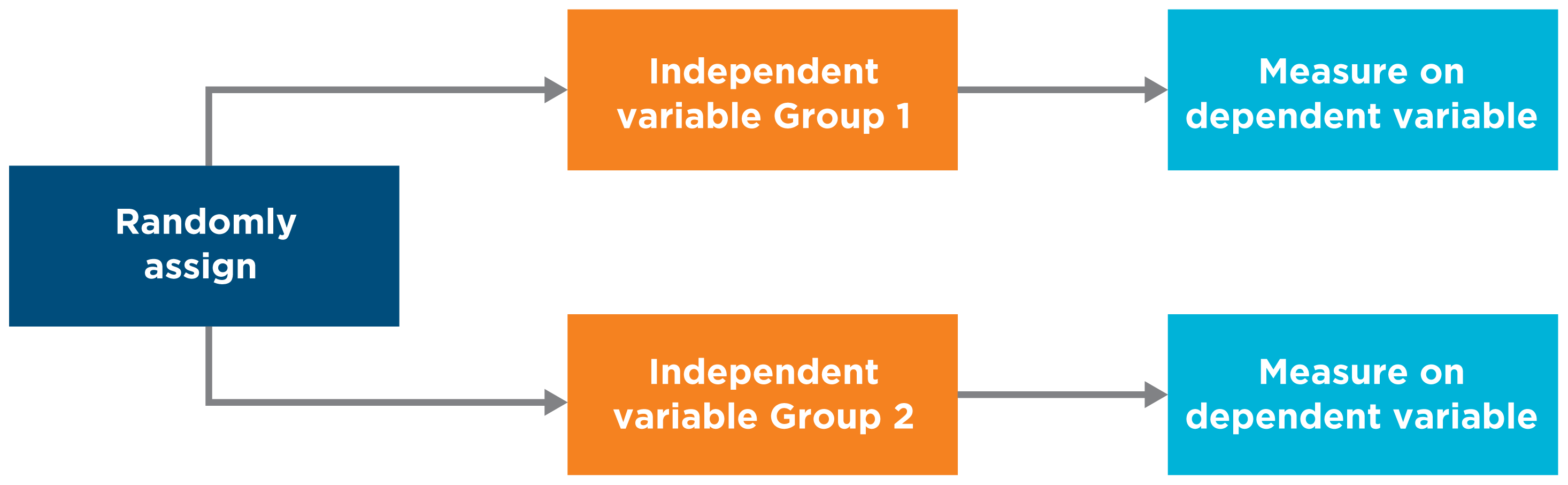
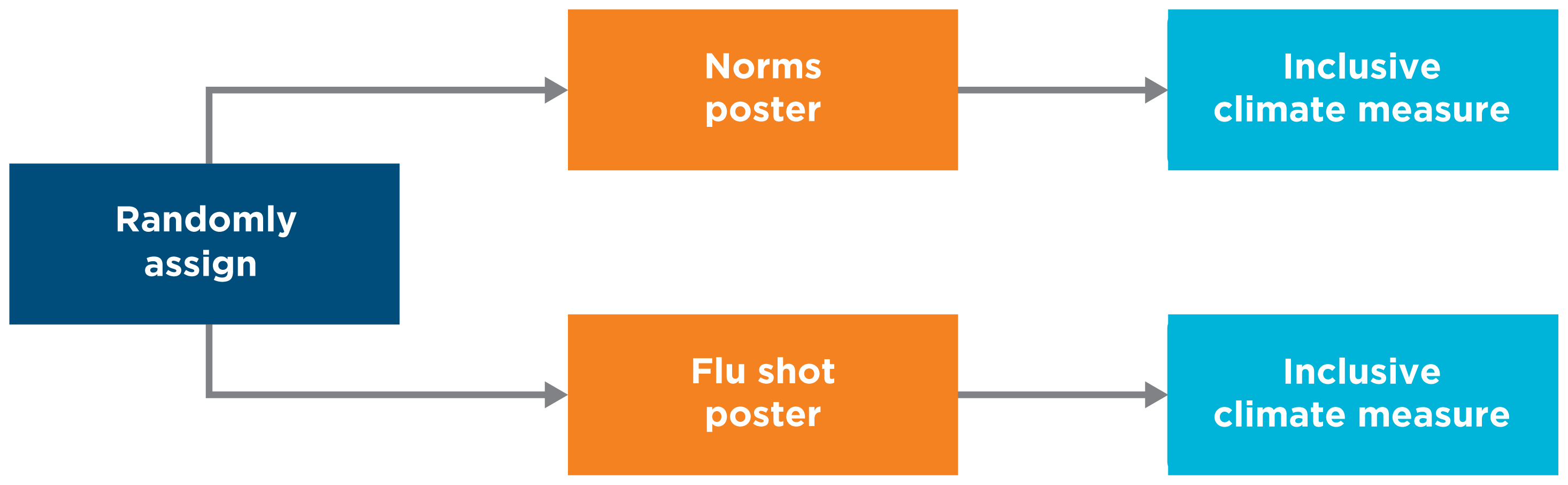
The posttest-only design, also known as an equivalent groups, posttest-only design, is one of the simplest independent-groups experimental designs. In this design, participants are randomly assigned to independent variable groups and are tested on the dependent variable once (Figure 10.10). The poster study is an example of a posttest-only design, with two independent variable levels (Murrar et al., 2020). Participants were randomly assigned to a norms poster condition or a flu shot poster condition (Figure 10.11), and they were tested only once on the measure of inclusive climate.
Posttest-only designs satisfy all three criteria for causation. They allow researchers to test for covariance by detecting differences in the dependent variable. (Having at least two groups makes it possible to do so.) They establish temporal precedence because the independent variable comes first in time. And when they are conducted well, they establish internal validity. When researchers use appropriate control variables, there should be no design confounds, and random assignment takes care of selection effects.
More information
A flowchart begins with randomly assigning individuals to group 1 or group 2, corresponding to different values of the independent variable. Individuals in each group are then measured for the dependent variable.
FIGURE 10.10
A posttest-only design.
More information
A flowchart illustrating a posttest-only design. The chart begins with randomly assigning individuals to the norms poster group or the flu shot poster group. Individuals in each group are then tested on the inclusive climate measure.
FIGURE 10.11
Studying norms: a posttest-only design.
Pretest/Posttest Design
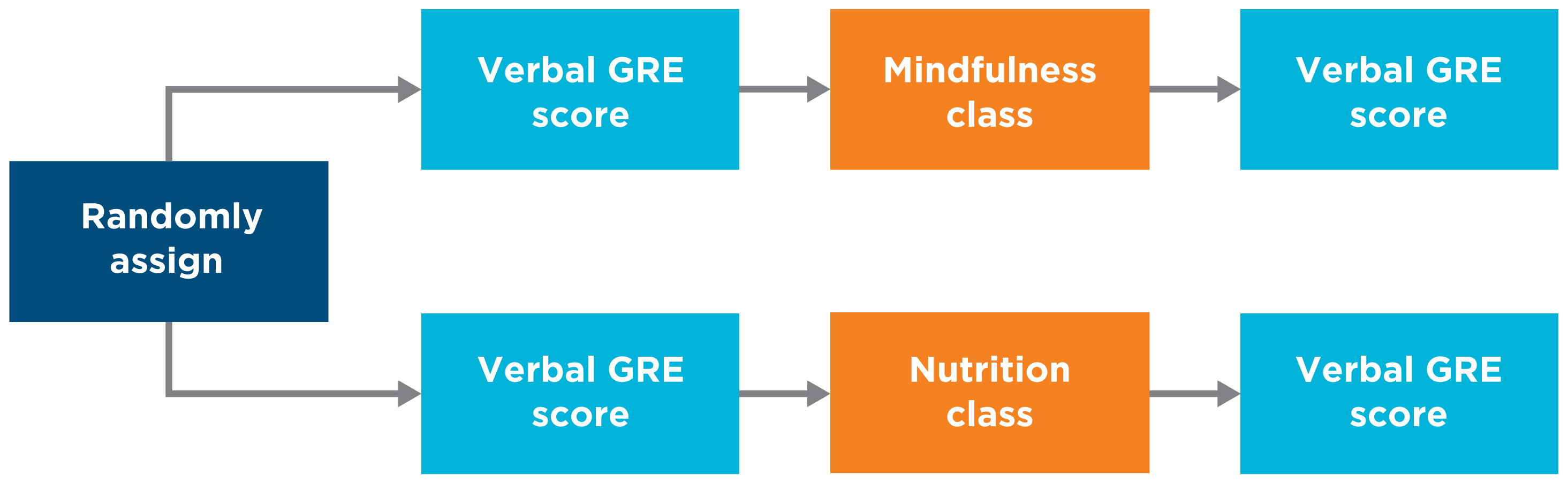
In a pretest/posttest design, or equivalent groups, pretest/posttest design, participants are randomly assigned to at least two groups and are tested on the key dependent variable twice—once before and once after exposure to the independent variable (Figure 10.12).
More information
A flowchart illustrating a pretest/posttest design. The chart begins with randomly assigning individuals to one of two groups. Each group is then tested to obtain a verbal G R E score from every member. The first group then take a mindfulness class, while the second group takes a nutrition class. The flowchart ends with each group again being tested to obtain verbal G R E scores.
FIGURE 10.12
A pretest/posttest design.
A study on the effects of mindfulness training, introduced in Chapter 1, is an example of a pretest/posttest design. In this study, 48 students were randomly assigned to participate in either a 2-week mindfulness class or a 2-week nutrition class (Mrazek et al., 2013). One week before starting their respective classes, all students completed a verbal-reasoning section of a GRE test. One week after their classes ended, all students completed another verbal-reasoning GRE test of the same difficulty. The results, shown in Figure 10.13, revealed that, while the nutrition group did not improve significantly from pretest to posttest, the mindfulness group scored significantly higher at posttest than at pretest.
Researchers might use a pretest/posttest design when they want to be sure random assignment made groups equal. In this case, a pretest/posttest design means researchers can be absolutely sure there is no selection effect in a study. If you examine the white pretest bars in Figure 10.13, you’ll see the nutrition and mindfulness groups had almost identical pretest scores, indicating that random assignment worked as expected.
In addition, pretest/posttest designs enable researchers to track people’s change in performance over time. Although the two groups started out, as expected, with about the same GRE ability, only the mindfulness group improved their GRE scores.
Which Design Is Better?
Why might researchers choose to do a posttest-only experiment rather than a pretest/posttest design? Shouldn’t they always make sure groups are equal on GRE ability or attitudes about diversity before they experience a manipulation?
Not necessarily. In some situations, it is problematic to use a pretest/posttest design. Imagine if the Murrar team had measured people’s inclusive climate attitudes both before and after exposure to the posters. It’s possible that participants—especially those in the norms poster condition—would have become suspicious about the nature of the study (“Gee, I’ve just answered questions about prejudice, and now I’m being asked to answer them again after seeing a pro-diversity poster”). Instead, the researchers trusted in random assignment to create equivalent groups. People with a range of inclusive climate attitudes had an equal chance of seeing either of the two posters. Therefore, any observed difference in inclusive climate attitudes after being in the waiting room should be attributable only to the exposure to the two posters.
In contrast, a pretest/posttest design made sense for the Mrazek team’s study. They could justify giving their sample of students the GRE test two times because they had told participants they were studying ways of “improving cognitive performance.”
In short, the posttest-only design may be the most basic type of independent-groups experiment, but its combination of random assignment plus a manipulated variable can lead to powerful causal conclusions. The pretest/posttest design adds a pretesting step to the most basic independent-groups design. Researchers might use a pretest/posttest design if they want to study improvement over time, or to be extra sure that two groups are equivalent at the start—as long as the pretest does not make the participants suspicious or change their subsequent behavior.
 TRY THIS!
What is the difference between independent-groups and within-groups designs? Use the term levels in your answer.
SHOW ANSWERHIDE ANSWER
See p. 288.
Glossary
- independent-groups design
- An experimental design in which different groups of participants are exposed to different levels of the independent variable, such that each participant experiences only one level of the independent variable. Also called between-groups design, between-subjects design.
- within-groups design
- An experimental design in which each participant is presented with all levels of the independent variable. Also called within-subjects design.
- posttest-only design
- An experiment using an independent-groups design in which participants are tested on the dependent variable only once. Also called equivalent groups, posttest-only design.
- pretest/posttest design
- An experiment using an independent-groups design in which participants are tested on the key dependent variable twice: once before and once after exposure to the independent variable.