CASE STUDY: SOUTH INDIAN RAGA NILAMBARI
Music sometimes carries such strong associations that it transmits the same meanings across a wide array of music traditions and settings. Raga nilambari provides a striking example within South Indian (Karnatak) soundscapes. In Chapter 1, in the discussion of the North Indian (Hindustani) Rag Des in Listening Guide 12, we learned that raga is the Indian system for organizing melodies according to their distinctive pitch content and their range of associations. ragas vary in their names and musical content between the North and South Indian traditions.
Ragas may be associated with the time of day when they are performed (morning, afternoon, or evening ragas), or according to the season of the year with which they are linked (the monsoon season, for example). Additionally, each raga also has emotional connotations, understood within an aesthetic system known as rasa, from a Sanskrit word meaning "juice, essence, or flavor."3 The sound of a raga therefore conveys meanings on both experiential and emotional levels.
Musicians perform a particular raga on the occasions with which that raga is associated. Our example, raga nilambari, is so closely associated with lullabies that it is known as "the lullaby raga" in South India and the South Indian diaspora. So close is the association of raganilambari with sleep that any melody in this raga may be sung as a lullaby.
Raga nilambari can best be represented in Indian sargam notation, which we encountered in our discussion of the North Indian Rag Des in Chapter 1 (Listening Guide 12). Sargam notation provides names for seven main scale degrees in ascending order—Sa Ri Ga Ma Pa Dha Ni—a system similar but not identical to the Western notion of scale. Each scale degree within a raga is termed a svara, which identifies both its particular place or position within a melody and the way in which it is combined with a type of ornament called a gamaka. The tonic, or first and most prominent svara, Sa, and Pa, the fifth svara, are fixed in their pitch level. In performances with instrumental accompaniment, Sa and Pa are usually reinforced by a drone, sometimes played by a plucked string instrument called a tanpura (or tambura). The remaining five svaras are flexible; their precise articulations, attacks and releases, and ornamentation vary according to their position and context in the particular raga.
Like many other ragas, nilambari has some variation in svara order for ascending (aroha) and descending (avaroha) melodic motion. These characteristic patterns and the emphasis on specific intervals and ornaments signal listeners that they are hearing raga nilambari. Note that contrasting melodic patterns differentiate the ascent from the descent—for instance, ascending nilambari often skips from Ma up to Dha, then down to Pa, and back up to Dha before continuing to ascend through Ni to the upper Sa. There are two forms of the seventh svara, Ni, one lower, the other inflected close to the upper tonic, Sa. On the descent, Dha is often omitted, creating a gap; note too, that the descending motion often incorporates a move back up to Ga before skipping down to Sa. The skip from Ga to Sa on the descent becomes a clear sonic marker for raga nilambari.
Ascending: Sa Ri Ga Ma Dha Pa Dha Ni Sa
Descending: Sa Ni Pa Ma Ga Ri Ga Sa
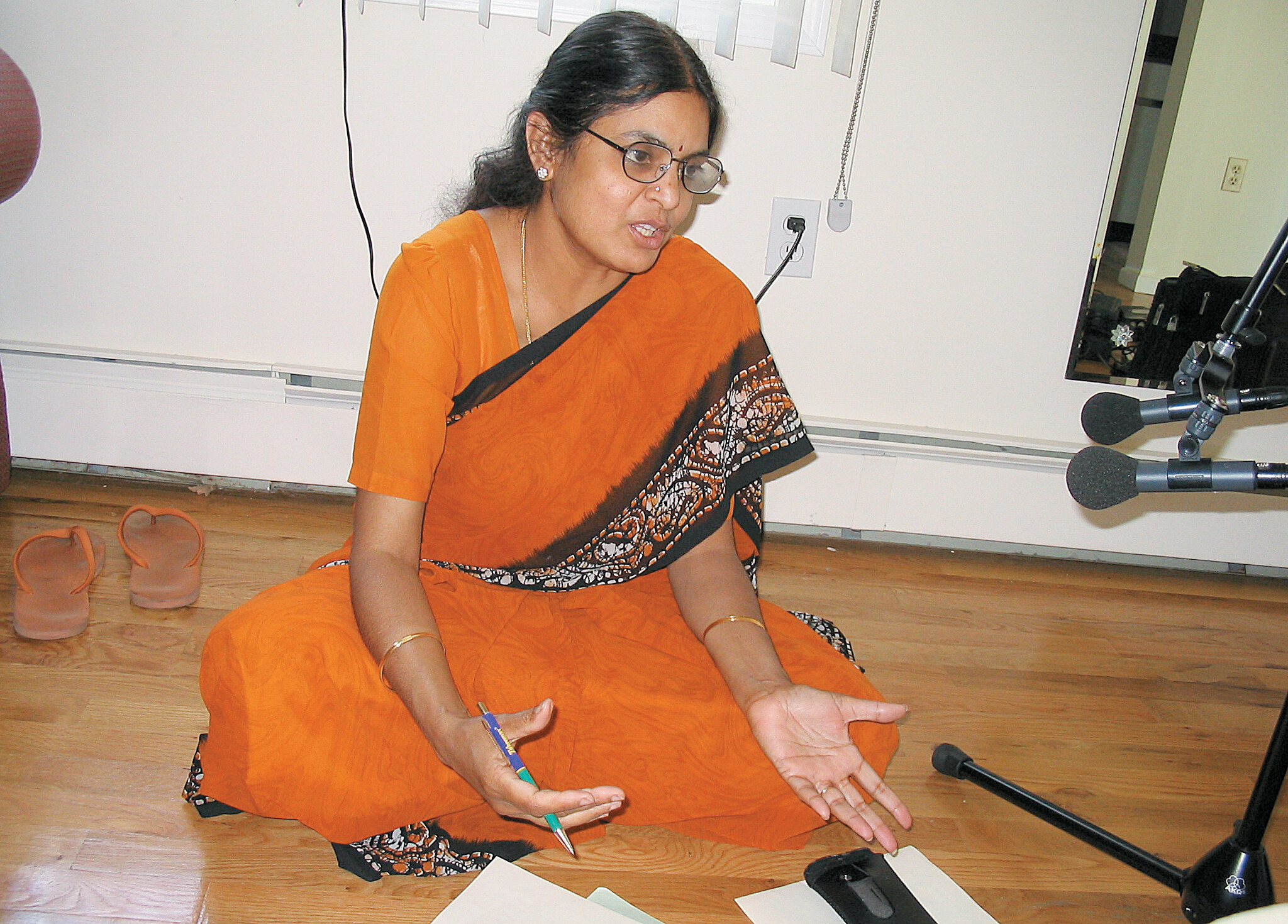
Raga nilambari is used mainly by those who have a classical music education or who belong to particular classes (castes) of South Indian society. The lullaby heard in Listening Guide 33, is performed by Mrs. Jeyalakshmi Sundar, a South Indian Brahmin woman born in Turaviman village, located near Madurai, in Tamil Nadu state. Trained as a teacher, Mrs. Jeyalakshmi has lived in Albertson, New York, since emigrating from Madras with her husband in 1984. She sang this lullaby regularly to her two children.
More information
At her home in Albertson (in Long Island, New York), with the author and ethnomusicologist Richard Wolf.
The Tamil word for lullaby is talattu (pronounced "TAH-lah-tu"), which means "tongue rocking," an expression borne out by the use of syllables known as vocables that do not convey literal meaning. In this lullaby, the vocables araro ariraro symbolize the motion of rocking a crying child.
Mrs. Jeyalakshmi describes Araro Ariraro as a "folk song that has been heard and sung for generations and generations." She explains:
This was sung by my mother and grandmother for all the children. My mother had thirteen children. It's a giant family, all my brothers grew up hearing this—my brothers, their wives, and children. So we sang for all those years and I sang for my children. And I have two sisters—one lives in Detroit—she also sings the same song and my sister back home, she also sings. But I really don't know how much the other generation will pick up. Maybe my daughter will sing for her children.4
Araro Ariraro tells of a woman's efforts to conceive a child and the ways in which all the members of her extended family coddle the baby. The lullaby begins with the story of the island town Sri Rangam in Tamil Nadu, located where two sections of the Cauvery River flow together. A place that honors the God Vishnu and where the God is said to sleep, Sri Rangam is described as "heaven on earth." The song text refers to the Mamangam, an observance that takes place every twelve years in March when the full moon causes high tides. At that time, an image of the deity Krishna is placed in a tank of water at the temple, and women who wish to bear children immerse themselves in the tank. The first part of the song recounts the tale of a woman unable to conceive who immerses herself in the tank and then conceives. The song stresses the image of overflowing water, its connection to fertility, and God's role in the conception of the child whom the mother is now lulling to sleep.
LISTENING GUIDE 33
ARARO ARIRARO (SOUTH INDIAN LULLABY)

2:33
Composer: Unknown
Date composed: Unknown, but transmitted for at least three generations
Date recorded: June 24, 2004
Performers: Mrs. Jeyalakshmi Sundar
Mode (raga): Nilambari
Function: Lullaby
WHAT TO LISTEN FOR:
- The vocables "araro ariraro," commonly used for lullabies, imitating the way babies cry
- The free rhythm shaped by meaningful text in the Tamil language
- The melodic content and contours of raga nilambari, which differs in its pitch content and order on the ascent and descent (ascending: Sa Ri Ga Ma Dha Pa Dha Ni Sa; descending: Sa Ni Pa Ma Ga Ri Ga Sa). Listen for the distinctive descent from Ga down to Sa marking raga nilambari, which is always heard between the last two pitches of phrases b and d. Also note that the melody of these two phrases remain largely the same throughout the three repetitions of the four-phrase verse in the lullaby. Phrases a and c, however, descend only to Ga, and their melodies are varied slightly each time they occur in the three verses.
More information
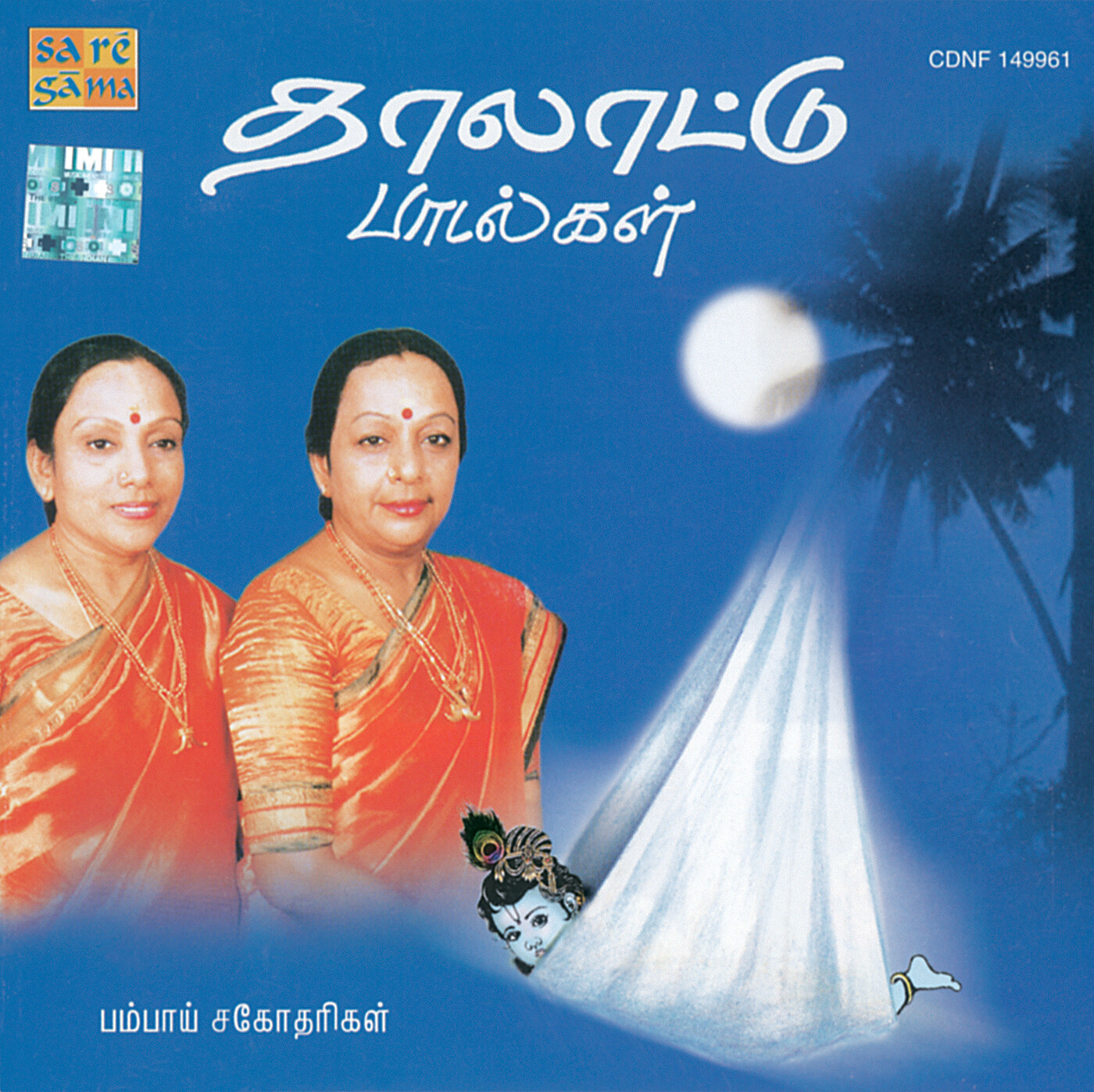
Have published a CD of lullabies with the title Thalattu Paadagal, “Lullaby Songs”; their recording contains one lullaby in raga nilambari.
The mother tells the crying child that "After all the penance I did, I got you." She next asks, "Why are you crying?" describing how the baby is always passed around from arm to arm, cuddled, and playfully hit by doting relatives with the conch-shaped spoon used to feed him, as well as with buds of jasmine and oleander flowers. The final verse returns to the image of water from the beginning of the song, again asking the baby why he is crying, and telling him that his "tears swell like a river, flowing through the house."
In South India, lullabies are sung in homes as well as distributed on commercial recordings. While other ragas are also used for lullabies, Mrs. Jeyalakshmi says that "if you sing in nilambari, it is mostly a lullaby." Thus a particular raga is considered to have a specific effect on the body (see "Studying Music: The Effect of Music on the Body," p. 132).
The strong associations between raga nilambari and the act of lulling a baby to sleep extends to South Indian rituals: The raga is thought to have the same sleep-inducing impact on deities as it does on humans. Today, raga nilambari is played in Hindu temples in South India on the nagasvaram, a double-reed aerophone.5 During rituals in the temple, the nagasvaram accompanies moments when the deity is awakened, bathed, or put to sleep.
More information
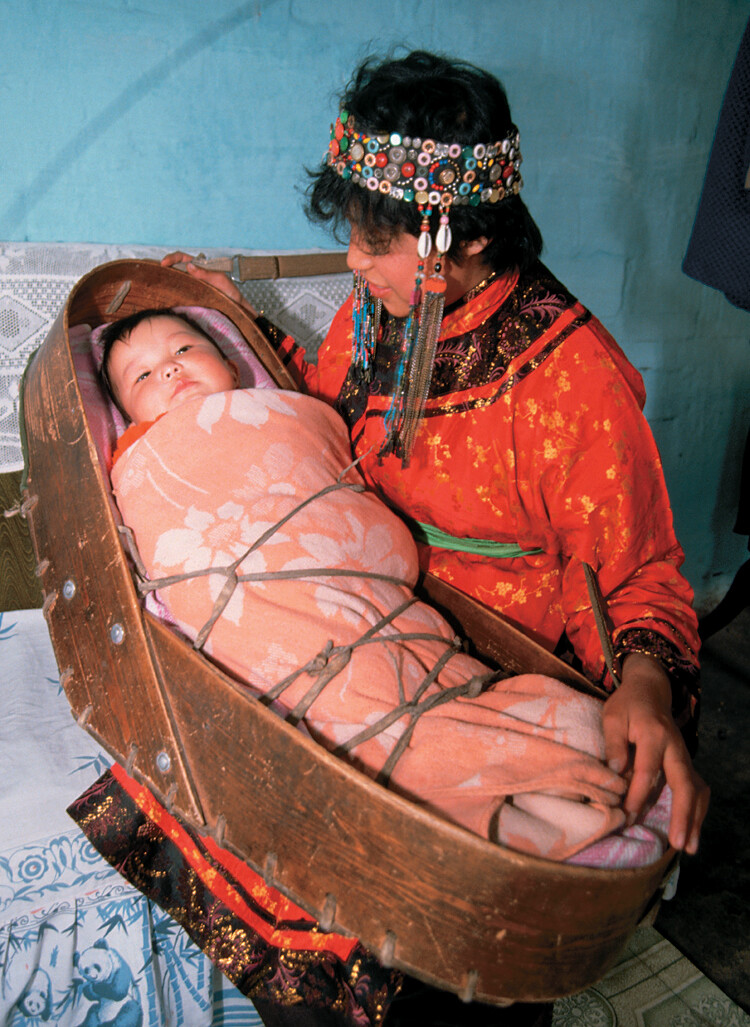
Who is secured in a traditional wooden cradle.

STUDYING MUSIC
THE EFFECT OF MUSIC ON THE BODY
As we think about the significance of music within a particular cultural context, it is important first to consider which aspects of musical meaning are shared across cultural boundaries. The lullaby provides a particularly rich example, given its existence in many cultures. Lullabies share many musical characteristics: They are often set in a higher range than other songs, they contain a great deal of internal repetition, and they often incorporate vocables within their texts. Lullabies tend to be slow and are commonly sung in combination with rocking motions. In their union of song and bodily motion, lullabies provide an excellent example of musical entrainment, an expression used by psychologists to refer to the alignment of bodily motion during the musical experience. Studies have shown that musical entrainment can both help regularize motion and modify a person's physical state. All of us can think of examples of musical entrainment in our own lives, such as using music to enhance repetitive motion during work or workouts, or slowing down our heart rates and relaxing as we drift off to sleep.6
Beyond the phenomenon of musical entrainment, there appear to be other factors shaping the effects of lullabies in all cultures. A recent comparative study of maternal singing in several cultures found that lullabies are closely related to speech and replicate the higher pitch, repeating patterns, and slow pace commonly used when talking to babies (so-called baby talk).7 Presumably, the historical association of raga nilambari with sleep in the South Indian tradition has been enhanced by a performance style demonstrated to induce sleep in all cultures.
Lullabies share a particular vocal quality, repetition, and a slow tempo, but they also reflect traditions shaped by broader patterns maintained over the course of generations. Thus they transmit images with culturally specific significance within particular ethnic or linguistic communities. But lullabies can also be newly composed by a creative singer or adapted from a popular song, leading to situations in which a song's repeated use as a lullaby may create unique associations within a unit as small as one family. One common example in Christian communities is the use of Christmas carols about the baby Jesus, such as Away in a Manger or Silent Night, as lullabies.
The lullaby is just one example of music performed to effect a change of mood or consciousness, in this case to calm a child or to induce sleep. Many studies of music have noted its apparent ability to alter mental states or even to induce trance. Some researchers hypothesized that the repetitive nature of musical sound causes brain waves to trigger an altered state.8 More recently, this theory has been rejected, and trance is now regarded as a culturally conditioned response based on longtime association between a particular musical event and the expectation that it will produce a particular state of body and mind.9 Although people universally acknowledge music's power to influence emotions, shape behavior, and even heal, scholars have not fully explained how music is perceived and processed within the brain. New technologies and recent advances in psychological research should provide new perspectives on the interaction between the cultural and physiological dimensions of music.
More information
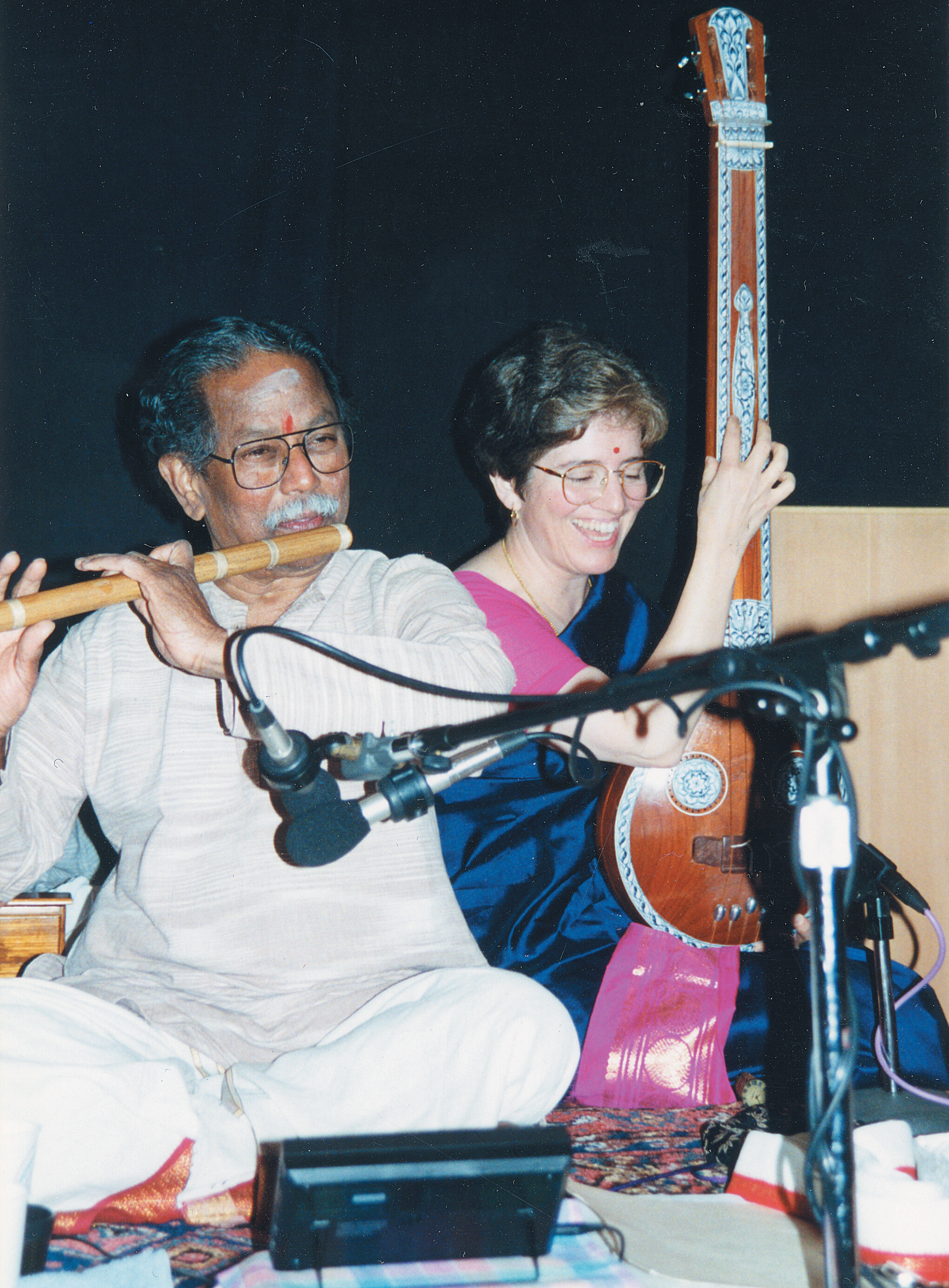
Is seen here performing with his wife, Jody Cormack, who is accompanying him on the tanpura. The small black object in the foreground is a sruti box, an electrophone which sounds a drone.
Outside the Hindu Temple, one can hear raga nilambari in many settings, including compositions by South Indian composers with texts that refer to the raga's significance as a lullaby for the Gods. For instance, there is a well-known devotional song in nilambari by Tyagaraja (1767–1847), perhaps the most famous composer of South Indian classical music, which describes putting the God Rama to sleep. In Listening Guide 34 (see p. 133), we hear a South Indian devotional song called a kriti (kirtanam) composed by Ponniah Pillai in the early nineteenth century, titled Amba Nilambari, which is still popular today as a concert piece. This kriti's text praises the deity Amba, to whom the singer pledges undying devotion. Amba Nilambari illustrates that the expressive possibilities of nilambari extend beyond its use in lullabies or explicit connections with sleep, although it continues to carry that significance on some level for the knowledgeable listener. Indeed, the famous South Indian violinist Dr. L. Subramaniam recalls that "his earliest memory of anything" was his mother singing Amba Nilambari every day to put him to sleep.10
In contrast to the free rhythm of the lullaby Araro Ariraro in Listening Guide 33, the rhythmic framework for the classical kriti in Listening Guide 34 is a tala. Tala is an Indian term denoting time cycles consisting of a fixed number of counts. These cycles are subdivided into units with different numbers of beats, sometimes of irregular lengths. The actual rhythms sung or played can vary greatly within a particular tala cycle. Listening Guide 34 is in Tala Adi, an eight-beat tala, one of the most commonly heard talas in South India. In Amba Nilambari, Tala Adi subdivides the eight-beat rhythmic units into combinations of 4 + 2 + 2 beats, stated and elaborated on by the South Indian double-headed drum, the mrdangam. (see "Try It Out: Count Adi Tala," p. 135) Note that the mrdangam provides not just a rhythmic framework, but also subtle alterations of pitch, sounded when the player presses the heel of his hand on the central membrane of the drum. This effect is also enhanced by putting a paste of cream of wheat or similar substance on the center of the drumhead, which lends added weight and depth to the drum's sound.
LISTENING GUIDE 34
AMBA NILAMBARI ("OH, MOTHER CLAD IN BLUE")
4:02
Composer: Sri Ponniah Pillai
Date recorded: March 15, 2001
Performers: T. Viswanathan, flute and voice; David Nelson, mrdangam; Kala Prasad, supporting vocal; Susan Tveekrem, tanpura
Form: Kriti with four main sections: pallavi, anupallavi, citta-svaram, and caranam
Meter (tala): Adi tala (4 + 2 + 2)
Mode (raga): Nilambari
Function: Devotional piece, also played in concert
WHAT TO LISTEN FOR:
- The four-part polyphonic texture with flute, drum, and voice(s) supported by a drone on plucked lute (tanpura )
- The melodic content and contours of raga nilambari, heard also in Listening Guide 33
- The regular eight-beat cycle of tala adi, usually subdivided 4 + 2 + 2
Raga nilambari provides a clear instance of a consistent meaning conveyed by music over long periods of time as well as across different repertories and broad geographical areas; our next case study provides a strong contrast. It focuses on a ceremony in which multiple heterogeneous musical styles without a single historical or aesthetic source become meaningful as a result of their performance on the same occasion by the same musicians, giving rise to shared significance.

Try It Out
COUNT ADI TALA
After you have listened to Amba Nilambari in Listening Guide 34, try counting eight-beat adi tala according to the practice of South Indian musicians, who use hand gestures.11 The hand motions, performed by a vocalist or musician invited specifically for this purpose, ensures that all of the musicians play in time, even when the drum (mrdangam) elaborates on the tala and masks the regular beat.
Adi tala, the most common tala, has eight beats, divided 4 + 2 + 2. To count the beats, you do a series of hand gestures: The clap (C), for which the palm of one hand is lightly struck against the other or against your thigh; the wave (W) for which the back of the hand is lightly touched against the other or against the thigh; and finger counts (pinky, ring, middle), which start from the pinky finger. For eight-beat adi tala, you will use the pinky, ring, and middle fingers, and you place the finger on the opposite hand's palm or on your thigh to count the beat. (You may use either hand for the gestures.)
Here are the gestures for adi tala in order of the beats:

When counting the tala, be aware that each beat of the tala is subdivided into two pulses. In Listening Guide 34, the tala begins at 0:14 with the entrance of the flute. The beginning of the second tala cycle occurs at 0:28, when the drum enters. These first two tala cycles may be difficult to count due to the flowing sound of the flute, but once the voice enters at 0:38, and the third tala cycle commences on the first syllable of the word Amba, you will find the tala easy to hear. The following diagram underlines syllables of the Pallavi text, indicating where the first, fifth, and seventh beats occur; all should be marked by the clap (C):

Endnotes
- Richard Widdess, "Rasa," in The New Grove Dictionary of Music and Musicians, 2nd ed., ed. Stanley Sadie (London: Macmillian, 2001), Vol. 20, p. 834.Return to reference 3
- Jeyalakshmi Sundar sang the lullaby in an interview at her home with the author and Richard Wolf on June 24, 2004.Return to reference 4
- Richard K. Wolf and Zoe C. Sherinian, "Tamil Nadu," in The Garland Encyclopedia of World Music, South Asia: The Indian Subcontinent, ed. Alison Arnold (New York: Garland Publishing, 2000), Vol. 5.Return to reference 5
- Tia DeNora, Music in Everyday Life (Cambridge: Cambridge University Press, 2000), pp. 78–79.Return to reference 6
- Sandra Trehub, Anna M. Unyk, and Laurel J. Trainor, "Maternal Singing in Cross-Cultural Perspective," Infant Behavior and Development 16 (1993): 185–95.Return to reference 7
- Andrew Neher, "A Physiological Explanation of Unusual Behavior in Ceremonies Involving Drums," Human Biology 4 (1962): 151–60.Return to reference 8
- Gilbert Rouget, Music and Trance: Relationship Between Music and Possession, rev. and trans. by Brunhilde Biebuyck (Chicago: University of Chicago Press, 1985).Return to reference 9
- www.raveindia.com/bir/version1/html/subramaniam.htmReturn to reference 10
- David P. Nelson, Solkattu Manual: An Introduction to the Rhythmic Language of South Indian Music (Middletown, CT: Wesleyan University Press, 2008), p. 1. This exercise draws generally on Nelson's Introduction (pp. 1–12) as well as pp. 15 and 49. I thank Richard Wolf for his assistance on this exercise.Return to reference 11