Of the 18 or so hominin species that at one time or another inhabited the Earth, only one remains. Our family tree is a bushy shrub with all but one of the branches now dead. Most of those extinct species lived and died out long ago in Africa. A few, like our own species, left Africa for Eurasia (the large landmass spanning Europe and Asia). But unlike Homo sapiens, the other hominins, including Homo naledi (see page 15), went extinct. The last of our close relatives, the three varieties of humans known as Neanderthals, Denisovans, and Flores Island “Hobbits,” disappeared between 50,000 and 30,000 years ago.
NEANDERTHALS
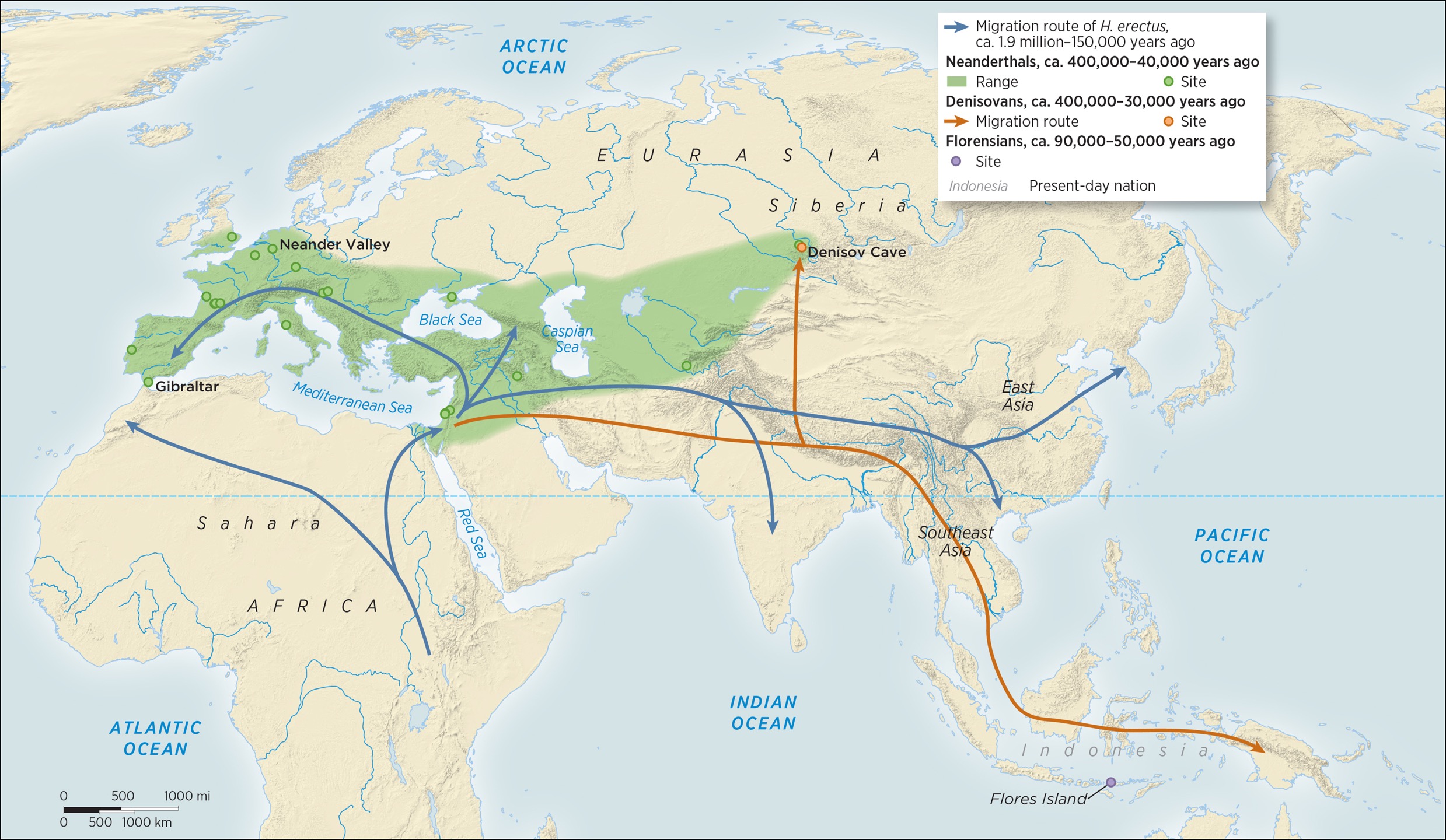
Neanderthals, so named because their remains were first found (in 1856) in the Neander River valley in Germany, lived from about 400,000 to about 40,000 years ago in Europe, Siberia, and southwestern Asia. They evolved from a hominin species, Homo erectus, that migrated out of Africa nearly 2 million years ago. We—Homo sapiens—also descend from Homo erectus, which went extinct only about 190,000 years ago and was one of the longer-lived branches of the human family. So we are remote cousins of Neanderthals.
Neanderthals flourished in an Ice Age environment, adapting to it both genetically and culturally: they were compact, heat-retaining, heavy-limbed, powerful creatures, on average about 30 percent heavier than modern-day people and with braincases larger than ours. Skeletons indicate that males on average stood about 5′5″ (165 cm) and weighed about 145 lbs. (66 kg), and females about 5′1″ (155 cm) and 120 lbs. (54 kg).
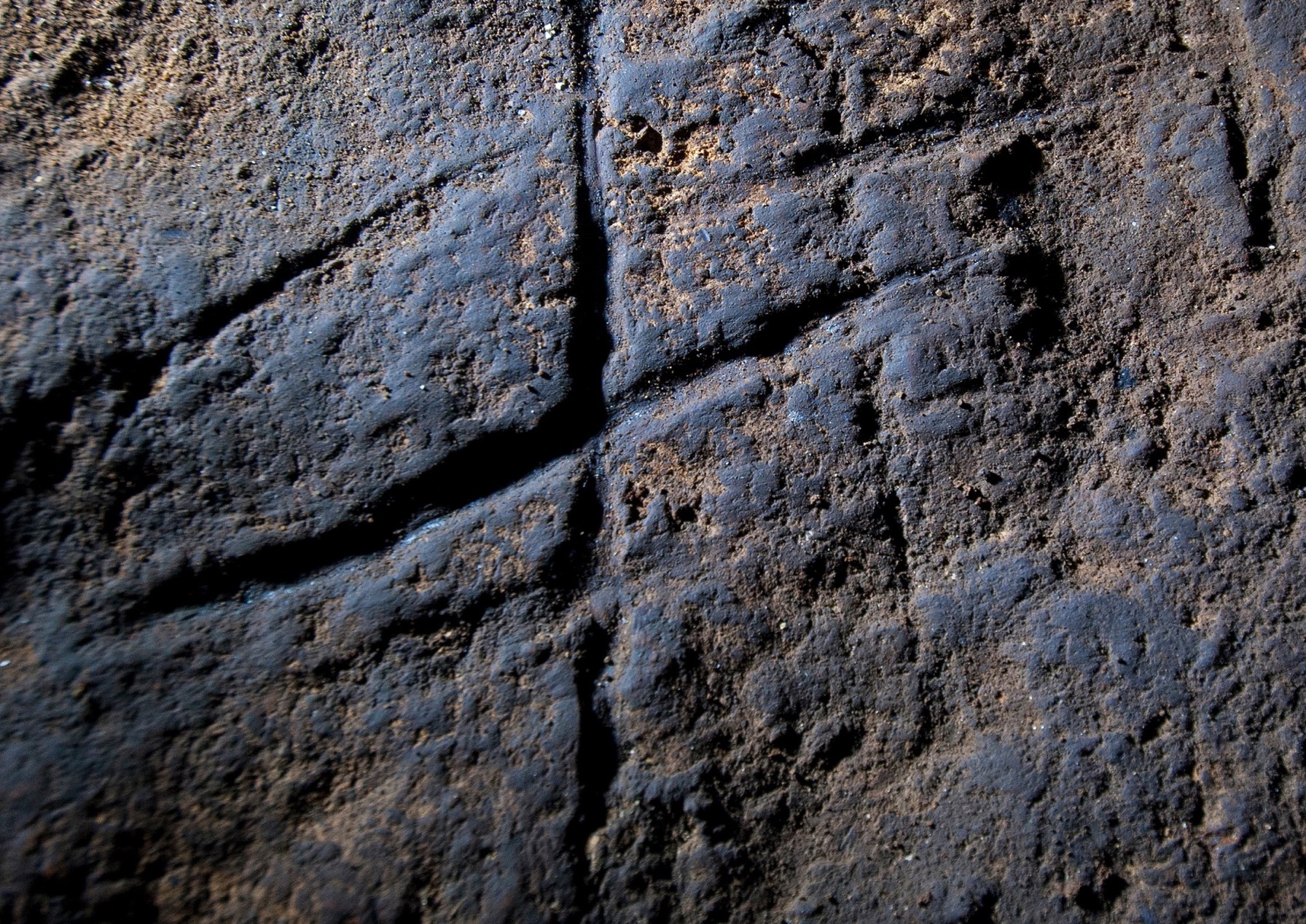
Neanderthal Culture A geometric pattern etched on the wall of a cave on Gibraltar, at the southern tip of Spain. It was probably created deliberately by a Neanderthal—perhaps as a map or a symbol of the people who lived in the cave, suggesting that Neanderthals were capable of abstract thought.
More is known about Neanderthals than any other extinct hominin, mainly because they lived in Europe, where far more archeological work has been done than in Africa or Asia. They hunted big game with stone-tipped spears and foraged for berries, nuts, roots, and fruits. They buried their dead, which may mean that they had religious beliefs. In 2014, archeologists found the first clear example of Neanderthal art: some scratchings on the wall of a cave in Gibraltar that are at least 39,000 years old. Neanderthals, it seems, were capable of abstract thought. Whether or not they had language, or how much they had, is controversial; but expert opinion currently is skeptical about their linguistic attainment. Almost all Neanderthal tools (among those found so far) remained close to where they were made, suggesting that the Neanderthals had only small trade networks—if any. Genetic evidence suggests their total population never exceeded a few thousand.
Neanderthal life was tough and cold: they lived out in the open when not in caves, and they didn’t live long. To judge by surviving skeletons, none managed to last beyond age 45. Their skeletons show many broken bones and possible indications of cannibalism. DNA evidence suggests that they were highly inbred, which is perhaps not surprising since they lived in small bands and rarely encountered strangers. Ice Age life grew colder for them about 39,000 years ago, owing to a giant volcanic eruption in what is now southern Italy that darkened skies for about three years and may have nudged them closer to extinction.
Our Closest Cousins, 400,000–30,000 Years Ago Among the closest relatives to our species are three hominins, the last ones to go extinct, known as Neanderthals, Denisovans, and Florensians or Flores Island “Hobbits.” Just how they are related to us is unclear, but they and we might be descendants of Homo erectus, the first hominin species to migrate out of Africa.
The last of the true Neanderthals lived in what is now Spain about 39,000 years ago, but Asians, Europeans, and Native Americans today are all, genetically speaking, about 1 to 4 percent Neanderthal. Africans carry a much smaller genetic inheritance from Neanderthals, well under 1 percent. (They acquired that via migrations of Eurasians back into Africa, starting about 8,000 years ago). Neanderthals vanished, but almost all of us are in small part Neanderthal.
CONSIDERING THE EVIDENCE
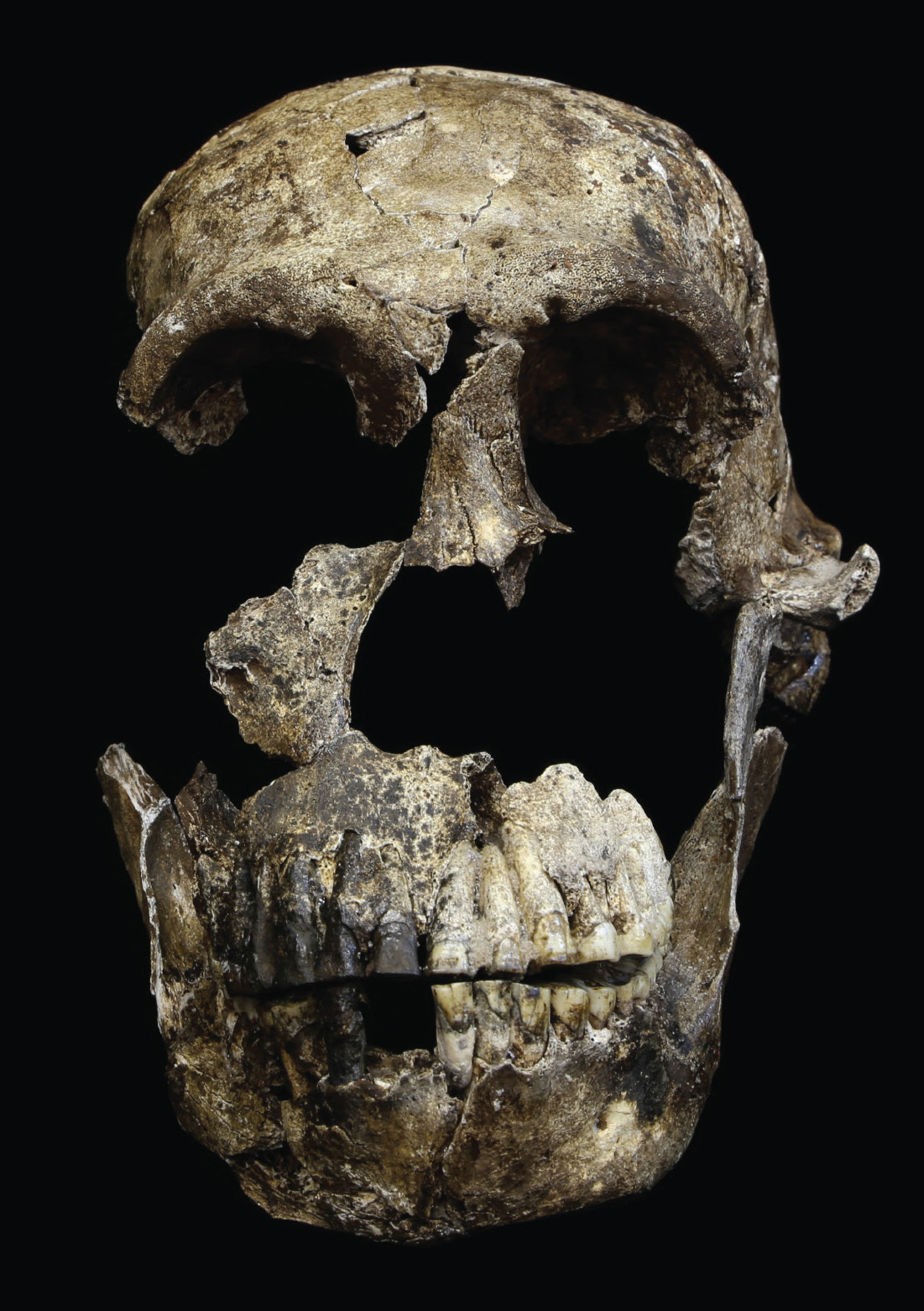
Our Cousin Neo
In 2013, paleontologists began excavating nineteen hominin skeletons from the Rising Star cave in South Africa. The reconstructed skull of the most complete skeleton, named Neo by the scientists, is shown here. At an estimated 100 lbs. (45 kg) and 4′10″ (1.2 m) in height, Neo was shorter than modern humans and had a much smaller brain—closer in size to the brains of Australopithecus afarensis like Lucy than hominins in our genus, Homo. Yet his brain was shaped more like ours, suggesting that he may have been able to use language. His hands, legs, and feet suggest that he was fully bipedal, but scientists usually link the shape of his hips and curved fingers with species from millions of years ago. So it was surprising when scientists confirmed that Neo lived 300,000 years ago, about the same time that our Homo sapiens ancestors first appeared in Africa. It’s possible that Neo’s species, Homo naledi, encountered early Homo sapiens, as our cousins the Neanderthals and Denisovans did.
QUESTIONS FOR ANALYSIS
Sequencing events in time helps historians to understand how people and communities influenced one other. Neo’s skeleton dates to a time when Homo sapiens was one of several human species, including Neanderthals, Denisovans, and Flores Island “Hobbits.” Most of our Homo sapiens ancestors lived far to the north of Neo’s Homo naledi community. However, if they did happen to meet, do you think they would have recognized each other as human? Why or why not? How might they have cooperated and competed with each other?
Some scientists have suggested that the caves where Neo and other Homo naledi skeletons have been found were burial chambers because they required intentional effort to access. The scientists argue that such burials prove that Homo naledi was human, but others disagree because the caves contained no objects usually found in human burials. What does burial reveal about the way in which early humans likely imagined their world and their community? Assuming that Homo naledi communities did bury their dead, is that enough to consider them human? Explain your response.
Besides burial, what tools or other kinds of artifacts described in this chapter would help scientists to prove that Homo naledi possessed modern human behaviors?
DENISOVANS
We have other extinct cousins called Denisovans, named after a cave in Siberia where archeologists found some remains. Careful study of their genome (the full set of genes of an organism) suggests that the Denisovans were more closely related to Neanderthals than any other (known) species of hominin. Like Neanderthals, they were stocky and well suited to cold conditions. Denisovans probably lived in Siberia and throughout East Asia for a few hundred thousand years. They had enough culture to make bone needles as of about 41,000 years ago, before any other branch of humans started sewing. The human population today that is genetically closest to the Denisovans lives in East and Southeast Asia. The genetic overlap shows that somehow, somewhere, Denisovans and Homo sapiens encountered one another and interbred. So Denisovans, like Neanderthals, went extinct, but their genes live on in many humans today.
HOBBITS
The most remarkable of our recently extinct cousins is Homo floriensis, popularly called Hobbits after the imaginary creatures in J.R.R. Tolkien novels. They were tiny folk, a little over 3 ft. (1 m) tall on average. Their remains were discovered on a cave floor on an Indonesian island, Flores, in 2003. Only a single skull and parts of nine skeletons have been found, so generalizations remain questionable. But it seems likely that they were the last of a very old pre-human lineage, isolated from all other hominins for thousands of generations. They lived on Flores as early as 90,000 years ago and shrank to their small stature under the pressure of natural selection. (Miniature mammals of many sorts have evolved in island habitats, where lower food requirements are an advantage.) They went extinct about 50,000 years ago, perhaps without any contact with Homo sapiens, unlike Neanderthals and Denisovans. Once the Flores “hobbits,” Neanderthals, and Denisovans had disappeared, Homo sapiens was the last species of hominin standing anywhere on Earth, as far as we know now.