THE EMERGENCE OF CITIES, STATES, AND COMPLEX SOCIETIES AFTER 3500 BCE
The advent of farming also made possible the emergence of new political forms and much bigger social units, which brought still more radical changes in turn. This section explains the emergence of cities and states, first created during the fourth millennium BCE and still with us today. They became the social contexts in which more and more people lived, and which produced ever more ideas, technologies, and other forces shaping human history. Their emergence was simultaneous with what social scientists call complex society. The development of all three—complex society, states, and cities—accelerated the building of larger webs of interconnection.
WHAT ARE CITIES, STATES, AND COMPLEX SOCIETIES?
These three related innovations in the structure of societies shaped world history from 3500 BCE onward. They require some definitions. Complex society, in the language of the social sciences, means a large-scale social unit with an elaborate division of labor, pronounced social hierarchy, hundreds of different social roles that people can fill, and institutions to regulate exchanges among individuals and among groups. Every society, even a hunting and foraging band, is complicated, with intricate networks of social relations; but in this specialized sense, not every society is complex. Complex societies usually developed together with states and cities.
A state is a territorial unit and political community with a formal government. States are easy to identify. They employ office-holders who govern according to set rules (bureaucrats), specialists in the administration of justice (judges), and masters of the arts of violence (soldiers). States claim for themselves a monopoly on the legitimate use of violence. They extract goods, labor, or money from a subject population through taxes and conscription. States, except for the most nakedly coercive, also have ideologies—sets of ideas that justify their existence and operations. State ideologies have typically been based in religion. An effective ideology can enable the rulers of a state to harness the willing support of their population, without frequent resort to coercion.
It’s not easy to draw a sharp line separating a city from a town or big village. But in general, a city contains the elaborate division of labor and social hierarchy of complex society, and it is distinguished by dense living quarters, open public spaces, and imposing public buildings. Cities feature trade and exchange, and institutions—usually, markets—that bring buyers and sellers together. Villages, at least big ones, may have some of these features, but never all.
Cities are central to world history because they are hothouses of innovation and exchange. They are the densest parts of interactive webs. In cities, unlike villages, people regularly dealt with strangers, provoking adoption and diffusion of new techniques, technologies, and ways of thinking. The dense living quarters of cities also facilitated the faster exchange and evolution of disease organisms.
As we’ve seen, by 7000 BCE a world of farming, herding, and villages had begun to emerge in Eurasia and Africa. A parallel world would soon emerge in the Americas, although without herding. In all of these villages, scores or hundreds of people living side by side experienced life very much as their neighbors did. They all took part in the tasks of agricultural life. Aside from roles specified by age and gender, there was little economic specialization or social stratification. Exchanges took place, as in all societies, but were usually a matter of reciprocal gifts rather than market transactions. This was not complex society.
In 3500 BCE, the world had no cities. Then, in six places around the world, something new evolved: urban life and complex society. These six places were Mesopotamia, Egypt, the Indus valley, China, Mesoamerica, and the Andes. Two of these places, Egypt and the Indus valley, may have acquired some of the habits of complex society from neighbors—specifically, Mesopotamia. But for the most part, these were all autonomous transformations. Every other complex society in the history of the world derives, directly or indirectly, from one or more of these original six. By 1500 BCE, the world contained hundreds of cities. Only 1 to 2 percent of the human population lived in cities, but the most powerful people did.
In the chapters to come, we’ll explore these complex societies in greater detail. Here let’s consider three widely shared aspects of early complex societies: (1) their underlying economic base, especially irrigation agriculture; (2) the social and political implications of cities and states; and (3), two basic tools that shaped the development of cities and states—writing and metallurgy.
ECONOMIC BASES OF EARLY COMPLEX SOCIETIES
The development of complex societies depended on farmers growing more food than they needed so that other people—soldiers, artisans, bureaucrats, and priests who did not produce food—could eat.
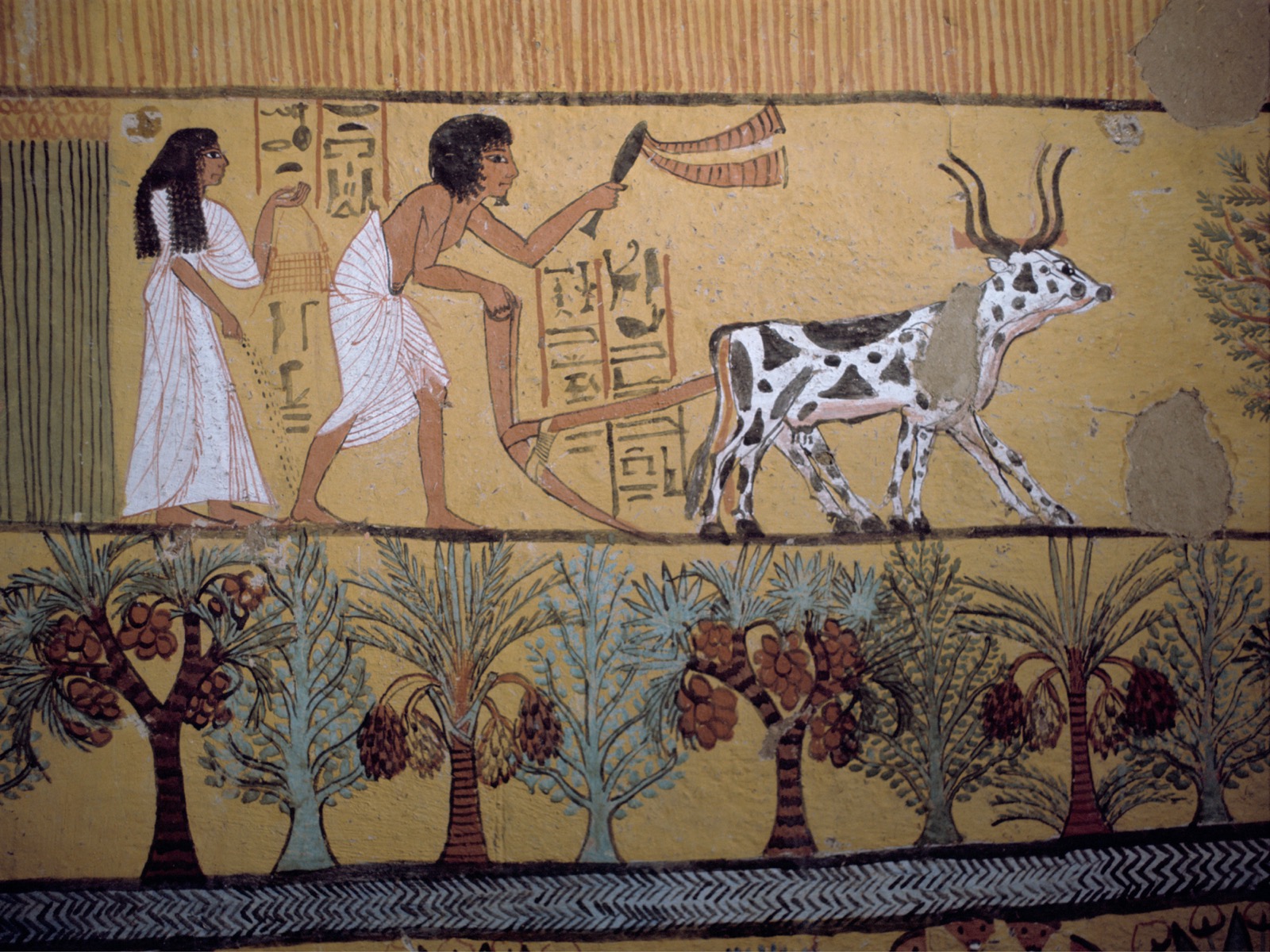
PLOW AGRICULTURE Where people had domesticated strong animals, they could use them to pull heavy things. Oxen and water buffalo—the tractors of the pre-modern world—proved especially adept at pulling plows through the soil. The earliest plows came into use soon after 3800 BCE in Mesopotamia. They quickly appeared in Egypt too, and possibly in China—estimated dates for the advent of plow agriculture in northern China range from 3000 to 500 BCE. Chinese plows differed enough in design from those used in Southwest Asia that many scholars think they were independently invented.
Oxen and Plows A painting on the wall of an Egyptian tomb shows a farmer driving oxen, which pull a plow to till the soil—one of the many innovations that enabled Egyptians to practice agriculture in an arid climate.
The first plows were made of wood, suitable only for soft ground. They scratched a shallow furrow in the soil, preparing it for planting. But they allowed farmers to cultivate up to five times as much land as they could without oxen and plows. Soon plows acquired metal tips, and later metal plowshares, which turned soil over, uprooted weeds, and brought deep-seated nutrients to the soil surface. These plows could work heavier soils, including ones moistened by irrigation. Whether by diffusion or by independent invention, between 3500 and 1500 BCE, plows became routine farm equipment in North Africa and Eurasia.
But in sub-Saharan Africa, Australia, and all of the Americas, there were no plows until much later—in most cases, because there were no animals suited to pulling them. Instead, farmers used hoes or digging sticks. On steep, rugged terrain, digging sticks worked better than plows. Without plow agriculture, it was harder for farmers to generate enough surplus food to support city life and complex society. Where this developed without plows, as in Mesoamerica, Peru, and along the bend in the Niger River in Africa, the needed surplus came from intensive human labor and irrigation.
IRRIGATION Among the perennial hazards of farming are drought and flood. Providing crops just the right amount of water at just the right times was at first a matter of luck. No doubt the earliest farmers quickly learned to carry water-filled skins or pots to their crops. But big fields required irrigation—that is, the construction of artificial channels to carry water from lakes, rivers, or streams to thirsty crops.
We don’t know when or where irrigation began. Some patchy evidence from the Levant and northern Mesopotamia suggests the presence of small irrigation works before 7000 BCE. But irrigation remained small-scale until about 3500 BCE, after which it appeared, via diffusion and independent invention, in suitable zones throughout Eurasia and North Africa. In the Americas, it began around 1900 BCE. The technologies of canals, ditches, dikes, and dams were simple enough in principle even if laborious to build, so it’s plausible that irrigation emerged independently in many places.
Irrigation had dramatic consequences. First, it raised per-acre yields by five or ten times. With this enormous expansion of farming productivity, the world’s food now increasingly came from a few pockets of irrigated farmland, surrounded by much less productive zones of rain-fed farming and herding, and by even broader zones where people collected and hunted food rather than growing it. Lands suitable for irrigation became distinctive, a new sort of agro-ecology capable of feeding far more mouths than any other landscapes on Earth. Irrigated landscapes not only raised grain yields but also served as nutritious aquariums swimming with fish, frogs, snails, and other protein-packed delicacies. In particular, irrigation produced abundant surplus food, enabling societies to support far more people who specialized in other things, from pottery to philosophy.
Second, even as successful irrigation fed many more mouths, it also needed many hands. Digging and maintaining canals, ditches, and reservoirs, and building dikes and dams, took enormous coordinated effort on a scale beyond what families alone could provide. Families and neighbors had to band together to build irrigation systems and make collective decisions on who would do what and when. Most irrigation schemes began as grassroots efforts, but over time religious and political authorities, and also rich landowners, usually stepped in to coordinate the necessary tasks. The greater the degree of coordination achieved, the larger the scale irrigation could attain. So irrigation favored the emergence of religious and political leaders, and in turn, successful leaders favored the extension of irrigation. Where irrigation prevailed, it co-evolved with social complexity: neither was a necessary pre-condition for the other, but each encouraged the development of the other.
Everywhere it developed, irrigation farming raised yields, generating surplus food that supported denser populations and more specialists. These were the conditions for the emergence of cities. Almost every early city was fed by irrigation agriculture.
DRAWBACKS OF IRRIGATION FARMING Along with its role in shaping social development, irrigation brought great vulnerabilities. Enemy armies, even a band of brigands, could easily destroy dikes and dams, ruining fields and starving those dependent on their bounty. Moreover, large-scale irrigation rested on the sustained cooperation of thousands of laborers—a fragile thing. Whenever that cooperation broke down, irrigation systems fell to ruin in short order through lack of maintenance. Societies dependent on the food surpluses delivered by irrigation agriculture became vulnerable to interruptions in the production and delivery of that surplus. In a loose way, we can liken the adoption of irrigation to modern societies’ adoption of oil as their principal fuel: both technologies allowed enormous expansion of economic activity, the production of more and cheaper food, and therefore larger populations. But both added new sources of vulnerability as well.
With respect to human health, irrigation carried additional risks. Irrigated landscapes invited certain diseases, such as schistosomiasis, which is spread by snails, and malaria, which is spread by anopheles mosquitoes. People who engaged in irrigation agriculture in Eurasia and Africa probably carried heavier parasite loads and hosted more infections than anyone else, and consequently often couldn’t work at full strength. In the Americas, where neither schistosomiasis nor malaria existed until much later, any health penalty of irrigation was much smaller.
ENVIRONMENTAL IMPACTS The most significant environmental impact of plowing and irrigation was on the soil. Animal-drawn plows enabled people to slice deeper into the earth. Upturned and loosened soil eroded easily. Over centuries and millennia, wherever people engaged in plow farming they suffered problems of soil erosion and nutrient loss. The process of soil erosion was highly visible and could be combated to a degree by measures such as building terraces. Nutrient loss was invisible but sometimes happened fast enough that people could see the result in the form of lower yields within their lifetimes. They typically understood this as the land becoming “tired,” which led ancient farmers to seek ways to renew soil fertility.
The most effective solution to nutrient loss was the use of manure on fields. Where farmers had livestock, they could graze their animals on nearby pastures, pen them at night, collect their manure, and spread it on fields. In effect, this strategy collected nutrients from a broad area and concentrated them where they did the most good for humans—one of the chief contributions to human welfare made by livestock. Where farmers didn’t have animals, as in Mesoamerica, or had few, as in East Asia, they relied more on “night soil,” or human excrement, as fertilizer. Another attempted solution was prayer: most early farmers, and most irrigation-based societies, worshipped earth deities whose portfolios included soil fertility. These were usually goddesses, such as Bhumi in India or Brigid in Ireland.
Irrigation agriculture brought damaging salinization of soils. Irrigation with poor drainage—which describes most irrigation—left soils waterlogged and brought dissolved salts up to the surface. As water evaporated from the soil surface, the salt content remained. Where waterlogging was common and evaporation intense, accumulated salt in topsoil layers eventually created white crusts. Only a few plants, and no useful crops, can flourish in salt-encrusted soils. In the Epic of Gilgamesh , a long narrative poem written around 2100 BCE in Mesopotamia, the gods turn soils white, perhaps a reference to salt encrustation.
The emergence of cities introduced a new peril to farm soils. In village agriculture, nutrients traveled from soil to plants to people and back to the soil again in a fairly closed system. Few nutrients disappeared altogether in the process. Cities, however, imported nutrients in food but didn’t necessarily return them to farmers’ fields. Most cities were built on rivers, which operated as convenient sewers carrying excrement and its soil nutrients to the sea. As a result, cities threatened to undermine the systems of agriculture and nutrient flows that supported urban life itself.
CITIES AND STATES AS SOCIAL SYSTEMS
Irrigation farming fed the growth of cities, and growing cities made new social orders possible. Where tens of thousands of people clustered together, they developed specialized skills and institutions that helped them live together in peace. Cities needed institutions to administer justice, oversee defense and war against outsiders, organize taxation, and manage other aspects of public affairs, often through organized religion.
SOCIAL INEQUALITY City life made social inequalities larger and more visible. In villages populated by farm families, status was based mainly on age, gender, individual achievement, and sometimes ancestry. In cities, there were added layers of stratification based on wealth, occupation, and social class.
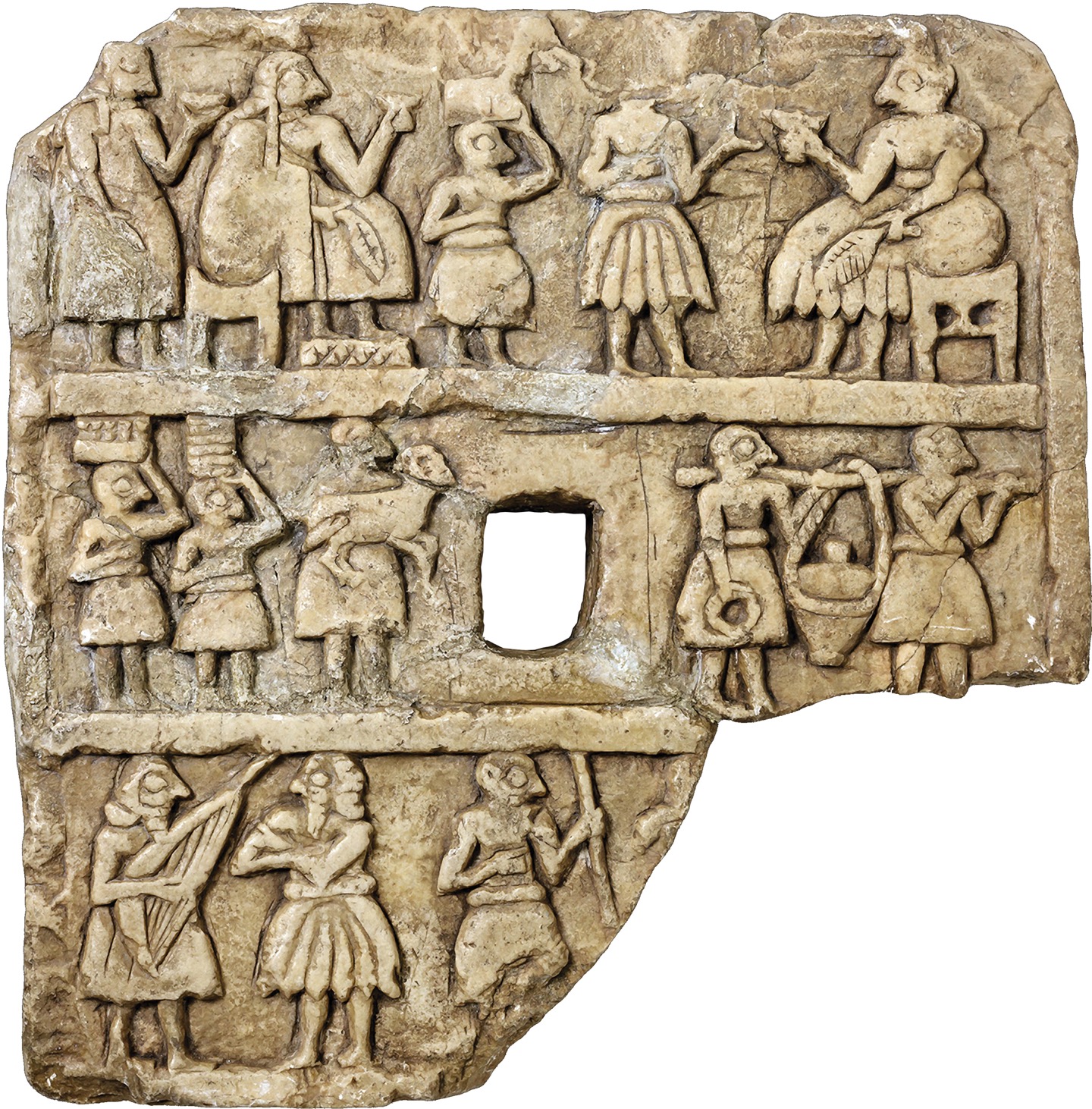
Social Stratification City life led to a proliferation of social roles and hierarchies. A Mesopotamian stone carving from around 2600 to 2300 BCE shows many laborers preparing and serving a feast to some dignitaries, who eat while being entertained by musicians (bottom left).
PUZZLES IN WORLD HISTORY
Why Do Humans Behave Like Ants?
One of the puzzles of world history is why human beings put up with the demands of complex society when it’s not in our nature—our genetic makeup—to live such regimented lives. Termites, bees, and ants live in complex societies. In fact, their societies are more complex than ours were for 99 percent of human history. Let’s just consider ants, a biologically successful life form that currently accounts for about 10 percent of the animal biomass on Earth: until a few decades ago, the total ant population outweighed the total human population.
It is in the nature of ants to live regimented lives in hierarchical societies. Ants live in colonies of some 5 million inhabitants and cooperate in their social roles. They domesticate insects called aphids, which digest plants that ants cannot and produce “honeydew” (actually, aphid excreta), which ants eat. When a colony moves, it carries its aphid livestock with it. Ants even farm fungi for their own food supply. Ant colonies also display a division of labor. There are food-collector and food-producer ants, warrior ants, and ants responsible for raising the young. And there is one ant, the queen, whose job is to give birth.
Humans are programmed genetically to behave more or less like chimpanzees. But since the rise of complex societies 5,500 years ago, we have programmed ourselves culturally to behave more like ants. We started to live in big social groups that cooperate to achieve things no individual could. We began to specialize in chores such as producing food or fighting. We started to domesticate other species to expand our food supply. We grew to accept that most of us will labor long and hard for little reward, and will support a tiny minority who need not work.
We are not ants, but our social behavior since adopting farming and forming complex society is much more ant-like than chimp-like. Ants behave like ants naturally. Humans have adopted habits, ideologies, religions, rituals, and institutions—in a word, culture—that allow us to suppress our inner chimpanzee and behave instead like ants.
QUESTIONS FOR DISCUSSION
What’s your view of the comparison of human social behavior to that of ants?
Give an example of how our culture prepares us to accept the social specialization and inequality of complex society.
Early cities typically had a ruling elite of specialists in government, religion, and commerce; they worked mainly with their thinking and communication skills, not with their hands. Beneath this elite stood a class of people who worked with skilled hands—smiths, carpenters, builders, stonemasons, potters, weavers, spinners, brewers, and musicians. Many in these latter occupations were women. Cities typically also had a class of unskilled male laborers who worked with their backs—stevedores, cart-pullers, animal drovers, water-carriers. Sharing the lower rungs of the social ladder were people who worked with disagreeable materials—handling manure or night soil, or tanning animal hides. Almost all early cities also had slaves, most of whom did manual labor. Some slaves had skills that enabled them to work as smiths or even scribes—specialists in writing, an honored occupation in mostly illiterate societies. Cities also normally had an underclass of people without regular work—beggars, thieves, and prostitutes. An elaborate social hierarchy like this posed acute problems of social harmony, which officials in government and religion strove to solve.
DISEASE Early cities were also cesspools of filth and infection that killed people faster than others were born. Only continuing in-migration from villages kept cities from shrinking. Disposing of human and animal excrement, carcasses of dead animals, residues from tanneries, offal from butcher shops, and other unhealthy wastes threatened human health. Few cities had clean water supplies, and all teemed with pathogens preying on tightly packed human populations.
Crowd diseases in particular afflicted cities, and especially networks of interacting cities. These infections, mostly derived from diseases of herd animals, need big populations to stay in circulation because the pathogens provoke immunity in people who survive a bout. Crowd diseases such as the smallpox, mumps, and pertussis viruses became childhood diseases when circulating in large populations. Interconnected cities had enough people, in frequent enough face-to-face (to be more precise, breath-to-breath) contact, to maintain perpetual circulation of lethal infections. Everyone encountered these infections in childhood, and those who survived became immune or resistant. A society needed several hundred thousand people regularly breathing in one another’s germs to make them endemic (always present) rather than epidemic (infrequently present). These diseases took a terrible toll on children.
Crowd diseases made cities, as well as complex societies of interlinked cities, extremely dangerous not only for their own children but also for adults who had grown up in more isolated places. In demographically smaller societies, with less breath-to-breath exchange of viruses, these infections were usually absent. That was good for the survival of children; but when these infections appeared as epidemics, they killed adults and children alike—a catastrophe. In this way, interacting networks of cities, if they contained enough people, were reservoirs of lethal infections that at any time could leak out into surrounding smaller communities and cause epidemics.
ENSLAVED LABOR These characteristics of cities meant that complex societies constantly needed more laborers. They needed them to toil in the fields that fed the cities and to do the most disagreeable jobs in the cities themselves. To meet the demand, the rulers of states normally resorted to enslaving people within reach who didn’t have the means to defend themselves. Or they organized slave trades, buying people from more distant lands who had been captured to meet the need for labor. Most cities and states thus gave rise to violent slaving frontiers, either just beyond their own borders or farther afield. After the rise of cities and states, the hunting and foraging peoples of the world, and stateless farmers too, lived in greater fear of capture and enslavement. For self-defense, they retreated into mountain forests, deserts, and swamps, where slave raiders and slave traders would not easily find them.
THE EMERGENCE OF STATES AND RULERS
The world had no states before 3500 BCE but scores of them by 1500 BCE. Wherever dense populations existed—mainly in lands of irrigation agriculture—opportunistic, forceful, and charismatic people saw the chance to set themselves up as rulers. In order to succeed they needed the means to reward followers and intimidate others, and in order to stay successful they needed an ideology to convince people that it was right that some should toil while others did not. Effective ideologies normally consisted of claims to divine status for rulers or to their special power as intermediaries to the gods or ancestors.
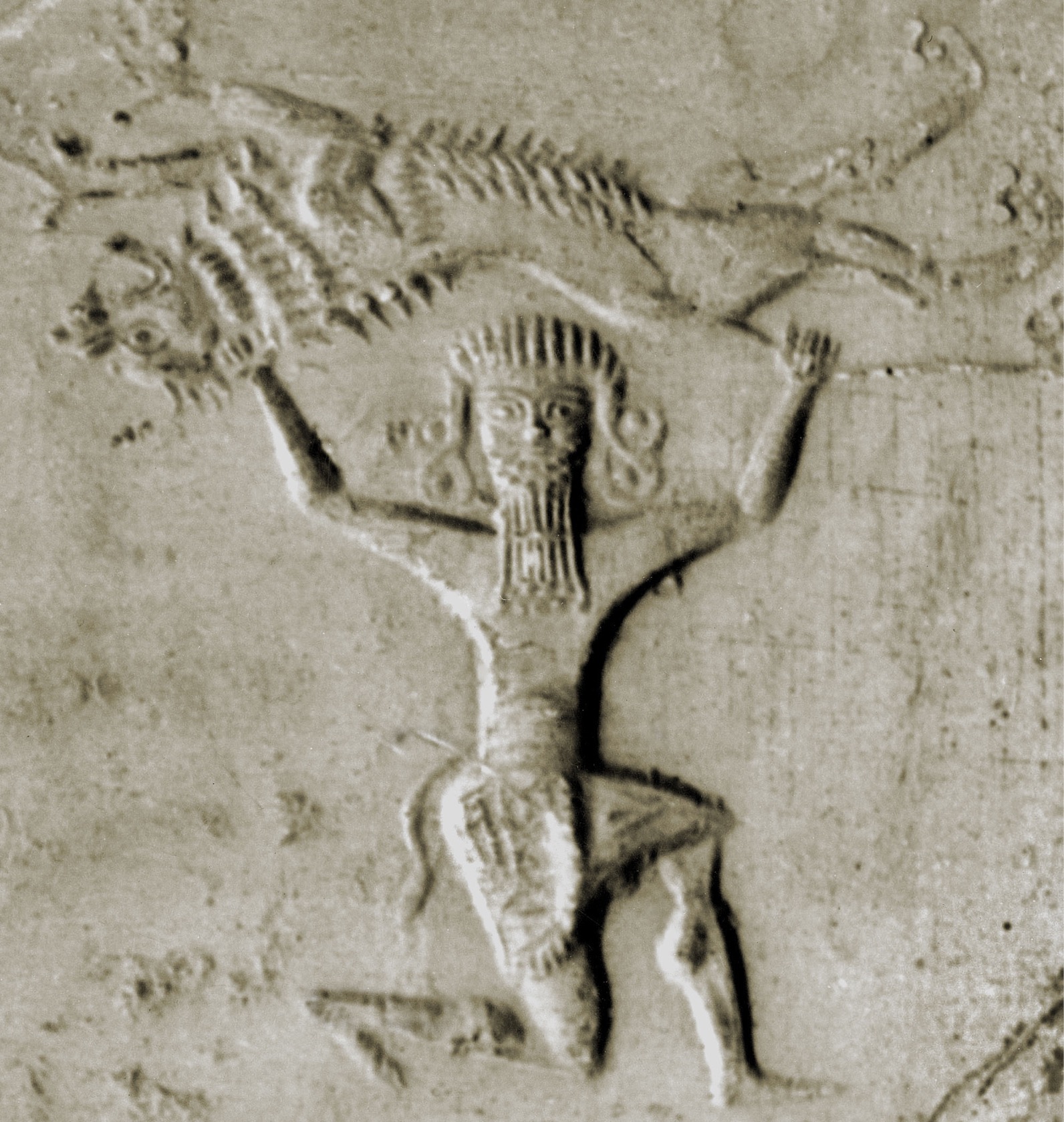
Divine Kings A seal from Babylon, dated to around 900 BCE, shows the legendary Mesopotamian king Gilgamesh holding a lion above his head, testifying to the supernatural strength that the gods were said to have given him.
Most early states were monarchies. Kings, and occasionally queens, made the final decisions on important matters. Bureaucrats and soldiers carried out royal commands. To retain the loyalty of these agents of royal power, kings had to show themselves worthy of their thrones. They had to reward bureaucrats and soldiers with food, goods, war booty, or captives. They had to claim royal ancestry, because kingship was always hereditary. Kingship was also always sacred. Kings typically professed to be the sons of gods and always claimed divine support, if not divine powers. They officiated at religious rituals, which were often sacrifices (of animals or humans), emphasizing that sacred and political authority were one and the same. Kings and their households showed off their power and wealth through displays of stunning jewelry and art, fancy clothes, and magnificent palaces.
As of 1500 BCE, no more than 2 percent of the globe’s land surface was controlled by states. But owing largely to irrigation agriculture, perhaps half of the world’s population lived in areas controlled, or partly controlled, by states. Over time, more and more states emerged because people without a state needed one to protect them from conquest and enslavement by existing states.
THE DEVELOPMENT OF WRITING Almost all complex societies developed writing as a means of preserving and transmitting information. The development of writing—a system of abstract images to represent either the countless ideas that can pass through human minds, or the many sounds that human voices can make—was a major human achievement. Yet people had managed without it for more than 200,000 years. Writing—like telephones, email, and Facebook—is a networked technology of little use to anyone until other people are using it too. So how and why did writing develop?
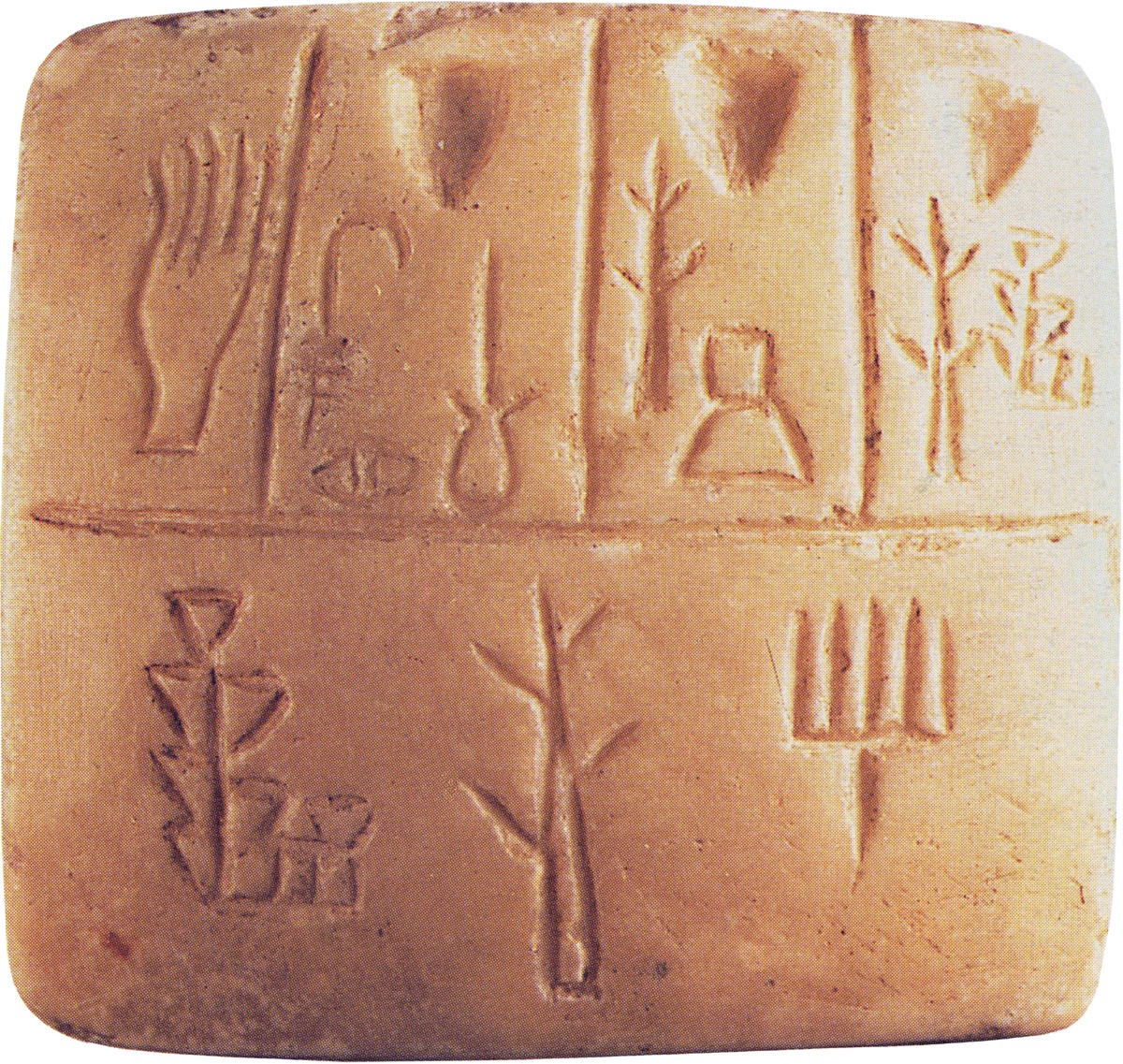
Early Writing One of the earliest known examples of writing for the purposes of accounting comes from Mesopotamia. This tablet, dated to around 3200 BCE, contains pictographic symbols that correspond to specific quantities of certain goods—including, perhaps, cereal grains such as wheat.
The answer lies in the demands of complex society. The first customers for information stored in writing were states and merchants. States that depended on thousands of inhabitants to pay taxes needed a way to monitor and record who had paid and who hadn’t. Merchants needed writing to track their numerous transactions and debts.
Whatever the format and whatever its original purpose, writing proved to be fundamental to history over the past 5,000 years. Writing and reading made possible much faster accumulation of knowledge and, indeed, the creation of new knowledge and belief. A reasonable case can be made that writing is the second most important innovation, after agriculture, since the origins of language. In later chapters, we’ll examine specific features of writing as it developed in Mesopotamia, Egypt, China, India, and Mesoamerica.
METALLURGY Another important tool that played a role in state making was metallurgy—the working of metal ores first into metals and then into useful objects. The important metals for this chapter are copper and bronze; iron had revolutionary effects in Eurasia and Africa, but only after 1500 BCE. In the Americas and Oceania, metallurgy remained of trivial importance until far later, after 1500 CE.
All metals come from the earth, and most are chemically or physically bound up with rock in ores. They require processing, often smelting with fire, to separate metal from rock. Smiths used high temperatures to make metals pliable enough to hammer into useful shapes. They applied even greater heat to melt metals into liquid that could be poured into molds. To generate heat, they burned wood or charcoal in enclosed spaces called forges. Smiths also learned how to combine metals into useful alloys. Smiths were highly skilled men—there is no evidence of female smiths until recent centuries.
Metalworking Ötzi the Iceman was found carrying a copper axe, evidence that the people he lived among used smelting techniques to process copper ore.
The earliest evidence of metalworking comes from the Paleolithic, but metals weren’t important anywhere until about 6000 BCE. The first smelting operations on a large scale occurred, remarkably, in southern Mesopotamia, a region with no useful ores and not much wood for fuel. Soon after 6000 BCE, smelting developed elsewhere in Southwest Asia and in southeastern Europe, mainly in upland regions where both ores and wood were abundant. Copper, tin, and lead were among the easiest metals to work. Ötzi the Iceman, to judge by chemical analysis of his hair, lived some of his life around copper smelters in the Alps.
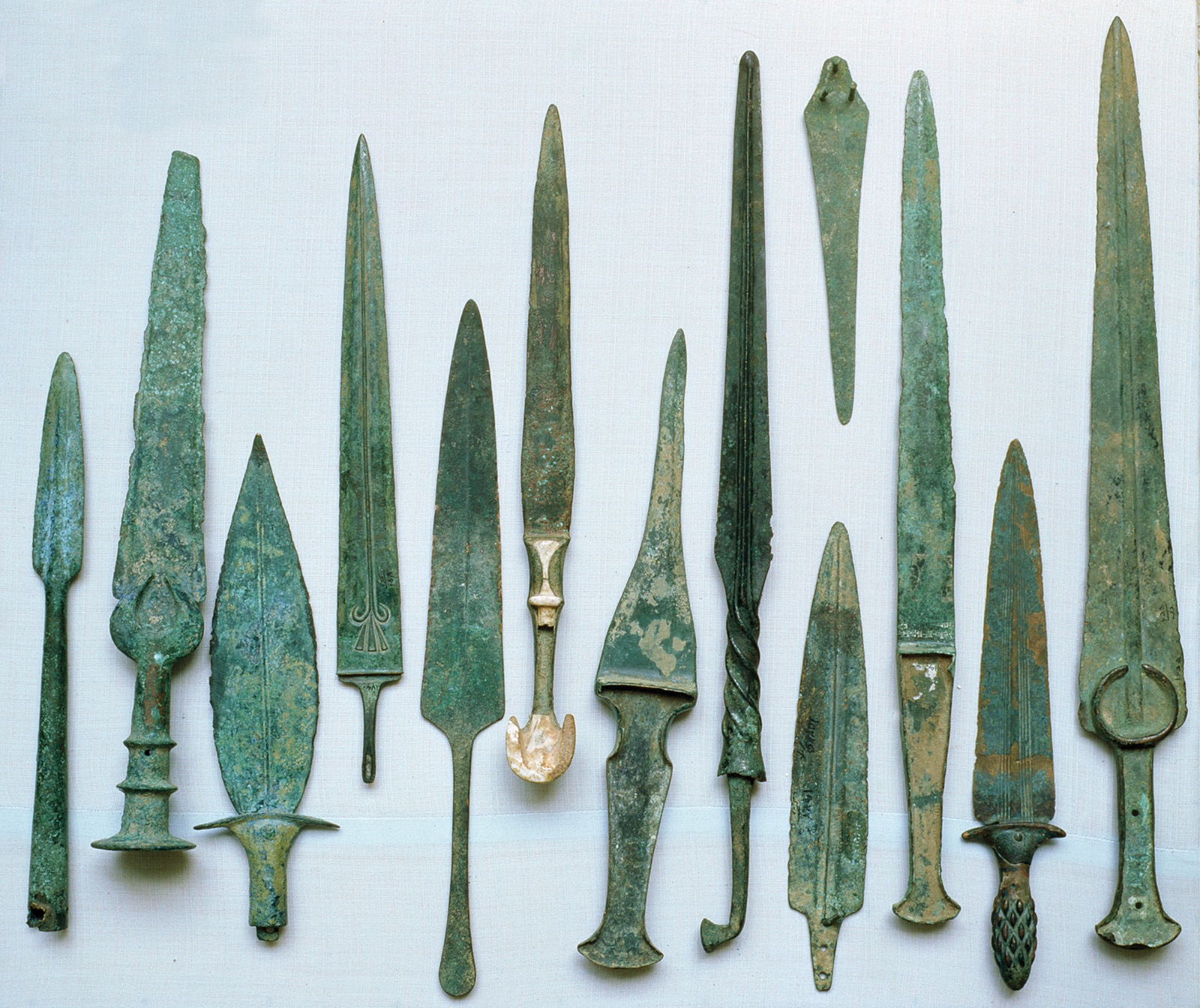
Metallurgy acquired much greater importance at about 3500 BCE, when smiths in Mesopotamia started to make bronze, an alloy of copper and tin. Bronze was a harder metal than any yet in use, good for axes, armor, and weapons as well as ornamentation. Since tin and copper aren’t generally found together, bronze making always involved long-distance trade of tin, much the rarer of the two metals. So bronze was always expensive and became a favorite ornament of the rich and powerful. By 2000 BCE, bronze-making skills had spread widely in Eurasia and North Africa.
Using Bronze A display of bronze knives found in present-day Iran, and dated to around 2000 to 1000 BCE, represents only a small range of the many items that could be made from the versatile and durable material. Knives could serve as tools, as weapons, or as luxury items to signify status.
Bronze quickly became important to states and rulers. It made much better weaponry than stone or any other available metal. Those who could control its supply held a military advantage over everyone else. Most early states in Eurasia struggled to acquire the tin and copper needed to make bronze weapons and armor. They set out either to conquer upland regions where the ores were found or to establish trade links. Few states without bronze could survive for long anywhere near others that had it. Bronze in Eurasia was a bit like fire, language, and farming everywhere: those with it enjoyed advantages over those without it, and those without it either acquired it, were conquered, or fled from those who had it.
THE TWIN CHALLENGES OF COMPLEX SOCIETY
In Chapter 2, we tried to account for the emergence of agriculture at least seven times between 11,000 and 4000 BCE after more than 200,000 years without it. The appearance of complex society presents a broadly similar problem. It arose independently in at least four places, and probably six: Mesopotamia, Egypt, the Indus valley, China, Mesoamerica, and the Andes. In all these places, it came several thousand years after a transition to agriculture. And in each case, complex society shared many of the same features: irrigation agriculture, cities, markets, states, monumental architecture, armies, and bureaucracies. Almost all shared kingship, writing, and metallurgy too.
Could it be accidental that such a similar socio-technological package evolved a few millennia after each transition to agriculture? It can’t be inevitable: people practiced farming for millennia in most of sub-Saharan Africa and North America without proceeding to develop cities, states, or writing. But it’s also not random—not by a long shot. Complex societies showed so much uniformity because they all faced two main challenges: attack by neighbors and civil strife within. They all had to develop practices, beliefs, technologies, and institutions to equip themselves to address these two problems.
THREATS FROM WITHOUT AND WITHIN Defense against unfriendly neighbors, whether skilled and violent horsemen or organized in a state with an army, was a matter of survival for complex societies. To create the means of protection, complex societies generally organized as states. Kingship, armies, metallurgy, and other practices—even writing—contributed directly to the goal of self-protection. Ideologies of social solidarity, religious emphasis on fertility, and technologies of irrigation agriculture contributed indirectly to a society’s ability to defend itself.
The other main problem for complex societies was conspicuous social inequality. The quest for status may be innate among humans, as it is among chimpanzees; but simple human societies, as we’ve seen, are relatively egalitarian. In complex society, however, the difference between kings and slaves was much greater than the difference between leaders and followers in any hunting-foraging band or village—or chimpanzee troop. This chasm expanded the scope for envy, jealousy, rivalry, division, and conflict within any given society.
All complex societies that endured developed cultures that persuaded people to accept, even if only resentfully, enormous inequalities. (In later chapters, we’ll examine some of these cultures in detail.) Religions played the leading role in convincing the toiling masses that it was proper that they should sweat and suffer while others lived in comfort. They justified kingship and elite power, keys to the survival of such unequal societies. To be sure, soldiers used violence (or threats of violence) when needed to keep the masses in line and societies stable. Architects designed awe-inspiring monuments to remind everyone of rulers’ authority. Rituals and ceremonies of social solidarity, including examples of public generosity on the part of elites, also helped to keep the lid on.
The twin problems of complex societies were closely related. To be strong in the face of threats from neighbors required some measure of inequality because rulers needed to equip and train warriors—which, if it required expensive equipment, made for a social structure with warrior elites. But too much inequality could become a source of weakness and division: the downtrodden might welcome defeat at the hand of outsiders on the theory that nothing could be worse than the rulers they had. This helps to account for the unstable nature of politics in most examples of complex society: states and dynasties came and went even if the underlying structures of societies remained much the same. States lasted longest, by and large, when and where effective ideologies united elites and commoners and on those occasions when and where trade, technology, or conquest allowed a society to enjoy an expanding economic pie.
A social unit characterized by a large hierarchical society, regulatory institutions, and a complex division of labor. Complex societies often developed states and cities.
A territorial unit and political community with a formal government. States always have bureaucrats, judges, and soldiers, and usually have ideologies.
A large settlement with elaborate divisions of labor, social hierarchies, tightly packed living spaces, open public areas, and large buildings. Trade, exchange, and markets feature prominently in cities.
The use of large domesticated animals to pull plows—a piece of farm equipment that tills soil. Farmers could cultivate five times more land using plows.
The process of diverting water from lakes, streams, and rivers and supplying it to fields and gardens to ensure crop growth. Irrigation enabled farmers to cultivate land that was otherwise too dry for growing crops.
Infections such as smallpox, mumps, or measles that require large populations in order to stay in circulation. In large populations, these pathogens mostly affect children.