2Settling DownDOMESTICATION AND AGRICULTURE30,000 to 6,000 years ago
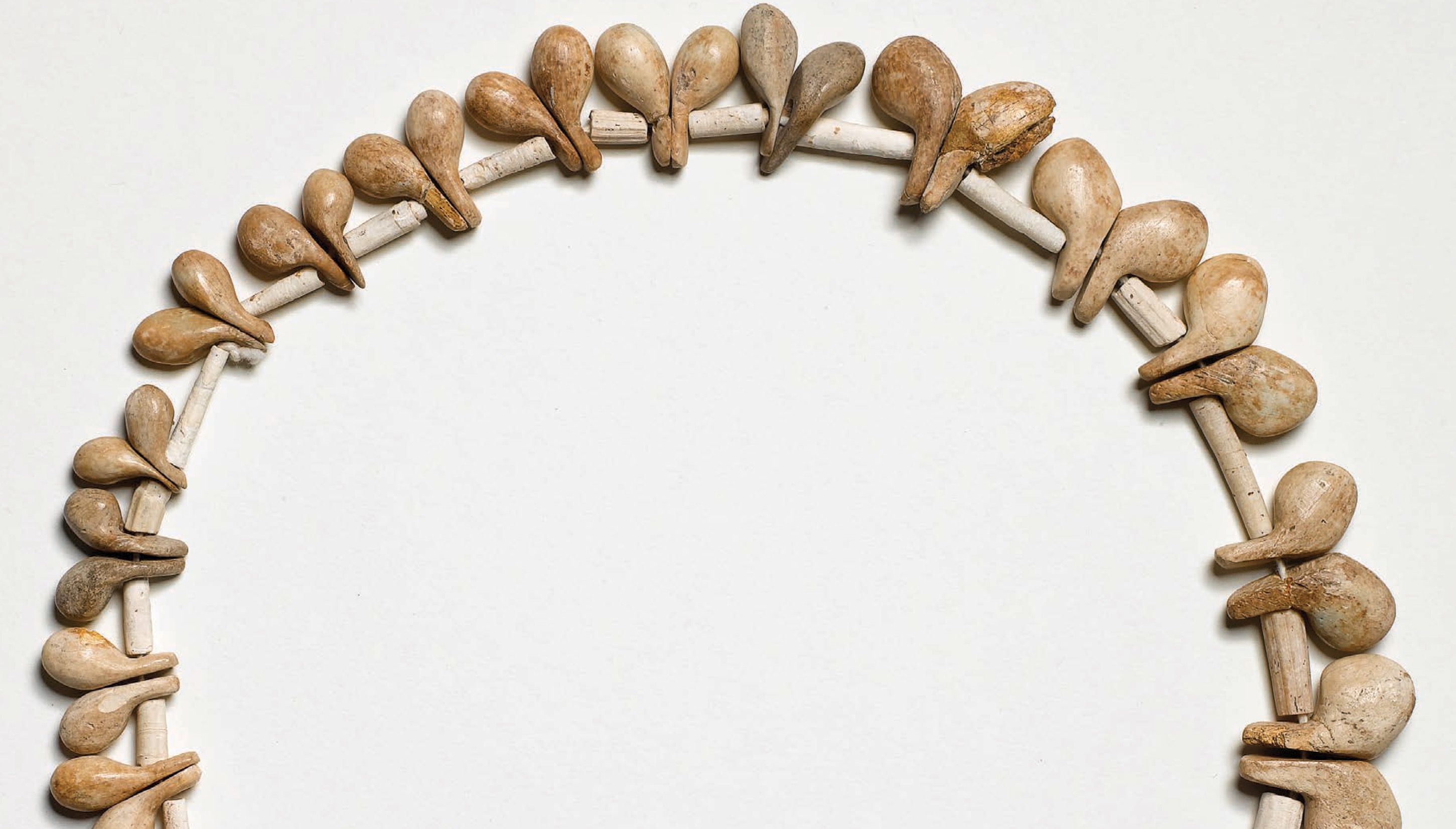
Natufian Burial A delicate shell and bone necklace found in a burial site in Mount Carmel, Israel. The necklace is dated ca. 11,000 BCE.CHRONOLOGYOPENCLOSE
ca. 30,000–18,000 BCEFirst domestication of dogs
ca. 25,000–10,000 BCEMammoth hunters flourish
ca. 15,000–9000 BCEMagdalenian culture flourishes
ca. 12,500–9500 BCENatufians flourish
ca. 11,000 BCEFirst transition to agriculture and plant domestication in the Levant
10,700–9700 BCEYounger Dryas
9700 BCEHolocene begins
ca. 9000–7000 BCEGöbekli Tepe
ca. 8500 BCEFirst domestication of pigs
ca. 8000–7000 BCEFirst domestication of cattle; transitions to agriculture in China’s Yangzi and Huang He river valleys
ca. 7000 BCEJomon culture settlements in Japan
ca. 6000 BCESettlements in North America; crop domestication begins in Mesoamerica
ca. 5000 BCETransition to agriculture in Southeast Asia
ca. 4500 BCEFirst domestication of chickens
ca. 4000 BCEDomestication of llamas
ca. 4000–3000 BCEDomestication of potatoes and manioc
ca. 3000 BCETransition to agriculture in Africa
ca. 2500 BCETransition to agriculture in North America
In 2008, archeologists dug up the floor of Hilazon Tachtit cave in Israel. There they found the 12,000-year-old remains of a burial feast for a 45-year-old female shaman. She was buried in high style, with tortoise shells under her skull and pelvis, and gazelle horn, an eagle’s wing tip, some chalk, and a human foot all placed around her. These and other burial objects led the archeologists to infer that she was a religious specialist of great reputation. The feast in her honor was a special occasion. The menu featured fish; meat from gazelles, foxes, and snakes; and no fewer than 80 roast tortoises—enough food for several dozen people. The guests tossed their leftovers over the body of the deceased woman. Someone then placed a big stone slab on top. No other burial from the time shows anything like the elaborate care lavished on this one.
The people who held the feast and buried the shaman are called Natufians. They flourished from about 12,500 to 9500 BCE. The Natufians lived in settled villages of 100 to 150 people with round houses dug into the ground. Their tool kit suggests they were in contact with people in northernmost Africa and acquired shells from Egypt’s Nile valley. They used obsidian that came from hundreds of miles away in Anatolia (modern Turkey). They hunted gazelles and gathered wild cereals. They invented the world’s first sickles for harvesting cereals, and they used bowls for grinding grain. At some point, they started sowing their favorite cereals and eventually became farmers, producing their food rather than finding it. They were among the pioneers of sedentary lifeways and—as far as we know—the world’s pioneers of agriculture.
The pioneer of Natufian studies was Dorothy Garrod. Born in England in 1892, she earned an undergraduate degree in history from Cambridge University in 1916. After her three brothers and her sweetheart died in World War I, the despondent Garrod went to the Mediterranean island of Malta to figure out what to do with her life. There she became fascinated by ancient artifacts, and soon returned to England to study archeology. Garrod found some Neanderthal remains at Gibraltar in 1925, which at a stroke made her an accomplished archeologist of the Paleolithic. In 1929, she began digging at Shuqba Cave, 20 miles (30 km) northwest of Jerusalem. She assembled a team of researchers, mostly women—a first in the history of archeology. Her team began the documentation of Natufian culture.
In 1939, much to her surprise, Garrod was appointed to a prestigious professorship in archeology at Cambridge University. She was the first woman ever to hold any professorship at the centuries-old university. Like her subject, the Natufians, Garrod was a pioneer in her own right.
Back in the Paleolithic, as we’ve seen, history unfolded at a leisurely pace. Over the first several tens of thousands of years of human history after the emergence of language, all people lived in approximately the same sorts of social units, and they all lived mobile lives focused on foraging, hunting, and, in places, fishing. Environment and culture changed with the onset of the Ice Age and its violent climatic fluctuations, with new tools, and with the invention of art. People spread out over the Earth. But the basics of their lives remained much the same.
As the last ice age waned and climate continued to warm, people who formerly wandered in search of food began in several sites to settle down. In multiple places they also began to domesticate animals. And in the final landmark transition considered in this chapter, people invented agriculture at many times in many places. Farming spread widely, changing the basics of life irrevocably. By our twenty-first-century standards, this sea change came slowly. By the standards of Paleolithic history, it came as suddenly as a tsunami.