THE AMERICAS JOIN THE GLOBAL WEB
Millions of African slaves experienced the brutal rigors of the Middle Passage because in the wake of Columbus the newly transformed economies of the Americas needed labor. The European discovery of sea routes, and the subsequent surge in globalization, disrupted the Americas much more than Africa. The first stage, following upon Columbus’s voyages, involved wave after wave of lethal epidemics in tandem with military conquests led by small bands of Spaniards, Portuguese, French, Dutch, and British.
DISEASE AND DEPOPULATION: REGIONAL VARIATIONS
As we saw in Chapter 16, the crowd diseases brought to the Americas by European mariners proved extremely lethal to native populations, who had no prior exposure for protection. Here we will take a closer look at the post-Columbian catastrophe, considering some of the regional variations in the Americas and the role of factors outside of biology.
THE CARIBBEAN The severity of the calamity varied considerably across the Americas. People in the warm coastlands of the Caribbean had the worst of it. The more densely populated islands, such as Hispaniola, where pathogens could most easily find new bodies to infect, suffered losses of more than 99 percent within three generations. Before Columbus arrived in 1492, the Taíno (as the Amerindians of this part of the Caribbean are called) on Hispaniola numbered several hundred thousand, perhaps a million or more. By 1514, an attempt to count them recorded only 26,000. By 1550, when malaria inadvertently brought from Africa had joined the crowd diseases, perhaps 5,000 Taíno remained.
Spanish violence and enslavement of the Taíno added to the deadly effect of unfamiliar diseases. Some Spaniards would stop at nothing in their efforts to find gold or seize farmland. Others, meanwhile, tried to convert Taíno to Christianity, which caused divisions within Taíno communities. Their social structures fell apart. Death of spouses, separations, and demoralization led birth rates to plummet. Young Taíno women became wives or concubines of Spaniards. The net effect of the Spanish efforts to make money on Hispaniola and save Taíno souls was to compound the disease disaster and hasten the demographic decline. On Hispaniola and several other islands, Taíno society, language, culture, and identity virtually disappeared—much as would happen later to the Tasmanians with whom this chapter began.
Immigrants from Europe and slaves from Africa came to dominate Hispaniola demographically, and its culture—religion, language, food, dress—evolved, like so many others, as a blended, or creole, culture. Pottery shows how rapid this process was on Hispaniola: in 1515, most pots bore the marks of Taíno potters. By 1530, none did, and the island’s pottery was made by Africans. The demographic story on other big Caribbean islands such as Cuba, Jamaica, and Puerto Rico was broadly similar.
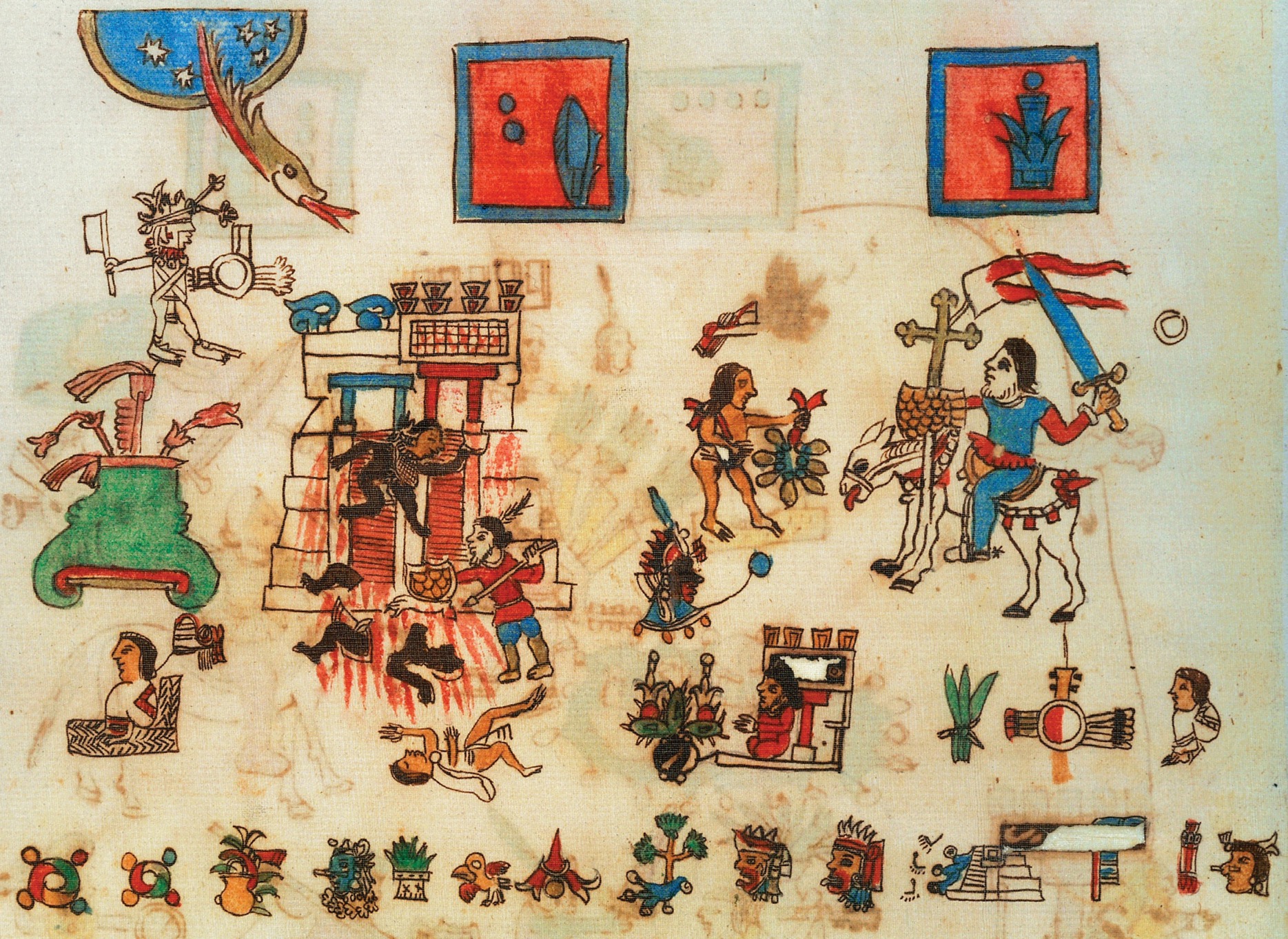
MESOAMERICA AND THE ANDES The major centers of Amerindian population—Mesoamerica and the Andes—suffered smaller losses in proportional terms than the Caribbean, but in absolute terms they lost more population than anywhere else in the Americas. Repeated battering from epidemics and disruption of family routines, village life, and the political order cost each region roughly 70 to 90 percent of its population. In Mesoamerica, where perhaps 15 to 20 million people lived in 1492, the disaster began in 1519 when a Spanish adventurer, Hernán Cortés, and a band of a few hundred Spaniards rallied some of the subject peoples of the Aztec Empire in an assault on Tenochtitlán. A raging smallpox epidemic scythed down millions of Amerindians but left Spaniards—normally survivors of childhood bouts with the virus—unscathed. Epidemics recurred time and again, birth rates fell, and by 1620 Mesoamerica held fewer than a million people.
In the Andes, waves of epidemics began in 1524, preceding the arrival of Spaniards. A civil war over succession to the throne divided the Inka Empire when in 1532 a distant kinsman of Cortés named Francisco Pizarro led a band of 168 men into the Andes. The combined effect of epidemic and civil war enabled Pizarro to engineer a coup d’état, overthrowing the Inka Empire. For a hundred years after Pizarro, native population continued to plummet, from perhaps 12 to 15 million in 1532 to under 1 million by 1630.
The demographic disaster in the Americas was least severe in those regions where people were few and pathogens could not easily find new bodies to infect. The Arctic is one such example, where the toll of disease was smaller (closer to 50 percent) and came later, in the eighteenth and nineteenth centuries. The Mapuche of southern Chile, whose armies kept Spanish conquistadores at bay, as they had done with the Inka before, also seemed to have survived better than most.
ECOLOGICAL, SOCIAL, AND ECONOMIC FACTORS The demographic catastrophe varied in its intensity from place to place partly for ecological reasons. Malaria, a warm-weather disease carried by mosquitos and introduced from Africa, became entrenched in some parts of the Americas but not others. Higher elevations and higher latitudes, which are colder than lower ones, hosted fewer mosquitos and less malaria.
The variability of the population catastrophe also had to do with social factors. In some cases, the ravages of introduced diseases began before European conquerors or settlers turned up, as in the Andes. In New England, in the years 1616–1619, epidemics took a terrible toll before the first English settlement at Plymouth Rock (1620). More often, however, social chaos created by European settlement compounded the effects of epidemics, as in Hispaniola during the early sixteenth century.
Warfare, loss of lands, and enslavement magnified the population losses. Wars of conquest, as in Mexico and Peru, were widespread. Although small in scale, these wars often involved Amerindians on both sides. In addition, Amerindian peoples when hit by epidemics often sought to recover their losses by seizing people, normally women and children, from their neighbors. The Iroquois, for example, who began to suffer heavily from epidemics in 1645, launched attacks on the Huron starting in 1648 partly to replenish their own numbers.
Almost everywhere in the Americas, sooner or later, Amerindians lost their best farmland to encroaching Europeans. That created additional problems of food supply and brought the demoralization that people typically experience when forced from their homes. Hunger and demoralization both can weaken disease resistance.
In many parts of the Americas, forced labor and enslavement added to the toll. Recent estimates suggest that between 1500 and 1800, some 2 to 4 million Amerindians were enslaved. Although slavery had existed in the Americas for millennia, its scale increased just when the population of the Americas was collapsing. This was no accident: population collapse created intense demand for labor, filled by both the transatlantic slave trade from Africa and the enslavement of Amerindians.
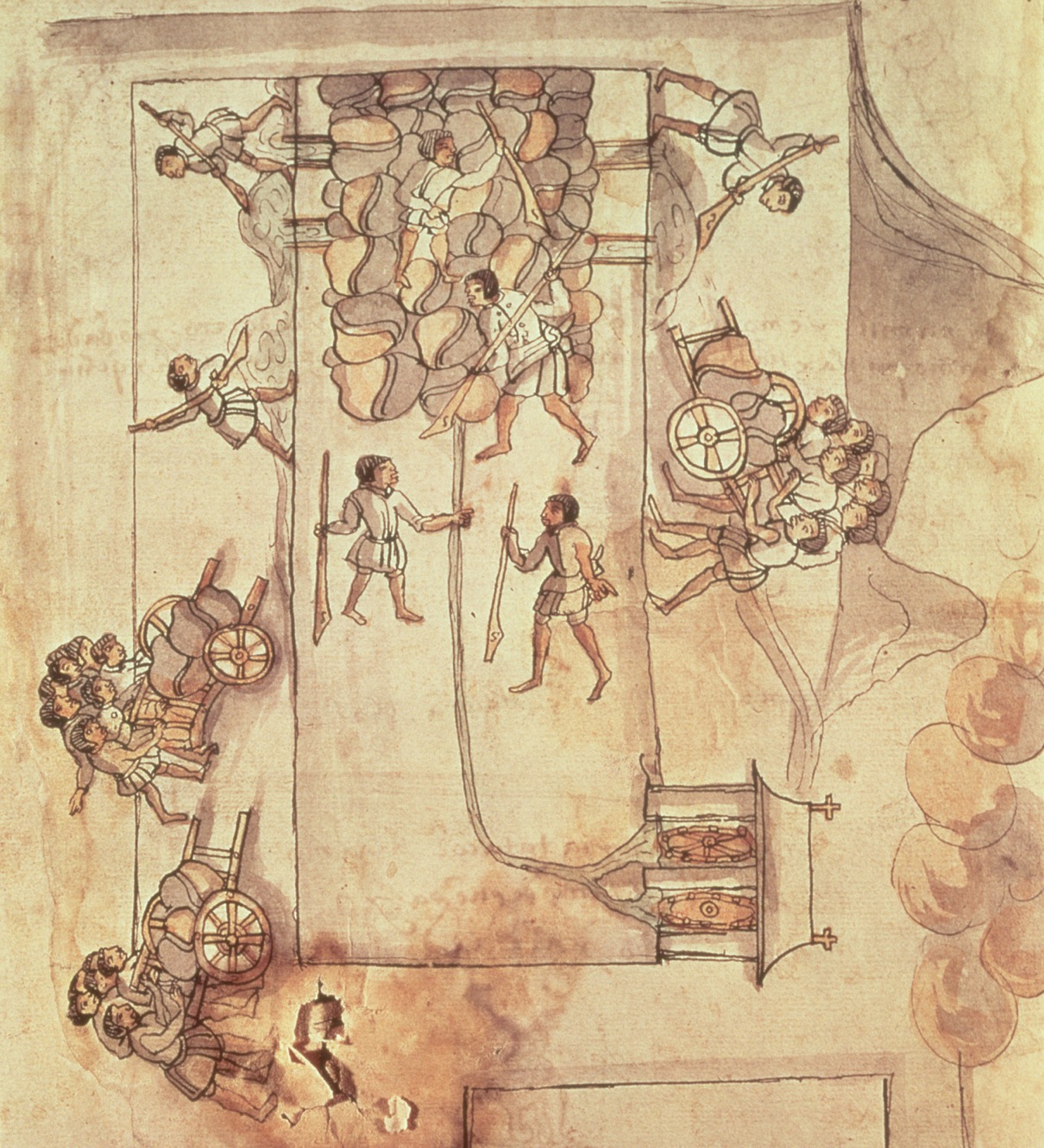
In particular, the newly developing mining and plantation economies (of which more below) relied on forced labor, both African and Amerindian. Spanish rule in South America continued the Inka practice of the mita, the forced labor draft imposed on Andean peoples, using it to provide workers for silver mines—where high mortality prevailed. Silver mines in Mexico, pearl fisheries off the coast of Venezuela, and early plantations in what would become the southeast of the United States also drew upon enslaved Amerindians. Charleston, South Carolina, in the seventeenth century even exported Amerindian slaves to plantations on the Caribbean island of Barbados.
Enslavement of Amerindians was repeatedly prohibited by European authorities. The Spanish did so throughout their empire early in the sixteenth century, but with important exceptions—for peoples judged cannibals, such as the Caribs (of the eastern Caribbean), or for those like the Mapuche of Chile, whose resistance to Spanish rule was especially fierce. Spanish law also permitted slavery for everyone already enslaved. This created incentives for Amerindians to capture their neighbors and sell them to Spanish mining or plantation enterprises.
Where Spanish authorities tried hardest to save Amerindians’ souls, death rates were especially high. Catholic missions throughout Spanish America clustered Amerindians together in agricultural villages to hasten their conversion to Christianity. Clustering, however, sped the transmission of most infectious diseases. The California missions begun in 1769, for example, suffered population losses that exceeded 90 percent over 50 years. Here too, few babies were born to take the place of the dead and dying.
EFFECT ON CLIMATE All in all, the fate of Amerindians after 1492 was among the most dismal chapters in world history. The experience of depopulation and displacement was shared with Tasmanians, the Khoi of southern Africa, and several other peoples around the world. But the scale of the population disaster was larger in the Americas than anywhere else—large enough, perhaps, to affect the Earth’s climate.
The loss of population in the Americas from 1492 to 1700 may have deepened the chill of the Little Ice Age. Where some 40 to 70 million people had once lived, in 1700 fewer than 5 million remained. Former farmland became forest over broad patches of the Americas. As the forests grew, they absorbed carbon dioxide from the atmosphere, lowering its concentration and weakening (ever so slightly) the greenhouse effect. This (along with big volcanic eruptions and reduced energy output from the sun) probably helps to explain why the coldest spells in the Little Ice Age occurred between 1590 and 1710.
NEW EMPIRES
The arrival of Europeans and the disastrous depopulation in the Americas had political consequences that varied from place to place. Where large empires had existed, as in the Andes and Mesoamerica, new, Spanish-led ones instantly replaced them. Where smaller-scale political structures had existed, as in most of the Americas, guerilla resistance was more common and European control took far longer to establish.
The largest-scale conquests took place in Mexico and Peru. In both cases, small bands of conquistadores allied with big armies of Amerindians, such as the Tlaxcalans who joined Cortés. Locals often out-numbered Spaniards in the armies of conquest by 100:1. So, in effect, Mesoamaerican conquerors used Cortés and his men to overthrow a hated Aztec Empire. Indeed, Tlaxcalans in the mid-sixteenth century considered that they, not Spaniards, had conquered the Aztecs. Similarly, in Peru, Spanish conquistadores made common cause with dissident subjects of the Inkas. When “Spanish” conquerors later marched into Chile, their armies consisted mainly of former Inka soldiers; and when Spaniards led armies into Guatemala or fought the Chichimecs in northern Mexico, it was mainly Aztecs and Tlaxcalans who followed.
In Mesoamerica, when Cortés and his allies overthrew the Aztec state (1519–1521), he and his followers proclaimed the Viceroyalty of New Spain. Pizarro created a Viceroyalty of Peru. In some ways, these Spanish colonial states were just the latest successors in native imperial traditions that stretched back centuries. The Spanish in Peru, for example, not only continued the Inka forced labor system, but they also maintained the reciprocal exchange networks among lineages that had underpinned Andean society under the Inkas, and before them the Moche. They fought on the same frontiers that the Inkas had a century before, using mainly Inka soldiers.
In Mexico, the Spanish re-built an empire on the foundations they seized from the Aztecs. Tribute payments from surrounding districts, formerly sent to Aztec Tenochtitlán, now went to Spanish Mexico City. The Spanish governed together with indigenous elites, splitting the resulting revenues and other perks of power. They did not exact tribute from the Tlaxcalans, their co-conquerors. In Mexico, as in Peru, the Spanish were too few to conquer and govern alone. Spaniards supplied superior armament and global knowledge; indigenous elites supplied local knowledge and manpower. Together, Spanish and local elites could rule the rapidly declining mass of the population.
Where Amerindian polities were small or absent, Europeans encountered more enduring resistance to their rule. The Mapuche of southern Chile and the Maya of Mexico’s Yucatán Peninsula, for example, who did not have much in the way of states, fought long and hard against Spanish control. Unlike the populations of Peru and central Mexico, they had no tradition of deference to any imperial authority. For centuries they succeeded in keeping themselves independent in most respects; and when they failed they often mounted rebellions, especially the Mapuche. In general, Amerindian revolts happened more often in northern New Spain and in the southern Andes. In what is now New Mexico in 1680, the Pueblo, an Amerindian people, rose up against Spanish authority and either killed or expelled all Spaniards from their area for the next 12 years. The biggest Amerindian uprising, however, took place in the heart of the Andes, around Cuzco in 1781–1783, led by a descendant of the Inka royal family, Túpac Amaru II. It failed, at a cost of more than 100,000 lives. Nonetheless, the Spanish Empire in America was a patchy one with firm control only in a few centers.
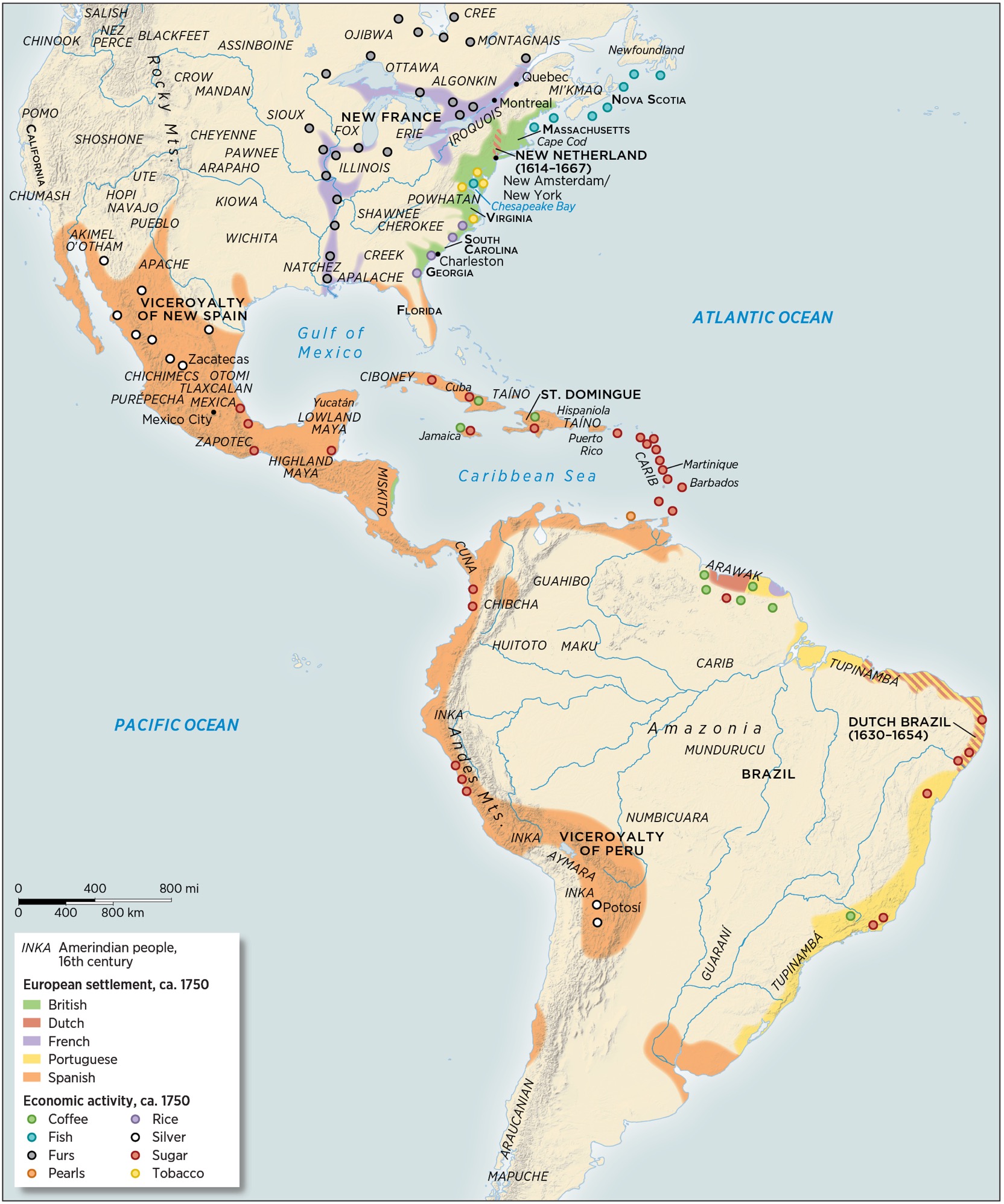
The other European empires in the Americas were smaller than the Spanish. Portugal claimed Brazil but controlled only stretches of coastline and their hinterlands as late as 1600. When the Dutch decided to take a bit of Brazil for themselves in 1618, Portugal could not prevent it. Almost all of Brazil remained Amerindian country into the eighteenth century, when gold and diamond strikes brought a wave of European immigrants. The Dutch Empire was smaller still, confined to a few small Caribbean islands, a tiny settlement of New Netherlands (now New York), and for 30 years a corner of Brazil. And the Dutch surrendered New Netherlands to English rule in 1667.
Like the Spanish and Dutch, both the French and British claimed some Caribbean territories. They founded colonies on several small islands and some of the big ones, such as Jamaica, that Spain could not hold. In North America, they took gradual control of the eastern seaboard from the dwindling Amerindian populations. The French settled at Quebec after 1608 but struggled to populate their colony, called New France, with farmers. By 1750, New France had about 50,000 people. British settlement began in 1607 in Virginia and 1620 in Massachusetts, and soon spread everywhere from Georgia to Nova Scotia. These colonies grew quickly, expanding to the Appalachian Mountains by 1750, at which time they held a population of perhaps 2 million. In economic and strategic terms, Caribbean islands such as Jamaica and even tiny Martinique were worth a lot more than the North American colonies—because of the money made selling sugar from slave plantations.
SETTLEMENT AND TRANSOCEANIC ECONOMIES
The sudden loss of native population in the Americas played havoc with economic life and increased the scale of slavery. Labor grew ever scarcer, and ambitious businessmen despaired over how to mine ores or raise crops without sufficient labor. The main motive behind both the African and Amerindian slave trades was to provide cheap labor for the economies of the Americas. European laborers crossed the Atlantic too, a few as slaves, many as indentured servants—meaning they had to work for no wages for a set period, often seven years. But up to 1820, roughly four enslaved Africans had come to the Americas for each European migrant whether indentured or free. It wouldn’t be until 1880 that the cumulative number of European arrivals in the Americas equaled the number of enslaved Africans who survived the Middle Passage.
With African and European migrants joining the Amerindian populations, building a new economy in the Americas became possible. The new connections to transatlantic markets, and in some cases new crops or technologies, presented novel opportunities. All the European powers hoped to find precious metals, as the Spanish did in great quantities. Where that failed, the new empires sought other ways to realize the economic potential of the Americas.
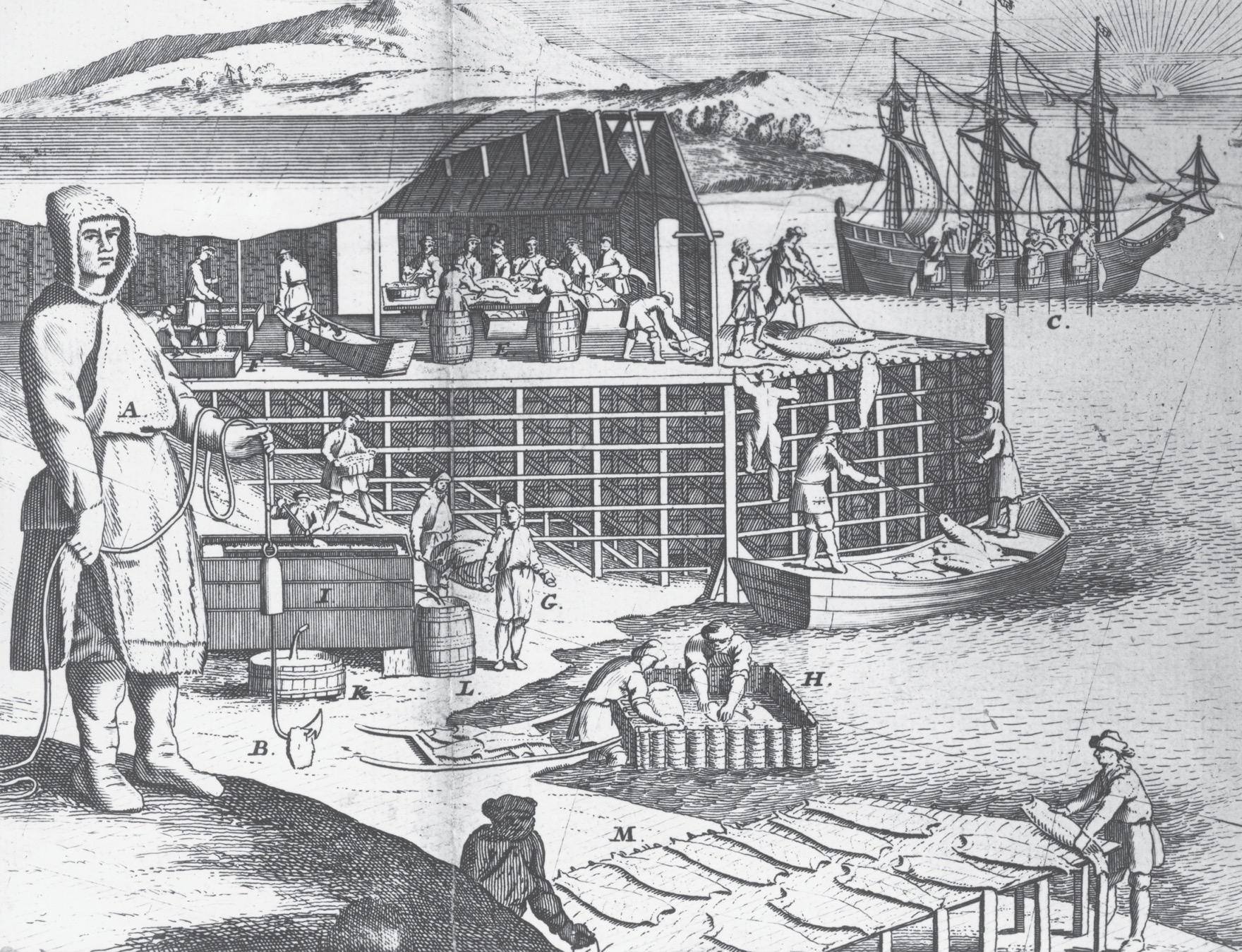
FISHERIES AND FURS One opportunity lay in the world’s richest cod fisheries, from Cape Cod to Newfoundland. From the 1520s onward, British, French, and Basque (and eventually American and Canadian) fishermen, free men working for wages, caught thousands of tons of cod annually. Most of it was salted or dried and shipped to Europe for sale. On the mainland of North America, at least its northern half, beaver fur offered another way to make money. Amerindians had long hunted and trapped fur-bearing animals. An export trade began around 1630, funneled through Montreal and New Amsterdam (New York after 1667) to Europe. Amerindians still did most of the trapping, but they now sold most of their fur harvest to French, Dutch, or British merchants. Agents for European fur merchants eventually ranged far into the interior of North America—especially those based in New France, often marrying into Amerindian communities in arrangements broadly parallel to those with wives of the coast in the African slave trade. By 1800, the North American fur trade extended as far west as the Rocky Mountains.
THE PLANTATION ZONE Another transatlantic economy, even more lucrative than the fishery or fur trade, took root in the warmer regions from the Chesapeake south to Brazil. This became the plantation zone of the Americas, the destination of the great majority of enslaved Africans shipped across the Atlantic. In the Chesapeake, where English settlement began in 1607, the money-making crop was tobacco. In South Carolina and Georgia, a rice plantation economy flourished after 1690, also based on slave labor and to some extent slave know-how in rice cultivation: some slaves came from rice-growing regions of West Africa and brought their techniques of irrigation and planting with them.
The heart of the plantation zone lay in the Caribbean and northeastern Brazil. Sugar became the most rewarding plantation crop. Unlike fishing, fur trapping, or even tobacco farming, sugar cultivation only made sense on a large scale. Sugarcane juice has to be crystallized within days after the cane is cut, which required elaborate machinery to press juice out of the cane and boiling houses to convert the cane juice to sugar crystals. Because it called for hefty capital investment, sugar production became a business dominated by big planters with connections to European merchant houses. Dozens of Caribbean islands, including British Barbados and Jamaica, Spanish Cuba, and French Saint-Domingue (part of Hispaniola), produced sugar, as did Portuguese Brazil. From 1650 to 1800, sugar islands were the second-most valuable possessions in the Americas. Sugar plantation workers suffered the highest mortality rates of slaves anywhere in the plantation zone. Millions of Africans died on these plantations. Planters bought millions more to take their places.
SILVER Precious metals formed the most valuable transatlantic economy. Cortés and Pizarro sought gold and silver, and found both in envy-provoking quantities. They and their successors used all the tools they had—imagination, guile, technology, brutality—to coax more gold and silver out of Mexico and Peru. Spanish authorities organized large-scale silver mining in Zacatecas, Mexico, and at Potosí in the Andes. Potosí alone yielded 40,000 tons of silver between the 1540s and 1780s. Potosí temporarily became one of the world’s largest cities, despite an elevation of more than 13,000 feet (4,000 meters).
By 1600, some 20,000 Amerindians—both wage workers and mita forced laborers—mined, processed, and minted silver into coins. Wage workers were well paid by local standards but their lives were brutal and short on account of harsh conditions, frequent accidents, and poisoning from mercury used in the refining process. Laborers in the Potosí mines performed heavy work in darkness relieved only by candlelight. They breathed air laced with dust that over time brought on silicosis and other lung diseases. Many of them spent their shifts carrying 55lb (25-kilo) sacks of ore up rickety ladders, climbing more than 650 feet (200 meters)—no wonder they wouldn’t work without a wad of coca leaves in their cheek to dull their pain, hunger, thirst, and minds.
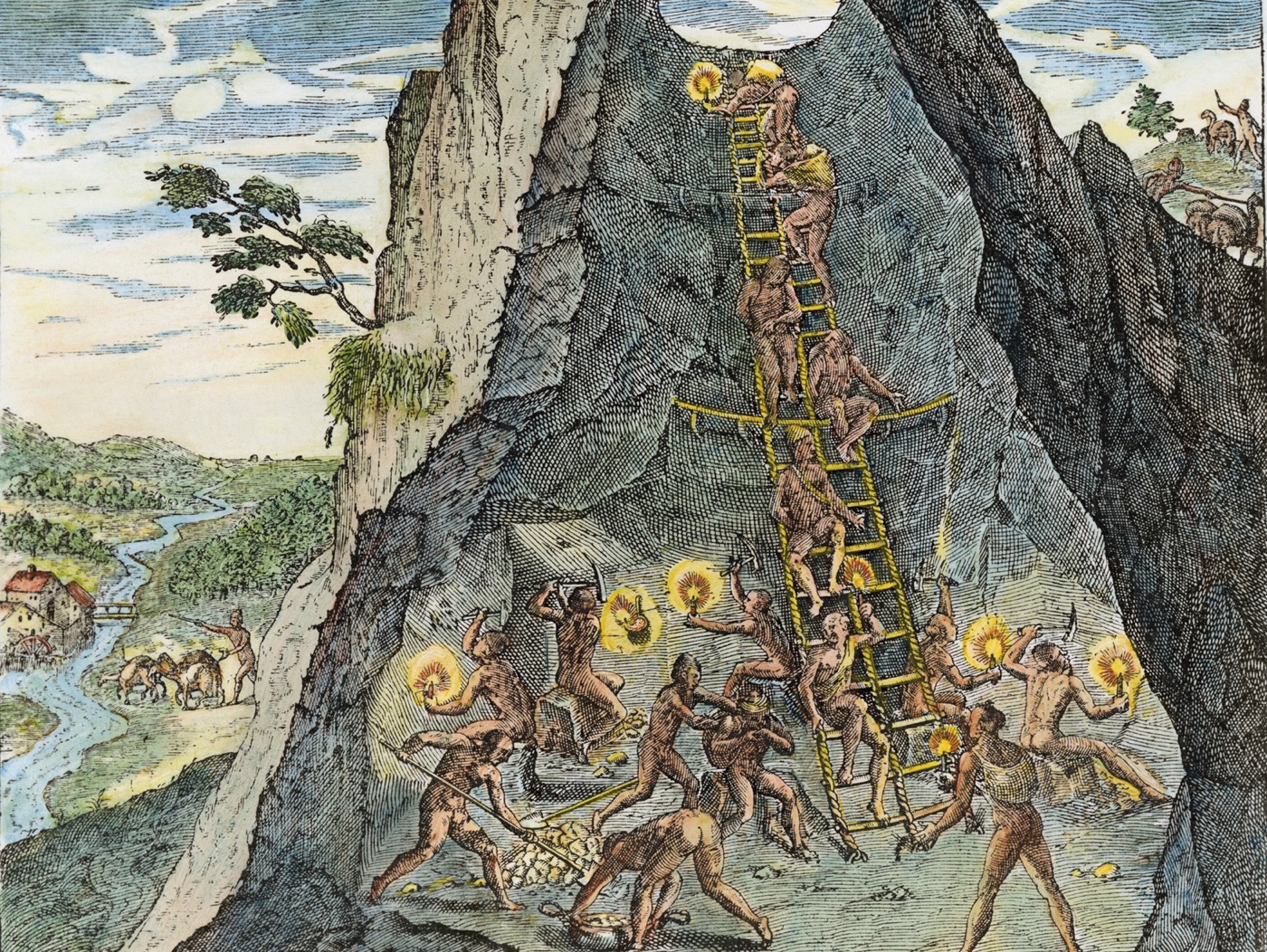
Additional unfree Amerindian workers were dragooned from as much as 350 miles (600 kilometers) away to replace the sick, maimed, and killed. Andean peasant communities held the equivalent of funerals for men drafted for the mita, knowing what lay ahead.
By 1608 the mita could no longer deliver enough workers, and mine-owners bought African slaves for work at Potosí. They generally toiled above ground in transport or refining. Life expectancies were so short for miners, and slaves so expensive, that employers preferred to see mita recruits do the lethal work below ground. One Spanish friar wrote in 1628, “Every peso coin minted in Potosí has cost the lives of ten Indians who died in the depths of the mines.” This exaggerated the toll but underlines the human cost of the silver business.
Mule caravans and coastal shipping carried most Mexican and Andean silver to port cities for transport through the Caribbean to Spain. Some went directly from Mexico to Manila in the Philippines. Much of the silver that Spain extracted from the Americas eventually found its way to China or India, as we shall see in a later chapter.
AGRICULTURE But people couldn’t eat furs or silver: agriculture fed almost everyone from French Quebec to Spanish Chile. Amerindian peoples everywhere grew their own food when they could avoid being dragged off to plantations, mines, or missions. They took up the raising of livestock with newly introduced species such as sheep, goats, and cattle. In seventeenth-century New Mexico, for example, the Navajo economy combined sheep herding with farming and raiding. Amerindians sometimes added Old World crops to their gardens too. Settlers from Pennsylvania to New England to Quebec also raised their own food, often planting American maize alongside European varieties of wheat. Farther south, in the plantation zone, the richer European settlers obliged slaves to do all farm work. Poor families in the plantation zone, whatever their racial identity, worked the land themselves. In Spanish America, settlers created big agricultural estates (haciendas), and the Crown granted them the right (an encomienda) to conscript Amerindians as unpaid laborers.
By and large, everyone ate local food. But by 1750, locally raised food might well consist of crops and animals that had been introduced from other continents in the Columbian Exchange and integrated into the farms and fields of the Americas.
HYBRID SOCIETIES
With lucrative transatlantic (and in cases transpacific) export economies linking the Americas to Africa, Asia, and Europe, the Americas developed creole societies and cultures that blended elements from these distant places. The changing languages of the Americas were a good measure of broader social and cultural change.
CREOLE LANGUAGES AND CULTURES Many Amerindian tongues spoken in 1492 gradually died out as the number of speakers dwindled. By 1800, perhaps one-third of the roughly 25 million people living in the Americas spoke an Amerindian language. Maybe one-tenth—generally, people born in Africa—spoke an African language. The great majority spoke a European language, although sometimes not as a native tongue. In the plantation zone especially, new, creole languages developed that typically combined features from European and African tongues. (Most people in the Caribbean today speak one or more creole languages.) Haitian Creole combined mainly French vocabulary with grammar based on West African languages such as Fon. Papiamento, spoken in Aruba, Bonaire, and Curaçao, is a blend of Portuguese, Spanish, Dutch, and indigenous Amerindian languages.
Similar blending took place in religious beliefs and practices. Most people in the Americas practiced one or another form of Christianity, but in ways that might have raised eyebrows in Christianity’s homelands. European colonization in the Americas included substantial efforts at conversion and religious education, especially in lands controlled by Catholic kingdoms such as Portugal, Spain, or France. They tended to entrust religion to one or several orders of the Catholic Church, such as the Jesuits, Franciscans, or Dominicans. Missionaries of these orders often accepted great hardship and suffered high on-the-job mortality rates: in New Mexico over the course of the seventeenth century, about 40 percent of Franciscans were killed by the people they were trying to convert, the Pueblo. Members of these orders built missions in French Canada, Portuguese Brazil, and throughout Spanish America, especially in frontier regions: Texas had 30 missions and California 21. Priests and friars, more than officials of the state, brokered the relations between Amerindian and European societies in the Catholic domains. In lands controlled by the mainly Protestant British and Dutch, Christianization of the indigenous population carried a far lower priority.
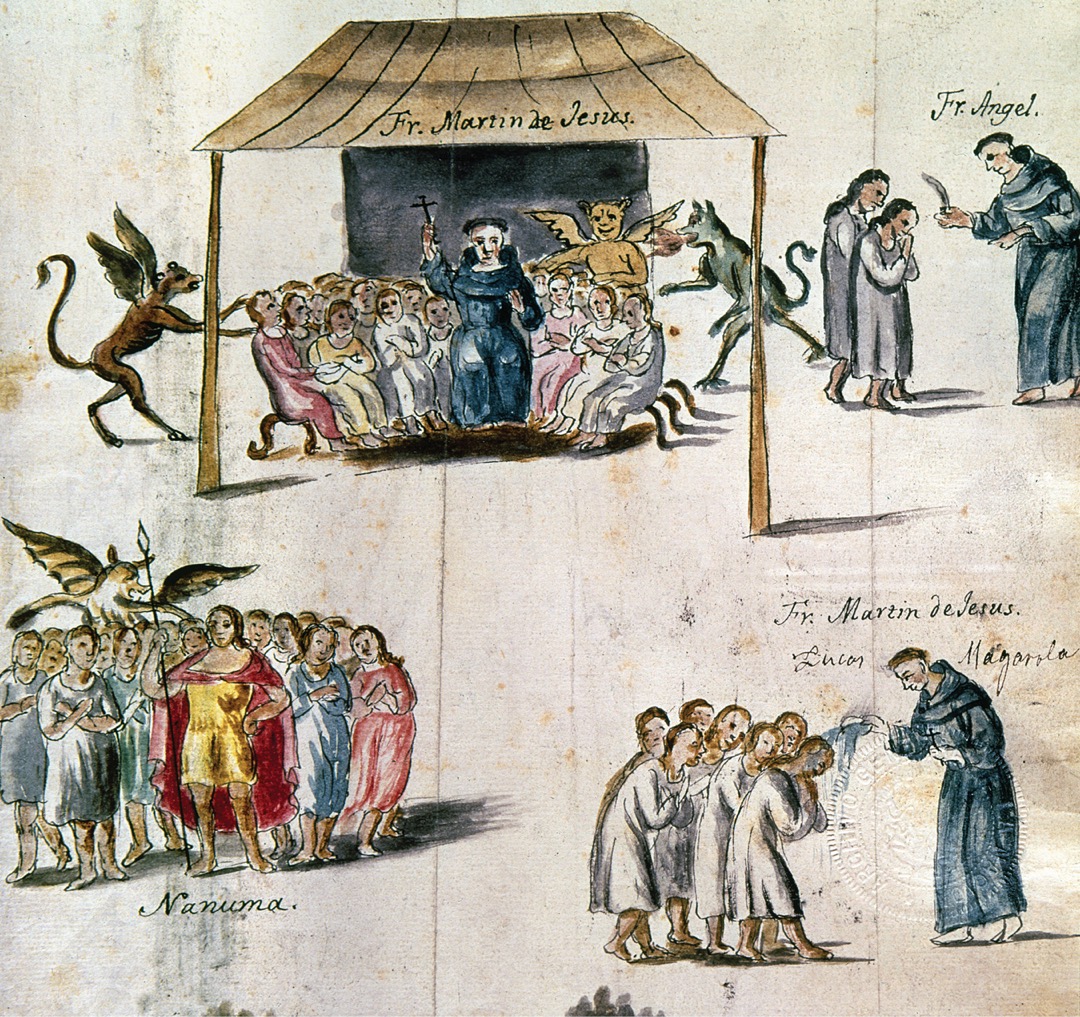
Amerindians who were attracted to Christianity generally preferred to meld the old with the new, to adopt Christian forms and belief selectively and mix them with their own practices—as Africans did with Islam or Chinese with Buddhism.
In the plantation zone, African religions entered the mix and often dominated it. Vodun, a polytheistic religion with a prominent role for female deities, was imported by enslaved Fon- and Ewe-speakers from West Africa. It took root in the Caribbean, Brazil, and Louisiana, acquiring new features, often from Catholicism, in each locale. Slaves (and former slaves) created new religions, such as Santería in the Spanish Caribbean or Candomblé in Brazil, based on West African spiritual practices but with components adapted from Christianity or Amerindian traditions. Yoruba religion played an especially large role in shaping religious practice in the plantation zone. Its tradition of orishas—spirits that guide people to live properly and help win favor from Olorun, the Yoruba creator god—blended fluidly with Catholicism’s emphasis on saints. Slaves and former slaves adjusted their spiritual lives to fit the challenges of plantation society.
SHIFTING SOCIAL HIERARCHIES The social structures of colonial societies in the Americas were complex and shifting hierarchies. Status depended on a long roster of variables. Gender and age mattered here much as everywhere else. Legal status (i.e., slave or free) and wealth mattered a lot in the Americas, as almost everywhere else. Skin color and presumed ancestry mattered more here than almost anywhere else because the Americas was one of the few places (the Dutch settlement at the Cape of Good Hope was another) where people from multiple continents and with notably different superficial characteristics (e.g., skin color) coexisted.
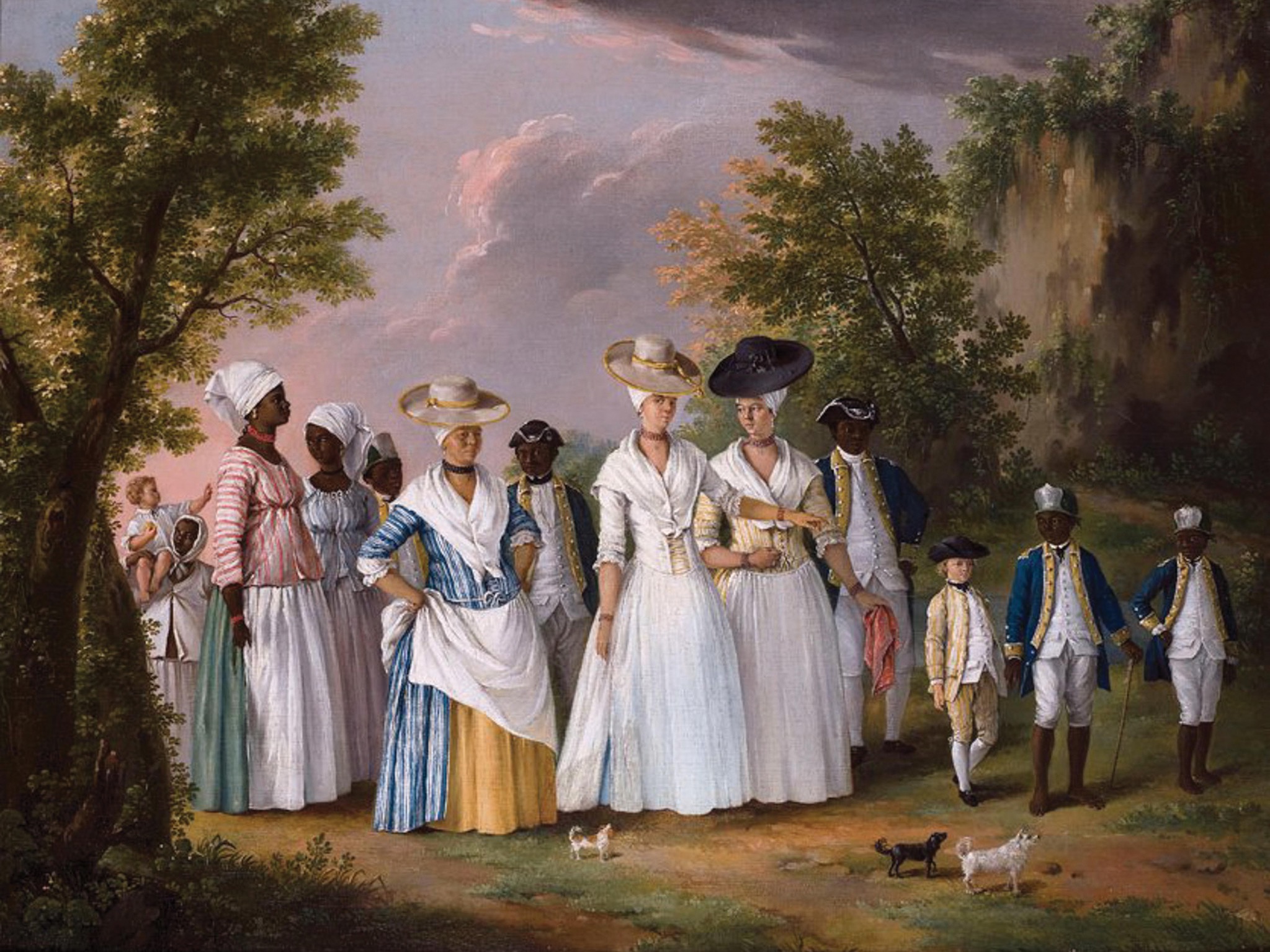
But every place calculated social status differently because so many variables were involved. For example, in the eighteenth century in the French plantation colony of Saint-Domingue (Haiti today), the social pyramid featured slaves—roughly 90 percent of the population—at the bottom. Above them stood free blacks of African birth; free blacks of Caribbean birth; gens de couleur libre, or free people of mixed African and European ancestry; poor whites; and at the top, prosperous whites. However, in some contexts wealthy gens de couleur libre might outrank poor whites. A lengthy vocabulary existed to distinguish among people depending on ancestry.
In Brazil, Mexico, or Peru, even more complex hierarchies existed, because—unlike in Saint-Domingue—Amerindians survived in large numbers. Many people had African, Amerindian, and European ancestors in every imaginable proportion, all captured in a correspondingly detailed vocabulary. In all three of these societies, slaves were on the bottom and wealthy Europeans on top of the social pyramid, but what lay in between was more complicated, and more fluid, than in Saint-Domingue.
New France and New England had different social hierarchies from the rest of the Americas. In 1750, New England had about 350,000 people, of whom roughly 330,000 were free, Christian, and of European descent. About 13,000 were of African descent, slave or free, and fewer were Amerindian. Social distinctions beyond those of age and gender rested mainly on wealth, the prestige of one’s ancestry, and one’s religious sect. But in New France and farther west, around the Great Lakes, there were only 70,000 French people in 1750 and about 1,200 of African descent. Amerindians outnumbered everyone else until about 1830. Many Amerindian groups retained their old social structures with hierarchies based on age, gender, and achievement. But increasingly they took part in market transactions with frontier settlers—providing furs and hides, for example—and as a result became part of larger societies in which they occupied subordinate roles.
INDEPENDENT GROUPS Some peoples in the Americas managed to keep their distance from the new European empires. The Mapuche and Maya, and the so-called Plains Indians of North America, successfully resisted encroaching empires until the nineteenth century, as did the peoples of the Northwest coast. But even these groups experienced some rearrangements of their social hierarchies. With war and trade more common, specialists in these pursuits could more easily gain status. Many Amerindian tribes in Amazonia evaded contact with outsiders altogether for centuries (some of them even until this day) and probably underwent no sharp changes in their social structures.
Communities of runaway slaves, called maroons in the English-speaking colonies, secured their freedom for decades, often in mountains or jungles. Brazil had many such communities, usually short-lived. The largest, Palmares, was home to 30,000 former slaves and lasted from about 1600 until 1694, when Portuguese forces overwhelmed it in an artillery assault. Other such communities were much smaller, mostly composed of young men eking out a living hunting, fishing, and sometimes raiding plantations from which they had escaped.
Maroons were not the only ones who temporarily escaped the reach of the new empires. Until about 1730, many coastlands of the Americas hosted pirates who operated on the margins of the new empires, preying on merchant ships and occasionally on settlements. Most were Europeans themselves, usually runaway sailors fleeing the harsh discipline of naval or merchant vessels, but perhaps one in three were African or of partly African descent. In general, piracy flourishes when a lucrative maritime trade springs up without powerful naval states nearby. The spurt of seaborne trade in the wake of Columbus and da Gama provided such an opportunity, and pirates multiplied in the Caribbean, the Mediterranean, the Indian Ocean, and in East Asian waters. Pirates in the Caribbean enjoyed considerable success from the 1570s until the 1720s, by which time European navies became too large and efficient for piracy to flourish.
The entanglement of the Americas in the growing Global web was an extremely disruptive process. It entailed the dismantling of the pre-Columbian American webs of interaction—mainly through the massive loss of native populations, but also through compulsory labor, forced migration, and other hardships visited upon Amerindians. Meanwhile, merchants, migrants, missionaries, and others forged new linkages both within the Americas and between the Americas and the wider world of Atlantic Europe, Atlantic Africa, and East Asia. A true global web was spun in the centuries after Columbus, for the first time in the history of the world. The newly refashioned Americas provided much of the thread in the form of silver, sugar, furs, fish, and other commodities traded far and wide.
Glossary
- Taíno [TAY-noh]
- The indigenous population of the Spanish-controlled Caribbean island of Hispaniola. Disease, violence, and enslavement led to a demographic catastrophe among the Taíno.
- plantation zone
- An area stretching from the Chesapeake to Brazil where the majority of African slaves were used. Plantations grew tobacco, rice, and sugar on a large scale as part of the transatlantic economy.
- Potosí [poh-toh-SEE]
- Site of large-scale, dangerously deadly silver mining in the Andes under Spanish authorities during the sixteenth and seventeenth centuries; laborers were mostly conscripted Amerindians and, later, African slaves who suffered harsh conditions, frequent accidents, and mercury poisoning. Silver was the most valuable transatlantic commodity.
- encomienda [ehn-koh-mee-EHN-dah]
- Granted by Spanish rulers to colonizers in Spanish America, the legal right to conscript Amerindians as unpaid laborers.
- mita [MEE-tah]
- The forced labor draft imposed on Andean peoples by the Inka. Under Spanish rule in South America, the mita provided unfree labor to work in the brutal conditions of the silver mines.