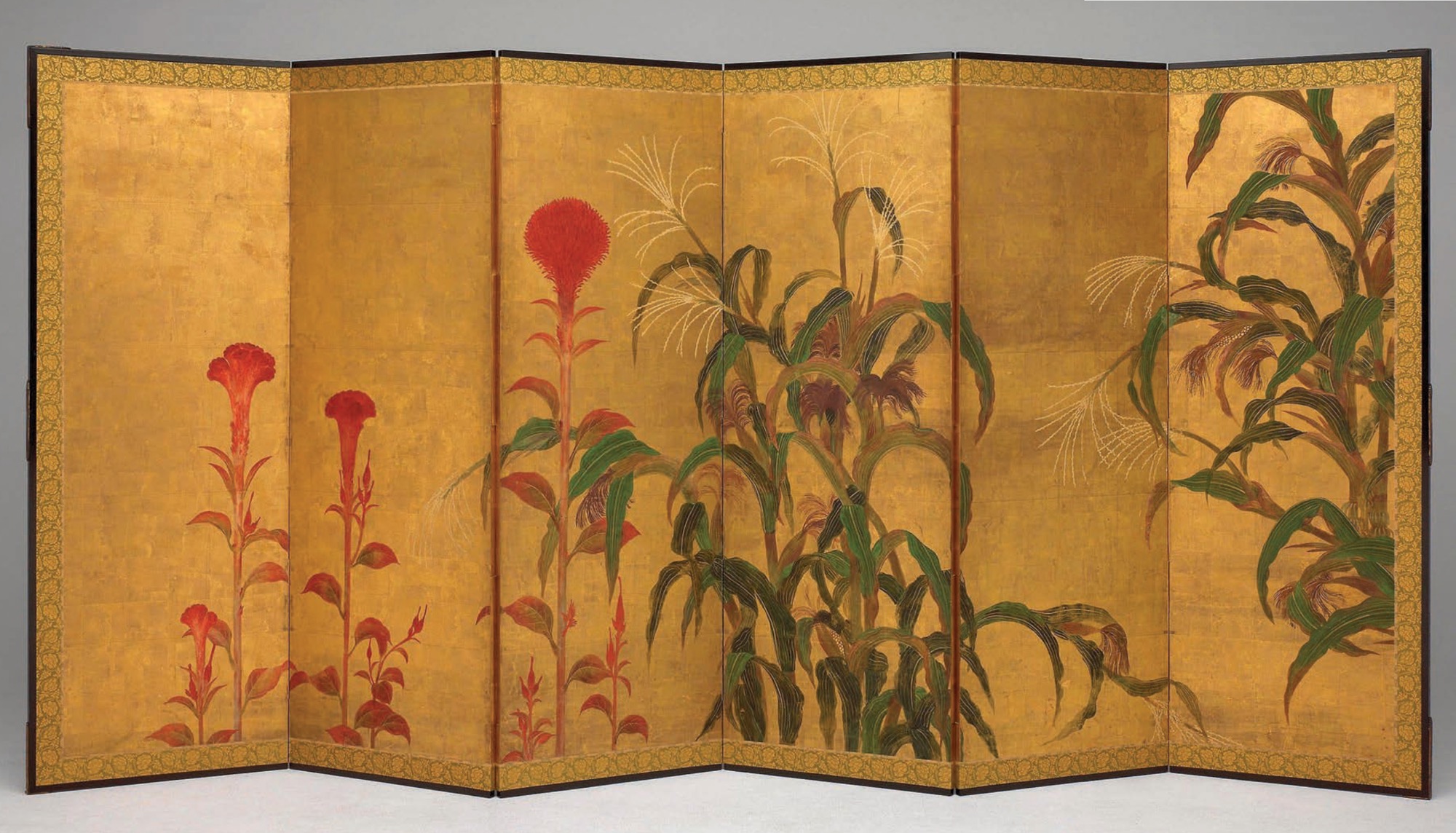
16ConvergenceTHE DISCOVERY OF THE OCEANS AND BIOLOGICAL GLOBALIZATION1400 to 1800
Maize Comes to Asia This Japanese screen from the mid-seventeenth century was probably produced in Kyoto, where aristocrats valued finely detailed ink drawings of exotic plants. It shows the Mesoamerican food crop of maize, which together with potatoes and cassava spread from the Americas to the rest of the world in a surge of biological globalization after 1492. The screen is among the earliest evidence of maize in Japan.CHRONOLOGYOPENCLOSE
1291Italian sailors attempt to circumnavigate Africa
ca. 1300–1400European and Moroccan sailors reach the Canary Islands
1368–1644Ming dynasty in China
1402–1424Reign of Yongle Emperor 1402–1496Spanish conquest of the Guanches in the Canary Islands
1405–1433Zheng He organizes and leads seven maritime voyages
1415Portuguese army captures Moroccan port of Ceuta
ca. 1430–1440Henry the Navigator organizes systematic voyaging along the coasts of Atlantic Africa
ca. 1480Knowledge of how to make great ships is lost in China; Portuguese sailors establish a fort in West Africa
1492Christopher Columbus lands in the Bahamas 1492–1650Populations in the Americas fall by 70 to 95 percent
1494Spain and Portugal sign the Treaty of Tordesillas
1497Vasco da Gama embarks on expedition to India; John Cabot makes round trip from England to Newfoundland
1500Pedro de Cabral claims Brazil for Portugal
1519–1522Ferdinand Magellan’s surviving crew members circumnavigate the globe
ca. 1550–1750Maize becomes a food staple in Atlantic Africa
By 1570The Pacific Ocean wind system is deciphered
ca. 1650Population of the Americas begins to recover
ca. 1670Military expansion of Asante kingdom begins
On the morning of October 11, 1492, Amerindians living on an island in the Bahamas (probably Watlings Island) walked to the beach and, to their astonishment, discovered Christopher Columbus. Few if any Bahamians had ever seen men wearing clothes, which was not done in their islands, let alone men in metal armor. None had ever seen ships. Columbus’s ships far eclipsed the dugout canoes that plied Bahamian waters. What those astonished people made of the strangers on their shores we will never know, although it’s a reasonable guess that some were curious and some were terrified. Columbus, for his part, thought he stood on an island off the coast of China.
Nearly six years later, in 1498, residents of the Indian port city of Calicut, strolling along the harbor-front, were almost as astonished to discover Portuguese ships approaching. They had seen Europeans before, although not many. But they had never seen European ships anywhere in the Indian Ocean, nor any ships carrying big cannon as these did. The ships’ commander, Vasco da Gama, soon found occasion to use the big cannon.
These two encounters in the 1490s symbolize the opening of a new era in world history. Before the 1490s, the Americas and Afro-Eurasia remained essentially separate hemispheres. Before the 1490s, the Old World web relied heavily on overland connections together with the maritime links centered on the Indian Ocean. After the 1490s, the world’s coastlands quickly (well, over two centuries) became integrated as never before, thanks to seaborne trade. Indeed, the world’s populated coasts, with scant exceptions, came to form the first genuinely global web of human interaction, channeling the flow of ideas, technologies, goods, crops, diseases, and much else.
But before we get to the story of several sailors and the seven seas, let’s pause and look at the lands on which people lived as of the fifteenth century, and specifically, the webs of interaction within which they lived. Before examining the formation of a global web, it helps to remember its constituent parts.