 Key Differences among the Poleis of Athens, Sparta, and Miletus
PORTRAITS OF THREE POLEIS
The poleis of Greece developed in very different ways. To illustrate this diversity, we examine three particularly interesting examples: Athens and Sparta, both on the Greek mainland; and Miletus, on the Ionian coast of Anatolia. None of these cities can be considered typical; there were some one thousand poleis, and about most of them we know almost nothing. But at least we can survey some of the features that, with variations, made each polis unique—and yet comparable, in some ways, to its neighbors.
Athens
In Greek, the name of this city is the same as that of its patron goddess Athena, the warlike and wise daughter of Zeus. When the Athenians first came together to form a polis, theirs was a distinctly agricultural economy. Whatever profits aristocrats acquired through trade, they reinvested in land on the Attic Peninsula. Indeed, the Athenian elites regarded commerce as a disreputable means of earning a living, a mentality that persisted even when the city’s excellent harbors and orientation toward the Aegean made Athens famous as a mercantile center.
In the early centuries of its history, aristocratic dominance over the Athenian polis rested on monopolization of elected offices and control of the city’s council, the Areopagus (ah-ree-OP-ah-guhs). It took its name from the rocky outcrop where the council met, just below the acropolis that rose above it. By the early seventh century B.C.E., the aristocrats who came to wield executive authority in Athens were called archons (“first men”). Ultimately, nine archons presided over the entire governance of the polis, including its military, judicial, and religious affairs. Although each served for only one year, all became lifetime members of the Areopagus. And because the Areopagus appointed the archons, it could therefore ensure that power remained in the hands of its own future membership. It also served as a kind of high court in judicial cases.
As this small group consolidated power, deep economic and social divisions developed. A significant proportion of the Athenian population fell into slavery through debt, while struggles among aristocratic families destabilized society and fomented cycles of revenge killings. This situation eventually inspired Athenians’ first attempt to promulgate a set of written laws. In 621 B.C.E., an aristocrat named Drakon sought to regulate violence through harsh punishments: hence our term draconian to describe any severe penalty or regime. The negative effects of this policy ultimately led both aristocrats and hoplites to an agreement. In 594 B.C.E., they agreed to support the election of the poet Solon as the sole archon for one year, and they gave him broad legislative powers. Solon was an aristocrat, but he had made his fortune as a merchant so he was not allied with any one interest. Indeed, he does not appear to have cared about cultivating public opinion, and after his laws were enacted, he went into self-imposed exile for a decade.
Solon’s reforms, though hardly democratic in their promulgation, laid the foundations for the later development of Athenian democracy. He forbade the practice of debt slavery and set up a fund to buy back citizens who had been sold abroad. He encouraged the cultivation of olives and grapes, thus spurring cash-crop farming and urban industries such as oil and wine production, and the manufacture of pottery storage jars and decorative drinking cups. He also broadened rights of political participation and set up courts in which a range of citizens served as jurors and to which any Athenian might appeal.
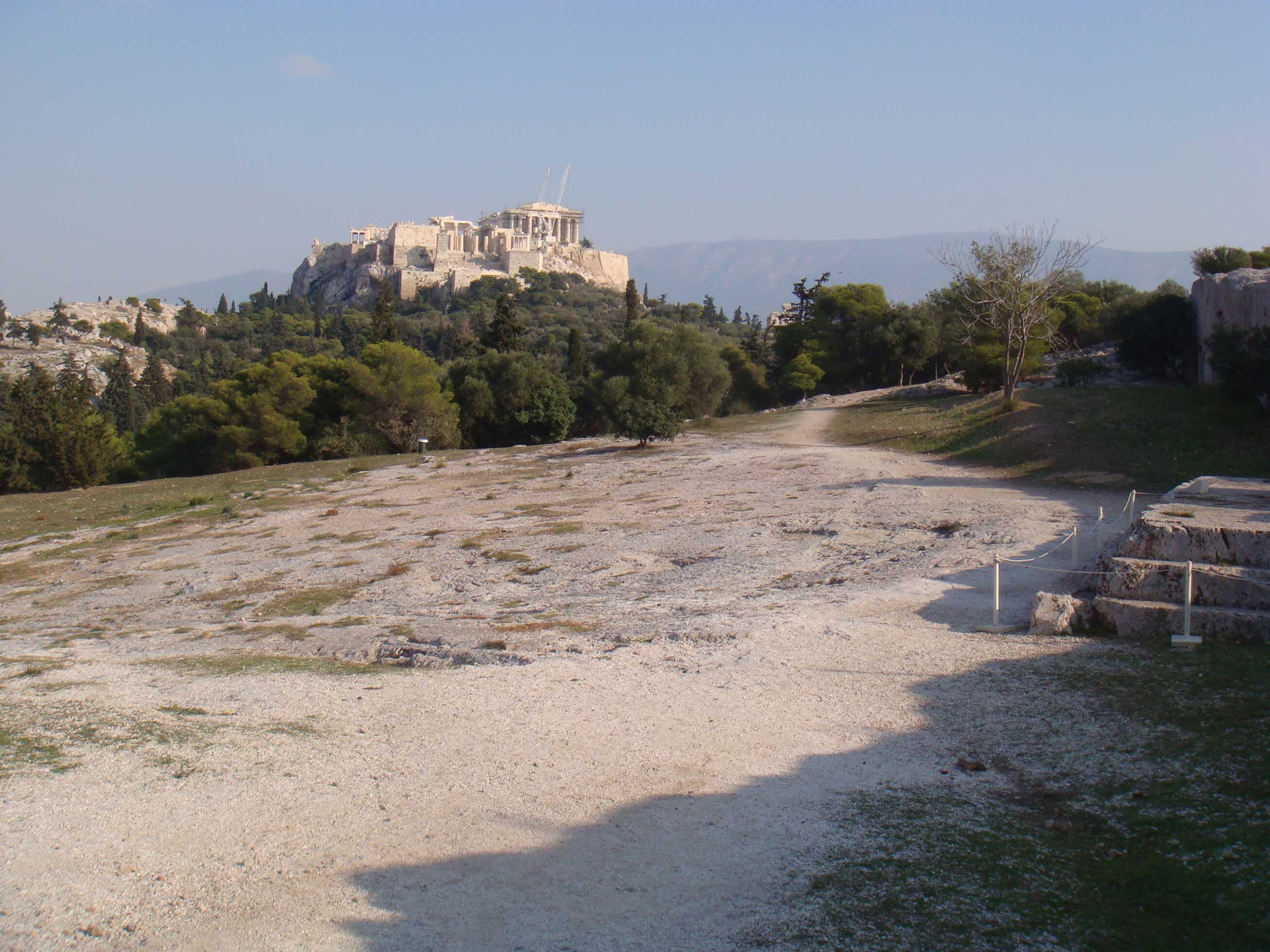
Most significantly, he based eligibility for political office on property qualifications, thus making it possible for someone not born into the aristocracy to gain access to power. Moreover, he convened an Athenian assembly, the ekklesia (eh-KLAY-see-a) and gave it the right to elect archons. Now all free-born Athenian men over the age of eighteen could participate in government. Even those who were not eligible for citizenship were able to see the workings of government for themselves, since the assembled citizens met on the slopes of the Pnyx (pNIX), a hill visible from the central marketplace and overlooked by the sacred precincts of the acropolis.
More information
A rocky outcropping at the top of the hill has stone steps carved into it. In the distance, the hill slopes more steeply, and is covered in trees and further beyond, the Acropolis can be seen at the top of a nearby hill.
Solon’s reforms initially met with resistance. The aristocracy thought them too radical, the people of the demos thought them not radical enough. In the resulting decades of controversy, an aristocrat named Peisistratos (pi-SIS-trah-tohs) succeeded in establishing a tyranny in 546 B.C.E. In a somewhat ironic move, Peisistratos then proceeded to institute Solon’s reforms. He also launched a massive campaign of public-works projects, including the collection and copying of Homer’s epics. But the apparent mildness of his rule was undergirded by the quiet, persistent intimidation of Athenian citizens by foreign mercenaries and the ruthlessness with which Peisistratos crushed any dissent. Still, by enforcing Solon’s laws, he strengthened the political role of the demos and remained a popular ruler until his death. His sons, however, were less able to control the various factions that threatened their rule. One was assassinated, and the other was ousted with the help of the Spartans in 510 B.C.E.
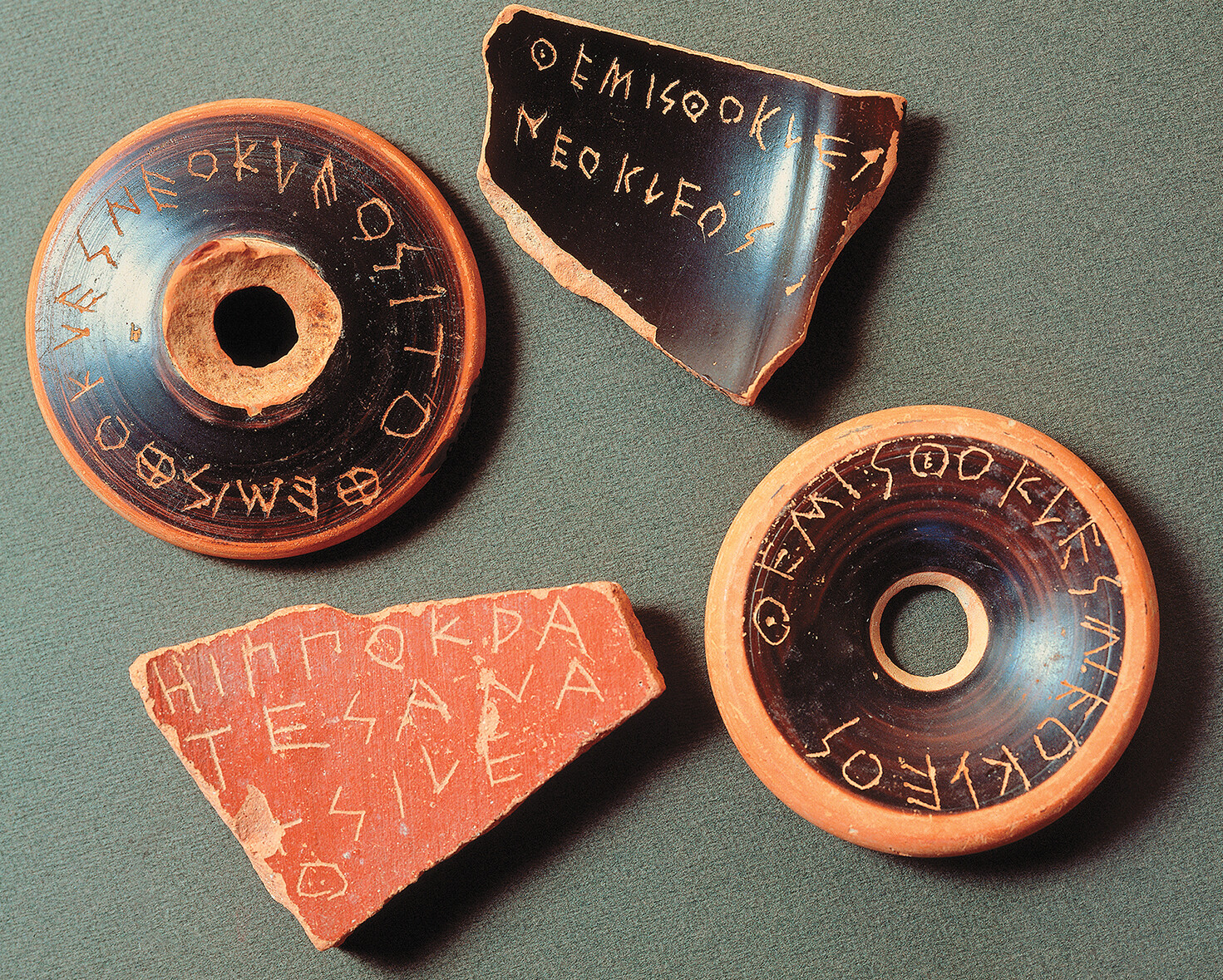
The following period of Spartan-sponsored oligarchy (“rule of the few”) was brief. Two generations of increasing access to power had left the Athenian demos with a taste for self-government. For the first time in recorded history, a group of commoners can be credited with the overthrow of a regime: they rallied behind Cleisthenes (CLIE-sthen-ees), an aristocrat who championed the cause of the demos. Although he did not hold the elected office of archon at the time, Cleisthenes was able to build a coalition within the ekklesia and, by these democratic means, was able to check the power of the oligarchs in 508–507 B.C.E.
Then, by reorganizing the Athenian population into ten voting districts, Cleisthenes suppressed traditional loyalties that had tied each demos to certain aristocratic families. He further strengthened the powers of the Athenian assembly and extended the machinery of democratic government to the local level throughout Attica. He also introduced the practice of ostracism, whereby Athenians could decide each year whether they wanted to banish someone for a decade and, if so, whom. This, Cleisthenes hoped, would prevent the return of a tyranny.
The result of these political struggles made the governance of Athens far more populist than that of any other Greek polis (at least, that we know of). In the meantime, Athens had become the principal exporter of olive oil, wine, and pottery in the Greek world. It was poised to assume the role it would claim for itself during the fifth century B.C.E.
Sparta
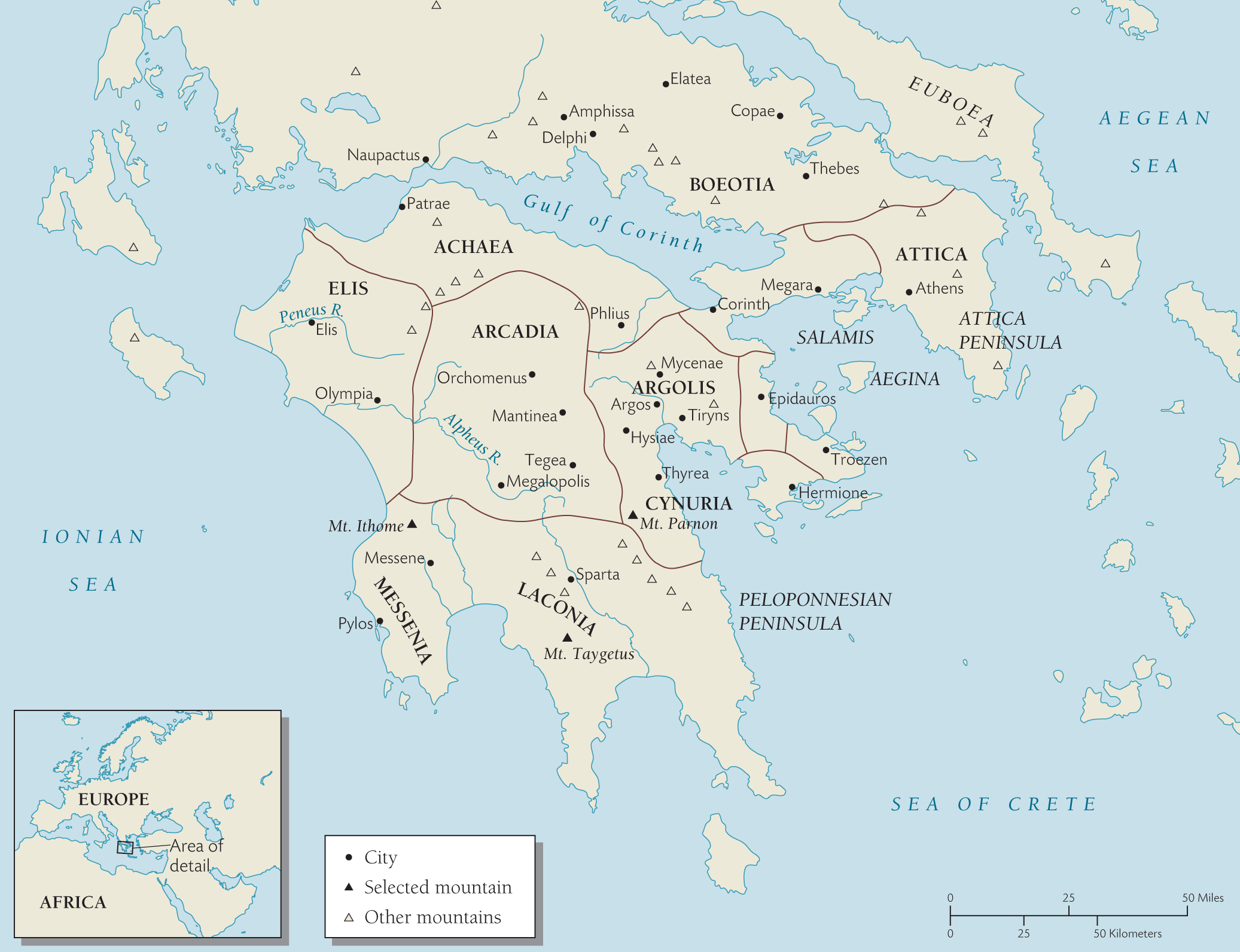
Located in the southern part of the Peloponnesus, the polis of the Spartans took shape when four villages (and ultimately a fifth) combined to form a single entity. Perhaps as a relic of the unification process, Sparta retained a dual monarchy throughout its history, with two royal families and two lines of succession. Although seniority or ability usually determined which of the two ruling kings had more influence, neither was technically superior to the other, a situation that often led to competition among their respective supporters.
According to our only written accounts—all authored by Athenians and therefore requiring careful analysis—Spartan control over the surrounding region of Laconia began with the conquest of Messenia, one of Greece’s few agriculturally rich territories. Around 720 B.C.E., the Spartans subjugated and enslaved the indigenous people there, the helots, who now became an unfree population forced to work under Spartan lordship. Around 650 B.C.E., however, the helots revolted, gaining support from several neighboring poleis, and briefly threatening Spartan hegemony. Eventually, Sparta triumphed, but the shock of this rebellion brought about a permanent transformation.
Determined to prevent another uprising and to protect its superior position, Sparta became the most militarized polis in Greece. Within a few generations, everything was oriented to the maintenance of its hoplite army—a force so superior that the Spartans confidently left their city unfortified. At a time when Athenian society was becoming more democratic and citizens spent more time legislating than fighting, Spartan society was becoming increasingly devoted to an older aristocratic ideal of perpetual warfare, with personal freedom mattering less than the collective honor and security of the polis.
The Spartan system made every male citizen a professional soldier of the phalanx. At birth, every Spartiate child was examined by officials who determined whether it was healthy enough to raise; if not, the infant was abandoned in the mountains. This was a custom observed elsewhere in the ancient world, but only in Sparta was it institutionalized by the state. If deemed worthy of upbringing, the child was placed at age seven in the polis-run educational system. Boys and girls trained together until age twelve, participating in exercise, gymnastics, and other physical drills and competitions. Boys then went to live in barracks, where their military training would commence in earnest. Girls continued their training until they became the mates of eligible Spartiate males, usually when the girls were around the age of eighteen and the men often much older. But for most of their married lives, couples lived apart, so their domestic interests would not compete with the objectives of the polis.
Barracks life was rigorous, designed to accustom youths to physical hardship. At age eighteen, the young man who survived this training would try for membership in a brotherhood whose sworn comrades lived, ate, and fought together. Failure to gain acceptance would mean that the young man could not become a full Spartiate and would lose his rights as a citizen. If accepted, however, he remained with his brotherhood until he was thirty years of age. Between the ages of twenty and thirty he was also expected to mate with a Spartiate woman—but occasions for this were few, a fact that partially accounts for the low birthrate among Spartan citizens. After age thirty, a Spartiate male could opt to live with his family, but he was still required to remain on active military duty until he was sixty.
All Spartiate males over the age of thirty were members of the citizens’ assembly, the apella, which voted on matters proposed to it by a council, the gerousia (gher-oo-SEE-ah; “assembly of elders”), consisting of twenty-eight senior citizens and the two kings. This gerousia was the main policy-making body of the polis and also its primary court. Its members were elected for life but had to be over the age of sixty before they could stand for office. Meanwhile, five ephors (“overseers”), elected annually, supervised the educational system and acted as the guardians of Spartan tradition. In the latter role, ephors could even remove an ineffectual king from command of the army while on campaign. The ephors also supervised the Spartan “secret service,” the krypteia, recruiting agents from among the most promising young Spartiates. Agents spied on citizens, but their main job was to infiltrate the helot population and identify potential troublemakers.
More information
A smaller inset map in the corner shows that the area shown on the larger map is a small part of the land in southern Europe close to the northern part of Africa. The peninsula contains the following areas. Boeotia, Attica, Achaea, Elis, Arcadia, Argolis, Cynuria, Laconia, and Messenia. Major cities in Boeotia included Naupactus, Amphissa, Delphi, Elatea, Copae, and Thebes. The major city in Attica was Athens. Major cities in Achaea were Patrae and Phlius. Major cities in Elis were Elis and Olympia. Major cities in Arcadia were Orchomenus, Mantinea, Tegea, and Megalopolis. Major cities in Argolis were Mycenae, Argos, Tiryns, and Hysiae. Major areas in Cynuria were the city of Thyrea and Mount Parnon. Major cities in Messenia were Pylos, Messene, and Mount Ithome. Major cities in Laconia were Sparta and Mount Taygetus. Other major cities pointed out were Megara, Corinth, Epidaurus, Troezen, and Hermione.
This Spartan polity hinged on the precarious relationship with the helots, who outnumbered the Spartiates ten to one. Messenia routinely seethed with revolt. In wartime, helots accompanied the Spartans on campaign as shield bearers, spear carriers, and baggage handlers. At home, however, the helots were a constant security concern. Every year the Spartans ritually declared war on them as a reminder that they would not tolerate dissent. Moreover, the constant threat of unrest at home meant that the polis was notoriously reluctant to commit its army abroad. So helot slavery made the Spartan system possible, but Sparta’s reliance on a hostile population of enslaved people was also a serious limitation.
This system also constrained the Spartans’ contact with the outside world. Spartiates were forbidden to engage in commerce because wealth might distract them from the pursuit of martial glory. Nor did Spartiates farm their own lands, as many Athenians did. Economic activity in the Spartan state fell either to the helots or the free residents of other Peloponnesian cities who were known as perioikoi (per-ee-OY-koi; “those dwelling around”). The perioikoi enjoyed certain rights and protections within Spartan society, and some grew rich handling its business concerns. But unlike the residents of Attica, in the hinterland of Athens, the perioikoi exercised no political rights within the Spartan polis. Spartiates who lost their rights as citizens also became perioikoi.
More information
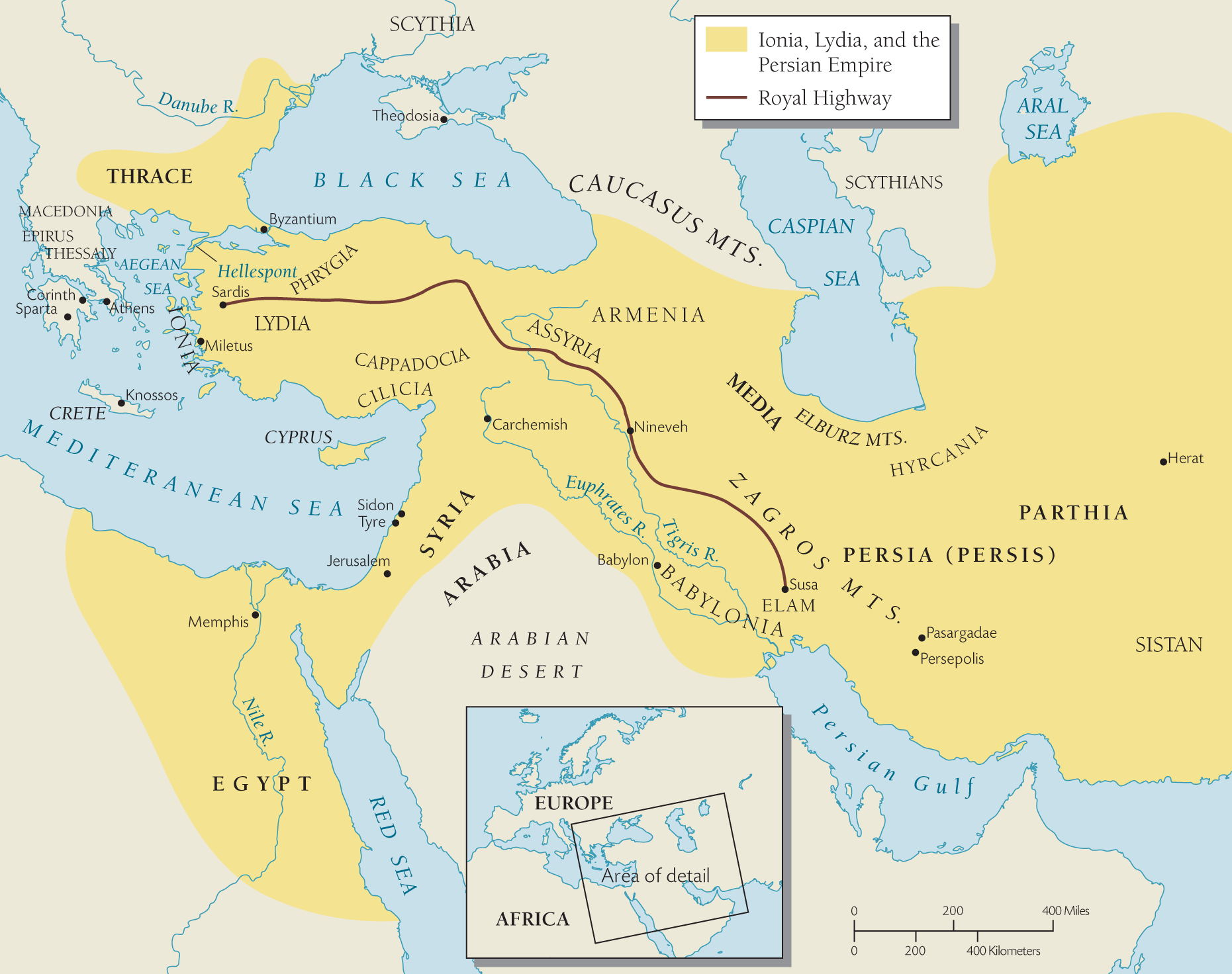
A smaller inset map shows that the area of detail in the larger map is centered on modern-day Saudi Arabia, and includes parts of southern Europe and northeastern Africa. It included the areas of Thrace, Phrygia, Lydia, Cappadocia, Cilicia, Assyria, Armenia, Media, the Elburz Mountains, Hyrcania, Parthia, Persia or Persis, Sistan, the Zagros Mountains, Elam, Babylonia, Syria, and Egypt. The Royal Highway connected the cities of Sardis and Susa, going through the city of Nineveh. Some other major cities plotted are Byzantium, Miletus, Sidon, Tyre, Jerusalem, Memphis, Carchemish, Babylon, Pasargadae, Persepolis, and Herat.
The Spartans rejected innovation. They styled themselves as the protectors of the “traditional customs” of Greece, by which they meant aristocratic dominance and a strict observance of older heroic ideals. In this role, Sparta tried to prevent the establishment of tyrannies in neighboring states and moved to overthrow them when they arose: hence their willing intervention in the affairs of Athens under the Peisistratids. Indeed, Sparta’s stern defense of tradition made it an object of admiration throughout the Greek world, even though few Greeks had any desire to live as the Spartans did.
The most fatal flaw in the Spartan system was demographic. There were many ways to fall from the status of Spartiate, but the only way to become one was by birth—and the Spartan birthrate simply could not keep pace with the demand for trained warriors. As a result, the number of full Spartiates declined from perhaps as many as 10,000 in the seventh century to only about 1,000 by the middle of the fourth century B.C.E. Another flaw is historical: because the Spartans placed little value on the written record of their traditions, almost everything we know about them (including the summary offered here) must be gleaned from the negative propaganda of their Athenian rivals.
Miletus and the Ionian Revolution in Thought
Across the Aegean from the Greek mainland lay the Greek cities of Ionia, located on a narrow strip of the Anatolian coast. Long a part of the Greek world (see Analyzing Primary Sources on page 55), it had also been shaped by Mesopotamian and Egyptian influences. It was therefore a crucible of hybrid cultures that produced important art forms and modes of thought.
The relationship between the Ionian Greeks and the interior kingdom of Lydia—which, like Ionia, was absorbed into the Persian Empire in the sixth century (Chapter 2)—was fraught. It was through the Ionians that the Lydian invention of coinage was introduced to the Greek world, where it revolutionized trade by making wealth portable while also introducing a host of new philosophical and ethical problems. The Ionians, in turn, played a crucial role in Hellenizing western Asia while insisting on their independence. Ultimately, the major poleis of Ionia banded together to form the Ionian League, a political and cultural confederation. This was the first such organization known in the Greek world, and its aim was to insulate Ionian Greeks from the growing power of the Persians.
The Milesians founded many colonies, especially in and around the Black Sea. They were also active in Egypt, where the main Greek trading outposts were Milesian foundations. These colonial efforts, combined with its advantageous position for trade with the rest of Asia, brought Miletus extraordinary wealth. At the same time, it also became a center for speculative thinking, what the Greeks called philosophia (“love of wisdom”). Beginning in the sixth century B.C.E., a series of intellectuals now known as the pre-Socratics—because they came before the great philosopher Socrates—raised new and vital questions about the relationship between the natural world (the kosmos), the gods, and men. And often, their explanations moved the direct influence of the gods to the margins or removed it altogether, something that other Greeks regarded as blasphemous. For example, Milesian philosophers built on older traditions of learning, such as Babylonian mathematics and astronomy, but complicated many older conclusions. They sought physical explanations for the movements of the heavens and did not presume that heavenly bodies were divine. By making human observation the starting point for their knowledge, they began to formulate more scientific explanations for the workings of the universe.
Stimulated by the cultural diversity of their city, Milesian philosophers also began to rethink their place in the cosmos. Hecataeus (heck-ah-TAY-us) criticized his contemporaries’ unquestioning acceptance of a narrow worldview; and he set out to expand their horizons by mapping the world, traveling extensively, and studying the customs and beliefs of other cultures. Xenophanes (zee-NOFF-uh-nees) posited that all human knowledge is relative and conditioned by human experience: he observed that the Thracians (people living north of Greece) believed that the gods had blue eyes and red hair, just as the Thracians themselves did, whereas Ethiopians portrayed the gods as dark skinned and curly haired, as they were. He concluded that human beings always make gods in their own image, not the other way around. If horses could fashion images of the gods, Xenophanes argued, the gods would look like horses.
These and other theories formed a distinctive strand in Greek philosophy, yet they would continue to be regarded as disturbing and dangerous—dangerous enough to warrant the later execution of Socrates in Athens, where the struggle between religion and philosophy would ultimately be fought more than a hundred years after Xenophanes’ bold proclamation. By that time, the Persian conquest of Lydia had made Miletus and its sister cities subject to that great empire. Indeed, Ionian resistance to Persian rule triggered the greatest clash the Greek world had yet known.
Glossary
- Athens
- Athens emerged as the Greek polis with the most markedly democratic form of government through a series of political struggles during the sixth century B.C.E. After its key role in the defeat of two invading Persian forces, Athens became the preeminent naval power of ancient Greece and the exemplar of Greek culture. But it antagonized many other poleis, and became embroiled in a war with Sparta and its allies in 431 B.C.E. Called the Peloponnesian War, this bloody conflict lasted until Athens was defeated in 404 B.C.E.
- Sparta
- Around 650 B.C.E., after the suppression of a slave revolt, Spartan rulers militarized their society in order to prevent future rebellions and to protect Sparta’s superior position in Greece, orienting their society toward the maintenance of their army. Sparta briefly joined forces with Athens and other poleis in the second war with Persia in 480–479 B.C.E., but these two rivals ultimately fell out again in 431 B.C.E. when Sparta and its Peloponnesian allies went to war against Athens and its allies. This bloody conflict lasted until Athens was defeated in 404 B.C.E., after Sparta received military aid from the Persians.
- Miletus
- A Greek polis and Persian colony on the Ionian coast of Asia Minor. Influenced by the cultures of Mesopotamia, Egypt, and Lydia, it produced several of the ancient world’s first scientists and sophists. Thereafter, a political conflict between the ruler of Miletus, Aristagoras, and the Persian emperor, Darius, sparked the Persian Wars with Greece.