Like Hesiod, many ancient Greek poets described a heroic age when great men mingled with gods and powerful kingdoms contended for wealth and glory. For a long time, modern scholars dismissed these stories as fables. Tales of the Athenian hero Theseus and the Minotaur, the Trojan War, and the wanderings of Odysseus were not regarded as reflecting any historical reality. Greek history was assumed to begin in 776 B.C.E., when the first recorded Olympic Games occurred. Greece in the Bronze Age was considered a primitive backwater that played no significant role in the Mediterranean world or in the later, glorious history of classical Greece.
But in the late nineteenth century, an amateur archaeologist named Heinrich Schliemann became convinced that these legends were really historical accounts. Using the epic poems of the Iliad and The Odyssey by Homer as his guide, he found the site of Ilium (Troy) near the coast of northwest Anatolia. He also identified a number of once-powerful citadels on the Greek mainland, including the home of the legendary King Agamemnon at Mycenae (MY-seh-nee).
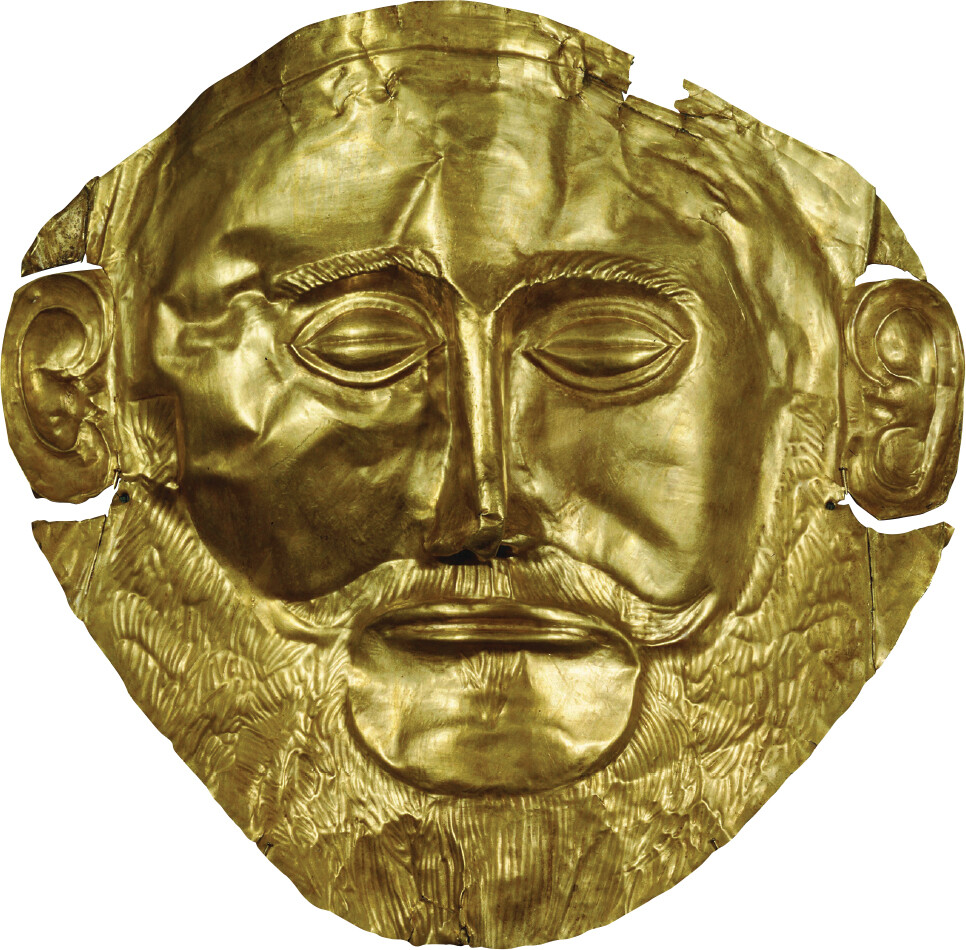
MYCENAEAN DEATH MASK, c. 1550–1500 B.C.E. When the archaeologist Heinrich Schliemann discovered this gold funeral mask in a burial shaft at Mycenae, he immediately declared it to be that of Agamemnon. Although it is certainly royal, this mask is too old to have been made for that legendary king, who lived several centuries later.
Soon afterward, the British archaeologist Sir Arthur Evans took credit for discovering the remains of a great palace at Knossos (kuh-NOHS-ohs) on the island of Crete—a vast complex that predated any of the major citadels on the Greek mainland. He dubbed its magnificent culture (which no modern person had known to exist) “Minoan Crete,” after King Minos, the powerful ruler whom the ancient Greeks had described as dominating the Aegean, and the man for whom the legendary engineer Daedalus had designed the Labyrinth.
Although some of their conclusions have been proven false, the discoveries of Schliemann and Evans forced scholars to revise, entirely, the early history of Western civilizations. It is now clear that Bronze Age Greece—or, as it is often termed, Mycenaean Greece—was an important player in this integrated Mediterranean world during the second millennium B.C.E.
The Minoan Thalassocracy
In the fifth century B.C.E., the Athenian historian Thucydides wrote that King Minos of Crete had ruled a thalassocracy, an empire of the sea. We now know that Thucydides was correct and that a very wealthy civilization began to flourish on the island of Crete around 2500 B.C.E. Thereafter, for about a millennium, the Minoans controlled shipping around the central Mediterranean and the Aegean, and may have exacted tribute from many smaller islands. At its height between 1900 and 1500 B.C.E., Minoan civilization was the contemporary of Egypt’s Middle Kingdom and the Hittite Old Kingdom. But unlike them, it was virtually unassailable by outside forces, protected by the surrounding sea. Astonishingly, neither the great palace at Knossos nor the other palaces on the island were fortified, so secure were they from attack.
Thanks to its strategic position, Crete was not only a safe haven but a nexus of vibrant economic exchange. In this it resembled its counterparts on the mainland because it acted as a magnet for the collection of resources, which were then redistributed by its rulers and their emissaries. Knossos was also a production center for textiles, pottery, and metalwork. Minoan merchants traded these with Egypt, southwest Anatolia, and Cyprus for a range of exotic goods. Through Cyprus, the Minoans had further contacts with the Levantine coast. Artistic influences also traveled along these routes; among much else, Minoan-style fresco paintings from this period appear regularly in the Nile Delta and the Levant.
More information
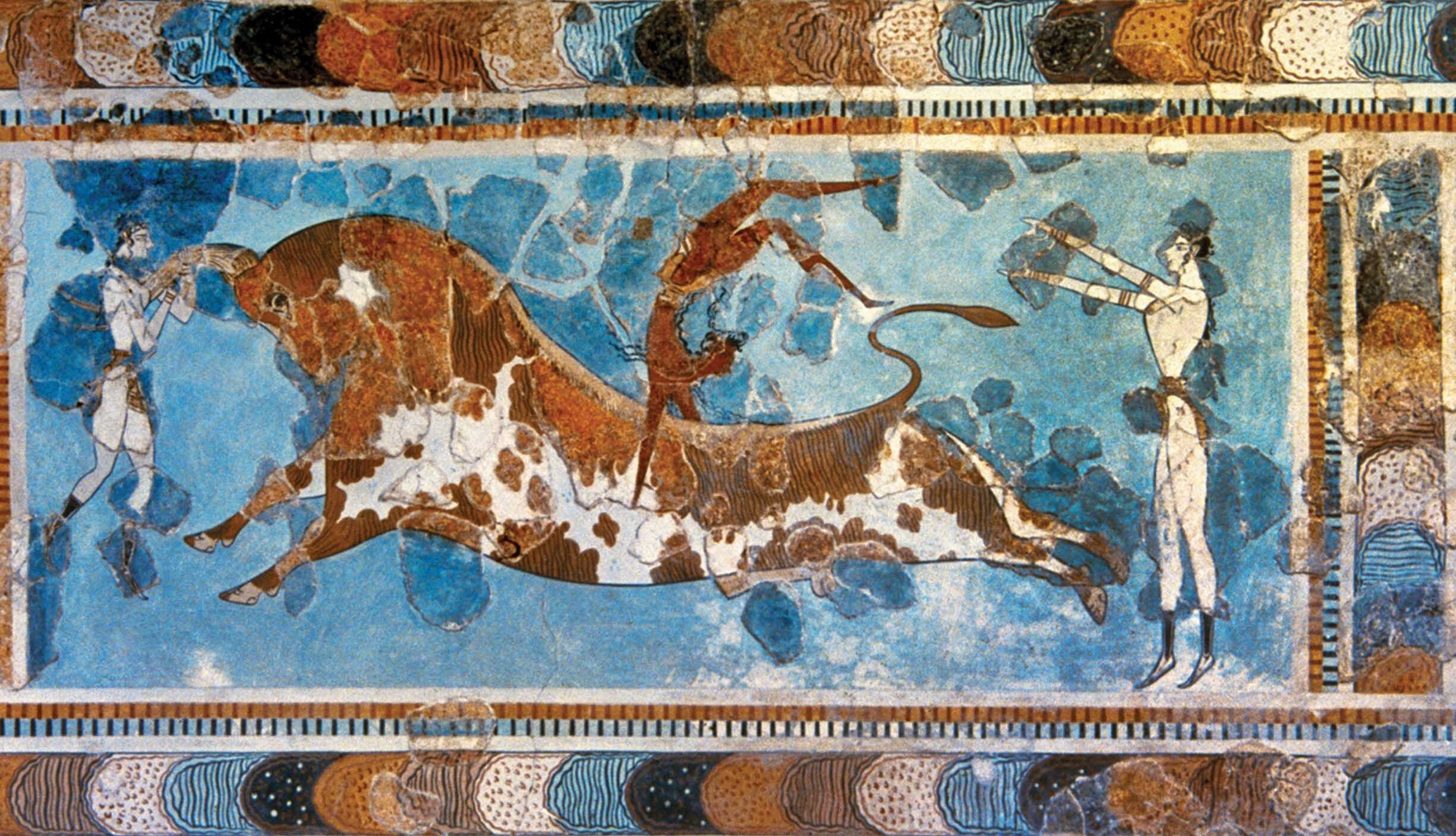
The first man directly faces the bull grabbing the bull by its horns. The second man is upside down with his front facing the bull’s head on top of the bull. The third man faces the back of the bull and has his arms extended in front of him.
MINOAN FRESCO, c. 1500 B.C.E. A stylized representation of bull-leaping, painted into the plaster of a wall at Knossos. ■ Is this fresco likely to represent real practices? ■ Why or why not?
Traces of the bright colors and graceful lines of these paintings are still evident on the ruined walls of the palace at Knossos. Enhanced with indoor plumbing, among other luxuries, it covered several acres and comprised hundreds of rooms joined by an intricate web of winding hallways that surely inspired the story of the Labyrinth, at the center of which lurked the terrible Minotaur, half man and half bull. These legends, too, reflect historical evidence: the Minoans probably worshiped a god in the form of a bull, and they appear to have devised an elaborate ritual sport known as bull-leaping, which is similar to bullfighting but involving an element of athletic dance. There is also some evidence that they practiced human sacrifice (possibly facilitated by the dangers of bull-dancing) as a religious rite.
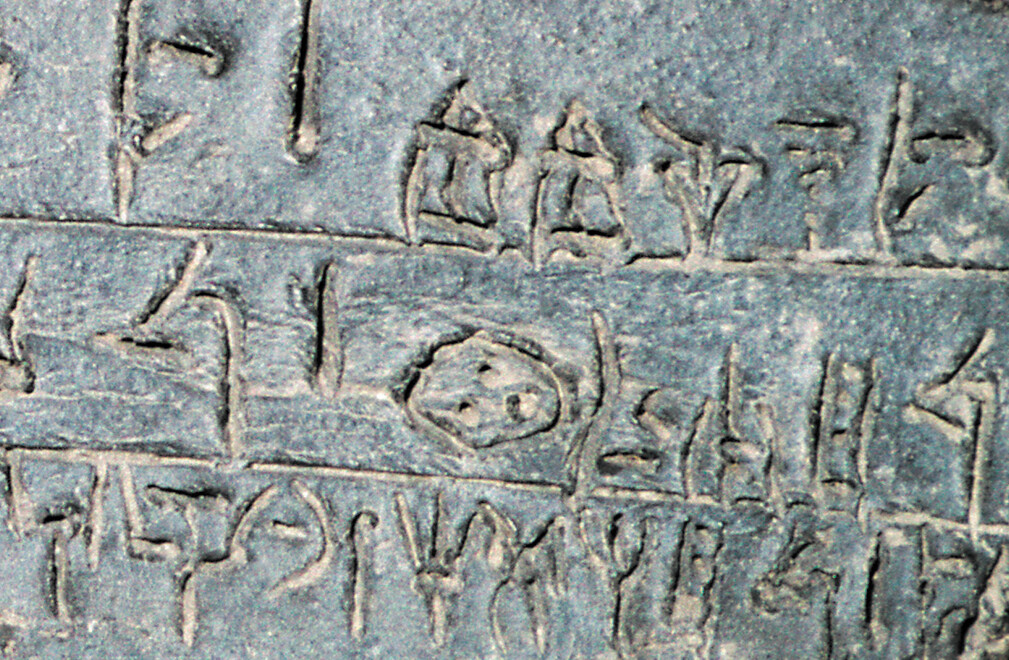
Despite all these fascinating remains, Minoan culture maintains its mystery because its language has yet to be decoded. Minoan script is called Linear A, to distinguish it from Linear B, used in Mycenaean Greece—a script that has been deciphered. Although Linear A and Linear B represent different languages, the formal relationship between them reflects the close ties between Minoan Crete and the mainland of Greece. Yet the nature of that relationship is still debated. The Minoans were clearly much more sophisticated and originally may have dominated their Greek neighbors. One story told of the Greek hero Theseus describes how the young Athenian was sent to Crete as a hostage, intending to free Athens from the heavy tribute imposed by King Minos. Given what we have already learned about the close relationship between myth and history, it is probable that this story preserves ancient memory, just as the story of Daedalus, the brilliant inventor and engineer, is an attempt to explain the technological marvels of the palace at Knossos.
Mycenaean Greece
In the early 1950s, the English researchers Michael Ventris and John Chadwick joined their linguistic skills with expertise gained during the Second World War, when many classically trained scholars were employed in cracking enemy codes. Their efforts resulted in the decoding of Linear B, which proved that the history of ancient Greece stretched well back into the Bronze Age. Since then, new research shows that the Indo-Europeans whose language became Greek entered the region in several waves after the turn of the second millennium, dominating and displacing the indigenous inhabitants. The emergence of a distinctive Mycenaean (my-sen-EE-an) culture becomes evident around 1750 B.C.E.; by 1500 B.C.E., their huge citadels dotted the Greek landscape, ruled by warriors whose epitaphs boast of their martial prowess and who were buried with their weapons.
LINEAR A TABLET FROM KNOSSOS. Unlike cuneiform, whose characters are formed using the wedge-shaped tip of a reed, Linear A was inscribed with a sharp stylus that incised fine lines in clay or soft stone.
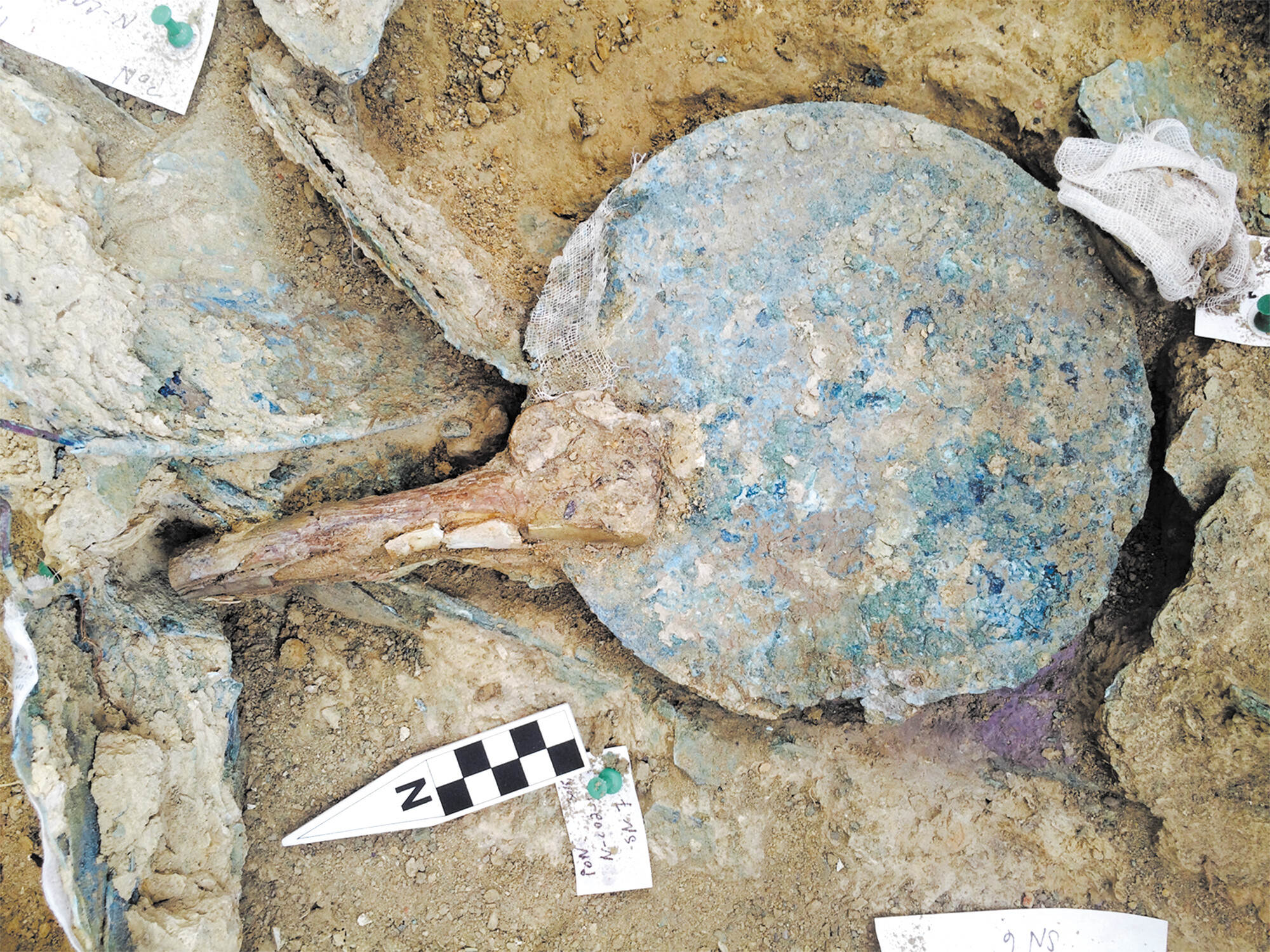
In 2015, American archaeologists excavating near one of these citadels—at Pylos in southwestern Greece, the same place where the first Linear B tablets on the Greek mainland were found—discovered an extraordinarily rich grave with all of its contents intact. Known as the tomb of the Griffin Warrior (from the decorative motifs of this mythical beast carved on an ivory plaque), it contained the body of a man in his early thirties who was buried with his sword and dagger, as well as combs, a mirror, jewelry, and other items; all were made of ivory, silver, gold, bronze, and all were beautifully fashioned.
Many of these items came from Minoan Crete, and because the tomb was dug before the building of the great palace citadel at Pylos, it allows us to glimpse the process of cultural transfer that was shaping a new civilization on the Greek mainland. Analysis of ancient DNA (aDNA) extracted from the warrior’s teeth and bones may soon yield even more information about him, while radiocarbon analysis of any surviving plant material or of the bones themselves could assist in dating the burial.
This grave, and the close relationship between the writing systems of Crete and the mainland, reveal that Mycenaean society was decisively influenced by Minoan cultural, religious, and political models. The citadels, copying the great palaces of Crete, were both centers of government and warehouses for the storage and redistribution of goods and agricultural surpluses, of which they kept careful records. (Thousands of Linear B tablets testify to this.) By the thirteenth century B.C.E., some rulers had carved out territorial kingdoms with as many as 100,000 inhabitants, dwarfing the city-states of the later classical age; Hesiod imagined their citadels to have been built by giants. Indeed, their massive size was not really suited to the Greek landscape; nor were the war chariots that the Mycenaean elites adopted from their contemporaries on the plains of Anatolia, despite the fact that they were highly impractical on the rocky Greek terrain.
THE GRAVE OF THE GRIFFIN WARRIOR AT PYLOS. The contents of this Mycenaean tomb, discovered in 2015, reveal the extent of the connections between Mycenaean Greece and Minoan Crete. This photograph shows a bronze mirror in its original location.
Gradually, the Mycenaean Greeks came to play a central role in Bronze Age networks. By about 1400 B.C.E., they had subjugated Crete, taking over Knossos and remaking it as a Mycenaean center. When the pharaoh Amenhotep III mentions a place called Keftiu in his correspondence, he is probably negotiating with Crete’s Mycenaean conquerors. In western Anatolia, not far from fabled Troy, at least one Mycenaean king exercised enough influence for a Hittite ruler to address him as “my brother.” This evidence suggests that the Mycenaeans earned prestige as warriors and mercenaries, just as the Greeks’ heroic poems attest.
The basic political and commercial unit of the Mycenaean world—a powerful king and war leader, a warrior aristocracy, a palace bureaucracy, a complex economy, large territorial kingdoms—differs markedly from the tiny, self-contained Greek city-states of the later classical age (see Chapter 3). However, we can trace some features of this later civilization back to the Mycenaeans, including the Greek language. Linear B tablets speak of a social group with considerable economic and political rights, the damos; this may be the precursor of the demos, the urban population that sought political empowerment (democracy) in many Greek cities. The tablets also introduce the names of several gods familiar from the later period, such as Zeus, Poseidon, and Dionysos. Indeed, the later Greeks believed themselves to be descended from these legendary forebears, whom they credited with superhuman achievements. Although later Greeks such as Hesiod knew little about these Mycenaean ancestors in fact, the impact of what they imagined about them was considerable.
More information
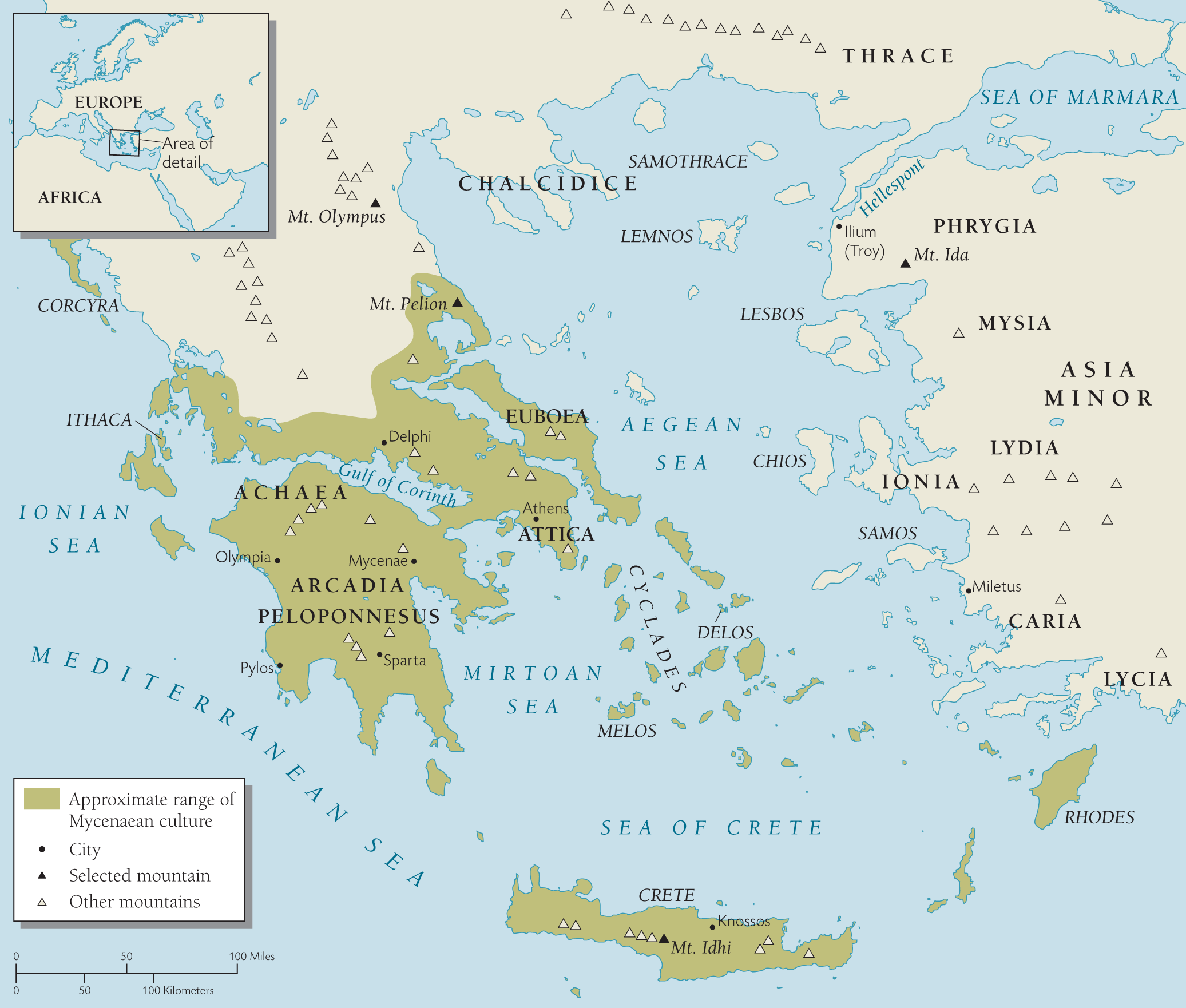
The highlighted area consists of southern Greece and many islands between the Mediterranean Sea and the Aegean Sea, and includes cities such as Knossos, Sparta, Olympia, Mycenae, Delphi, and Athens. Mountains highlighted on the map are Mount Idhi, Mount Ida, Mount Pelion, and Mount Olympus.
MYCENAEAN GREECE.■ What stands out about the geography of Greece? ■ How might this dry, mountainous country surrounded by the sea influence the nature of Greek civilization and economic interests? ■ How might geography have allowed Mycenaean culture to spread so widely?
The Sea Peoples and the End of the Bronze Age
For many years, historians have guessed that the collapse of Mycenaean civilization was caused by factors such as drought, disease, and social unrest. Indeed, new climatological research shows that sustained arid conditions could have led to drought and decreased crop yields, both of which suggest famine was a serious factor. The devastating consequences are clear. Because Mycenaean Greece was an integrated part of a global network, the effects of its demise were felt throughout the region (see Analyzing Primary Sources on page 55). Thereafter, a wave of devastation swept from north to south, caused by a group of people so thoroughly destructive that they obliterated everything in their path.
We might know nothing at all about them were it not for a narrow victory by the pharaoh Ramses III around 1176 B.C.E. In the monument set up to commemorate his triumph, near the modern city of Luxor on Egypt’s West Bank, Ramses III referred to these invaders as the Sea Peoples and named several groups as parts of a coalition. Some were familiar to the Egyptians, who had employed them as mercenaries. From Ramses’ description of their battle gear, as well as recent archaeological discoveries, it seems that many were from the Aegean, and their war-bands could have included refugees from the collapsing civilization of Mycenaean Greece. Most notable were the Philistines who, after their defeat, withdrew to populate the coast of the region now named after them: Palestine. In 2018, another inscription describing the Sea Peoples was finally deciphered and indicates that one member of the Sea Peoples’ confederation was a powerful new kingdom called Mira, which had begun its rise by conquering Troy.
Analyzing Primary Sources
The Diplomacy of the Mycenaeans and the Hittites
Around 1260 B.C.E., the powerful Hittite king Hattusilis III sent the following letter to a “King of Ahhiyawa, ” identifiable as a leader of the Mycenaean Greeks, who often called themselves Akhaiwoi, or Achaeans. This fascinating document exemplifies the tangle of close ties that bound powerful men together within the networks of the Late Bronze Age, as well as the problems and misunderstandings that could arise from the misbehavior of the men under their command. The events referenced here all occurred in western Anatolia (Turkey), a region controlled partly by the Hittites and partly by the Greeks, the same region in which Troy (Ilium) was located. (See the map on page 54.)
I have to complain of the insolent and treacherous conduct of one Tawagalawas. We came into contact in the land of Lycia, and he offered to become a vassal of the Hittite Empire. I agreed, and sent an officer of most exalted rank to conduct him to my presence. He had the audacity to complain that the officer’s rank was not exalted enough; he insulted my ambassador in public, and demanded that he be declared vassal-king there and then, without the formality of an interview. Very well: I order him, if he desires to become a vassal of mine, to make sure that no troops of his are found in Iyalanda when I arrive there. And what do I find when I arrive in Iyalanda?—the troops of Tawagalawas, fighting on the side of my enemies. I defeat them, take many prisoners . . . scrupulously leaving the fortress of Atriya intact out of respect for my treaty with you. Now a Hittite subject, Piyamaradus by name, steals my 7,000 prisoners, and makes off to your city of Miletus. I command him to return to me: he disobeys. I write to you: you send a surly message unaccompanied by gift or greeting, to say that you have ordered your representative in Miletus, a certain Atpas, to deliver up Piyamaradus. Nothing happens, so I go fetch him. I enter your city of Miletus, for I have something to say to Piyamaradus, and it would be well that your subjects there should hear me say it. But my visit is not a success. I ask for Tawagalawas: he is not at home. I should like to see Piyamaradus: he has gone to sea. You refer me to your representative Atpas: I find that both he and his brother are married to daughters of Piyamaradus; they are not likely to give me satisfaction or to give you an unbiased account of these transactions. . . . Are you aware, and is it with your blessing, that Piyamaradus is going round saying that he intends to leave his wife and family, and incidentally my 7,000 prisoners, under your protection while he makes continual inroads on my dominion? . . . Do not let him use Achaea [in Greece] as a base for operations against me. You and I are friends. There has been no quarrel between us since we came to terms in the matter of Ilios [the territory of Troy]: the trouble there was my fault, and I promise it will not happen again. As for my military occupation of Miletus, please regard it as a friendly visit. . . . [As for the problems between us], I suggest that the fault may not lie with ourselves but with our messengers; let us bring them to trial, cut off their heads, mutilate their bodies, and live henceforth in perfect friendship.
Source: Adapted from Denys Page, History and the Homeric Iliad (Berkeley: 1959), pp. 11–12.
Questions for Analysis
Reconstruct the relationship between Hattusilis III and the Achaean king, on the basis of the references to people and places in this letter. What picture emerges of their interactions and of the connections between the Hittite Empire and Mycenaean Greece?
Why is Hattusilis so concerned about the disrespect that the Achaeans have shown to him? Reading between the lines, what do you think he wanted to accomplish by sending this letter?
On the basis of this letter, what can you deduce about the standards of behavior expected of civilized participants in the cultural and political networks of the Late Bronze Age? Within this code of conduct, what sanctions or penalties could be imposed on individuals or their nations?
This recent evidence lends weight to older hypotheses that the Sea Peoples’ arc of destruction began in the northern Aegean and was one of the factors contributing to the collapse of Mycenaean Greece. Disruption of northern commercial networks would have devastated the Mycenaean kingdoms, which could not support their enormous populations without trade. Suddenly faced with an apocalyptic combination of overpopulation, famine, and violence, bands of desperate refugees would have fled the Aegean basin. Meanwhile, the damage to commerce had a domino effect and devastated the economy of the Hittites, whose ancient kingdom rapidly disintegrated. Along the Mediterranean coast we find other clues. The king of Ugarit wrote a letter to a “brother” king on the island of Cyprus, begging for immediate aid because he had sent all his own warriors to help the Hittites. It is poignant, however, that we have his letter only because the clay tablet on which it was written baked hard in the fire that destroyed his palace. The letter was never sent.
The desperation of refugees fleeing famine and violence, combined with the raids of the Sea Peoples, destroyed the Western civilizations that had flourished for more than 2,000 years (see Past and Present on page 59). The devastation was not total; not all the cities disappeared, and trade did not cease entirely. But the Hittite Empire was eradicated, leaving behind it many weak, short-lived principalities. The great cosmopolitan cities of the eastern Mediterranean lay in ruins, and new groups—sometimes contingents of Sea Peoples like the Philistines—populated the coast. The citadels of Mycenaean Greece were depopulated by as much as 90 percent over the next century, and Greece entered into a period of cultural and economic isolation that would last for 250 years.
The victorious Egyptians survived; but with their major trading partners diminished or dead, their civilization suffered. The Assyrians, the original architects of the networks that had undergirded the interconnected civilizations of the Bronze Age system, had to fight for their very existence. In Babylon, the peaceful and prosperous rule of the Kassites withered. In the vacuum left behind, new political configurations took shape, and a new metallurgical technology began to supplant the use of bronze. Out of the ashes arose the phoenix of the Iron Age.
A sea empire based at Knossos on the Greek island of Crete and named for the legendary King Minos. The Minoans dominated the Aegean for much of the second millennium B.C.E.
(1600–1200 B.C.E.) The term used to describe the civilization of Greece during the late Bronze Age, when territorial kingdoms such as Mycenae formed around a king, a warrior caste, and a palace bureaucracy.