 New Empires and Kingdoms That Emerged in the Iron Age
THE STATES OF THE EARLY IRON AGE
With the fraying of Bronze Age networks, the geopolitical map of the ancient world changed significantly. In Anatolia, a patchwork of small kingdoms grew up within the vast territories once controlled by the Hittites. Similar developments took place in the Levant, the eastern Mediterranean coastline that today comprises Palestine, Israel, Jordan, Lebanon, and parts of Syria and Turkey. For centuries, this region had been controlled successively by the Hittites, the Semitic peoples who had migrated there, or Egyptians. With the collapse of these empires, new states began to emerge there, too. They were relatively small, but they had a huge impact on the history of Western civilizations.
The Phoenicians
The most influential people of this period are usually called by their Greek name: the Phoenicians. They spoke a Semitic language and were extraordinarily talented brokers of communication, information, technology, and commerce. These traits, however, seem to be all that they had in common: recent research reveals they did not share a cultural identity. The Phoenicians favored the establishment of small, independent cities on the Levantine coast, each with its own form of government, religion, and social structures. As they began to establish a web of profitable and powerful colonies throughout the Mediterranean, new types of political systems emerged that would become models for many other Western societies, including those of classical Greece and Rome (see Chapters 3 and 5).
During the Late Bronze Age, most Phoenician cities had been controlled by Egypt. But the erosion of Egyptian imperial power after 1200 B.C.E. gave them the opportunity to strengthen their autonomy and to capitalize on their commercial advantages, some of which were unique to each city. One of these, Byblos, was a clearinghouse for papyrus, the highly prized writing material of the ancient Mediterranean. This explains why the name for this city became the basis for the common Greek word biblion, meaning both “paper” and “book.” (The Bible is so called from the plural biblia, “books.”)
More information
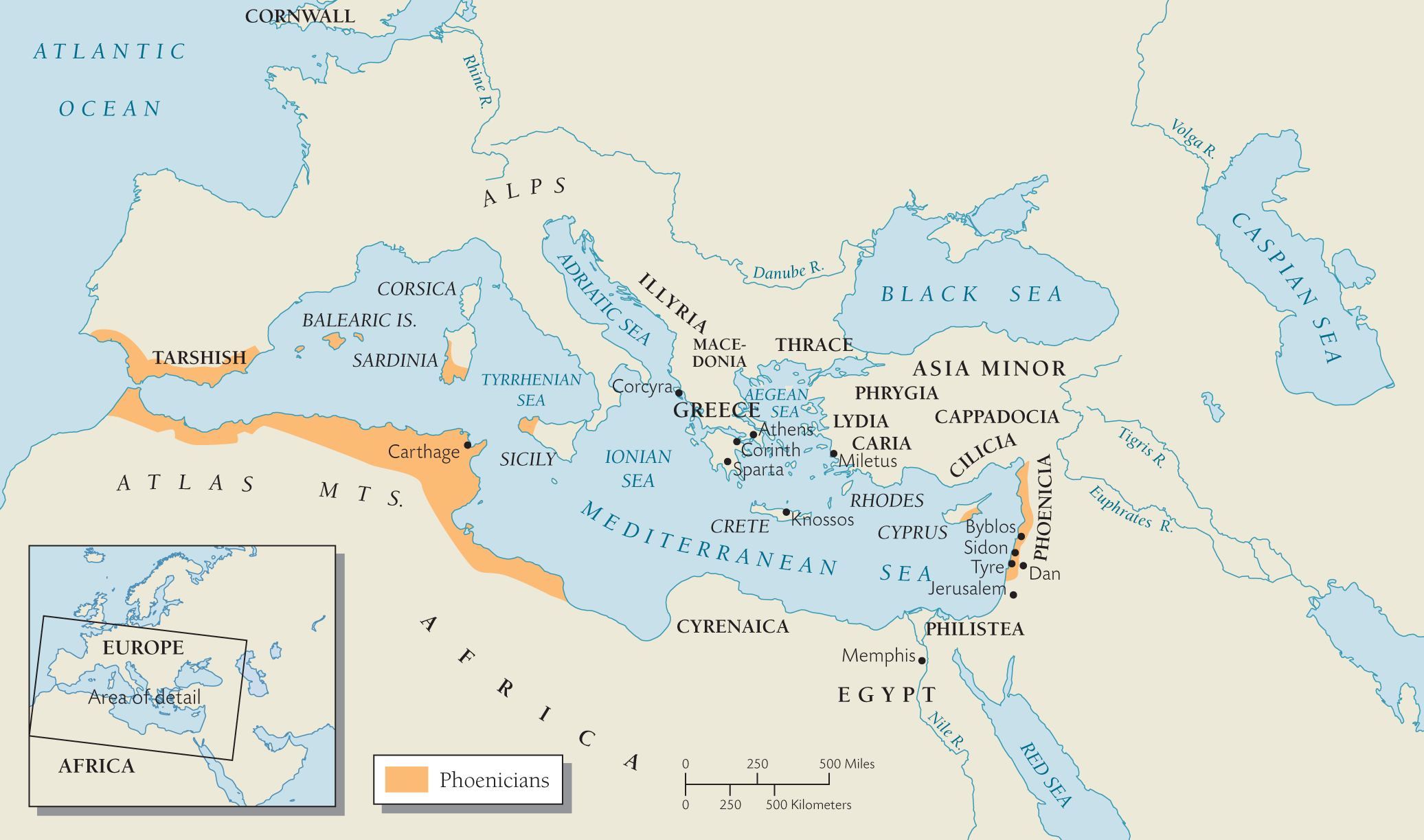
The Phoenician colonies include the western half of Africa’s north coast, southern coast of modern day Spain and Portugal, select islands in southwestern Europe, and the eastern coast of Phoenicia.
Another valuable commodity that came to be associated with the Phoenicians, and that gave them their Greek name, was a rare purple dye derived from the shells of snails culled from the seabed off the Levantine coast. As far as the Greeks were concerned, those who supplied this rich dye were Phoinikeoi, “purple people.” Phoenician textiles commanded a high price everywhere; so did timber from the Levant, especially cedar, as did glass. The Phoenicians also became expert metalworkers, ivory carvers, and shipbuilders.
Phoenician Colonies and Cultural Influence
The Phoenicians became famous as merchants and seafarers, but they were also aggressive migrants and colonists. By the end of the tenth century B.C.E., they had planted settlements from one end of the Mediterranean to the other, and their merchants had begun to venture out into the Atlantic Ocean. We have good evidence that they traveled as far as Cornwall (southwest Britain) during this period. The Greek historian Herodotus later claimed that Phoenician merchant-explorers even circumnavigated Africa. At the end of the ninth century B.C.E., Phoenicians from the city of Tyre established Carthage in modern-day Tunisia (North Africa). Carthage would ultimately become the preeminent power in the western Mediterranean; centuries later, this brought it into conflict with Rome (see Chapter 5).
The widespread colonial and mercantile efforts of the Phoenicians meant that they influenced cultures across the Mediterranean. Among their early overseas trading partners were the Greeks, and the Phoenicians may have played an important role in reintroducing urban life to Greece after the collapse of the Mycenaean citadels. They also brought with them a number of artistic and literary influences. Without question, however, the most important contribution of the Phoenicians was their alphabet.
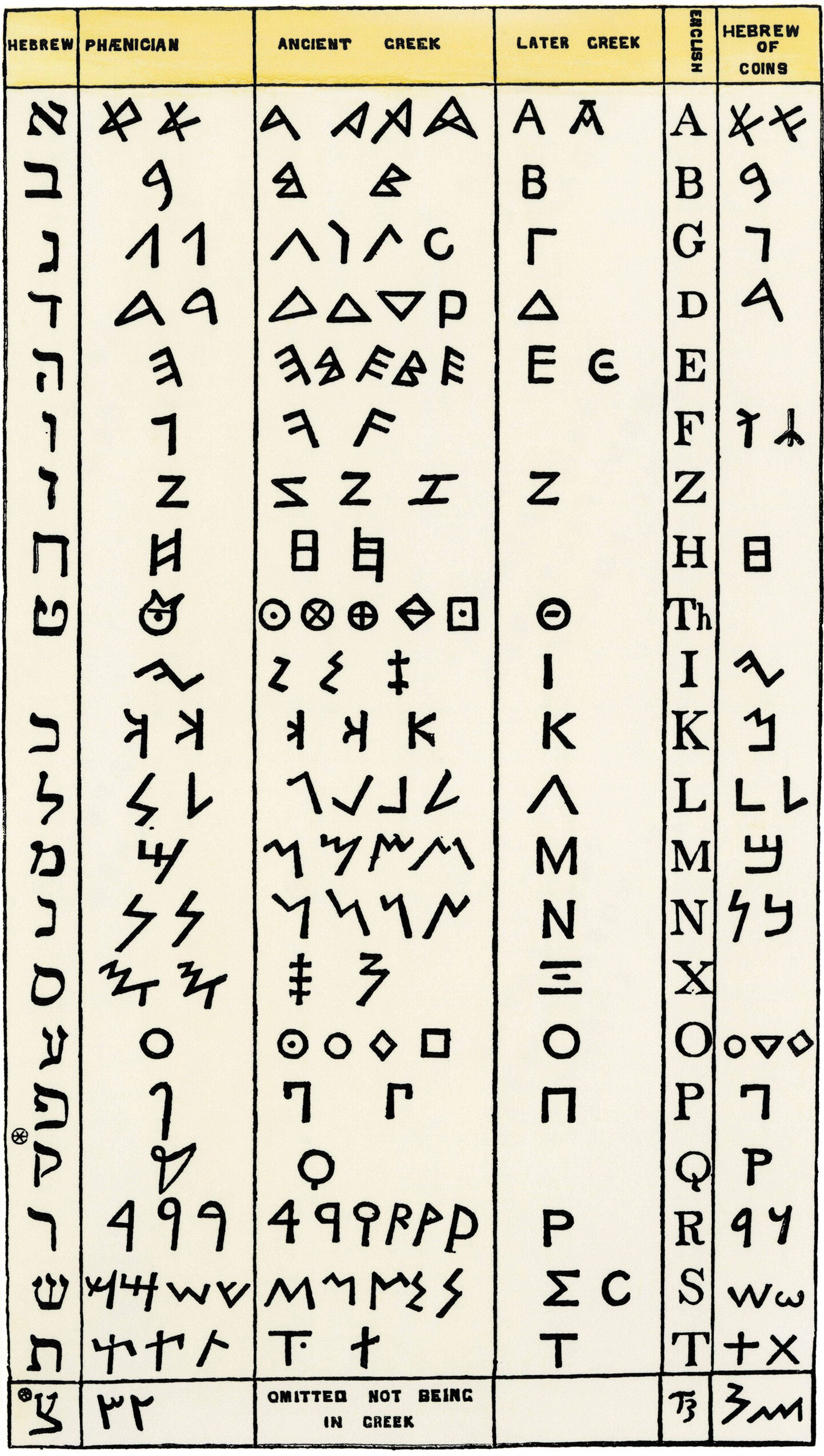
As we noted earlier, a thirty-character alphabet had evolved at Ugarit by the end of the Bronze Age. Around 1100 B.C.E., the Phoenicians refined this writing system to twenty-two characters. This simpler system further facilitated communication and accounting, and the Phoenicians may have wanted to encourage similar practices among their trading partners, to safeguard their own interests. The Greeks certainly remained aware of their debt to the Phoenicians: their legends ascribe the invention of the alphabet to Cadmus, a Phoenician who settled in Greece. Their debt is also clear in the close relationship between the names of letters in Greek (alpha, beta, gamma, delta, . . .) and Phoenician letter names (aleph, bayt, gimel, dalet, . . .), and from the obvious similarities in letter shapes.
More information
These cultures consist of Hebrew, Phoenician, ancient Greek, later Greek, and English. The table displays the alphabet of each culture.
The Philistines
Southward along the Levantine coast lay the land of the Philistines. These were descendants of the Sea Peoples who, after their defeat by Ramses III (see the map on page 61), had settled in the region known as Canaan. And in fact, much of their bad reputation is the result of their dominance over their pastoral neighbors, the herdsmen known as the Hebrews. Because the Hebrews learned to use writing as an effective political weapon, the Philistines became the great villains of the Hebrew scriptures. Accordingly, the word philistine has come to mean a boorish, uncultured person. And because the Philistines do not appear to have made use of the same powerful technology to record their own outlook on the world, almost everything we know about them comes from the work of archaeologists or has to be sifted through the bad press of their detractors.
The Philistines occupied a unique position in the Levant and retained a separate identity for several generations; each new archaeological discovery roots this identity more firmly in their Aegean past. We know little about their language, but their material culture, behavior, and organization all exhibit close affinities with Mycenaean Greece. For example, the Philistines introduced grapevines and olive trees to the Levant from the Aegean basin. With the profits from these industries, they created powerful armies that dominated the region in the twelfth and eleventh centuries B.C.E. They also established a monopoly over metal-smithing, making it virtually impossible for their enemies to forge competitive weaponry.
Philistine power was based in five great strongholds, the so-called Pentapolis (Greek for “five cities”): Gaza, Ashkelon, and Ashdod on the coast, and the inland cities of Ekron and Gath. (Again, these citadels are strikingly similar to the fortified palaces of Mycenaean civilization, and they appear to have had many of the same functions.) From these strongholds, the Philistines dominated the surrounding countryside by organizing agricultural production and controlling trade routes. An independent lord ruled over each citadel, and no doubt tensions and rivalries existed among them. But much like the heroes of Greek epic, the Philistines could set aside differences when facing a common enemy.
Because we see the Philistines primarily through the eyes of their Hebrew enemies, we must be careful about drawing conclusions about them from the stories of Goliath’s brutality or Delilah’s sexual treachery, to name the two most infamous Philistines of the Hebrew scriptures. Yet the Hebrews had good reason to fear the Philistines, whose pressure on the Hebrew hill country was constant and who threatened the Hebrews’ holy sanctuary at Shiloh, where the sacred Ark of the Covenant—said to contain the original tablets of the law given to Moses on Mount Sinai—was kept. In Hebrew tradition, the tribes of Israel had once carried the ark before them into battle against the Philistines, only to lose it in the fray and to witness thereafter the destruction of Shiloh. The Philistines then established garrisons throughout the land of the Hebrews and exacted tribute, denied them access to weapons, and engaged in the typical abuses of an occupying people.
Past and Present
The Fragility of Global Networks
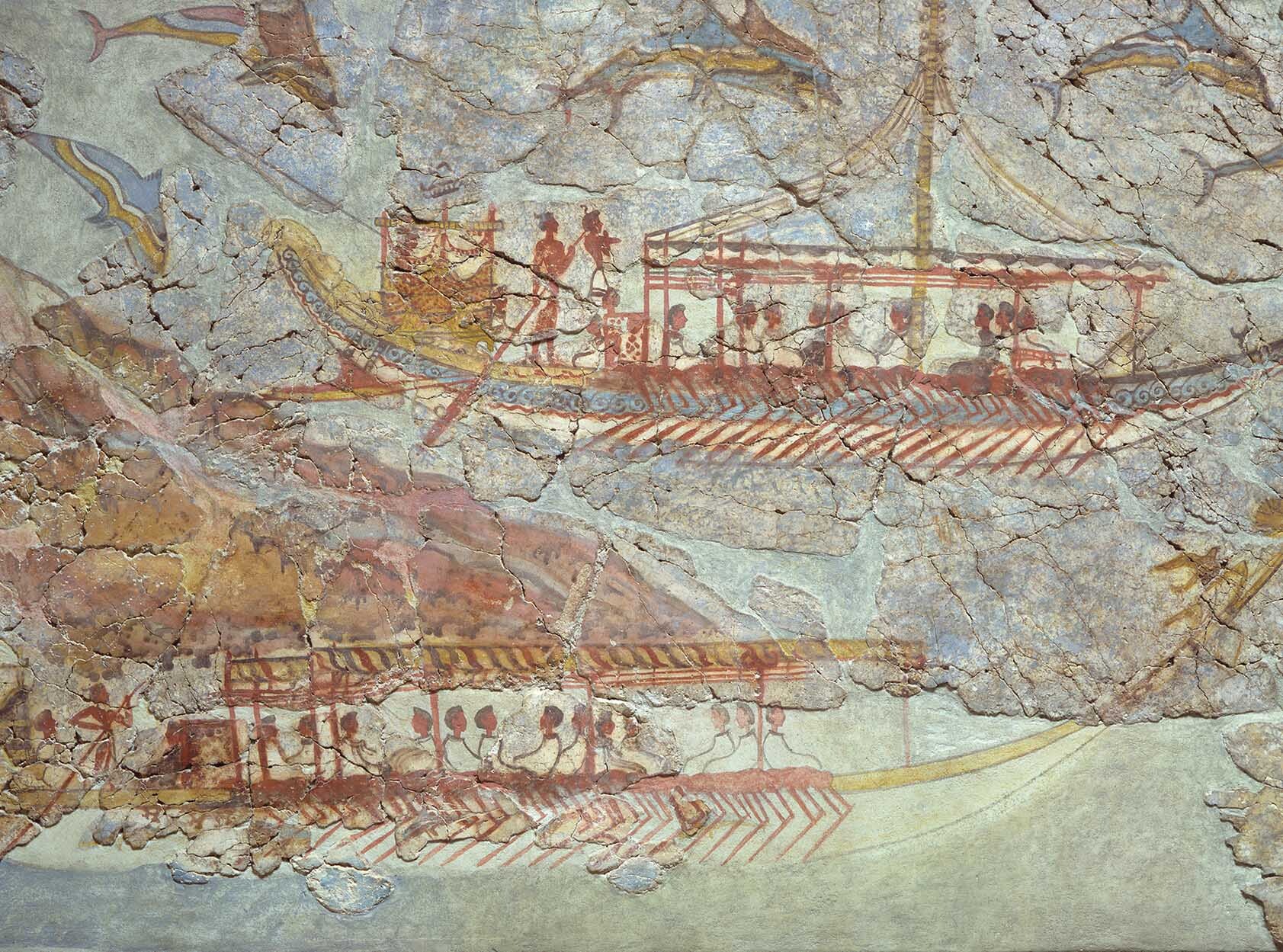

During the Late Bronze Age, the destruction of commercial networks had a domino effect on the interlocking civilizations of the West, plunging many into a “dark age” of isolation and impoverishment. The global economic crisis of 2007–2008 was caused by a similar phenomenon: the collapse of mutually dependent financial systems that proved more fragile than most observers had anticipated.
 Video: The Fragility of Global Networks
The Hebrews and Their Scriptures
The central feature of Hebrew culture, their conception of and relationship to their god, will be discussed at greater length toward the end of this chapter. In this section, we focus our attention on the development of Hebrew society in the Iron Age Levant. In reconstructing this early history, we are indebted to an unusual textual source already mentioned: a series of scriptures (literally, “writings”) that comprise mythology, laws and ritual practices, genealogical records, books of prophecy, proverbs, poetry, and royal chronicles. These are collectively known as the Hebrew Bible or (among Christians) the Old Testament.
These multiple books were composed at different times for different purposes and were only gradually assembled over many centuries, mostly by unknown authors, copyists, and editors. Some are clearly derived from ancient oral traditions; others respond to immediate challenges. Like other historical sources, then, they have to be placed in their specific individual contexts and analyzed carefully. At the same time, of course, they can be read collectively as the story of a people’s unification and religious awakening.
The first five books of the Hebrew Bible are traditionally attributed to the Hebrew leader Moses. But many of the materials in these books were borrowed from other cultures, including the stories of the creation and the flood, which parallel those of Sumer (as we saw in Chapter 1). The story of Moses’s childhood draws on a legend told about the Akkadian king Sargon the Great. The laws and rituals of the patriarchs can be found in other traditions, too. Meanwhile, the story of the exodus from Egypt is fraught with contradictions. Although the later Book of Joshua claims that the Hebrews who returned from Egypt conquered and expelled the native Canaanites, archaeological and linguistic evidence suggests that the Hebrews were essentially Canaanites themselves. They may have merged with scattered refugees from Egypt in the aftermath of the Sea Peoples’ invasions, but for the most part they had been continuously resident in Canaan for centuries. In sum, the first five books of the Bible constitute a retrospective history whose purpose was to justify Hebrew traditions and claims to territory.
Among the other writings included in the Hebrew Bible are a group of texts that record events of the more recent past, the period we are considering now. These “historical books” are more straightforwardly verifiable, even if many details are difficult to confirm. According to the Book of Judges, the Hebrews were herdsmen who had just begun to establish permanent settlements around the time of the Philistines’ arrival in the Levant. They had organized themselves into twelve tribes: extended clan units whose families owed each other mutual aid and protection in times of war, but who frequently fought over cattle and grazing rights. Each tribe was ruled by a patriarch known as a judge, who exercised the typical functions of authority in a clan-based society: war leadership, high priesthood, and dispute settlement. By the middle of the twelfth century B.C.E., these tribes occupied two major territories, with those settled in the south calling themselves the tribes of Judah, and those in the north the tribes of Israel.
The Emergence of Hebrew Kingship
The Hebrew tribes of this period had few occasions to work together as a group and little experience of organized activity. This made them highly vulnerable, especially when the Philistines conquered the Levantine coast, around 1050 B.C.E. Faced with the threat of extinction, the Hebrews appear to have put up desperate resistance from their bases in the hilly interior. To counter the Philistine threat effectively, however, they needed a leader. According to the Hebrew Bible, an influential tribal judge called Samuel selected a king to lead the tribes of Israel against the Philistines, around 1025 B.C.E. (see Analyzing Primary Sources on page 63). His name was Saul. However, Saul proved to be an ineffective warlord. Although he blocked Philistine penetration into the hill country, he could not oust the Philistines from the valleys or coastal plains.
So Samuel withdrew his support from Saul and threw it behind a young man in Saul’s entourage, Saul’s son-in-law, David, a warrior from Judah. Waging his own independent military campaigns, the scriptures record that David achieved one triumph after another over the Philistines. By contrast, the armies of Saul had met frequent reversals—that is, according to the chroniclers responsible for the historical books of the Bible, who may have written their accounts under David’s patronage.
These same books reveal that David was not initially motivated by tribal loyalties or religious piety. He was a man on the make: an outlaw on the fringes of Hebrew society and a mercenary in Philistine service. It was as a Philistine mercenary, in fact, that David is said to have fought against Saul in the climactic battle in which Saul was killed. Soon thereafter, the scriptures claim that David himself became king, first over the tribes of Judah, his home territory, and later over Saul’s territory of Israel as well.
The Consolidation of a Hebrew Kingdom
After David’s victory around 1000 B.C.E., the histories of the Hebrew Bible describe how he strove to strengthen his authority within and beyond his kingdom. He took advantage of the opportunity afforded by Egypt’s decline to expand his territory southward, eventually confining the Philistines to an inconsequential strip of coastal land. David also defeated the neighboring Moabites and Ammonites, extending his control to the Dead Sea. By the time of his death, dated 973 B.C.E., Hebrew historians claimed that his kingdom stretched from the middle Euphrates in the north to the Gulf of Aqaba in the south, and from the Mediterranean coast eastward into the Syrian deserts. If this is true, Israel had become a force to be reckoned with, although it partly owed that status to the temporary weakness of its imperial neighbors, Egypt and Assyria.
As David’s power and prestige grew, even the books that celebrate his achievements reveal that he imposed a highly unpopular system of taxation and forced labor on his subjects. His goal was to build a glorious capital at Jerusalem, a Canaanite settlement that he designated as the central city of his realm. It was a shrewd choice: as a newly conquered city, Jerusalem had no previous affiliation with any of Israel’s twelve tribes and so stood outside the ancient rivalries that divided them. Jerusalem was also a geographically strategic choice, lying between the southern tribe of Judah (David’s people) and the more powerful northern tribes of Israel.
David took steps to exalt the city as a religious center by making Jerusalem the resting place of the sacred Ark of the Covenant and elevating the priesthood of the Hebrew god, Yahweh. By these measures, he sought to forge a new collective identity centered on his own family and its connections to Yahweh. To this end, he may also have encouraged the writing of histories and prophecies that would affirm this identity and his central role in forging it. In any case, there is still no evidence from archaeology or from another independent textual tradition, to verify that David existed—or that, if he existed, he was anything more than a charismatic tribal leader.
The Reign of King Solomon (973–937 B.C.E.)
In these same Hebrew histories, David’s son Solomon is represented as continuing his father’s policies, but on a much grander scale. His chief initiative was to build the great Temple complex at Jerusalem to house the Ark. Such visible support of Yahweh’s cult was clearly approved by the chroniclers whose works are included in the Bible, and who portray Solomon’s reign as a golden age.
Despite his proverbial wisdom, however, the scriptures acknowledge that Solomon could be a ruthless and often brutal ruler whose promotion of Yahweh coincided with a program of despotism. According to these histories, Solomon kept an enormous harem of some 300 wives and 700 concubines, many of them drawn from subject or allied peoples. His palace complex—of which the Temple was a part—allowed him to rule in the grand style of ancient Mesopotamian potentates. To finance his expensive tastes and programs, Solomon instituted oppressive taxation and imposed customs duties on the lucrative caravan trade that passed through his country. With the help of the Phoenician king of Tyre, Solomon constructed a commercial fleet whose ships plied the waters of the Red Sea and beyond, trading—among other commodities—the gold and copper mined by Solomon’s enslaved laborers.
This new wealth was bought at a high price. Solomon maintained a large standing army of unwilling conscripts from his own people, equipped with chariot and cavalry squadrons and powered by horses purchased abroad. To undertake his ambitious building projects, Solomon also required many of his subjects to perform forced labor four months out of every year. This level of oppression was too much for many Israelites, and the northern tribes seethed with rebellion against the royal capital.
More information
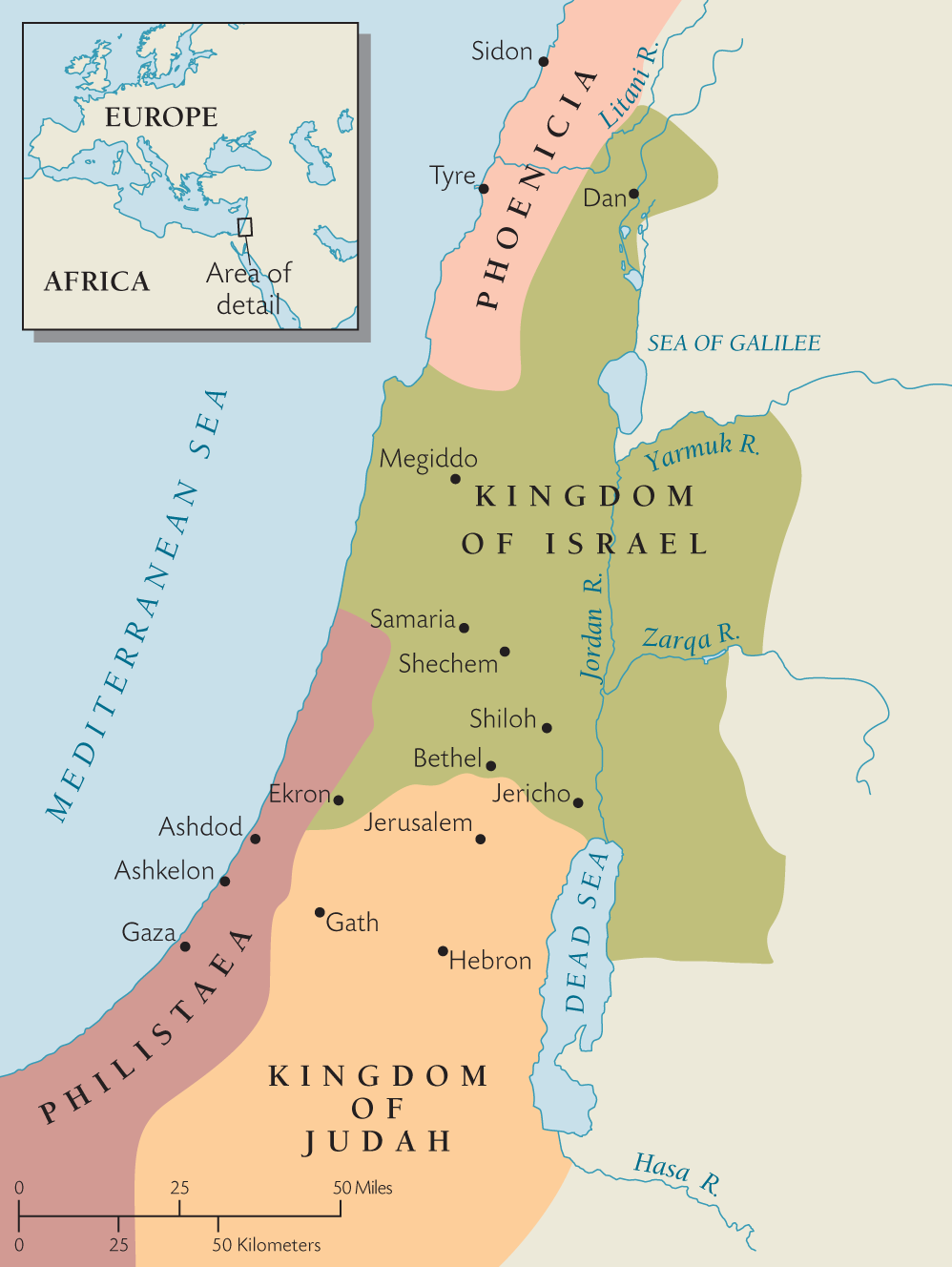
The southern portion of the coastline was Philistaea and included the cities of Gaza, Ashkelon, and Ashdod. Further inland reaching the Dead Sea was the Kingdom of Judah, comprising cities such as Jerusalem, Gath, and Hebron. The Kingdom of Israel occupied the central region spanning the coastline to the east of the Dead Sea in some parts. Jericho, Bethel, Shiloh, Shechem, Samaria, Ekron, Megiddo, and Dan were cities in the Kingdom of Israel. Along the northern coastline of this region was the Phoenicia, including the cities of Tyre and Sidon.
Within a decade or so of Solomon’s death, this fragile monarchy split in two. The dynasty descended from David continued to rule the southern kingdom of Judah with its capital at Jerusalem, but the ten northern tribes banded together as the kingdom of Israel, with their capital at Shechem. Archaeology, combined with accounts in the Bible, reveal that the cult of Yahweh was not yet dominant in either the north or the south, so major religious differences made reconciliation or unification even more difficult. In the meantime, the changing political situation of the larger region made the Hebrew kingdoms increasingly vulnerable.
Glossary
- Phoenicians
- A Semitic people known for their trade in exotic purple dyes and other luxury goods, they originally settled in present-day Lebanon around 1200 B.C.E. and from there established commercial colonies throughout the Mediterranean, notably Carthage.
- Philistines
- Descendants of the Sea Peoples who fled to the region that now bears their name, Palestine, after their defeat at the hands of the pharaoh Ramses III. They dominated their neighbors the Hebrews, who used writing as an effective means of discrediting them. (The Philistines themselves did not leave a written record to contest the Hebrews’ views.)
- Hebrews
-
Originally a pastoral people divided among several tribes, they were briefly united under the rule of David and his son, Solomon, who promoted the worship of a single god, Yahweh, and constructed the first temple at the new capital city of Jerusalem. After Solomon’s death, the Hebrew tribes were divided between the two kingdoms of Israel and Judah, which were eventually conquered by the Neo-Assyrian and Chaldean empires. It was in captivity that the Hebrews came to define themselves through worship of Yahweh and to develop a religion, Judaism, that could exist outside of Judea. They were liberated by the Persian king Cyrus the Great in 539 B.C.E.