“THE GREATEST WAR IN HISTORY” AND ITS CONSEQUENCES
In more ways than one, then, Athenian freedom rested on the servitude of others. In addition to its reliance on enslaved labor, Athens relied on allies in the Delian League to provide the resources that supported Athenian greatness. Without the surplus wealth flowing in, none of the projects Pericles undertook—pay for political participation, massive building projects, the patronage of Athenian drama—would have been possible. And ultimately, Athens’ foreign policy and imperial ambitions undermined these achievements.
Since the 470s, as we noted previously, Athens had begun crushing those allies who attempted to break from its control. By the early 440s, its only rival for supremacy in the Greek world was Sparta. Rather than attempting to maintain a balance of power, however, Pericles determined on a more aggressive policy: he made formal peace with Persia to ensure that available military resources would be directed toward any future Spartan opposition. But this undermined the sole purpose of the Delian League, which had been the defense of Greece against Persian aggression. Athens now had no justification for compelling the league members to maintain their allegiance. Many remained loyal nonetheless, paying their contributions and enjoying the economic benefits of warm relations with Athens. Others, however, did not, and Athens found itself increasingly having to force its reluctant allies back into line, often installing Athenian garrisons and planting Athenian colonists—who retained their Athenian citizenship—to ensure continued loyalty.
In the context of recent history and long-standing Greek values, such behavior was disturbing. The Delian League had been established to preserve Greek independence. Now Athens itself was becoming an oppressive, imperial power. Foremost among its critics were the Corinthians, whose own economic standing was threatened by Athenian dominance. The Corinthians were close allies of the Spartans, who in turn were the dominant power in what historians call the Peloponnesian League. (The Greeks called it simply the “Spartans and their allies.”)
When war finally erupted between Athens and Sparta, Thucydides—himself an Athenian—ascribed it to the growing power of Athens and the anxiety this inspired in other poleis. No modern historian has improved on Thucydides’ thesis. Yet for the Athenians and their leaders, there could be no question of relinquishing their empire or the dream of dominating the Mediterranean world. For Sparta and its allies, meanwhile, the prospect of relinquishing their own culture and independence was equally unthinkable. Two very different ideas of Greek superiority were about to fight to the death.
The Peloponnesian War Begins
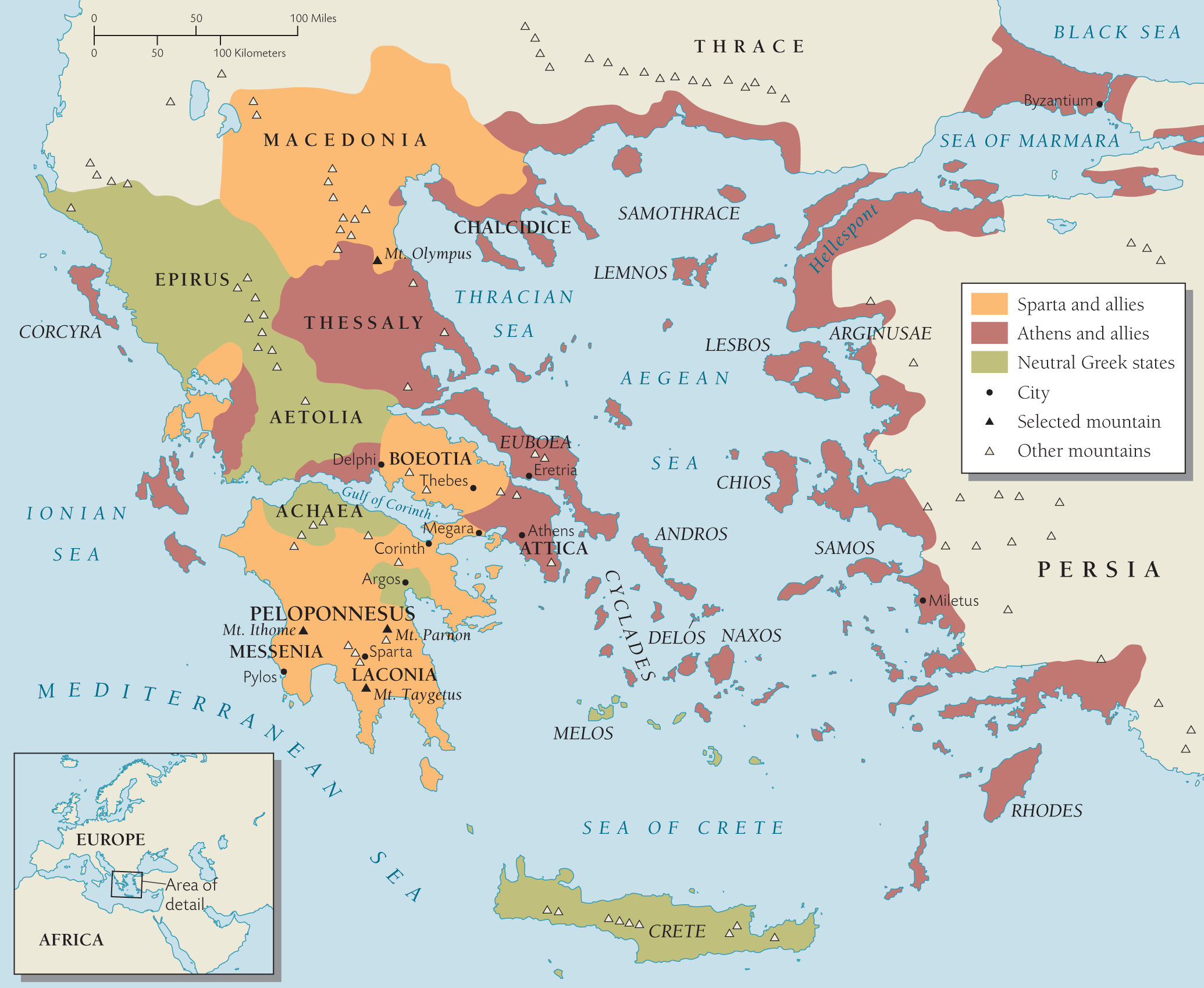
When the Athenians and Spartans found themselves at war with one another in 431 B.C.E., both sides believed a conclusion would come quickly—a delusion common to many of history’s pivotal wars. Instead, the Peloponnesian War dragged on for twenty-seven years. Thucydides, writing about it in exile, recalled that he knew from the time of its outbreak that it was going to be “the greatest war in history,” amounting to the first world war, because by the time it was over it would involve the entire Mediterranean. He also meant that it was the worst, so devastating to both sides that it partially destroyed the Greeks’ proud heritage of independence. By the time Athens was forced to concede defeat, all the poleis were weakened to such an extent that never again were they able to withstand outside threats.
From the beginning, Athens knew that it could not defeat Sparta on land; and neither Sparta nor its allies had a fleet capable of facing the Athenians at sea. Pericles therefore developed a bold strategy: he would pull the entire population of Attica within the walls of Athens and its harbor and not attempt to defend the countryside against Sparta. For sustenance, Athens would rely on supplies shipped in by its fleet, which would also be deployed to ravage the coasts of the Peloponnesus.
The Spartans duly plundered the farms and pastures of Attica, frustrated that the Athenians would not engage them in battle. Meanwhile, the Athenians inflicted significant destruction on Spartan territory in a series of raids and by successfully encouraging rebellion among the helots. The advantage appeared to be on Athens’ side, but in 429 B.C.E. the crowded conditions of the besieged city gave rise to a typhus epidemic that killed over a third of the population, including the aged Pericles.
Pericles’ death revealed that he had been the only man capable of managing the political forces he had unleashed. His successors were mostly demagogues, ambitious men who played to the worst instincts of the demos. The most successful of these was Cleon, a particular target of Aristophanes’ ridicule, who refused a Spartan offer of peace in 425 B.C.E. and continued the war until his own death in battle four years later. It was under Cleon that Thucydides was given the impossible task of liberating a city under Spartan control; his failure in 423 led to his exile.
After the death of Cleon, a truce with Sparta was negotiated by an able Athenian leader named Nicias. But Athenians continued to pursue a “dirty war” by preying on poleis that might support the Spartans. This led to atrocities such as the destruction of Melos, an island colonized by the Spartans, but which had maintained its neutrality since the beginning of the war. When the inhabitants of Melos refused to compromise this position by accepting Athenian rule, Athens had the entire male population slaughtered and every woman and child sold into slavery.
Thereafter, Athens’ policy of preemptive warfare proved destructive even to itself. In 415 B.C.E., a charismatic young aristocrat named Alkibiades (al-kih-BY-uh-dees) convinced the Athenians to attack the powerful Greek city of Syracuse in Sicily, which was allegedly harrying Athenian allies in the western Mediterranean. Even the general who opposed him, Nicias (NICK-ee-ahs) was drawn into this ill-fated decision. The expedition failed disastrously, ending with the slaughter and enslavement of thousands of Athenian warriors (see Analyzing Primary Sources on page 106).
More information
Sparta and its allies included the following. Macedonia, southern parts of Epirus, Boeotia, Peloponnesus, Messenia, and Laconia. A smaller inset map shows that the area of detail is part of southern Europe that reaches the Mediterranean Sea. Athens and allies included the following. Shores of the Sea of Marmara and the Black Sea; all territories of the Aegean Sea and Thracian Sea: Chalcidice, Samothrace, Lemnos, Lesbos, Chios, Samos, Andros, Delos, Cyclades, Naxos, Melos, Rhodes; the territories of Thessaly, Euboea, Attica, Delphi, Corcyra and parts of Aetolia. Neutral Greek states were Epirus, Aetolia, Achaea, Argos, Melos, and Crete. Major cities pointed out are Byzantium, Delphi, Thebes, Eretria, Megara, Athens, Corinth, Argos, Sparta, Pylos, and Miletus. Selected mountains that are plotted include Mount Olympus, Mount Parnon, Mount Ithome, and Mount Taygetus.
THE PELOPONNESIAN WAR. This map shows the patchwork of colonies and alliances that bound together the supporters of Sparta and Athens at the outbreak of the Peloponnesian War. ■ Which side had the geographical advantage? ■ Which neutral powers might have been able to tip the balance by entering the war on one side or the other? ■ What strategic and military choices did geography impose on the two combatants and their allies?
News of the Syracusan disaster shattered the Athenians. Many political leaders were driven from the polis as scapegoats, and in 411 B.C.E. a hastily convened assembly of citizens voted democracy out of existence, replacing it with an oligarchy (“rule of the few”) consisting of 400 members, many of whom had been present at this vote. The remains of the Athenian fleet, then stationed at Samos on the Ionian coast, responded by declaring a democratic government in exile under the leadership of none other than Alkibiades. The oligarchy proved to be brief, and democracy was restored to Athens by 409. But a pattern of self-destruction had been established, making it difficult for anyone in Athens or outside it to believe in the possibility of restored greatness.
Analyzing Primary Sources
An Athenian Tragedy: The Sicilian Expedition
In 415 B.C.E., Athens and Sparta were observing a peace treaty negotiated in 421; yet both sides were wary of one another’s plans and motives. Athens was particularly concerned that the Sicilian city of Syracuse, the richest and most powerful state in the Mediterranean, would mobilize support for Sparta. So when an Athenian ally on Sicily, the city of Segesta, asked for military aid against its mightier neighbors, some Athenian hawks seized this as an opportunity to launch a preemptive strike against Syracuse and its allies, by sending a fleet of 60 ships. The Athenian general Nicias strongly opposed any such expedition, so he attempted to underscore the absurdity of the mission by arguing that Athens would need to send most of its fleet, 100 ships, plus a force of 5,000 hoplites, in order to succeed. His calculation failed when the assembly voted in favor of his misguided proposal and launched the offensive. In this excerpt from Thucydides’ history of the Peloponnesian War, we witness the tragic consequences of Athenian hubris: by September of 415, the remains of the army are driven from the battlefield, leaving their dead unburied. The survivors, imprisoned in foul conditions, are sold into slavery. Only a few men escaped to bring the tragic news back to Athens.
As soon as it was day Nicias put his army in motion, pressed, as before, by the Syracusans and their allies, pelted from every side by their missiles, and struck down by their javelins. The Athenians pushed on for the Assinarus [river], impelled by the attacks made upon them from every side by a numerous cavalry and the swarm of other arms, fancying that they should breathe more freely if once across the river, and driven on also by their exhaustion and craving for water. Once there they rushed in, and all order was at an end; each man wanting to cross first, and the attacks of the enemy making it difficult to cross at all, since they were forced to huddle together, and so fell against and trod down one another, some dying immediately upon the javelins, others getting entangled together and stumbling over the articles of baggage, without being able to rise again. Meanwhile the opposite bank, which was steep, was lined by the Syracusans, who showered missiles down upon the Athenians. . . .
At last, after many dead now lay upon one another in the stream, and part of the army had been destroyed at the river, and the few that escaped from thence cut off by the cavalry, Nicias surrendered himself to [the Spartan] Gylippus, whom he trusted more than he did the Syracusans, and told him and the Lacedæmonians [Spartans] to do what they liked with him, but to stop the slaughter of the soldiers. Gylippus, after this, immediately gave orders to make [them] prisoners . . .
The Syracusans and their allies now mustered and took up the spoils and as many prisoners as they could, and went back to the city. The rest of their Athenian and allied captives were deposited in the quarries, this seeming the safest way of keeping them; but Nicias and Demosthenes were butchered, against the will of Gylippus, who thought that it would be the crown of his triumph if he could take the enemy’s general to Lacedæmon [Sparta].
The prisoners in the quarries were at first hardly treated by the Syracusans. Crowded in a narrow hole, without any roof to cover them, after being tormented by the heat of the sun and the stifling closeness of the air during the day, the violent change to the nights which came on autumnal and chilly undermined their health; besides which as they had to do everything in the same place for want of room, and the bodies of those who died of their wounds or from the variation in the temperature, or from similar causes, were left heaped together one upon another, so that intolerable stenches arose; while hunger and thirst never ceased to afflict them, each man during eight months having only half a pint of water and a pint of corn given him daily. In short, no single suffering to be apprehended by men thrust into such a place was spared them. . . . The total number of prisoners taken it would be difficult to state exactly, but it could not have been less than seven thousand.
This was the greatest Hellenic achievement of any in this war, or, in my opinion, in Hellenic history; at once most glorious to the victors, and most calamitous to the conquered. They were beaten at all points and altogether; all that they suffered was great; they were destroyed with a total destruction, as the saying is—their fleet, their army—there was nothing that was not destroyed, and few out of many returned home.
Source: Excerpted from Thucydides, The History of the Peloponnesian War, trans. Richard Crawley (London: 1874), pp. 540–43.
Questions for Analysis
How does Thucydides describe the behavior of the Athenian soldiers and that of their enemies? What are some of the details that convey the impression of disaster and tragedy?
Given that it was Nicias whose miscalculation launched this expedition, how does Thucydides portray his involvement in these events? Is there evidence that he is continuing to make poor decisions?
What does Thucydides mean when he says that “this was the greatest Hellenic [Greek] achievement in this war”? What morals or conclusions does he want his audience to take away from his account?
The name given to the series of wars fought between Sparta (on the Greek Peloponnesus) and Athens from 431 B.C.E. to 404 B.C.E., which ended in the defeat of Athens and the loss of its imperial power.