 Political and Cultural Importance of Carolingian Empire
THE EMPIRE OF CHARLEMAGNE
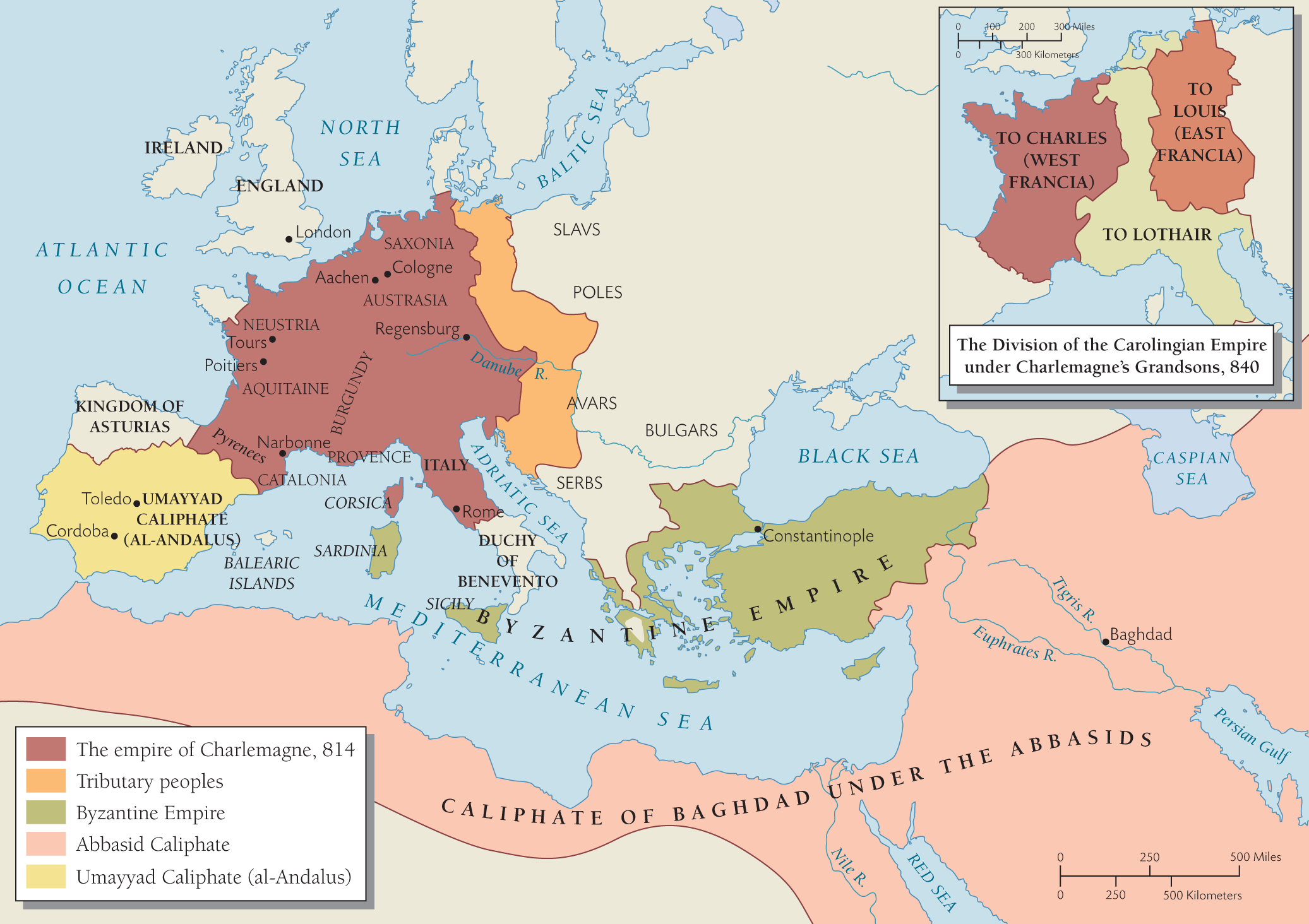
Toward the end of the seventh century, tensions among noble families in the Merovingian heartland of Neustria and in the Frankish border region of Austrasia were increasing (see map on page 244). The Austrasian nobles had profited from their steady push into the “soft frontier” east of the Rhine, acquiring wealth and military power in the process, while the Merovingians, settled in Neustria, had no such easy conquests at their disposal. Moreover, Merovingians had given a considerable portion of their land to monasteries during the course of the seventh century, which decreased their wealth and their capacity to attract followers. A succession of short-lived kings then opened the door to a series of civil wars, and finally to a decisive challenge to the dynasty.
Kings and Kingmakers
In 687, an Austrasian nobleman called Pepin (635/45?–714) came to power by making himself the Frankish king’s right-hand man and enforcer. He took the title maior domus (“great man of the house”) and began to exercise royal authority while maintaining the fiction that he was merely a royal servant. He did this effectively for more than twenty-five years. After his death, his illegitimate son Charles Martel (“the Hammer”; 688–741) further consolidated control over both the Merovingian homeland and the Frankish royal administration. For two generations, the Merovingian kings were largely figureheads in a realm ruled by Charles Martel and his sons.
Charles Martel is sometimes considered the second founder (after Clovis) of the Frankish kingdom. His claim to this title is twofold. First, in 733 or 734, he repelled a small Muslim force sent by the Umayyad caliphate in al-Andalus, which was attempting to expand its reach across the Pyrenees and into the rich farmlands of Aquitaine (the Bordeaux region of modern France). Charles and his army met them in battle between the cities of Poitiers and Tours, some 150 miles from the Merovingian stronghold at Paris. This victory won him great prestige, and he successfully advanced Frankish power southward toward the Muslim-held region of Narbonne.
At the same time, Charles was fostering an alliance with Benedictine missionaries from England, who were attempting to convert the Low Countries and central Germany to Christianity. Charles’s family had long been active in the drive to conquer and settle these areas, and he understood clearly how missionary work and Frankish expansion could go hand in hand, and so assisted these conversion efforts. In return, the leader of the English Benedictines, Boniface (c. 672–754), brought him into contact with the papacy.
More information
The empire of Charlemagne had territory in southwestern Europe, Italy, Corsica, Catalonia, Provence, Aquitaine, Burgundy, Neustria, Austrasia, and Saxonia. The cities within the empire were Rome, Poitiers, Tours, Aachen, Cologne, and Regensburg. The tributary people’s lands bordered the east side of Charlemagne. The Byzantine Empire was in modern-day Turkey and Greece. The Black Sea, the Caliphate of Baghdad, the Mediterranean Sea, and the Serbs border the Byzantine Empire. It also included Sicily and Sardinia. The city of Constantinople was in the Byzantine Empire. The Abbasid Caliphate covered northern Africa and spread toward the east, the Persian Gulf, and the Caspian Sea. The city of Baghdad was located within the Abbasid Caliphate. The mini-map in the corner shows the division of the Carolingian Empire under Charlemagne’s grandsons in 840. Charles ruled over West Francia, Louis ruled over East Francia, and Lothair ruled over the land between West and East Francia.
Although Charles never sought to become king himself, he was so clearly the effective ruler of Gaul that the Franks did not bother to choose a new king when the reigning Merovingian ruler died in 737. But then Charles himself died in 741, and his sons Carloman and Pepin were forced to allow the election of a new king while they exercised power behind the scenes. This compromise did not last long, however. In 750, Carloman withdrew from public life by entering a monastery, and Pepin decided to seize the throne for himself. This turned out to be harder than he may have expected. Even though the reigning king was ineffectual, Frankish identity was bound up with loyalty to Clovis’s descendants; and although tribal leaders had the power to elect a new king, they were reluctant to do so.
Pepin therefore turned to the Frankish bishops, who were also unwilling to support him without backing from Rome. To gain this support, Pepin traded on his family’s support of the monastic movement. The pope, for his part, saw that a powerful leader of the Franks could be a potential ally in his political struggle with the Byzantine emperors over iconoclasm (which the papacy opposed), and in his military struggle against the Lombard kings for control of central Italy.
So Boniface, acting as papal emissary, anointed Pepin king of the Franks in 751. Anointing was a new ritual, but it had a powerful biblical precedent: the ceremony by which the prophet Samuel had made Saul the first king of Israel, by anointing his head with holy oil (see Chapter 2). To contemporary observers, however, the apparent novelty of these proceedings underscored the uncertainty of the times: a legitimate king had been deposed and a new king elevated by a papacy that owed its survival to that newcomer. And as we will see, this king-making process was a step on the long road that eventually established the principle that kingship is an office that can be occupied, at least theoretically, by anyone; and by extension, if a ruler is ineffectual or tyrannical, he can be deposed and replaced.
The Reign of Charlemagne
The Franks benefited from Pepin’s military leadership. In 759, he finally defeated the Muslims of Narbonne and extended Frankish control to the Mediterranean coast. But his grip on the title of king was a tenuous one; and when he died in 768, it seemed likely that the Frankish kingdom would break up into mutually hostile regions: Austrasia, Neustria, and the new region of Aquitaine. That it did not was the work of Pepin’s son, Charles: known to the French as Charlemagne and to the Germans as Karl der Grosse (“Charles the Great”) because both modern nations claim him as their founding father. It is from him, as well as from his grandfather Charles Martel, that this new Frankish dynasty takes the name “Carolingian” (from Carolus, the Latin form of “Charles”).
When Charlemagne came to power in 768, he managed to unite the Franks by the tried and true method of attacking a common, outside enemy. In a series of conquests, the Franks succeeded in annexing the Lombard kingdom of northern Italy, most of what is now Germany, portions of central Europe, and—taking advantage of the weakened Umayyad caliphate—Catalonia, just beyond the Pyrenees. These conquests seemed to set a seal of divine approval on the new Carolingian dynasty. More important, they provided the victorious Franks with spoils of war and vast new lands that enabled Charlemagne to reward his closest followers.
Many of the peoples Charlemagne conquered were already Christians. In the northern territory of Saxonia (Saxony), however, Charlemagne’s armies campaigned for twenty years before subduing the pagan inhabitants and forcing their conversion (see Analyzing Primary Sources on page 246). This created a precedent that linked military conquest with conformity of belief, and it would be repeated by Charlemagne’s successors in Baltic and Slavic lands.
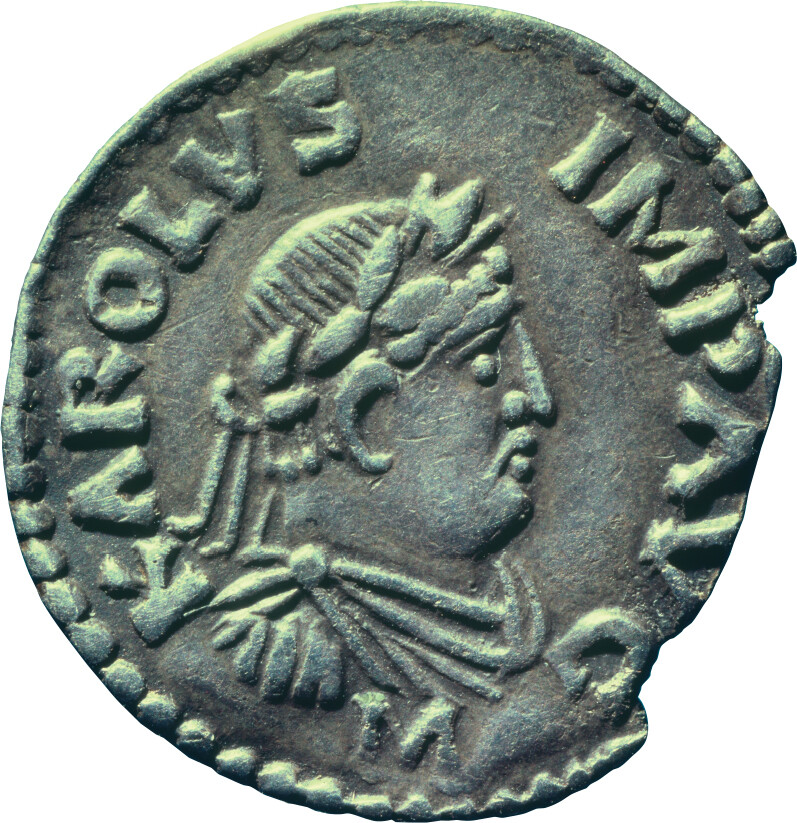
To rule his new empire, Charlemagne enlisted the help of the Frankish warrior class he had enriched and raised to positions of prominence. These counts (comites in Latin, “followers”) supervised local governance within their territories. Among their many duties were the administration of justice and the raising of armies. Charlemagne also established a network of other local officials who convened courts, established tolls, administered royal lands, and collected taxes. To facilitate transactions and trade, he created a new coinage system based on a division of the silver pound into units of twenty shillings, each worth twelve pennies: a system that would last into the 1970s in parts of continental Europe and in Britain (when it was replaced by a decimal-based currency). As noted earlier, much of the silver for this new coinage originated in the Abbasid caliphate and was payment for furs, cloth, and especially slaves captured in Charlemagne’s wars, who were now being transported to Baghdad. The silver, in turn, circulated as far north as Scandinavia and the Baltic Sea region.
Like Carolingian administration generally, this new monetary system depended on the regular use of written records, which means that the sources supporting historical research on Charlemagne’s empire are numerous. But Charlemagne did not rely on the written word alone to make his will felt. Periodically, his court sent special messengers, known as missi, on tours through the countryside to relay his instructions and report back on the conduct of local administrators. This was the most thorough system of governance known in Europe since the height of the Roman Empire, reaching many parts of the Continent that the Romans had never occupied. It set a standard for royal administration that would be emulated and envied for centuries.
Christianity and Kingship
In keeping with the traditions established by his father and grandfather, Charlemagne took his responsibilities as a Christian king seriously. Moreover, as his empire expanded, he came to see himself as the leader of a unified Christian society, Christendom, which he was obliged to defend. Like his contemporaries in Byzantium and the Muslim world—as well as his Roman predecessors—he recognized no distinction between religion and politics. Indeed, he conceived kingship as a sacred office created by God to protect the Church and promote the salvation of Christian people. Religious reforms were therefore no less central to proper kingship than were justice and defense. In some ways, a king’s responsibilities for his kingdom’s spiritual welfare were more important than his other, secular responsibilities.
Analyzing Primary Sources
The Capitularies of Charlemagne: The Conquest and Subjugation of the Saxons
Charlemagne’s careful governance of his domains set a high standard for other rulers far into the future. One of the means by which this governance was carried out was through capitularies (from a Latin word denoting a document divided into chapters), which contained instructions issued by the central administration of the court to local elites known as counts (or comites in Latin)—hence the word “county” to describe an administrative area. The following are directives addressed in 785 to the administrators of Saxony, a region Charlemagne had recently conquered and whose pagan inhabitants were converted to Christianity.
The Capitulary Concerning the Parts of Saxony
- Decisions were taken first on the more important items. All were agreed that the churches of Christ which are now being built in Saxony and are consecrated to God should have no less honor than the temples of idols had, but rather a greater and more surpassing honor.
- If anyone takes refuge in a church, let no one presume to drive him out of that church by force; rather let him be in peace until he is brought to plead his case, . . . and after this let him be brought to the presence of our lord the king. . . .
- If anyone makes forcible entry to a church, and steals anything from it by violence or stealth, or if he sets fire to the church, let him die.
- If anyone in contempt of the Christian faith should spurn the holy Lenten fast and eat meat, let him die; but let the priest enquire into the matter, lest it should happen that someone is compelled by necessity to eat meat.
* * *
- If anyone is deceived by the devil, and believes after the manner of pagans that some man or some woman is a witch and eats people, . . . let him pay the penalty of death.
- If anyone follows pagan rites and causes the body of a dead man to be consumed by fire, . . . let him pay with his life.
- If there is anyone of the Saxon people lurking among them unbaptized, and if he scorns to come to baptism, . . . let him die.
- If anyone sacrifices a man to the devil, . . . let him die.
* * *
- If anyone rapes the daughter of his lord, he shall die.
- If anyone kills his lord or his lady, he shall be punished in the same way.
* * *
- On Sundays there are to be no assemblies or public gatherings, except in cases of great need or when an enemy is pressing; rather let all attend church to hear the word of God. . . .
* * *
- With regard to perjury, the law of the Saxons is to apply.
- We forbid the Saxons to come together as a body in public gatherings, except on those occasions when our missus [messenger] assembles them on our instructions; rather, let each and every count hold court and administer justice in his own area. And the clergy are to see to it that this order is obeyed.
Source: From The Reign of Charlemagne: Documents on Carolingian Government, ed. and trans. H. R. Loyn and John Percival (New York: 1975), pp. 51–54.
Questions for Analysis
- What types of behavior does this capitulary attempt to regulate? What seem to be the major challenges faced by Charlemagne’s administrators in this new territory?
- In only one case does this capitulary mention the laws of the Saxon people themselves, in the clause relating to perjury (number 33). Why would Charlemagne’s administrators consider it advisable to punish this particular crime in accordance with Saxon custom?
- How would you characterize Charlemagne’s method of dealing with a conquered people? In your estimation, is this policy likely to be effective? Why or why not?
These ideas were not new in the late eighth century, but they took on a new importance because of the extraordinary power Charlemagne wielded. Like other rulers of this period, Charlemagne was able to appoint and depose bishops and abbots, just as he did the counts and other officials who administered his realm. He extended his authority by changing the liturgy of Frankish churches, reforming the rules of worship in Frankish monasteries, declaring the tenets of Christian belief, ruthlessly prohibiting pagan practices, and forcibly imposing basic Christian observances on the conquered peoples of Saxony.
As the dominant political power in central Italy, Charlemagne was also the protector of the papacy. Although he acknowledged the pope as the spiritual leader of Christendom, Charlemagne dealt with the bishop of Rome much as he did other bishops in his empire. He supervised and approved papal elections, and he also protected the pope from his many enemies. To Charlemagne, such measures were clearly required if God’s new chosen people, the Franks, were to avoid the fate that befell biblical Israel whenever Hebrews turned away from obedience to God.
The Carolingian Renaissance
Similar political motivations lay behind the phenomenon known as the Carolingian Renaissance, a cultural and intellectual flowering that took place around the Carolingian court. Like their biblical exemplars David and Solomon, Charlemagne and his son Louis the Pious considered it a crucial part of their role to be patrons of learning and the arts. In doing so, they created an ideal of the court as an intellectual and cultural center: an ideal that would profoundly influence western European cultural life until the First World War (see Chapter 24).
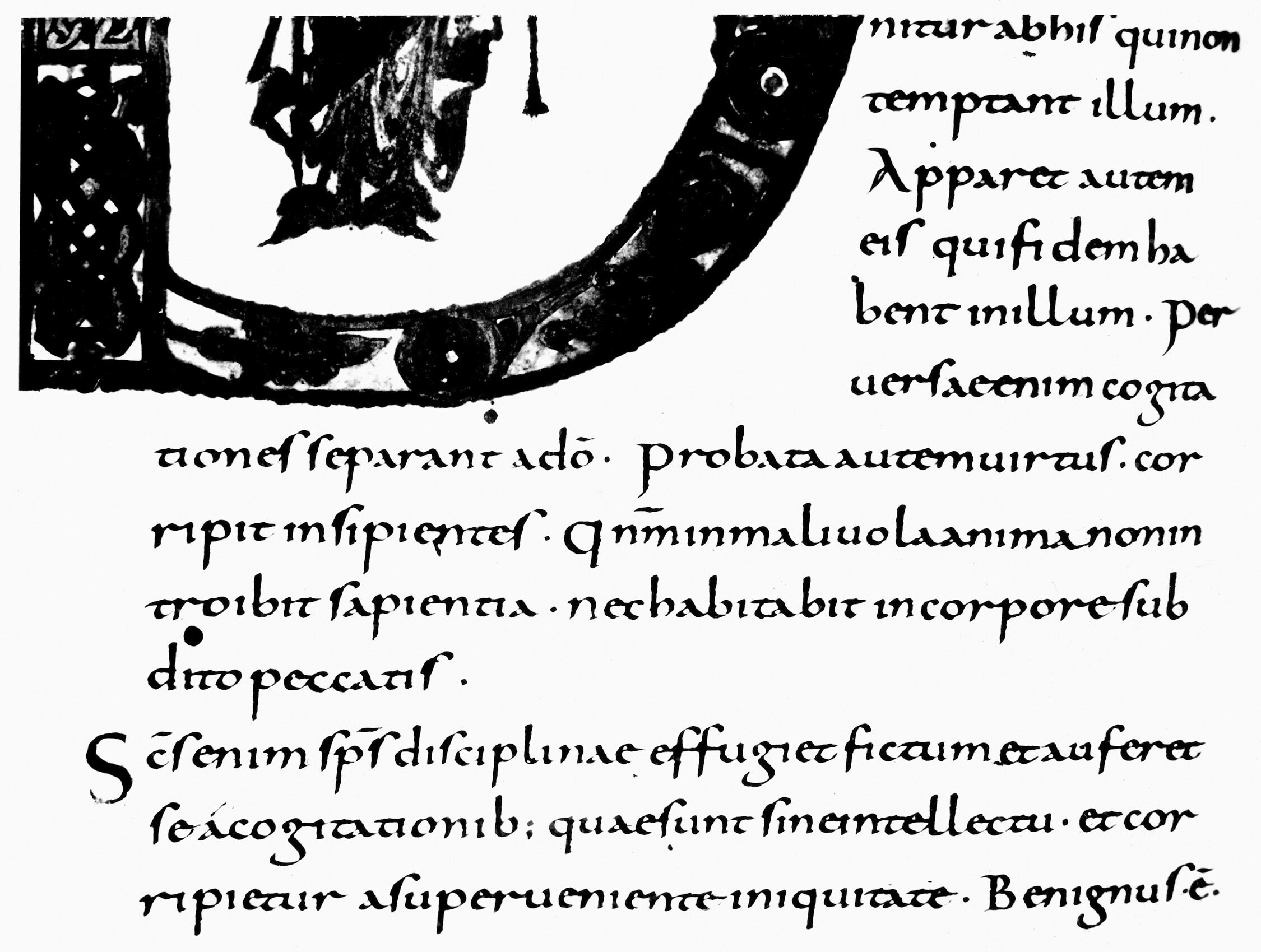
Behind the Carolingians’ support for scholarship was the conviction that learning was the foundation on which Christian wisdom rested, and that such wisdom was essential to the salvation of God’s people. Charlemagne therefore recruited intellectuals from all over Europe to further the cause of scholarship and classical learning. Foremost among these was the Anglo-Saxon monk Alcuin, whose command of classical Latin established him as the intellectual leader of Charlemagne’s court. Under Alcuin’s direction, Carolingian scholars produced much original Latin poetry and an impressive number of theological and pastoral tracts. But their primary efforts were devoted to collating, correcting, and recopying ancient Latin texts, including, most important, the text of the Latin Bible, which had accumulated many generations of copyists’ mistakes in the 400 years since Jerome’s translation (see Chapter 6).
To detect and correct these errors, Alcuin and his associates gathered as many different versions of the biblical text as they could find and compared them, word by word. After determining the correct version among all the variants, they made a new, corrected copy and destroyed the other versions. They also developed a new style of handwriting, with simplified letter forms and spaces inserted between words, so as to reduce the likelihood that subsequent copyists would misread the corrected texts. Reading was further facilitated by the addition of punctuation. This new style of handwriting, known as Carolingian minuscule, is the foundation for the typefaces of most modern books—including this one.
The Revival of the Western Roman Empire
On Christmas Day in the year 800, Charlemagne was crowned emperor of the Romans by Pope Leo III. Centuries later, popes would cite this epochal event as precedent for the political superiority they claimed over the ruler of the “Holy Roman Empire,” as it came to be called (see Chapter 9). In the year 800, however, Pope Leo was entirely under Charlemagne’s control. Yet Charlemagne’s biographer, Einhard, later claimed that the coronation was planned without the emperor’s knowledge. Why, then, did he accept the title and, in 813, transfer it to his son Louis?
The most important pretext for this event was the fact that imperial government in Byzantium was now headed by a woman, Empress Irene (r. 797–802). Charlemagne’s diplomats had suggested that this was a golden opportunity to merge the two dynasties through marriage, but his overtures had been rebuffed. In retaliation, Charlemagne could now claim that Irene’s reign was illegitimate and that the imperial throne in Constantinople was vacant. Charlemagne’s allegedly reluctant assumption of the title was therefore a clear slight to his Byzantine rivals, and deepened their suspicion of his cordial relationship with Caliph Harun al-Rashid in Baghdad.
For Charlemagne’s successors—and for all the medieval rulers who came after him—the assumption of the imperial title was also a declaration of independence and superiority. With only occasional interruptions, western Europeans continued to crown Roman emperors until the nineteenth century, while territorial claims and concepts of national sovereignty continued to rest on Carolingian precedent. Whatever his own motives may have been, Charlemagne’s revival of the western Roman Empire was crucial to the developing self-consciousness of western Europe.
Glossary
- Charlemagne
- (742–814) As king of the Franks (767–813), Charles “the Great” consolidated much of western Europe under his rule. In 800, he was crowned emperor by the pope in Rome, establishing a problematic precedent that would have wide-ranging consequences for western Europe’s relationship with the eastern Roman Empire in Byzantium and for the relationship between the papacy and secular rulers.
- Carolingian Renaissance
- A cultural and intellectual flowering that took place around the court of Charlemagne in the late eighth and early ninth centuries.
- classical learning
- The study of ancient Greek and Latin texts. After Christianity became the only legal religion of the Roman Empire, scholars needed to find a way to make classical learning applicable to a Christian way of life. Christian monks played a significant role in resolving this problem by reinterpreting the classics for a Christian audience.