Describe the principles of governance and the powers of the national government defined by the Constitution
Together, the Great Compromise and the Three-Fifths Compromise showcase the difficulty in uniting a geographically diverse group of people and creating a national government that is representative of all. But with these important principles in place, delegates at the Convention moved to fashion a constitution consistent with their economic and political interests. In particular, the framers wanted a new government that, first, would be strong enough to promote commerce and protect property from radical state legislatures. This goal led to the constitutional provisions for national control over commerce and finance, for national judicial supremacy over state courts, and for a strong presidency. (See Table 2.1 for a comparison of the Articles of Confederation with the Constitution.)
TABLE 2.1Comparing the Articles of Confederation and the Constitution
MAJOR PROVISIONS
ARTICLES OF CONFEDERATION
CONSTITUTION
Executive branch
None
President of the United States
Judiciary
No federal court system. Judiciary exists only at state level.
Supreme Court
Legislature
Unicameral legislature with equal representation for each state. Delegates to the Congress of the Confederation were appointed by the states.
Bicameral legislature consisting of Senate and House of Representatives. Each state is represented by two senators, while apportionment in the House is based on each state’s population. Senators are chosen by the state legislatures (changed to direct popular election in 1913) for six-year terms and members of the House by popular election for two-year terms.
Fiscal and economic powers
The national government is dependent upon the states to collect taxes. The states are free to coin their own money and print paper money. The states are free to sign commercial treaties with foreign governments.
Congress is given the power to levy taxes, coin money, and regulate international and interstate commerce. States are prohibited from coining money or entering into treaties with other nations.
Military
The national government is dependent upon state militias and cannot form an army during peacetime.
The national government is authorized to maintain an army and a navy.
Legal supremacy
State constitutions and state law are supreme.
National Constitution and national law are supreme.
Constitutional amendment
Must be agreed upon by all states
Must be agreed upon by three-fourths of the states
Slavery
No mention
Enslaved people count as 3/5 of a state’s total enslaved population, and trade of enslaved people is allowed for 20 years.
Second, the framers wanted to prevent what they saw as the threat posed by the “excessive democracy” of both state and national governments under the Articles of Confederation. This desire led to such constitutional principles as a bicameral (or two-chambered) legislature; checks and balances among the three branches of government; staggered terms in office; and indirect election (selection of the president by an electoral college and of senators by state legislatures, rather than directly by voters).
Third, lacking the power to force the states or the public to accept the new form of government, the framers wanted to identify principles that would help gain support for it. This goal became the basis of the constitutional provision for direct popular election of representatives and, later, of the addition of the Bill of Rights to the Constitution.
Finally, the framers wanted to ensure that the government they created did not pose an even greater threat to its citizens’ liberties and property rights than did the radical state legislatures they despised. To prevent abuses of power, they incorporated principles such as the separation of powers and federalism into the Constitution.
The Preamble
Marking the shift to a stronger national bond than was present under the Articles of Confederation, the Constitution begins with a powerful, unifying preamble: “We the People of the United States, in order to form a more perfect union, establish Justice, insure domestic Tranquility, provide for the common defence, promote the general Welfare, and secure the Blessing of Liberty to ourselves and our posterity, do ordain and establish the Constitution of the United States of America.”
Generations of Americans have returned to the phrase “we the people,” as it is an affirmation that the authority of government in the United States derives from the people. Yet, while it was established that the goal of government was to meet the needs of “the people,” it’s important to note that at the time of the writing of the Constitution, the Founders’ conception of “the people” and “justice” was limited. Enslaved Black people were not considered citizens, the rights of Native peoples were nonexistent, and women were excluded from voting. Over the years, different groups have fought for and expanded the meaning of “we the people,” and in so doing they have continued the work of perfecting the union.
The Legislative Branch
In Article I, Sections 1–7, the Constitution provides for a Congress consisting of two chambers: a House of Representatives and a Senate. Members of the House of Representatives were given two-year terms in office and were to be elected directly by the people. Members of the Senate were to be appointed by the state legislatures (a provision changed in 1913 by the Seventeenth Amendment, which instituted direct election of senators) for six-year terms. These terms were staggered so that the appointments of one-third of the senators would expire every two years.
The Constitution assigned somewhat different tasks to the House and Senate. Though the enactment of a law requires the approval of both, the Senate alone is given the power to ratify treaties and approve presidential appointments. The House, on the other hand, is given the sole power to originate revenue bills.
More information
A quill pen rests atop a copy of the Constitution. We the People, the Constitution begins, shortly followed by Article One.
Article I of the Constitution establishes the structure of Congress and lists certain specific powers of Congress. The language of the Constitution reflects the framers’ desire to create government that was powerful enough to be effective but not so powerful that it would threaten individual liberty.
The character of the legislative branch was related to the framers’ major goals. The House was designed to be directly responsible to the people in order to encourage popular support for the new Constitution and thus enhance the power of the new government. At the same time, to guard against “excessive democracy,” the power of the House was checked by that of the Senate, whose members were to be appointed by the states for long terms rather than elected directly by the people for short ones. The purpose of this provision, according to Alexander Hamilton, was to avoid “an unqualified complaisance to every sudden breeze of passion, or to every transient impulse which the people may receive.”26 Staggered terms in the Senate were intended to make that body even more resistant to popular pressure. Since only one-third of the senators would be selected at any given time, it was thought that the institution would be protected from changes in public opinion transmitted by the state legislatures.
While the Constitution set the framework for the legislative branch, the powers of Congress have evolved significantly since the Founding. Specific rules set by the House and Senate themselves have shaped how they operate and what laws emanate from them (see Chapter 12).
The issues of governmental power and popular consent are important throughout the Constitution. Section 8 of Article I specifically lists the powers of Congress, which include the authority to collect taxes, borrow money, regulate commerce, declare war, and maintain an army and a navy. By granting Congress these powers, the framers indicated that they intended the new government to be far more powerful than its predecessor under the Articles of Confederation. At the same time, by assigning its most important powers to Congress, they promoted popular acceptance of this critical change by reassuring citizens that their views would be fully represented whenever these powers were used.
As a further safeguard that the new government would pose no threat to the people, the Constitution implies that any powers not listed were not granted at all. This is what Chief Justice John Marshall named the doctrine of expressed powers: the Constitution grants only those powers specifically expressed in its text. But the framers intended to create an active and powerful government, so they also included the necessary and proper clause, sometimes known as the elastic clause, which declares that Congress can write laws needed to carry out its expressed powers. This clause indicates that the expressed powers could be broadly interpreted and were meant to be a source of strength to the national government, not a limitation on it. In response to the charge that they intended to give it too much power, the framers included language in the Tenth Amendment stipulating that powers not specifically granted by the Constitution to the federal government were reserved to the states or to the people. As we’ll see in Chapter 3, the resulting tension between the elastic clause and the Tenth Amendment has been at the heart of constitutional struggles between federal and state powers.
The Executive Branch
The Articles of Confederation had not provided for an executive branch. The president under the Articles was the official chosen by the Congress to preside over its sessions, not the chief executive of the national government. The framers viewed the absence of an executive as a source of weakness. Accordingly, the Constitution provides for the presidency in Article II. As Hamilton commented, the article aims toward “energy in the Executive.”27 It does so in an effort to overcome the natural tendency toward stalemate that was built into the separation of the legislature into two chambers and of governmental powers among the three branches. The Constitution affords the president a measure of independence from both the people and the other branches of government—particularly the Congress. However, unlike the legislative branch, for which the Constitution enumerates explicit powers, executive branch powers are often implied. For example, Article II states that “executive power” is vested in the president—but what does this power encompass? Throughout the nation’s history, presidents have interpreted executive power in many different ways, as we’ll see in Chapter 13.
In line with the framers’ goal of increased power for the national government, the president is granted the unconditional power to accept ambassadors from other countries—to “recognize” other governments—as well as the power to negotiate treaties, although their acceptance requires approval of the Senate by a two-thirds vote. The president is also given the unconditional right to grant reprieves and pardons except in cases of impeachment, and the powers to appoint major departmental heads (e.g., Agriculture, Defense, Energy, Justice), to convene Congress in a special session, and to veto bills it passes. The veto power is important but not absolute, since Congress can override it by a two-thirds vote, reflecting the framers’ concern with checks and balances.
The framers hoped to create a presidency that would make the federal government, rather than the states, the agency capable of timely and decisive action to deal with national issues and problems—hence the “energy” that Hamilton hoped to bring to the executive branch. At the same time, however, they tried to help the presidency withstand excessively democratic pressures by creating a system of indirect rather than direct election. As a result, Americans do not vote directly for presidental candidates in the way they vote for candidates to be elected to Congress. Instead, for the presidency, the United States uses the electoral college. The electoral college is a group of of electors, chosen by each party in each state, who formally select the president. (This complex process will be explored more in Chapter 10.)
The Judicial Branch
In establishing, in Article III, that “the judicial Power of the United States” resides in the Supreme Court, the Constitution reflects the framers’ preoccupations with nationalizing governmental power and checking radical democratic impulses while preventing the national government itself from interfering with liberty and property ownership. The most important expression of this intention is granting the Supreme Court the power to resolve any conflicts between federal and state laws. In particular, it can determine whether a power is exclusive to the national government, exclusive to the states, or shared between the two.
In addition, the Supreme Court is assigned jurisdiction over controversies between citizens of different states. The long-term significance of this provision was that as the country developed a national economy, it came to rely increasingly on the federal judiciary, rather than state courts, to resolve disputes.
Federal judges are given lifetime appointments to protect them from political or public pressure and from interference by the other branches. The judiciary isn’t totally free of political considerations of the other branches, however, for the president appoints the judges and the Senate must approve the appointments. Congress also has the power to create inferior (lower) courts, change the jurisdiction of the federal courts (the geographic area or types of cases they have authority over), add or subtract federal judges, and even change the size of the Supreme Court.
The Constitution doesn’t explicitly mention judicial review—the power of a court to determine whether the actions of the Congress or the executive are consistent with law and the Constitution. The Supreme Court eventually assumed the power of judicial review in the case Marbury v. Madison (1803). Its assumption of this power, as we’ll see in Chapter 15, was based not on the Constitution itself but on the strategic maneuverings of individual justices and the politics of later decades.
National Unity and Power
The Constitution addressed the framers’ concern with national unity and power in the comity clause of Article IV, which provides for reciprocity among all states and their citizens. That is, each state is prohibited from discriminating against the citizens of or goods from other states in favor of its own citizens or goods, with the Supreme Court being charged with deciding cases where such discrimination is alleged. The Constitution thus restricts the power of the states so as to give the national government enough power to ensure a free-flowing national economy.
The framers’ concern with national supremacy was also expressed in Article VI, whose supremacy clause provides that national laws and treaties “shall be the supreme Law of the Land.” This means that laws made under the “Authority of the United States” are superior to those adopted by any state or other subdivision and that the states must respect all treaties made under that authority. The supremacy clause also binds all state and local as well as federal officials to take an oath to support the national Constitution. Therefore, they must enforce national law over state law if the two conflict.
Amending and Ratifying the Constitution
The Constitution establishes procedures for its own amendment in Article V. The requirements are so difficult that, as we’ll see below, the amending process has succeeded only 17 times since 1791, when the first 10 amendments were adopted. The rules for ratification, or adoption, of the Constitution are set forth in Article VII. Of the 13 states, 9 would have to ratify it in order for it to go into effect. Even if all the states did not ratify the Constitution, it would take effect for those that did once the threshold of 9 had been crossed.
Citizens are assigned an indirect but important role in the process of amending the Constitution. Figure 2.2 outlines the ways in which the Constitution can be amended, all of which involve citizens’ input—through the election of members of Congress and state legislatures or, hypothetically, through the election of delegates to national and state constitutional conventions.
FOR CRITICAL ANALYSIS
What are the U.S. Constitution’s greatest strengths? What are its most pronounced weaknesses? If you were revising the Constitution today, what would you change? Why?
Ordinary citizens, including students, can influence America’s constitution. Take the case of the Twenty-Seventh Amendment, which declares that no congressional pay increase can take effect until the next Congress is elected. This amendment was proposed in 1789 along with the 10 that became the Bill of Rights; it was ratified by several states, but never the three-fourths needed to be added to the Constitution. In 1982, however, a University of Texas undergraduate, Gregory Watson, wrote a term paper proposing a campaign to complete the ratification process. His professor gave it a C, calling the proposal unrealistic. Watson was undeterred and launched a student-led campaign. In 1992 the Twenty-Seventh Amendment was added to the Constitution, more than two centuries after it was proposed.
Since 1789, more than 11,000 amendments have been formally introduced in Congress. Of these, Congress officially proposed only 29, and 27 were eventually ratified by the states. Historically, most amendment efforts have failed because they attempted to use the constitutional amendment process, instead of legislation, to address a specific public problem. The successful amendments, on the other hand, are concerned with the broader structure or composition of government—not with specific policies (see Table 2.2). This pattern is consistent with the dictionary definition of constitution as the makeup or composition of something. And it’s consistent with the concept of a constitution as “higher law,” whose purpose is to establish a framework within which the processes of governing and making ordinary law can take place.
FIGURE 2.2Four Ways the Constitution Can Be Amended
More information
A diagram shows four methods of amending the constitution. At the national level, the amendment may be proposed through passage by two-thirds votes in the House and in the Senate, or it may be proposed by passage in a national convention in response to petitions by two-thirds of the states (34 states). However, this second method of proposal has never been employed, and so only two of the four possible methods have been attempted. Once proposed, an amendment must be ratified at the state level, either through acceptance by majority vote in the legislatures of three-fourths of the states (38 states) or through acceptance by conventions called for the purpose in three-fourths of the states. Congress has the power to choose the method of ratification, the time limit for consideration by the states, and other conditions of ratification. The movement to repeal Prohibition in the Twenty-First Amendment was the only occasion in which ratification method 2 was used successfully.
*This method of proposal has never been employed. Thus, amendment methods 3 and 4 have never been attempted.
**For each amendment proposal, Congress has the power to choose the method of ratification, the time limit for consideration by the states, and other conditions of ratification. The movement to repeal Prohibition in the Twenty-First Amendment was the only occasion in which method 2 was used successfully.
There is great wisdom in this concept. A constitution ought to make laws and policies possible, but not determine what they ought to be. For example, property ownership is one of the most fundamental and well-established rights in the United States—not because it is recognized as such in the Constitution, but because legislatures and courts, working within an agreed-upon constitutional framework, have made it a crime for anyone, including the government, to trespass on or take away property without compensation. A constitution is good if it leads to just legislation, courts that protect citizens’ liberties and rights (like the right to vote; see Who Participates?, p. 59), and appropriate behavior of public officials. Its principles can be a citizen’s dependable defense against the abuse of power. Since the Founding, debates have raged as to whether the United States Constitution achieves these goals for all Americans.
Constitutional Limits on the National Government’s Power
Although the framers wanted a powerful national government, they also wanted to guard against possible misuse of that power. Thus they incorporated two key principles into the Constitution—federalism and the separation of powers. A third set of limitations, the Bill of Rights, was added in the form of 10 amendments proposed by the first Congress and ratified by the states. Most of the framers had thought a Bill of Rights unnecessary but accepted the idea during the ratification debates after the new Constitution was submitted to the states for approval.
WHO PARTICIPATES
Who Gained the Right to Vote through Amendments?
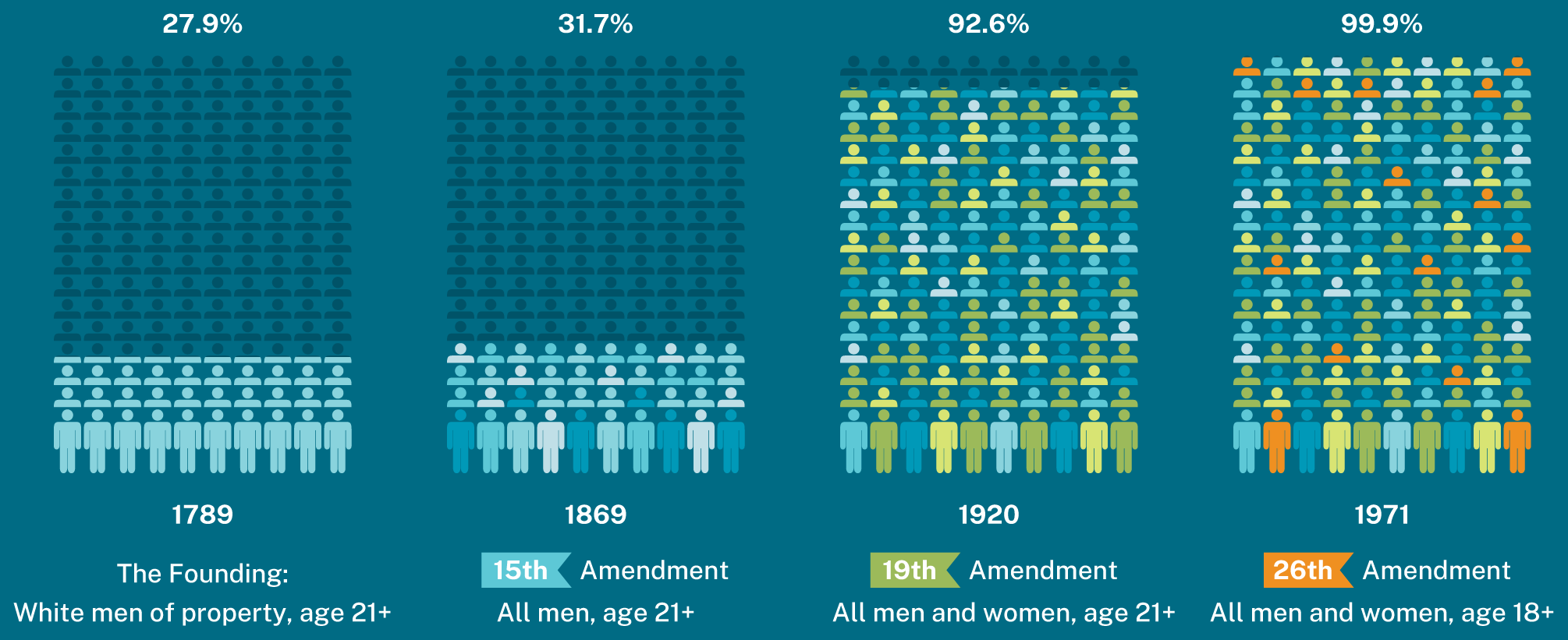
The right to vote is seen as a cornerstone of American democracy, but not all Americans have had that right. Three constitutional amendments, ratified over roughly a 100-year span, have had a profound effect on who can vote in U.S. elections.
Adult Citizens Eligible to Vote in National Elections*
More information
A Who Participates? infographic. At the 1789 founding, only property-owning white men 21 and over could vote. They represented 27.9% of the adult population, meaning 18 and over. In 1869, the 15th Amendment extended the vote to all men 21 and older, representing 31.7% of the adult population. In 1920, the 19th Amendment extended the vote to all men and women 21 and older, representing 92.6% of the adult population. In 1971, the 26th Amendment lowered the voting age to 18. The figures are approximate for 1789 and 1869. The voting rights of persons convicted of a felony are restricted in some states, and of noncitizens in all states.
Proportion of 2020 Electorate by Amendment
More information
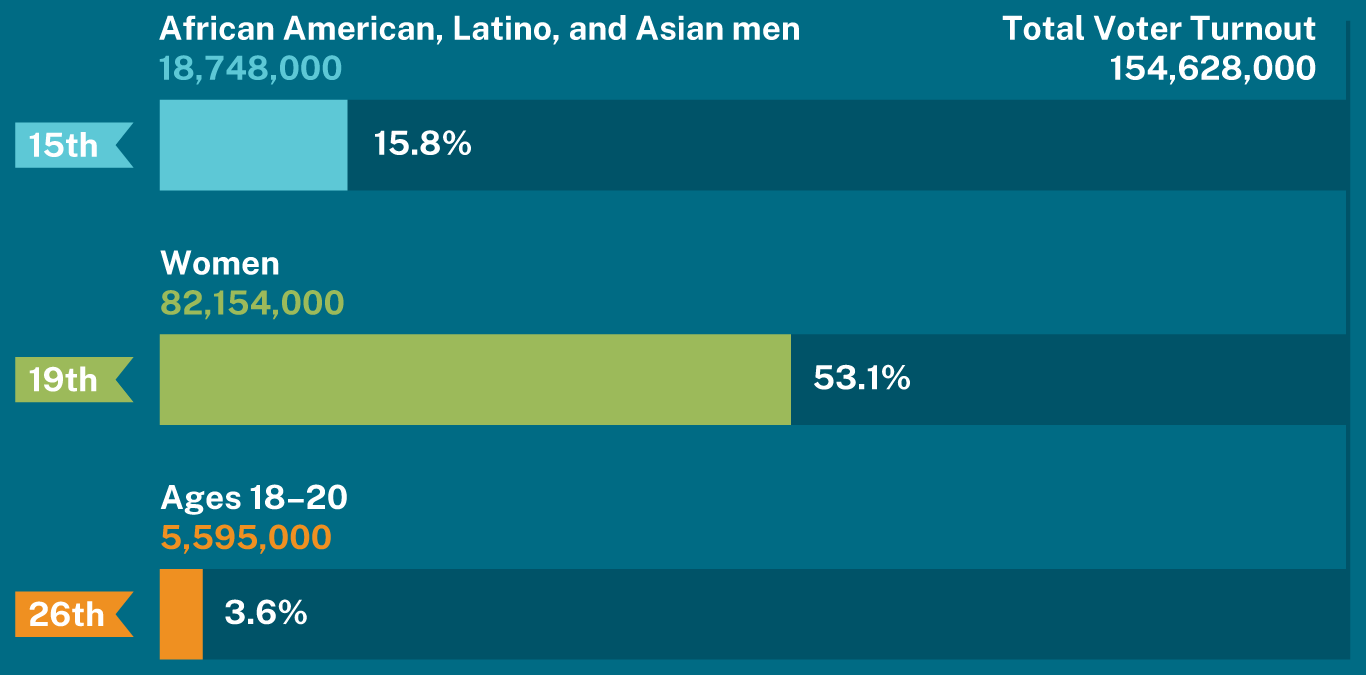
A Who Participates? infographic. The total number of people voting in 2020 was about 155 million. Of these, just under 19 million, or 12.1% percent, were African-American, Latino, and Asian Men, able to vote because of the 15th Amendment; just over 82 million, or 53.1%, were women, able to vote because of the 19th Amendment; and about 5.6 million, or 3.6%, were voters aged 18 to 20, eligible because of the 26th Amendment.
* Percentages are of the adult (18+) population. These figures are approximate for 1789 and 1869. The voting rights of persons convicted of a felony are restricted in some states, and of noncitizens in all states.
SOURCE: U.S. Census Voting and Registration in the Election of November 2020, Tables 1 and 2, www.census.gov/data/tables/time-series/demo/voting-and-registration/p20-585.html (accessed 1/28/22).
FOR CRITICAL ANALYSIS
Which amendment had the greatest effect in increasing the percentage of the population allowed to vote?
Roughly how many voters today would have been denied the chance to vote if not for the ratification of the Twenty-Sixth Amendment? Do you think the voting age should be decreased even further?
TABLE 2.2Amendments to the Constitution
AMENDMENT
PURPOSE
PROPOSED
ADOPTED
I
Congress is not to make any law establishing a religion or abridging free exercise of religion, speech, press, assembly, or petitioning the government for redress of grievances.
1789
1791
II, III, IV
No branch of government may infringe on the right of people to keep arms (II), arbitrarily occupy homes for a militia (III), and engage in the search or seizure of evidence without a court warrant swearing to belief in the probable existence of a crime (IV).
1789
1791
V, VI, VII, VIII
The courts* are not to hold trials for serious offenses without provision for a grand jury (V), a petit (trial) jury (VII), a speedy trial (VI), presentation of charges (VI), confrontation of hostile witnesses (VI), immunity from testimony against oneself (V), and immunity from more than one trial for the same offense (V). Neither bail nor punishment can be excessive (VIII), and no property can be taken without just compensation (V).
1789
1791
IX, X
All rights and powers not enumerated are reserved to the states or the people.
1789
1791
XI
Federal courts have limited jurisdiction over suits involving the states.
1794
1795
XII
A separate ballot must be provided for the vice president in the electoral college.
1803
1804
XIII
Slavery and the right of states to treat persons as property are eliminated.
1865
1865
XIV
The principle of national citizenship is asserted and the states are prohibited from infringing upon the rights of citizens of the nation, no matter that they happen to live in that state. States are prohibited from denying voting rights to male citizens over the age of 21.**
1866
1868
XV
Voting rights are extended to all races.
1869
1870
XVI
National power to tax incomes is established.
1909
1913
XVII
Direct election of senators is established.
1912
1913
XVIII
The manufacture, sale, transportation, or export of alcohol is prohibited.
1917
1919
XIX
Voting rights are extended to women.
1919
1920
XX
“Lame-duck” session of Congress is eliminated.
1932
1933
XXI
The Eighteenth Amendment is repealed.
1933
1933
XXII
Presidential term is limited.
1947
1951
XXIII
Voting rights are extended to residents of the District of Columbia.
1960
1961
XXIV
Voting rights are extended to all classes by abolition of poll taxes.
1962
1964
XXV
Presidential succession is provided in case of disability.
1965
1967
XXVI
Voting rights are extended to citizens age 18 and over.
1971
1971
XXVII
Congress’s power to raise its own salary is limited.
1789
1992
*These amendments also impose limits on the law-enforcement powers of federal, state, and local executive branches.
**In defining citizenship, the Fourteenth Amendment actually provided the constitutional basis for expanding the electorate to include all races, women, and residents of the District of Columbia. Only the “18-year-olds’ amendment” should have been necessary, since it changed the definition of citizenship. The fact that additional amendments were required following the Fourteenth suggests that voting is not considered an inherent right of U.S. citizenship. Instead, it is viewed as a privilege.
The Separation of Powers
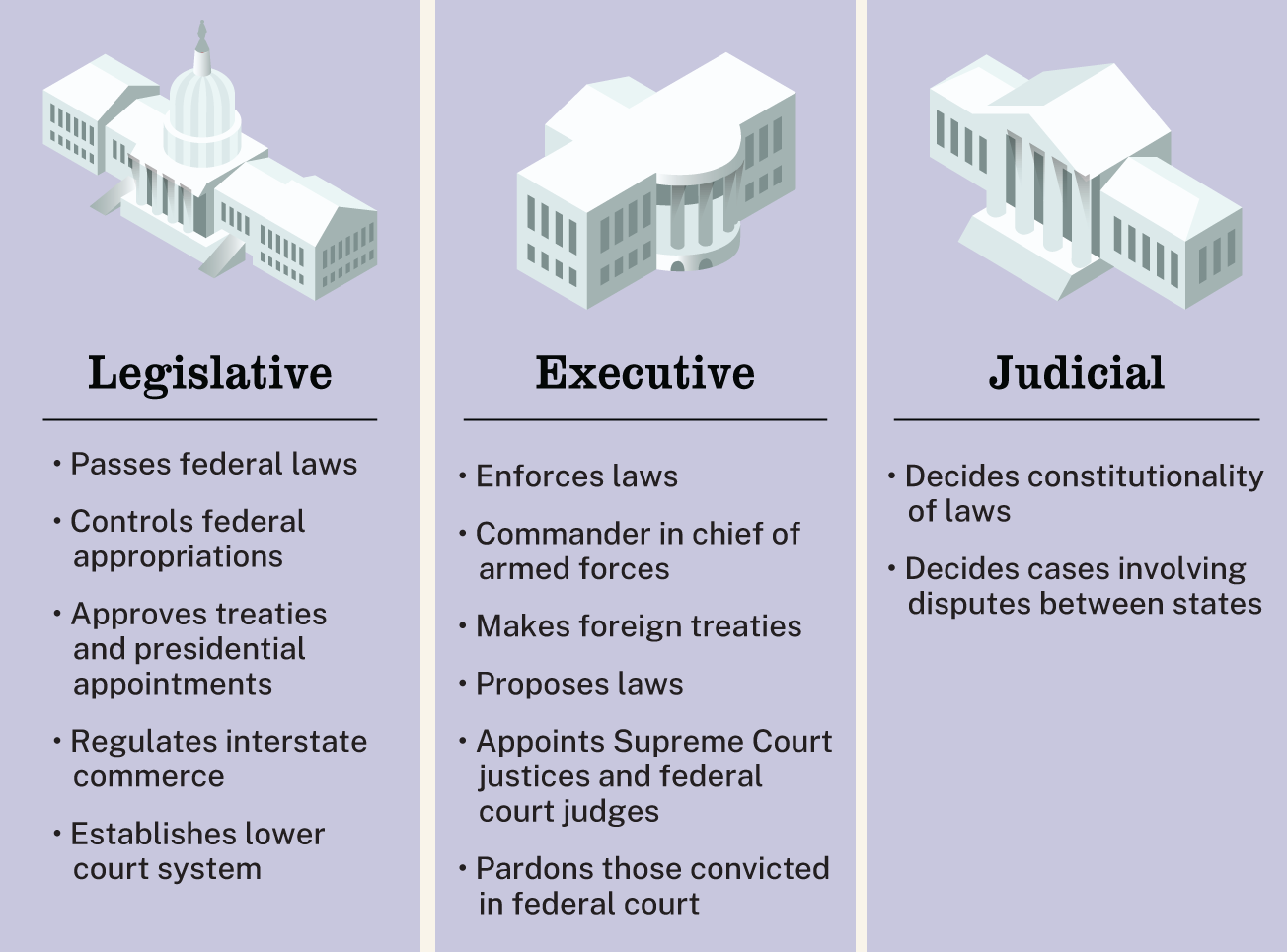
No principle of politics was more widely shared at the time of the 1787 Founding than the principle that power must be used to balance power. Although the separation of powers is not explicitly stated in the Constitution, the entire structure of the national government was built precisely on Article I, the legislature; Article II, the executive; and Article III, the judiciary (see Figure 2.3).
FIGURE 2.3The Separation of Powers
More information
A figure in table format lays out the Separation of Powers. Legislative Powers: The legislature Passes federal laws, Controls federal appropriations, Approves treaties and presidential appointments, Regulates interstate commerce, Establishes lower court system. Executive Powers: The Chief Executive Enforces laws, is the Commander in chief of armed forces, Makes foreign treaties, Proposes laws, Appoints Supreme Court justices and federal court judges, and Pardons those convicted in federal court. Judicial Powers: The Supreme Court Decides constitutionality of laws and Decides cases involving disputes between states.
The method adopted to maintain that separation became known by the popular label checks and balances (see Figure 2.4). Each branch is given not only its own powers but also some power over the other two branches. Among the most familiar checks and balances are the president’s veto power over Congress and Congress’s power over the president through its control of appointments to high executive posts and to the judiciary. Congress also has power over the president with its control of appropriations (the spending of government money) and the requirement that the Senate ratify treaties. The judiciary has the power to declare actions of the other two branches as unconstitutional.
FIGURE 2.4Checks and Balances
An important aspect of the separation of powers is that each branch is given a distinctly different constituency. Theorists such as Montesquieu called this arrangement a “mixed regime,” with the president being chosen, indirectly, by electors; the House, by popular vote; the Senate (originally), by state legislatures; and the judiciary, by presidential appointment. Through these means, the occupants of each branch would develop very different outlooks on how to govern, different definitions of the public interest, and different alliances with private interests.
FOR CRITICAL ANALYSIS
How does the separation of powers limit the national government’s power? What are the consequences for the ability of the federal government to govern? Do you think the separation of powers is working effectively today? Explain your answer.
Federalism
Compared with the decentralizing principle of the Articles of Confederation, federalism was a step toward greater concentration of power. The delegates to the Constitutional Convention agreed that they needed to place more power at the national level without completely undermining the power of the state governments. Thus, they devised a system of two sovereigns, or supreme powers—the states and the nation—with the hope that competition between them would effectively limit the power of each. (See Chapter 3 for more on this.)
The Bill of Rights
Late in the Convention, a motion was made to include a list of citizens’ rights in the Constitution. After a brief debate in which hardly a word was said in its favor and only one speech was made against it, the motion was almost unanimously turned down. Most delegates believed that since the federal government was already limited to its expressed powers, further protection of citizens was not needed. These delegates argued that states should adopt bills of rights because their greater powers needed greater limitations. But almost immediately after the Constitution was drafted, a movement arose to adopt a national bill of rights that would provide greater protection for individual rights.
the concluding paragraph of Article I, Section 8, of the Constitution (also known as the “necessary and proper clause”), which provides Congress with the authority to make all laws “necessary and proper” to carry out its enumerated powers
the power of the courts to review actions of the legislative and executive branches and, if necessary, declare them invalid or unconstitutional; the Supreme Court asserted this power in Marbury v. Madison (1803)
Article VI of the Constitution, which states that laws passed by the national government and all treaties are the supreme law of the land and superior to all laws adopted by any state or any subdivision
mechanisms through which each branch of government is able to participate in and influence the activities of the other branches; examples include the presidential veto power over congressional legislation, the Senate’s power to approve presidential appointments, and the Supreme Court’s power of judicial review of congressional enactments
Endnotes
Alexander Hamilton, James Madison, and John Jay, The Federalist Papers, no. 71, ed. Clinton L. Rossiter (New York: New American Library, 1961).Return to reference 26