Exchanges and Expansions in the Americas
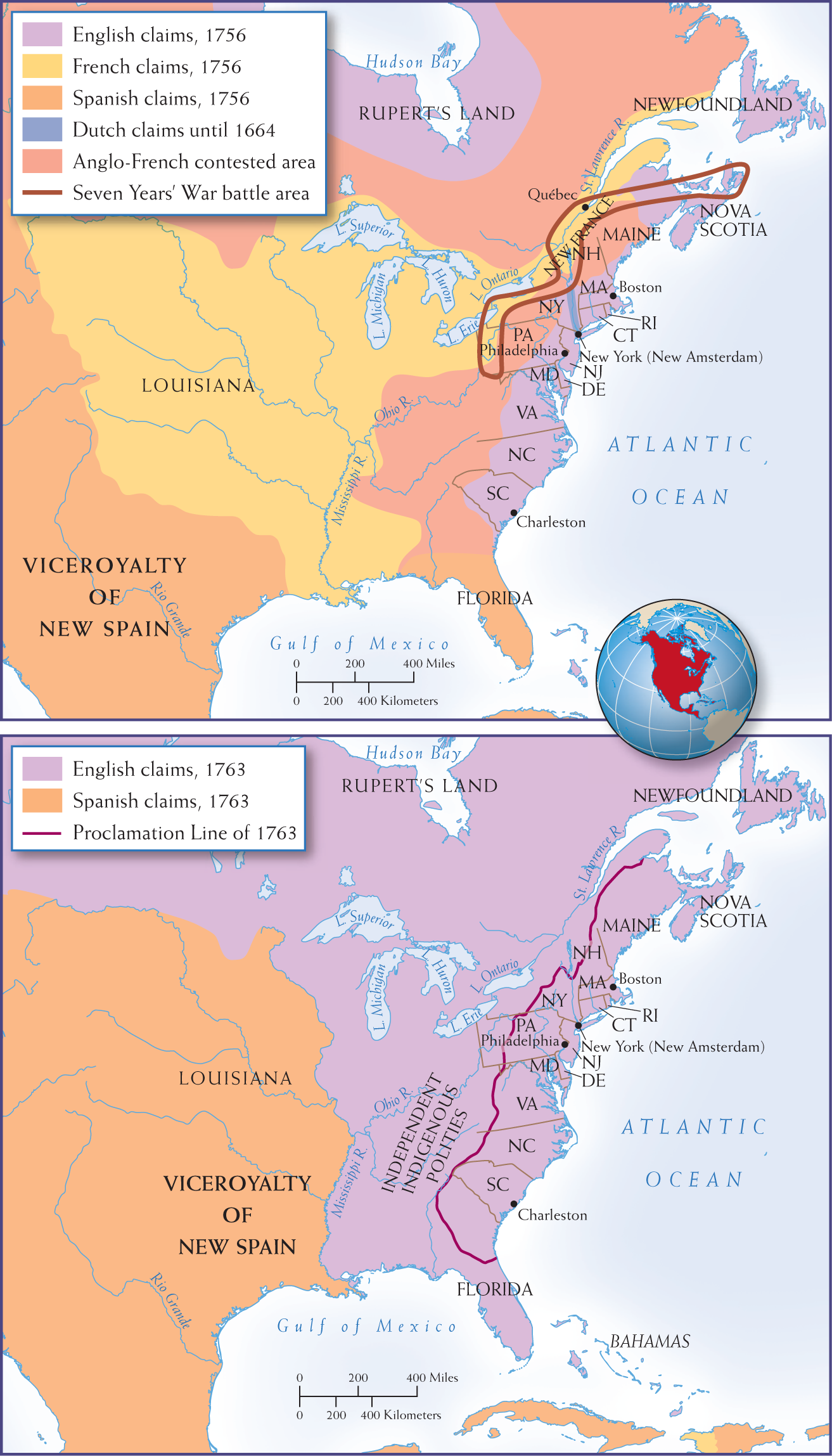
As rulers in England, France, and Holland granted monopolies to merchant companies, those countries began to dominate the settlement and trade of new colonies in the Americas and compete with the established colonies of Spain and Portugal. (See Map 13.2.) Although the search for precious metals or water routes to Asia had initially spurred British, French, and Dutch efforts to establish New World colonies, colonizers soon learned that only by exploiting other resources could they generate profits.
More information
Map 13.2 is titled, Colonies in North America, 1607-1763. The map contains images of two maps arranged one above the other. The top map image displays English, French, and Spanish claims in 1756, as well as Dutch claims until 1664, the Anglo-French contested area, and the Seven Years’ War battle area. It also shows the location of the 13 American colonies, Quebec, Boston, New York (New Amsterdam), and Philadelphia. Dutch claims are limited to a narrow sliver extending north from New York City. Spanish claims (labeled “Viceroyalty of New Spain”) include Florida, Mexico, and most of Texas and that part of the present-day United States that extends northwest of Texas. The English claim the east Coast colonies from South Carolina to Massachusetts as well as Nova Scotia, Newfoundland, and an area around the Hudson Bay labeled “Rupert’s Land.” and the land around Hudson Bay. The French claim an area labeled Louisiana that includes the present-day United States south of Canada and east of the Rockies to the Ohio River, as well as a small section of land (labeled “New France”) extending northeast from Lake Ontario to Newfoundland. The Anglo-French contested area includes Canada south and east of Rupert’s Land, the area between the 13 colonies and the Ohio River, New Hampshire, Maine, and the western portions of New York and Pennsylvania. The Seven Years’ War battle area covers a small diagonal section that extends first north and then east from the western edge of Maryland to Nova Scotia. The bottom image displays English possessions and Spanish possessions in 1763 as well as the same American colonies and cities shown in the top image. In 1763, Spanish possessions (labeled “Viceroyalty of New Spain”) include Mexico and all of the present-day United States west of the Mississippi River and south of the Canadian border, an area labeled “Louisiana.” English possessions include all of the United States east of the Mississippi and Canada.
MAP 13.2 | Colonies in North America, 1607–1763
France, England, and Spain laid claim to much of North America at this time.
- Where was each of these colonial powers strongest before the outbreak of the Seven Years’ War in 1756? (See p. 624 for a discussion of the Seven Years’ War.)
- Which empire gained the most North American territory, and which lost the most at the end of the war in 1763?
- How do you think Indigenous peoples reacted to the territorial arrangements agreed to by Spain, France, and England at the Peace of Paris, which ended the war?
Expanding Mainland Colonies
The Little Ice Age hit mainland North America hard. The first English, French, and Spanish settlers faced daunting challenges in freezing woodlands or in areas where Indigenous peoples were already scrambling for survival. Early settlements ended badly: the Spanish in Florida, the French in the mouth of the St. Lawrence River, and then the English in Jamestown in 1607 on the northern bank of the James River in what would become Virginia. The English arrived in the midst of a severe drought that lasted from 1606 to 1612; 80 percent of the settlers died of starvation and disease. The survivors were desperate to return to England. It was not until June 10, 1610, when a relief fleet arrived, that the struggling base avoided calamity. The first English settlement in North America could sink in its roots.
How the interlopers grappled with the challenges and opportunities laid the foundations for different models of North American colonialism. The important determinants were the resources they found and the relations between newcomers and Indigenous peoples. While the Dutch relied primarily on commerce, the British and the French exploited natural resources in their North American colonies: the British established farms in several different ecological zones, while the French relied primarily on the fur trade, especially in the interior.
In their colonies along the Atlantic seaboard, the English established one model for new colonies in the Americas. Although these territories failed to yield precious metals or a waterway across the continent, they did boast land suitable for agriculture. Different climates and soils made for very different agricultural possibilities: wheat, rye, barley, and oats in the Middle Colonies; tobacco in Virginia and North Carolina; and rice and indigo farther south. In all of England’s North American colonies, population growth fed greater hunger for farmlands, which put pressure on Indigenous holdings, leading to the dispossession of Indigenous peoples from lands between the Atlantic Ocean and the Appalachian Mountains.
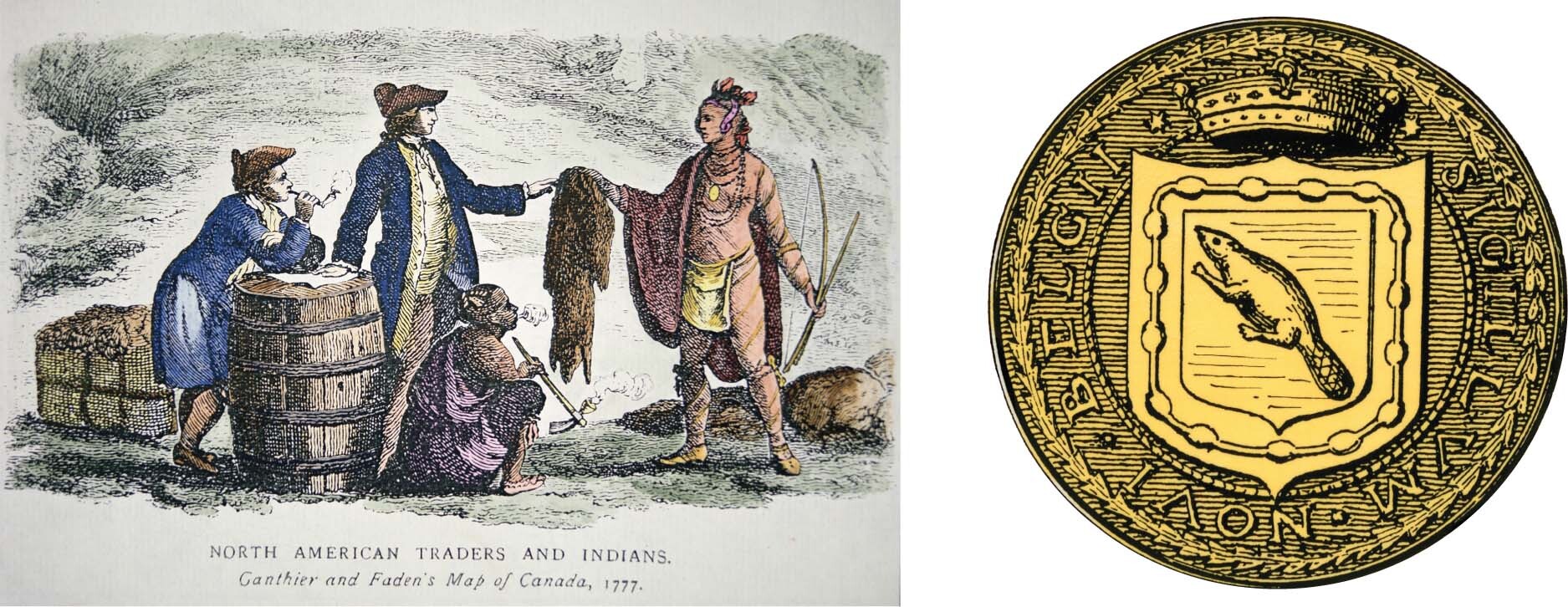
By contrast, Dutch and French colonies rested not on the expulsion of Indigenous peoples but on dependence on them. Holland’s North American venture proved short-lived, as the English took over New Netherland and renamed it New York in 1664. French claims were more enduring and extended across a vast swath of the continent, encompassing eastern Canada, the Great Lakes, and the Mississippi Valley. Crucial to the trade between Europeans and Indigenous peoples in the northern parts of North America was the beaver, an animal for which Indigenous peoples previously had only minor use.
The fur trade stood out for the Europeans’ utter dependence on Indigenous know-how. Trapping required familiarity with the beavers’ habits and habitats. Responding to Indigenous peoples’ desires to use trade as an instrument to cement familial bonds, the French gave gifts, participated in Indigenous diplomatic rituals, even married into Indigenous families. Women and girls acted as mediators. French–Indigenous offspring, Métis, inherited the mantle in New France as interpreters, traders, and guides. Intermarriage and the creation of mixed-race peoples became commonplace across the rest of the Americas as well, with the notable exception of the English colonies.
More information
A drawing of two Indigenous North Americans trading fur to two Europeans. One Indigenous North American holds a bow and arrow and holds out a pelt for inspection to the Europeans. The other Indigenous North American crouches near a barrel and smokes a large pipe. One of the Europeans holds a hand out to take the pelt and the other leans on the barrel and smokes a small pipe. There is a snowy landscape behind them and a caption that reads North American Traders and Indians. Ganthier and Faden’s Map of Canada, 1777 below them.
The seal of New Netherland shows a shield with the figure of a beaver in the center of it. The central figure is surmounted by the crown, and encircled by the words, “Sigillum Novi Belgii.”
As French (and English) traders introduced guns into the exchange networks, however, they initiated an arms race among Indigenous peoples. To get more guns, Indigenous peoples had to collect more skins, which resulted in the depletion of the beaver population in heavily trapped areas. That, in turn, pushed Indigenous peoples to expand their hunting/trapping zones, which heightened conflicts between groups now increasingly competing for hunting territories. Alcohol, too, became a potent weapon for Europeans. It gave them a commodity that Indigenous peoples wanted badly enough to undermine long-standing understandings of the relationship between humans and animals and to overwhelm strictures against overhunting.
New Indigenous Empires
Through the seventeenth century and into the middle of the eighteenth, most land in the interior of the North American continent remained firmly in Indigenous hands, despite the European empires’ expanding claims. On the Great Plains in the center of North America, some Indigenous communities lost ground to newcomers, but here the winners were other, often-displaced Indigenous groups. In effect, European penetration turned Indigenous tribes against each other as the dislocated from one place became invaders of others. In retrospect, it became more and more difficult to name anyone truly “Indigenous” as populations responded to the great upheaval. On the northern plains, the Lakotas, who had migrated westward onto the grasslands, emerged as the most successful expansionists. Migrating eastward, the Comanches reigned across a vast swath of the southern plains. These and other invaders displaced existing Indigenous societies from some lands, added to their ranks by capturing and often enslaving large numbers of people (especially women), and enriched themselves by their raiding and through their control over trading. The control that the Comanches asserted extended not only over other local peoples whom they captured and whose horses they plundered, but also over would-be European colonizers. From the eastern Plains almost to the Pacific Ocean, apart from a few enclaves of European settlement, Indigenous peoples largely determined where Europeans could go, stay, and trade. Thus, while early eighteenth-century maps drawn by European empire makers divvied up North America principally among British, French, and Spanish realms, the reality on the ground mocked these imperial pretensions.
There was considerable irony in the fact that Spanish colonizers had empowered the Plains peoples. The Spanish, after all, had brought horses to the Americas, and it was the acquisition of these animals that revolutionized local life and enabled Indigenous expansions on the Great Plains. Recognizing the role that horses played in their conquests, the Spanish had tried to keep them out of the hands of Indigenous communities. They failed. Once introduced into new habitats, the animals dispersed and flourished on the grasses of the Plains. So did the Indigenous peoples who had the greatest access to horses and who most decisively adapted. On horseback, Indigenous hunters could kill bison much more effectively, which encouraged some groups to forsake farming for hunting. Other groups, like the Lakotas and Comanches, moved onto the Plains in pursuit of buffalo. With horses, Indigenous peoples often gained military superiority over more sedentary peoples, whose villages and cornfields were vulnerable to mobile forces. By the early nineteenth century, equestrian empires unified vast areas. This was most significant for the Comanche, who had gone from being a tribal or ethnic group to becoming a powerful confederation capable of defeating European and Indigenous folk alike.
Not all Indigenous peoples prospered, however, and certainly not all equally. The gains of nomadic equestrians often came at the expense of those who remained wedded to a mixture of horticulture and hunting. Within horse cultures, new inequalities materialized. More successful raiders and hunters not only earned greater honor but also acquired more horses. One effect was to create new divides within Indigenous households between men who became more ambulatory and devoted to hunting and women who remained closer to the villages and worked on their sustenance. For victorious men, capturing more horses usually brought higher status and more wives. At the same time, the status of women generally declined in the transition from horticultural to hunting societies. Their burdens, however, did not, as there were now more buffalo waiting to be turned by women into the products that sustained Plains peoples’ life.