Exchanges and Expansions in North America
Freezing temperatures and warfare in Europe did not prevent England, France, and Holland from joining Spain and Portugal in the rush to reap riches from American colonies and to take a greater share of global commerce. As rulers in England, France, and Holland granted monopolies to merchant companies, they began to dominate the settlement and trade of new colonies in the Americas. (See Map 13.2.) Although the search for precious metals or water routes to Asia had initially spurred many of these enterprises, the new colonizers learned that only by exploiting other resources could their claims in the Americas generate profits. Also, differences among New World societies required rethinking the character of colonies within mercantilist regimes.
The Little Ice Age made the repopulating of mainland North America traumatic. Especially hard-hit were the first English, French, and Spanish settlers. Getting a toehold in freezing woodlands or in areas where Indigenous peoples were already scrambling for survival presented the European interlopers with never-ending frustrations. Early settlements ended badly: namely, the Spanish in Florida, the French in the mouth of the St. Lawrence River, and then the English in Jamestown in 1607 on the northern bank of the James River in what would become Virginia. The English arrived in the midst of a severe drought that lasted from 1606 to 1612; 80 percent of the settlers died of starvation and disease. The survivors were desperate to return to England. It was not until June 10, 1610, when a relief fleet arrived, that the struggling base avoided calamity. The first English settlement in North America could sink its roots.
How the interlopers grappled with the challenges and opportunities laid the foundations for different models of North American colonialism. The important determinants were the resources they found and the relations between newcomers and Indigenous peoples. In Indigenous peoples’ colonies along the Atlantic seaboard, the English established one model for new colonies in the Americas. Although these territories failed to yield precious metals or a waterway across the continent, they boasted land suitable for growing numerous crops. Within the English domain, different climates and soils made for very different agricultural possibilities: wheat, rye, barley, and oats from the Middle Colonies (Pennsylvania, New York, New Jersey, and Delaware); tobacco from Virginia and North Carolina; and rice and indigo from farther south. But all the English colonies shared a common feature: population growth led to greater demand for farmlands, which put pressure on Indigenous holdings. The Little Ice Age exacerbated the stress, because shorter growing seasons diminished harvests. Thus, more acreage had to be cultivated to support the colonies’ surging population in North America, which meant more lands taken from Indigenous tribes. The result: a souring of relations between Indigenous peoples and colonists. In 1675, which colonists described as a “year without a summer,” ferocious wars broke out between Indigenous peoples and English colonists in Virginia and New England. Similar pressures ignited other conflicts throughout the seventeenth and eighteenth centuries and led to the dispossession of Indigenous peoples from lands between the Atlantic Ocean and the Appalachian Mountains.
More information
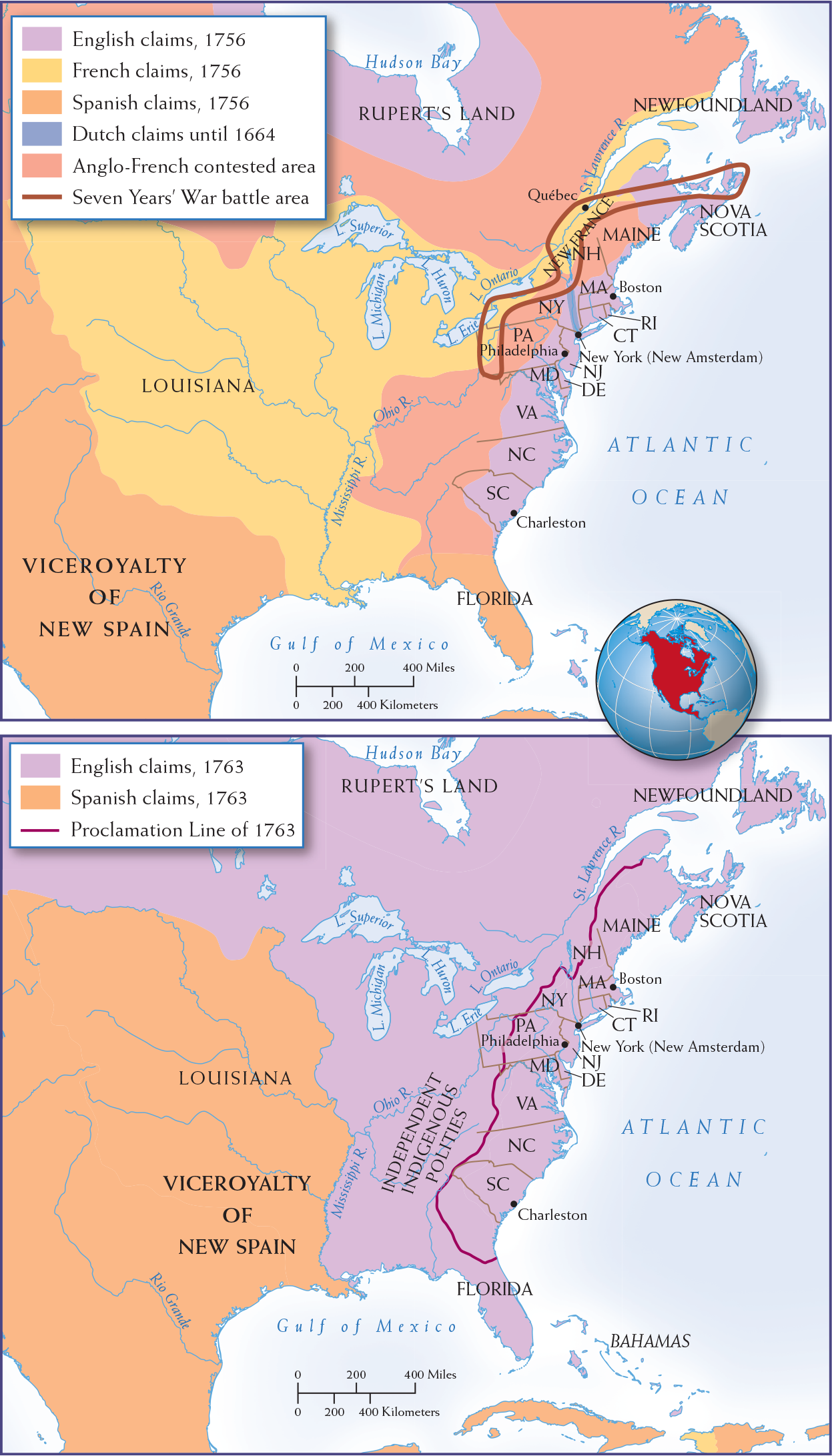
Map 13.2 is titled, Colonies in North America, 1607-1763. The map contains images of two maps arranged one above the other. The top map image displays English, French, and Spanish claims in 1756, as well as Dutch claims until 1664, the Anglo-French contested area, and the Seven Years’ War battle area. It also shows the location of the 13 American colonies, Quebec, Boston, New York (New Amsterdam), and Philadelphia. Dutch claims are limited to a narrow sliver extending north from New York City. Spanish claims (labeled “Viceroyalty of New Spain”) include Florida, Mexico, and most of Texas and that part of the present-day United States that extends northwest of Texas. The English claim the east Coast colonies from South Carolina to Massachusetts as well as Nova Scotia, Newfoundland, and an area around the Hudson Bay labeled “Rupert’s Land.” and the land around Hudson Bay. The French claim an area labeled Louisiana that includes the present-day United States south of Canada and east of the Rockies to the Ohio River, as well as a small section of land (labeled “New France”) extending northeast from Lake Ontario to Newfoundland. The Anglo-French contested area includes Canada south and east of Rupert’s Land, the area between the 13 colonies and the Ohio River, New Hampshire, Maine, and the western portions of New York and Pennsylvania. The Seven Years’ War battle area covers a small diagonal section that extends first north and then east from the western edge of Maryland to Nova Scotia. The bottom image displays English possessions and Spanish possessions in 1763 as well as the same American colonies and cities shown in the top image. In 1763, Spanish possessions (labeled “Viceroyalty of New Spain”) include Mexico and all of the present-day United States west of the Mississippi River and south of the Canadian border, an area labeled “Louisiana.” English possessions include all of the United States east of the Mississippi and Canada.
MAP 13.2 | Colonies in North America, 1607–1763
France, England, and Spain laid claim to much of North America at this time.
- Where was each of these colonial powers strongest before the outbreak of the Seven Years’ War in 1756? (See p. 582 for a discussion of the Seven Years’ War.)
- Which empire gained the most North American territory, and which lost the most at the end of the war in 1763?
- How do you think Indigenous peoples reacted to the territorial arrangements agreed to by Spain, France, and England at the Peace of Paris, which ended the war?
By contrast, Dutch and French colonies rested not on the expulsion of Indigenous peoples but on dependence on them. Holland’s North American venture, however, proved short-lived, as the English took over New Netherland and renamed it New York in 1664. French claims were more enduring and extended across a vast swath of the continent, encompassing eastern Canada, the Great Lakes, and the Mississippi Valley.
Trade between European and Indigenous Peoples
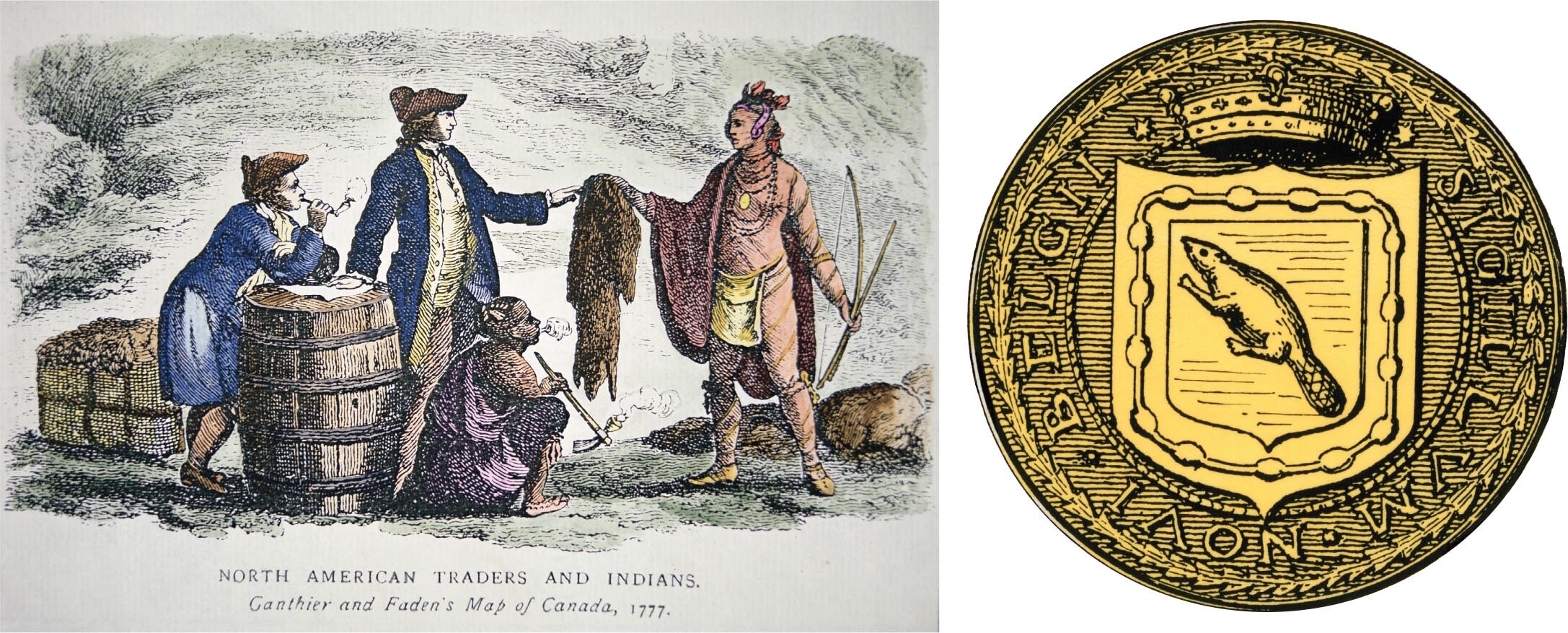
Crucial to the trade between European and Indigenous peoples in northern North America was the beaver, an animal for which local peoples previously had only minor use. In response to the Europeans’ interest, one French Jesuit heard an Innu man explain, “The beaver does everything perfectly well; it makes kettles, hatchets, swords, knives, bread; in short it makes everything.” As long as there were beavers to be trapped, trade between the Europeans and their Indigenous partners flourished.
The distinctive aspect of the fur trade was the Europeans’ utter dependence on Indigenous know-how. After all, trapping required familiarity with the beaver’s habits and habitats, which Europeans lacked. In particular, this reliance forced French traders who ventured farther into the continent’s interior to adapt to local ways, especially when living among Huron and Algonquin peoples. Responding to Indigenous peoples’ desires to use trade as an instrument to cement familial bonds, the French gave gifts, participated in Indigenous diplomatic rituals, and even married into local families. Women and girls were crucial mediators and brokers in the relationships between newcomers and Indigenous peoples. French-Indigenous offspring, Métis, inherited the mantle in New France as interpreters, traders, and guides. Thus, the French colonization of the Americas—owing to French reliance on Indigenous peoples as trading partners, military allies, and mates—rested more on cooperation than conquest, especially compared with the empires built by their Spanish and English rivals. Intermarriage and the creation of mixed-race peoples became commonplace across the rest of the Americas as well, with the notable exception of the English colonies.
Over the long run, Europeans’ trade in guns, alcohol, and trinkets gave them power advantages. It also set off a crippling arms race between Indigenous groups, many of whom competed to extract furs to trade. This led to a depletion of beaver stocks. But through the seventeenth century and into the middle of the eighteenth, the majority of lands in the interior of the North American continent remained firmly in local hands, despite the invaders’ expansive claims. On the Great Plains in the center of North America, some locals lost ground to newcomers, but here the winners were other, often-displaced, Indigenous groups. In effect, European penetration turned Indigenous peoples against each other as fugitives from one place became invaders of others. In retrospect, it became more and more difficult to name anyone truly “Indigenous” as populations responded to the great upheaval. On the northern plains, the Lakotas, who had migrated westward onto the grasslands, emerged as the most successful expansionists. Coming eastward, the Comanches reigned across a vast swath of the southern plains. These and other invaders displaced existing Indigenous societies from some lands, added to their ranks by capturing and often enslaving large numbers of people (especially females), and enriched themselves by their raiding and through their control over trading. The control that the Comanches asserted extended not only over other local peoples whom they captured and whose horses they plundered, but also over would-be European colonizers. From the eastern Plains almost to the Pacific Ocean, with the exception of a few enclaves of European settlement, it was Indigenous peoples who largely determined where Europeans could go, stay, and trade. Thus, while early eighteenth-century maps drawn by European empire makers divvied up North America principally among British, French, and Spanish realms, the reality on the ground mocked these imperial pretensions.
More information
A drawing of two Indigenous North Americans trading fur to two Europeans. One Indigenous North American holds a bow and arrow and holds out a pelt for inspection to the Europeans. The other Indigenous North American crouches near a barrel and smokes a large pipe. One of the Europeans holds a hand out to take the pelt and the other leans on the barrel and smokes a small pipe. There is a snowy landscape behind them and a caption that reads North American Traders and Indians. Ganthier and Faden’s Map of Canada, 1777 below them.
The seal of New Netherland shows a shield with the figure of a beaver in the center of it. The central figure is surmounted by the crown, and encircled by the words, “Sigillum Novi Belgii.”
There was considerable irony in the fact that Spanish colonizers had empowered the Plains peoples. The Spanish, after all, had brought horses to the Americas, and it was the acquisition of these animals that revolutionized local life and enabled Indigenous expansions on the Great Plains. Recognizing the role that horses played in their conquests, the Spanish had tried to keep them out of local hands. They failed. Raiders targeted horses because they were so valuable. Once introduced into local habitats, the animals dispersed and flourished on the grasses of the Plains. So did the Indigenous peoples who had greatest access to horses and who most decisively adapted to equestrianism. On horseback, incumbents could kill bison much more effectively, which encouraged some groups to forsake farming for hunting. Other groups, like the Lakotas and Comanches, moved onto the Plains in pursuit of buffalo. Astride horses, Indigenous peoples and newcomers also gained military superiority over more sedentary peoples, whose villages and cornfields were vulnerable to mobile forces. By the early nineteenth century, equestrian empires brought vast areas under one roof. This was most significant for the Comanche, who had gone from being a tribal or ethnic group to becoming a powerful confederation capable of subduing and defeating European and Indigenous folk alike.
Not all Indigenous peoples prospered, however, and certainly not all equally. The gains of nomadic equestrians often came at the expense of those who remained wedded to a mixture of horticulture and hunting. Within horse cultures, new inequalities materialized. More successful raiders and hunters not only earned greater honor but also acquired more horses. One effect was to create new divides within Indigenous households between women who remained closer to the villages and worked on their sustenance and men who became more ambulatory and devoted to hunting. For victorious men, capturing more horses usually brought higher status and more wives. At the same time, the status of women generally declined in the transition from horticultural to hunting societies. Their burdens, however, did not, as there were now more buffalo waiting to be turned by women into the products that sustained Plains peoples’ life.
The Plantation Complex in the Caribbean
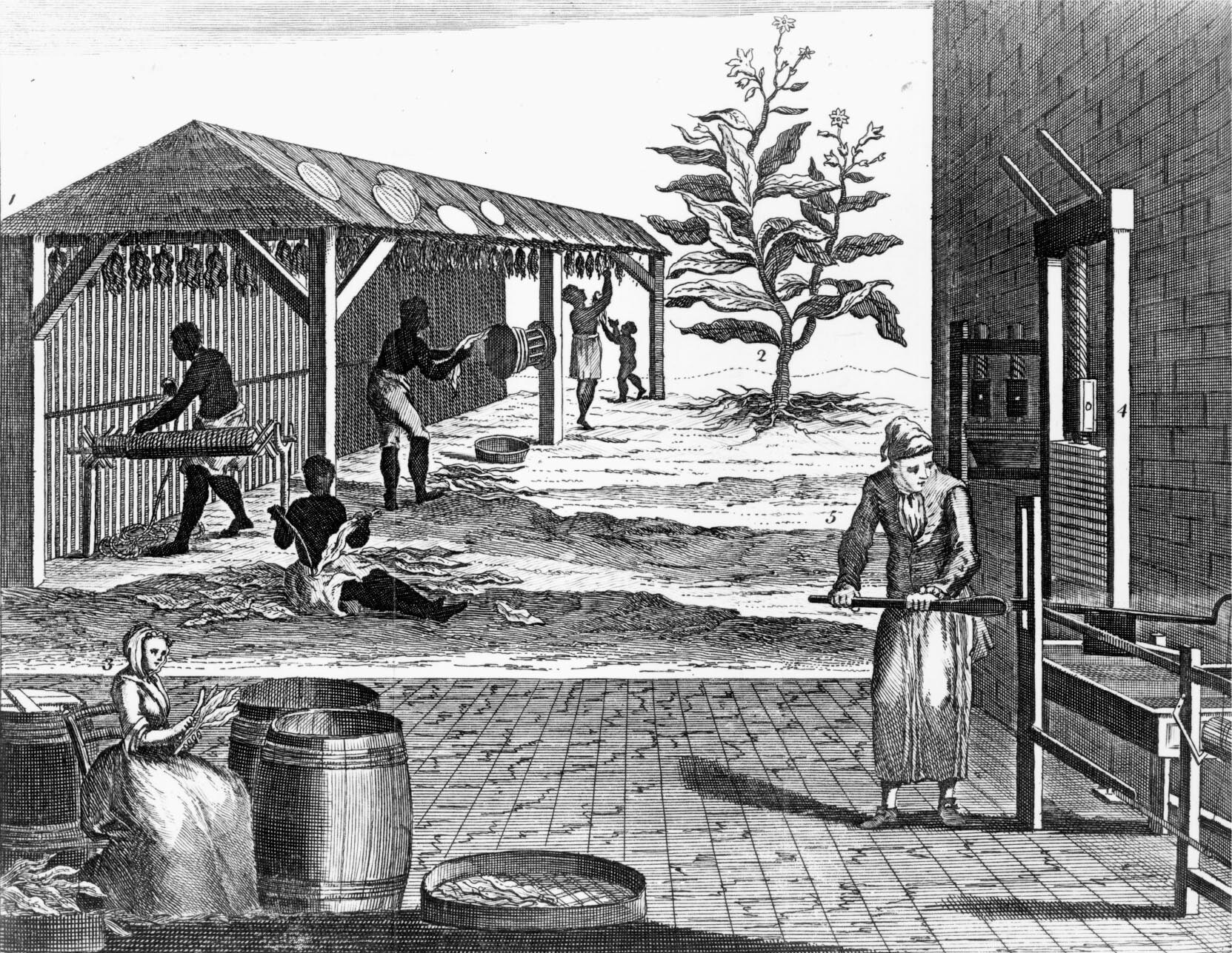
As late as 1670, the most populous English colony was not on the North American mainland. It was the Caribbean island of Barbados. Because sugar was so desirable, from the mid-seventeenth century onward the English- and French-controlled islands of the Caribbean replicated the Portuguese sugarcane plantations of Brazil; sugar became a quintessential mercantilist commodity. All was not sweet here, however. To begin with, the Indigenous peoples were all but wiped out or scattered to the mainland (see Chapter 12). Moreover, because no colonial power held a monopoly over the archipelago of islands, competition to control the region—and sugar production—was fierce. The resulting turbulence did not simply reflect imperial rivalry; it also reflected labor arrangements in the colonies. Competing owners of Caribbean estates looked to Africa to supply workers for their plantations.
More information
A drawing of tobacco processing on a plantation. In the foreground one white woman sorts tobacco leaves while another operates a machine that presses them. In the background one enslaved African person sorts tobacco leaves while several others roll dried tobacco into ropes under a covered area. There are some barrels in the foreground, the wall of a brick building to the right, and a tree in the background.
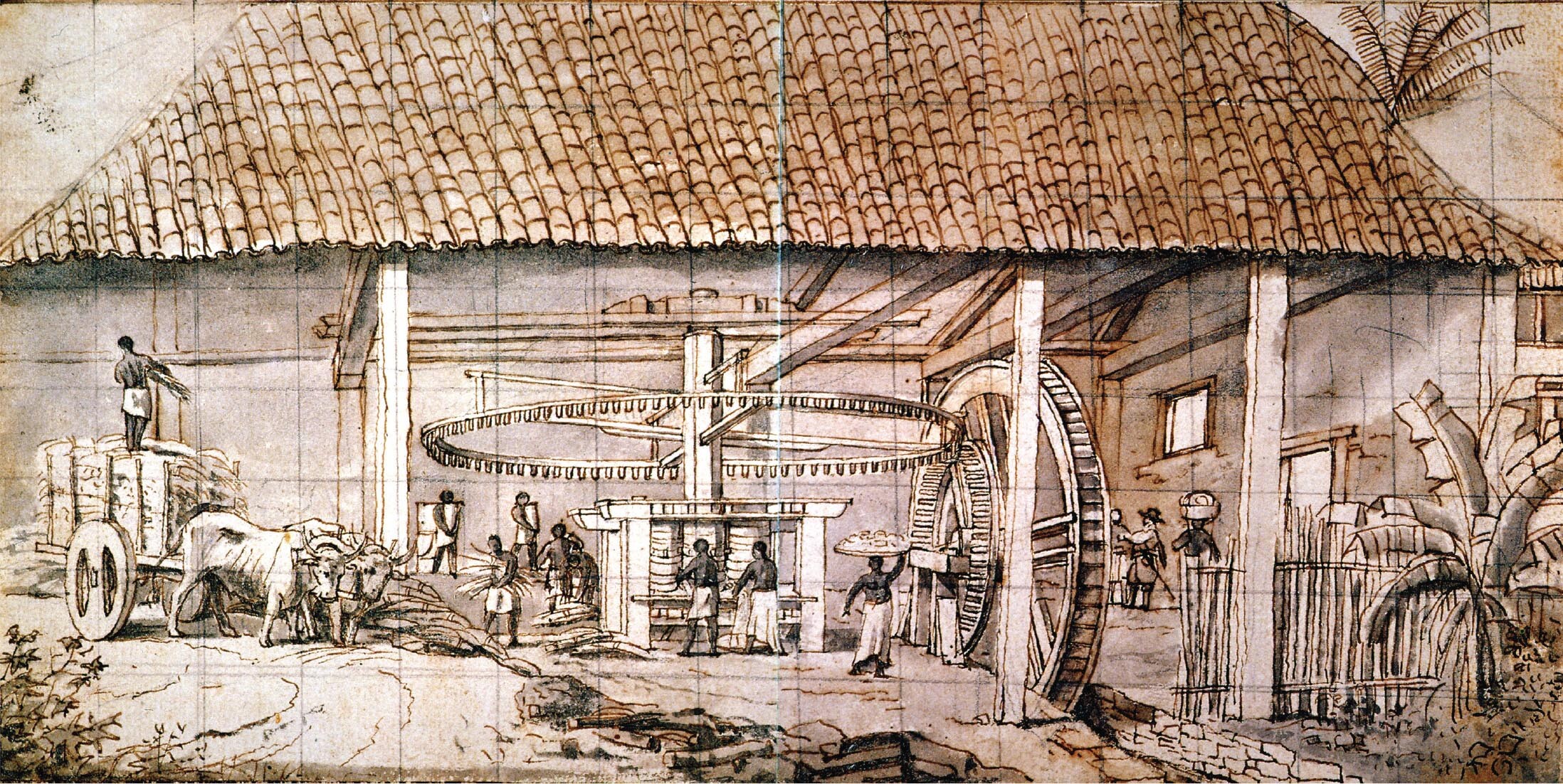
Sugar was a killing crop. So deadly was the hot, humid environment in which sugarcane flourished (as fertile for disease as for sugarcane) that many sugar barons spent little time on their plantations. Management fell to overseers, who worked their enslaved laborers to death. Despite having immunity to yellow fever and malaria from their homeland’s similar environment, Africans could not withstand the regimen. Inadequate food, atrocious living conditions, and filthy sanitation added to their miseries. Moreover, plantation managers dehumanized African workers starting on the first day they became property, when they were branded with the enslaver’s seal. One English observer commented that the enslaved were like cows, “as near as beasts may be, setting their souls aside.”
More information
A drawing shows a sugar mill with enslaved Africans working in it depicting the nature of the sugar production process. A man on the left stands on the ox cart carrying a load of cut sugar cane. Two men in the center pass the cane through the rollers of the mill. There is a large circle with many short rods hanging downwards from above the rollers. There are two large wheels over twice the height of a person to the right of the rollers. One man carries a large disc above his head while several others carry objects around the mill.
More than disease and inadequate rations, the work itself was decimating. Average life expectancy was three years. Six days a week, people who were enslaved on a plantation rose before dawn, labored until noon, ate a short lunch, and then worked until dusk. At harvest time, 16-hour days saw hundreds of men, women, and children bent over to cut the sugarcane and transport it to refineries, sometimes seven days per week. Entire households labored in the fields, erasing distinctions of age and gender. Under this brutal schedule, people occasionally dropped dead from exhaustion.
Amid disease and toil, the enslaved coped and resisted as they could. The most dramatic form of resistance was violent revolt. A more common form was flight. Casting around for refuge from overseers, thousands of freedom seekers took to the hills—for example, to the remote highlands of Caribbean islands or to Brazil’s vast interior. Those who remained on the plantations resisted via foot-dragging, pilfering, and sabotage.
Caribbean settlements and slaveholdings were not restricted to any single European power. But it was the latecomers—the Dutch, the English, and especially the French—who concentrated on the West Indies and who grew wealthy and powerful. (See Map 13.3.) The English took Jamaica from the Spanish in 1655 and made it the premier site of Caribbean sugar by the 1740s. When the French seized half of Santo Domingo in the 1660s (renaming it Saint-Domingue, which is present-day Haiti), they created one of the wealthiest societies based on slavery of all time. This French colony’s exports eclipsed those of all the Spanish and English Antilles combined. The capital, Port-au-Prince, was one of the richest cities in the Atlantic world. The colony’s merchants and planters built immense mansions worthy of the highest European nobles. Thus, the Atlantic system benefited elite Europeans, who amassed new fortunes by exploiting the colonies’ natural resources and the labor of the Africans they enslaved. The American trade also laid the financial foundations and the heightened consumer demands that were crucial for Europe’s late eighteenth- and early nineteenth-century industrial revolution (see Chapter 15).