Core Objectives
COMPARE the internal divisions within the Islamic, Tang, and Christian worlds.
COMPARE the internal divisions within the Islamic, Tang, and Christian worlds.
European historians debate whether or not to label this period in Europe “the Dark Ages.” Scholars who have spurned the term “Dark Ages,” in favor of the term “Late Antiquity,” emphasize the political and cultural continuities between Rome and its successor states, especially in the eastern Mediterranean, and the new dynamic institutions that arose in Rome’s wake. Scholars who favor the term “Dark Ages” stress what they see as a sharp cultural, political, and economic decline accompanying the Roman Empire’s fall, especially in the western Mediterranean. “The Dark Ages,” as a label for this period, has been resurrected by environmental historians, who argue that the period was indeed dark, as a result of a colder and drier climate. Agricultural production declined, famines occurred year after year, and infectious diseases spread across Afro-Eurasia (for example, the plague during the reign of Justinian; see Chapter 1). This harsher climate and the diseases that accompanied it between 400 and 900 CE caused dying and mortality on a large scale. The drought that was wreaking havoc in Europe is the same one that helped spur Arab tribal peoples, carrying the banner of Islam, to pour out of their severely affected lands in the Arabian Peninsula in search of better lands and a better life, as other nomadic groups had done.
Although western Europe lacked a highly developed political empire like that of the Abbasids or the Tang dynasty, Christianity increasingly unified the peoples of Europe. In fifth-century CE western Europe, the mighty Roman military machine gave way to a multitude of warrior leaders whose principal allegiances were local. The political ideal of the Roman Empire certainly influenced western Europeans, but the true inheritor of Rome in the west was the Roman Catholic Church, with its priests, missionaries, and monks. In northern Europe, a frontier mentality and the Viking incursions played their own role in shaping the Catholic church. In eastern Europe and Byzantium, a form of Christianity known as Greek Orthodoxy had become dominant by 1000 CE. Together, these two major strands of the faith—the western Roman Catholic Church and eastern Greek Orthodoxy—constituted the realm of Christendom, the entire portion of the world in which Christianity prevailed as a unifying institution. (See Map 2.7.)
 Alubabaz, the Elephant
Far removed from the old centers of high culture, Charlemagne (r. 768–814 CE), ruler of the Franks, expanded his western European kingdom through constant warfare and plunder. In 802 CE, Harun al-Rashid, the Abbasid ruler of Baghdad, sent the gift of an elephant to Charlemagne, already the king of the Franks for three decades and recently crowned by the pope in Rome as “Holy Roman Emperor” (on Christmas Day in 800 CE). While the Franks interpreted the caliph’s gift as an acknowledgment of Charlemagne’s power, al-Rashid more likely sent the rare beast as a gracious reminder of his own formidable sway. In al-Rashid’s eyes, Charlemagne’s “empire” was a minor principality. Although Charlemagne claimed the lofty title of emperor and ultimately controlled much of western Europe, compared with the Islamic world’s rulers and vast domain, he was a political lightweight.
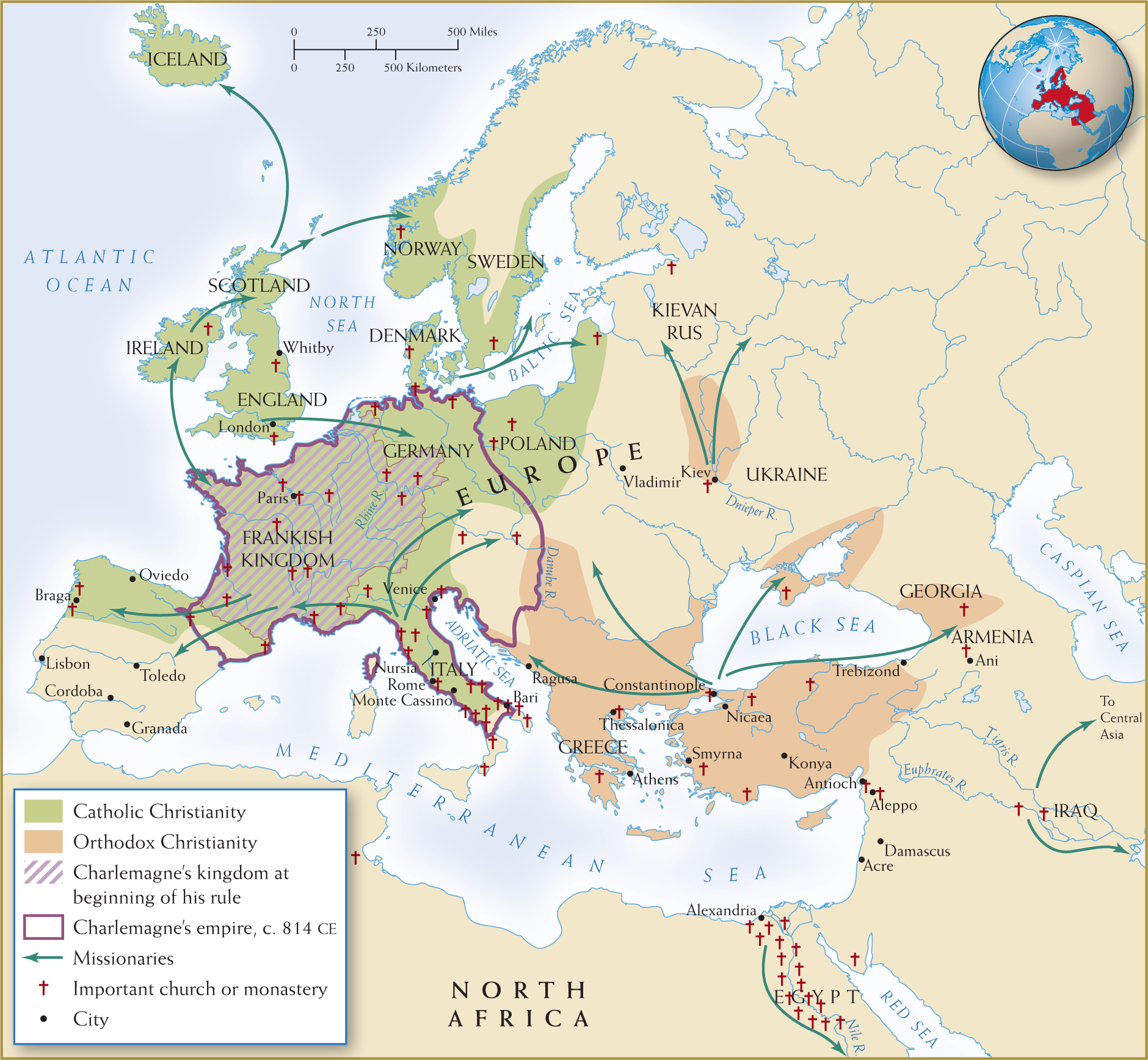
Map 2.7 Christendom, 600–1000 CE
The end of the first millennium saw much of Europe divided between two versions of Christianity, each with different traditions. On the map, locate Rome and Constantinople, the two seats of power in Christianity.
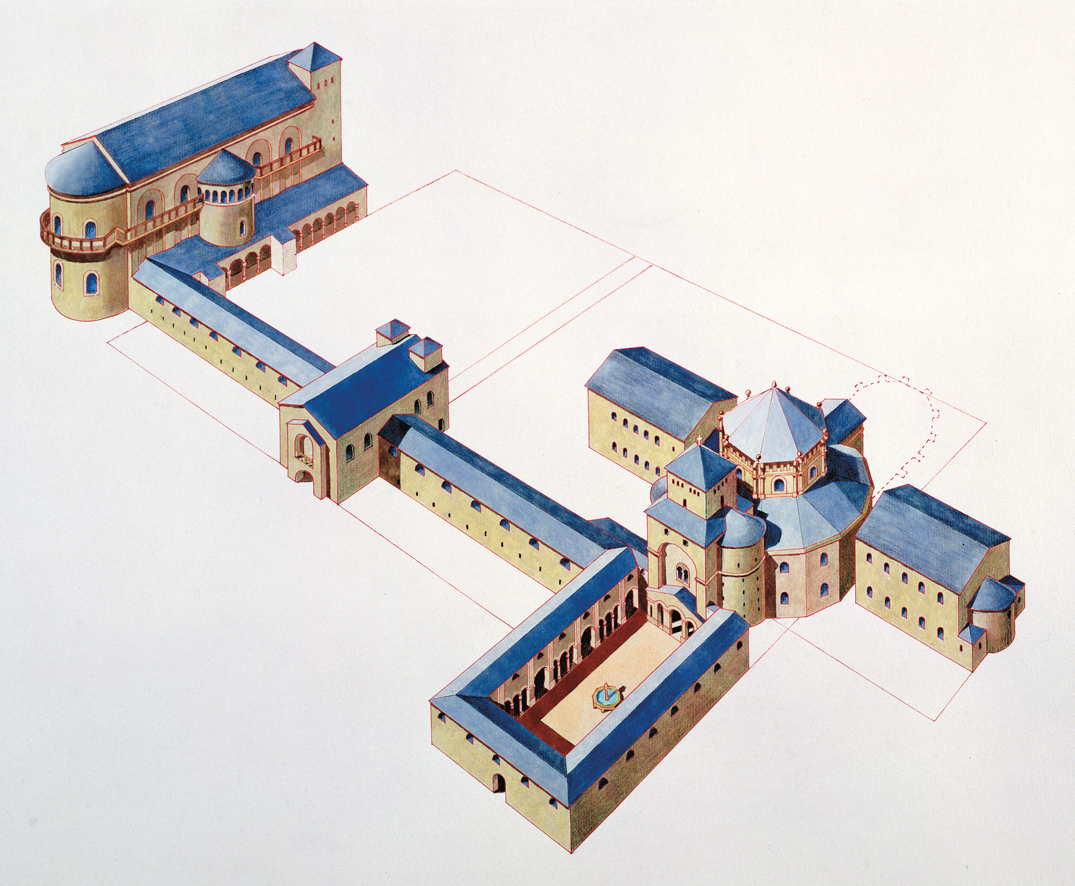
Charlemagne’s empire had a population of less than 15 million; he rarely commanded armies larger than 5,000; and his tax system was rudimentary. At a time when the caliph’s palace at Baghdad covered nearly 250 acres, Charlemagne’s palace at Aachen was merely 330 by 655 feet. Baghdad itself was almost 40 square miles in area, whereas there was no “town” outside the palace at Aachen. The palace was essentially a large country house set in open countryside, where Charlemagne and his Franks hunted wild boar from horseback.
Charlemagne and his men were representatives of the warrior class that dominated post-Roman western Europe. After Roman control faded away, war became once again the duty and joy of the aristocrats. Although the Franks vigorously engaged in trade, even that trade was based on war. Europe’s principal export at this time was Europeans, and the massive sale of prisoners of war, in markets at Alexandria, Tunis, and southern Spain, financed the Frankish Empire. The main victims of this trade were Slavic-speaking peoples, tribal hunters and cultivators from eastern Europe. This trade in Slavs gives us the modern term slave.
Yet Charlemagne’s seemingly uncivilized and inhospitable empire offered fertile ground for Christianity to sink down roots. As Christianity grew in western and northern Europe, the rough frontier mentality fueled its expansionist ambitions.
Christians of the west, including those in northern Europe, felt that theirs was the one truly universal religion. Their goal was to bring rival groups into a single Roman Catholic Church that was replacing a political unity lost in western Europe when the Roman Empire fell. Drawing on the ideas of Augustine of Hippo (c. 410 CE), the western Christians believed that the “city of God” would take earthly shape in the form of the Catholic Church, and that the Catholic Church was not just for Romans—it was for all times and for all peoples.
The arrival of Christianity in northern Europe provoked a cultural revolution. Preliterate societies now encountered a sacred text—the Bible—in a language that seemed utterly strange. Latin had become a sacred language, and books themselves were vehicles of the holy. A bound codex or manuscript, which had replaced the clumsy scroll, was still messy: it had no divisions between words, no punctuation, no paragraphs, no chapter headings. Readers who knew Latin as a spoken language could understand the script. But Irishmen, Saxons, and Franks could not, for they had never spoken Latin. Consequently, great care was lavished on the few parchment texts—like the Gospels in the Book of Kells (c. 800 CE)—that were prepared with words separated, sentences correctly punctuated and introduced by uppercase letters, and chapter headings.
CONTEXTUALIZATION Explain the origins and role of monasticism in Europe during the Late Antiquity.
The artists producing these stunning Bibles were starkly different from ordinary men and women. They were monks and nuns. Christian monasticism had originated in Egypt, but it suited well the missionary tendencies of Christianity in northern Europe. The root of “monastic” and “monk” is the Greek monos, “alone”: a monastic was a man or a woman who chose to live alone, without the support of marriage or family. In Muslim (and Jewish) communities, religious leaders emphasized what they had in common with those around them. Many Islamic scholars, theologians, and mystics were married men, even merchants and courtiers. In the Christian west, the opposite was true: warrior societies honored small groups of monks and nuns who were utterly unlike themselves: unmarried, unfit for warfare, and intensely literate in an incomprehensible tongue.
Monasticism appealed to a deep sense that the very men and women who had little in common with ordinary people were best suited to mediate between believers and God. Laypersons (common believers, not clergy) gave gifts to the monasteries and offered them protection. In return, they gained the prayers of monks and nuns and the reassurance that although they themselves were warriors and men of blood, the monks’ and nuns’ interventions on their behalf would keep them from going to hell. Payment for human sin, the atoning power of Jesus’s crucifixion, and the efficacy of monastic prayers were significant theological emphases for western Roman Catholics.
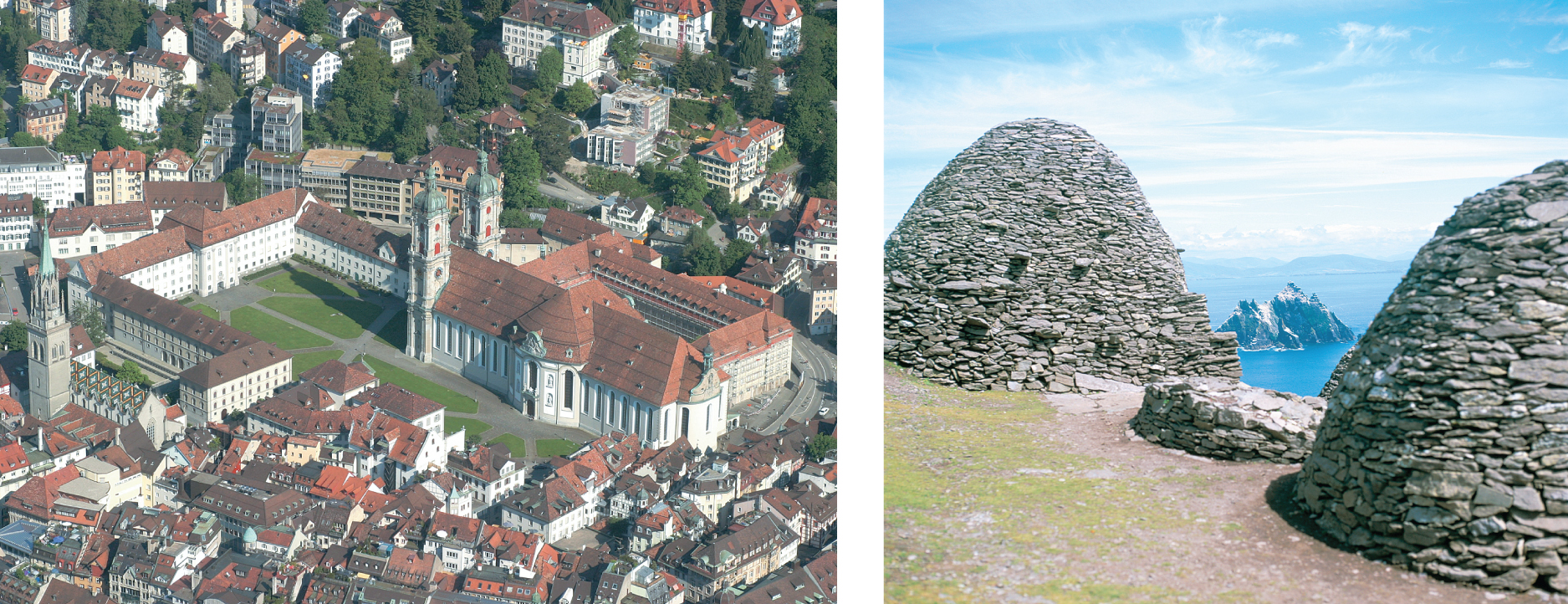
The Catholic Church of northern Europe was a religion of monks, whose communities represented an otherworldly alternative to the warrior societies of the time. By 800 CE, most regions of northern Europe held great monasteries, many of which were far larger than the local villages. Supported by thousands of serfs donated by kings and local warlords, the monasteries became powerhouses of prayer that kept the regions safe.
Northern Christianity also gained new ties to an old center: the city of Rome. The Christian bishop of Rome had always enjoyed much prestige but often took second place to other bishops in Carthage, Alexandria, Antioch, and Constantinople. Though people spoke of him with respect as papa (“the grand old man”), many others shared that title.
CONTEXTUALIZATION Explain how the popes achieved importance in Roman Catholicism.
By the ninth century CE, this picture had changed. Believers from the distant north saw only one papa left in western Europe: Rome’s pope. New Christians in northern borderlands wanted to find a religious leader for their hopes, and the Catholic Church of western Europe united behind the symbolic center of Rome and its popes. Charlemagne fed this desire when, in 800 CE, he went out of his way to celebrate Christmas Day by visiting the shrine of Saint Peter at Rome. There, Pope Leo III acclaimed him as the new “emperor” of the west. A “modern” Rome—inhabited by popes, famous for shrines of the martyrs, and protected by a “modern” Christian monarch from the north—was what Charlemagne’s subjects wanted.
The Vikings
Vikings from Scandinavia exposed the weakness of Charlemagne’s Christian empire. When al-Rashid’s elephant died in 813 CE, the Franks viewed it as an omen of coming disasters. The great beast keeled over when his handlers marched him out to confront a Viking army from Denmark. Charlemagne died the next year. In the next half century, Charlemagne’s empire of borderland peoples met its match on the wide border between the European landmass and the Atlantic. (See Map 2.8.)
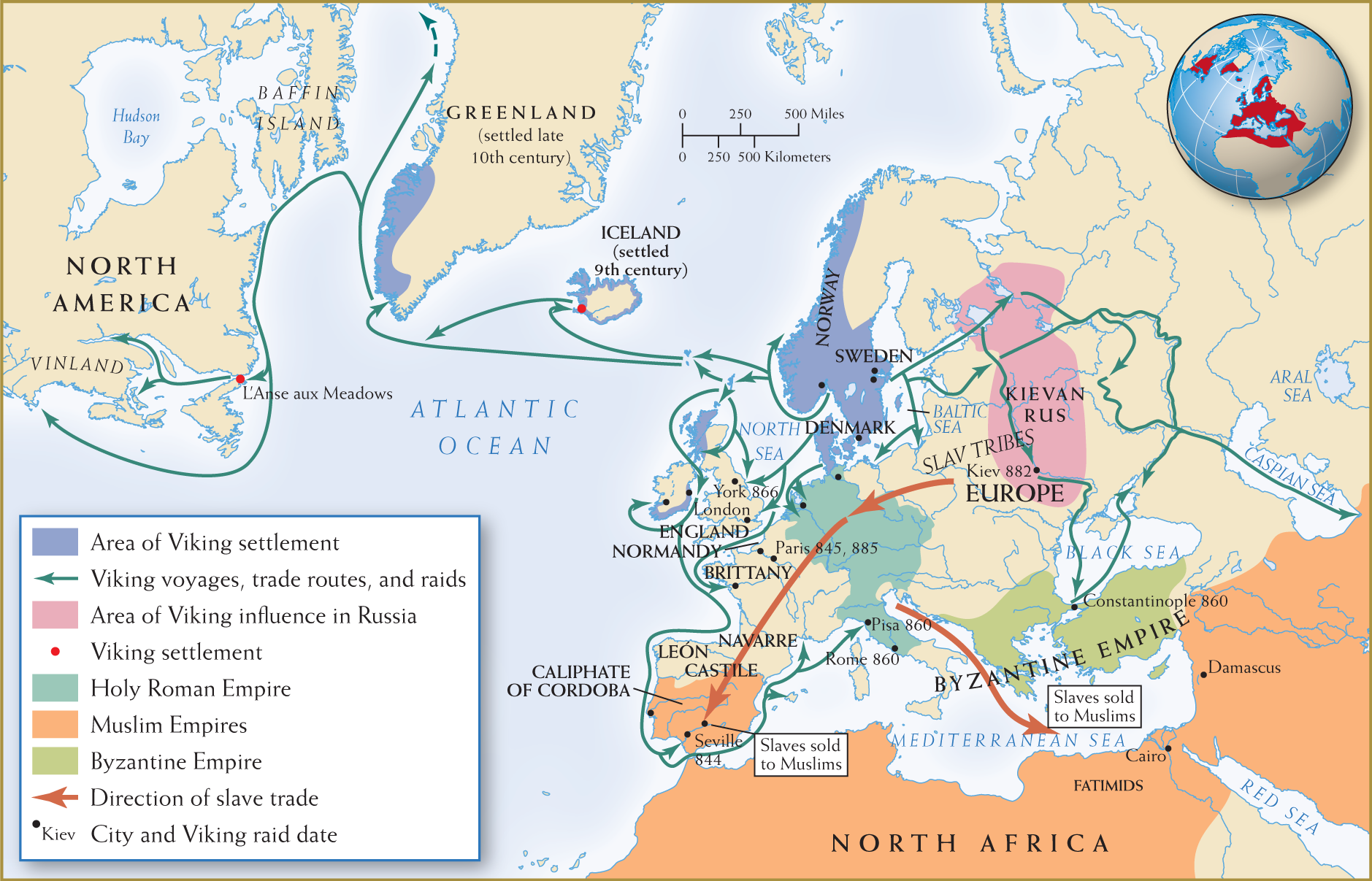
Map 2.8 The Age of Vikings and the Slave Trade, 800–1000 CE
Vikings from Scandinavia dramatically altered the history of Christendom.
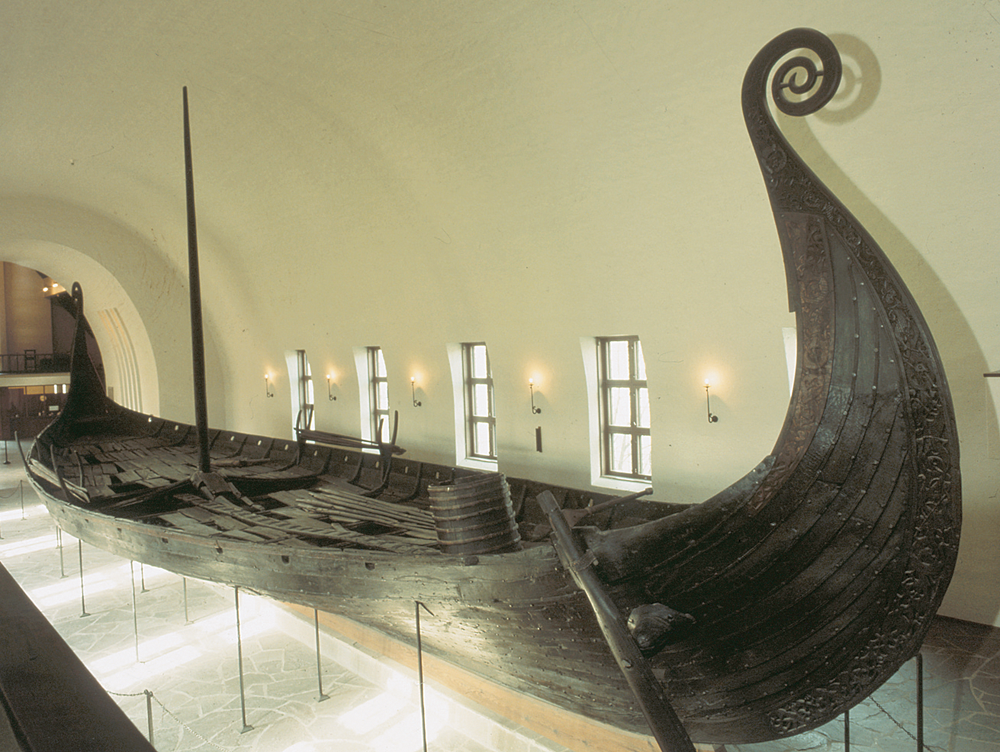
The Vikings’ motives were announced in their name, which derives from the Old Norse vik, “to be on the warpath.” The Vikings sought to loot the now-wealthy Franks and replace them as the dominant warrior class of northern Europe. They succeeded in their plundering and enslaving because of a deadly technological advantage: ships of unparalleled sophistication. Light and agile, Viking ships traveled far up the rivers of northern Europe and could even be carried overland from one river system to another. Under sail, the same boats could tackle open water and cross the North Atlantic. In the ninth century CE, the Vikings set their ships on both courses. They sacked the great monasteries along the coasts of Ireland and Britain and overlooking the Rhine and Seine Rivers. At the same time, Norwegian adventurers colonized the uninhabited island of Iceland, and then Greenland. By 982 CE, they had even reached continental North America and established a settlement at L’Anse aux Meadows on the Labrador coast.
More long-lasting than their settlements in North America was the Viking incursion into eastern Europe. The Vikings sailed east along the Baltic and then turned south, edging up the rivers that crossed the watershed of central Russia. Here the Dnieper, the Don, and the Volga Rivers flow south into the Black Sea and the Caspian. Consequently, the Vikings created an avenue of commerce that linked Scandinavia and the Baltic directly to Constantinople and Baghdad. Muslim geographers bluntly called this route “The Highway of the Slaves” because so much of the trade was in human cargo.
COMPARISON Evaluate the tactics Vikings used to expand their influence.
In 860 CE, more than 200 Viking longships gathered ominously beneath the walls of Constantinople in the straits of the Bosporus. What they found was not poorly defended monasteries or Charlemagne’s rustic Aachen, but a city with a population exceeding 100,000 protected by well-engineered late-Roman walls. For nearly two centuries, Constantinople had resisted almost yearly campaigns launched by the successive Islamic empires of Damascus and later Baghdad. These campaigns were deflected by Constantinople’s highly professional generals, a line of skillfully constructed fortresses that controlled the roads across Anatolia, and a deadly technological advantage in naval warfare: Greek fire. This combination of petroleum and potassium, when sprayed from siphons, would explode in a great sheet of flame on the water. The experience and weaponry of Byzantium were too much for the Vikings, and their raid of the most significant city in eastern Christendom was a spectacular failure. Despite their inability to take Byzantium, the Vikings asserted an enduring influence through their forays across the North Atlantic, their brutal interactions with Christian communities in northern Europe, and their expansion into eastern Europe, especially the slave trade they facilitated there.
Outlasting so many military emergencies bolstered the morale of the eastern Christians and led to a flowering of Christianity in this region. Not just Constantinople but Justinian’s Hagia Sophia—its heart—had survived significant threats. That great building and the solemn Greek divine liturgy that reverberated within its domed spaces symbolized the branch of Christian belief that dominated in the east: Greek Orthodoxy. Greek Orthodox theology held that Jesus became human less to atone for humanity’s sins (as emphasized in Roman Catholicism) and more to facilitate theosis (a transformation of humans into divine beings). This was a truly distinct message from that which prevailed in the Roman Catholicism of the west.
In the tenth century CE, as Charlemagne’s empire collapsed in western Europe, large areas of eastern Europe became Greek Orthodox, not Roman Catholic. In addition, Greek Christianity gained a spiritual empire in Southwest Asia. The conversion of Russian peoples, Balkan Slavs, and Arab peoples to Greek Orthodox Christianity was a complex process. It reflected a deep admiration for Constantinople on the part of Russians, Bulgarians, Arabs, and Slav princes. It was an admiration as intense as that of any western Catholic for the Roman popes.
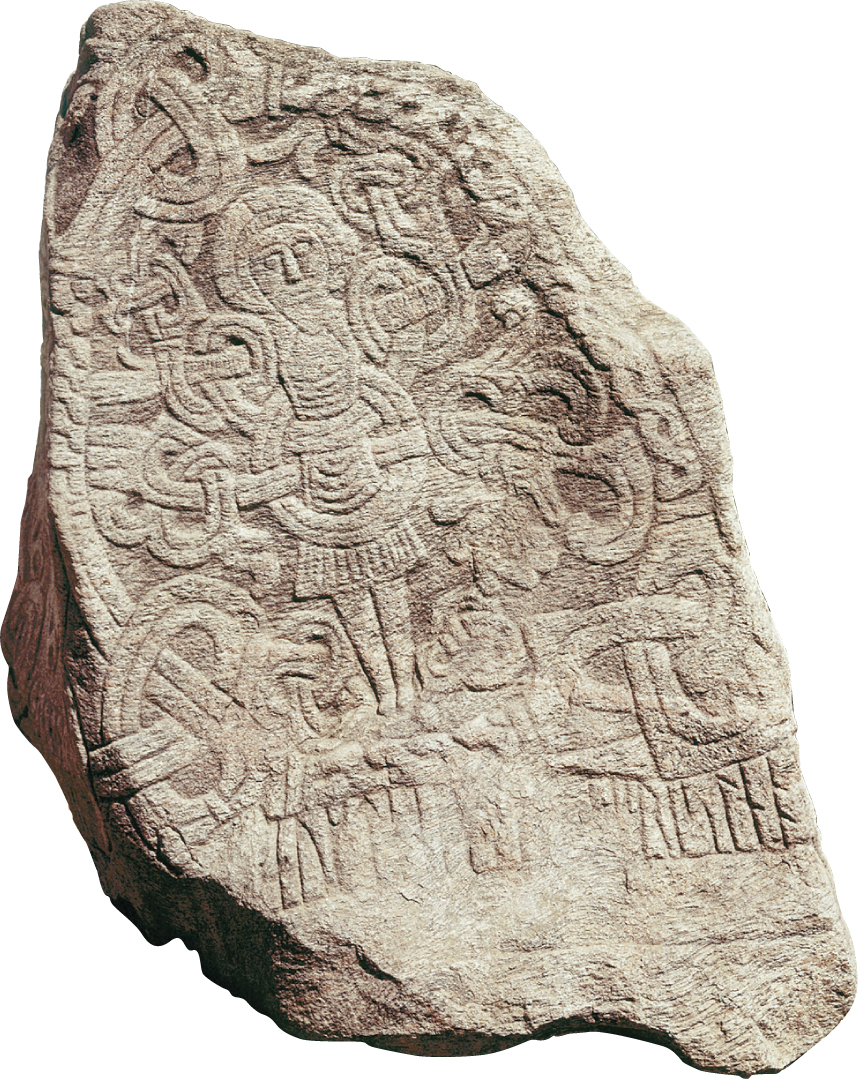
By the year 1000 CE, then, there were two Christianities: the new and confident “borderland” Roman Catholicism of western Europe and an ancient Greek Orthodoxy. Western Roman Catholics believed that their church was destined to expand everywhere. Greek Orthodox Christians were less euphoric but believed that their church would forever survive the regular ravages of invasion. This was a significant difference in attitude; Greek Orthodox Christians considered the Franks barbarous and grasping, and western Roman Catholics contemptuously called the eastern Christians “Greeks” and condemned them for “Byzantine” cunning.
Thus, like Islam, the Christian world was divided, with differences in heritage, theology, customs, and levels of urbanization. At that time, the Orthodox world was considerably more ancient and more cultured than the world of the Catholic west. And each dealt with Islam differently. At Constantinople, eastern Christianity held off Muslim forces that constantly threatened the great city and its Christian hinterlands. In the west, by contrast, Muslim expansionism reached all the way to the Iberian Peninsula. Western Christendom, led by the Roman papacy, set about spreading Christianity to pagan tribes in the north, and it began to contemplate retaking lands from the Muslims. Yet in spite of their deep political, ethnic, and theological differences, the two regions of Christianity conducted a brisk trade in commodities and ideas.