1The Rise of Universalizing Religions300–600 CE
Core Objectives
- DESCRIBE the characteristics of universalizing religions, and EXPLAIN why universalizing religions developed to varying degrees in Afro-Eurasiabut did not develop elsewhere in the world.
- ANALYZE the relationship between empires and universalizing religions across Afro-Eurasia in this period.
- ASSESS the connections between political unity and religious developments in sub-Saharan Africa and Mesoamerica in the fourth to sixth centuries CE.
- COMPARE the unifying political and cultural developments in sub-Saharan Africa and Mesoamerica with those that took place across Eurasia in this period.
Around 180 CE, twelve Christians, seven men and five women, stood trial before the provincial governor at Carthage. Their crime was refusal to worship the gods of the Roman Empire. While the governor argued for the simplicity of his religion with its devotion to “the protecting spirit of our lord the emperor,” one Christian retorted that his own lord was “the king of kings and emperor of all nations.” This distinction was an unbridgeable gap between the governor and the Christians. The governor condemned them all. “Thanks be to God!” cried the Christians, and straightaway they were beheaded. As the centuries unfolded, the governor’s old Roman ideas of the supremacy of an emperor-lord would give way to the martyrs’ devotion to their Lord God as emperor over all. As with Christianity’s claim of an “emperor of all nations,” a religion’s capacity for universalizing—particularly its broad appeal across diverse peoples and cultures—became ever more important to its success.
From 300 to 600 CE, the entire Afro-Eurasian landmass experienced a surge of religious activity. In the west, Christianity became the state faith of the Roman Empire. In India, the Vedic religion (Brahmanism) evolved into a more formal spiritual system called Hinduism. Buddhism spread across northern India, central Asia, and China. Around the same time, the peoples living in sub-Saharan Africa reached beyond their local communities, creating common cultures across wider geographical areas. The Bantu-speaking peoples, residing in the southeastern corner of present-day Nigeria, began to spread their way of life throughout the entire southern half of the landmass. Similarly, across the Atlantic Ocean, the Maya established political and cultural institutions over a large portion of Mesoamerica. Across much of the world, spiritual concerns integrated scattered communities through shared faiths. (See Map 1.1.)
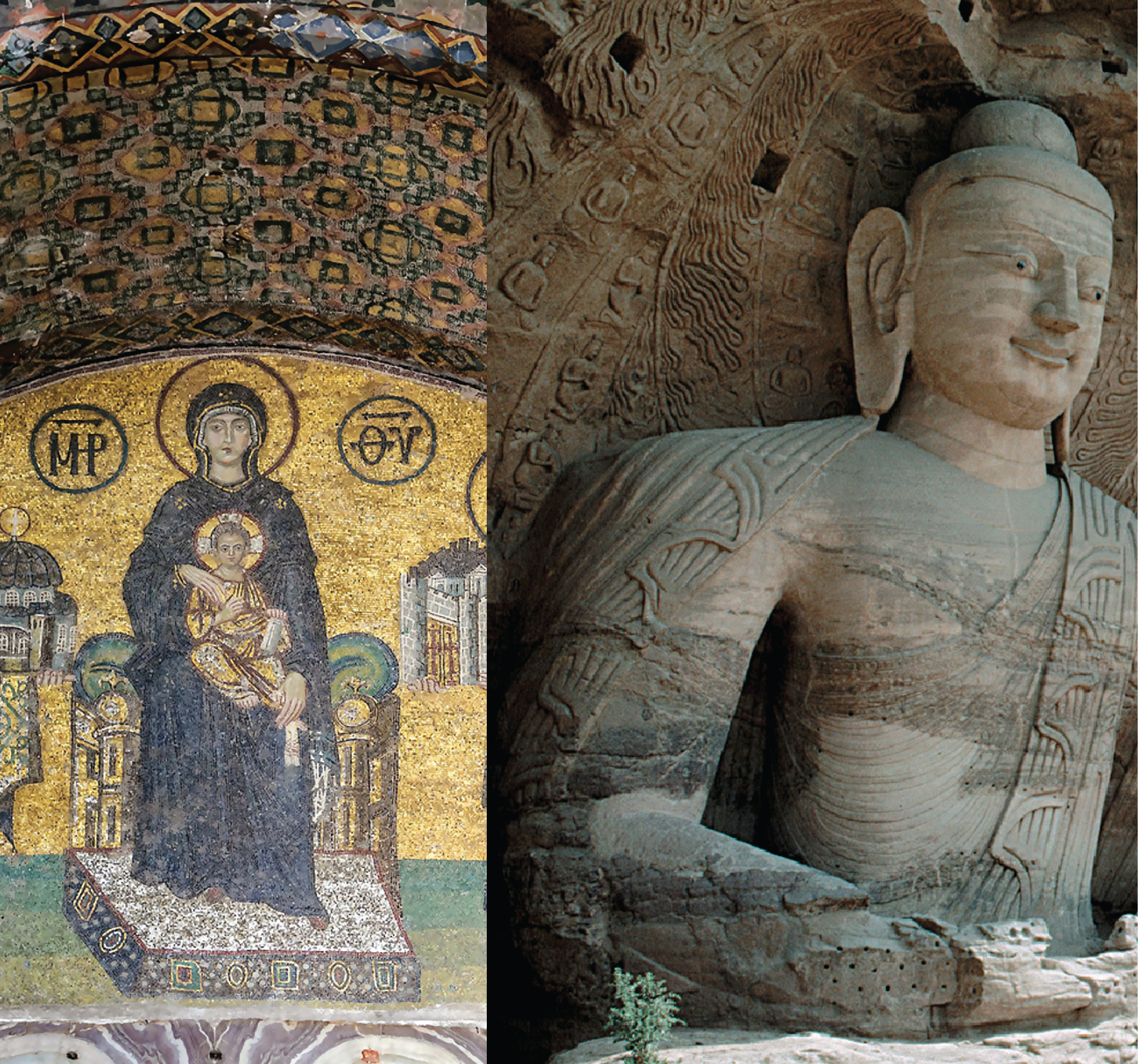
This integration was facilitated in Afro-Eurasia in part by the spread of what we might call universalizing religions. Two faiths in this era—Christianity and Buddhism—fit the model for this type of religion particularly well. Six main features characterize universalizing religions: their appeal to diverse populations (men and women, freeborn and slaves, rich and poor); their adaptability as they moved from one cultural and geographical area to another; their promotion of universal rules and principles to guide behavior that transcended place, time, and specific cultural practices; their proselytizing of new believers by energetic and charismatic missionaries; the deep sense of community felt by their converts despite, and perhaps because of, their many demands on followers; and—in the case of Christianity, and to a lesser extent Buddhism—the support given to them by powerful empires. Even as the Roman Empire and the Han dynasty began to crumble, these universalizing traditions continued to flourish.
Across Afro-Eurasia, universalizing religions were on the move. (See Map 1.2.) Religious leaders carrying written texts (books, scrolls, or tablets of wood or palm leaf) traveled widely. Christians from Persia went to China. Buddhists journeyed from South Asia to Afghanistan and used the caravan routes of central Asia to reach China. Voyages, translations, long-distance pilgrimages, and sweeping conversion campaigns remapped the spiritual landscape of the world. New religious leaders were the brokers of more universal but also more intolerant worldviews, premised on a distinct relationship between gods and their subjects. Religions and their brokers profoundly integrated societies. But they also created new ways to drive them apart.
Global Storylines
 Universalizing Religions
- Universalizing religions—notably Christianity and Buddhism—appeal to diverse, widespread populations and challenge the power of secular rulers and thinkers.
- Across Afro-Eurasia, these universalizing religions offer continuity even as powerful empires, specifically the Roman Empire in the west and the Han dynasty in China, are transformed.
- Along the Silk Roads, the merchants and rulers of Sasanian Persia, Sogdiana, and South Asia profoundly influence the exchange of goods, people, and ideas between east and west.
- In the “worlds apart,” common cultural beliefs help unify newly organized polities in Mesoamerica and new communities of Bantu speakers in sub-Saharan Africa.
Glossary
- universalizing religions
- Religions that appeal to diverse populations; are adaptable to new cultures and places; promote universal rules and principles; proselytize new believers, often through missionaries; foster community; and, in some cases, do all of this through the support of an empire.