After You Read This Chapter
Go to  to see what you’ve learned—and learn what you’ve missed—with personalized feedback along the way.
The breakdown of two imperial systems—Rome around the Mediterranean, and Han China in East Asia—introduced an era in which religion and shared culture rather than military conquest and political institutions linked large areas of Afro-Eurasia.
The Roman Empire gave way to a new religious unity, first represented by Christian dissenters and then co-opted by the emperor Constantine. In western Europe, the sense of unity unlimited by imperial frontiers gave rise to a universal, or “Catholic,” church—the “true” Christian religion that believers felt all peoples should share. In the eastern Mediterranean, where the Roman Empire survived, Christianity and empire coalesced to reinforce each other. Christians here held that beliefs about God and Jesus found their most correct expression within the Eastern Roman Empire (Byzantium) and in its capital, Constantinople.
Similarly, in East Asia, the weakening of the Han dynasty enabled Buddhism to dominate Chinese culture. Without a unified state in China, Confucian officials lost their influence, while Buddhist priests and monks enjoyed patronage from regional rulers, local warriors, and commoners. In India, Brahman elites exploited population movements beyond the reach of traditional rulers as they established ritual forms for daily life on every level of society while melding aspects of their own Vedic faith with those of Buddhism to create a new Hindu synthesis.
Not all regions felt the spread of universalizing religions, however. In most of sub-Saharan Africa, belief systems were much more localized. Similarly, in Mesoamerica, where long-distance transportation was harder and political authority more diffuse, religion was a unifying force but nothing like the widespread universalizing religions of Afro-Eurasia. Nevertheless, spiritual life was no less profound. Here, a strong sense of a shared worldview, a shared sense of purpose, and a shared sense of faith enabled common cultures to develop. Indeed, the Bantus and the Maya became large-scale common cultures—but ruled at the local level.
CORE OBJECTIVES
Thus, the period 300–600 CE saw the emergence of three great cultural units in Afro-Eurasia, each defined in religious terms: Christianity in the Mediterranean and parts of Southwest Asia, Hinduism in South Asia, and Buddhism in East Asia. They illustrate the ways in which peoples were converging under larger religious tents, while also becoming more distinct. Universalizing religions, whether Christian or Buddhist, and codes of behavior, such as the Brahmanic Code of Manu, gave people a new way to define themselves and their loyalties.
Go to to see what you’ve learned—and learn what you’ve missed—with personalized feedback along the way.
Europe and Southwest Asia
South Asia and East Asia
Sub-Saharan Africa and Mesoamerica
KEY TERMS
Thinking about Crossing Borders and Universalizing Religions Why did the challenge of crossing borders seem to infuse vitality into Christianity and Buddhism in the fourth through sixth centuries CE? Which religions in this period did not seem to cross borders and why? What effect did this have on those religions?
Thinking about Changing Power Relationships and Universalizing Religions Universalizing religions, like Christianity and Buddhism, were successful in part because of their diverse personalized appeal to women and men, rich and poor, and the upper and lower classes. How might this diverse appeal enable a universalizing religion like Christianity to undermine and alter traditional power relationships? In what ways did Buddhism do the same?
Thinking about Worlds Together, Worlds Apart and Universalizing Religions Why did universalizing religions like Christianity and Buddhism develop in some parts of the world but not in others in the period 300 to 600 CE? How did these universalizing religions allow for continuity in Eurasia, even as empires fell away? In the “worlds apart,” how might the lack of universalizing religion have influenced continuity, as political entities rose and fell over time?
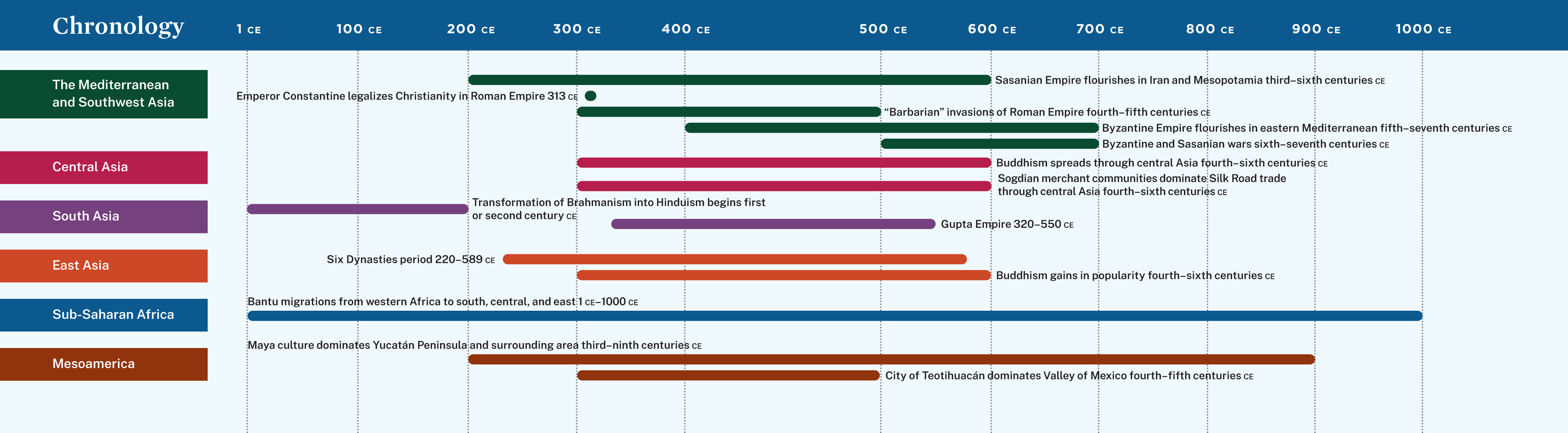
A horizontal timeline covering 1 to 1000 CE organizes major historical developments by region: the Mediterranean and Southwest Asia, Central Asia, South Asia, East Asia, Sub-Saharan Africa, and Mesoamerica. Bars mark important periods such as the legalization of Christianity in the Roman Empire, the flourishing of the Sasanian and Byzantine Empires, and invasions that affected the Roman world. In Asia, the timeline highlights the spread of Buddhism through Central and East Asia, the Gupta Empire in South Asia, and the Six Dynasties period in China. In Africa, it shows the long migration of Bantu-speaking peoples across the continent. In Mesoamerica, it marks the prominence of Maya culture and the rise of the city of Teotihuacán.