KEYCONCEPT QUESTION
3.2 Explain why hooves would be considered adaptations of horses but horseshoes would not.
In Chapter 2, we discussed early theories that tried to explain the remarkable match between the structure of organisms and the environments they inhabit. Now that we understand how the process of natural selection shapes the traits of organisms, we will use the word adaptation to describe the results of this process.
Adaptations help organisms deal with both the abiotic and biotic aspects of their environment. Consider a saguaro cactus in the Sonoran Desert. The waxy coating on its surface, its shallow root system, and its low surface area to volume ratio are adaptations to its abiotic environment: They help it gather and retain water and survive the high temperatures and low humidity to which it is exposed. Its flowers and spines, meanwhile, are an adaptation to its biotic environment. The flowers attract pollinators, and the spines protect the valuable water stored inside from herbivores that might otherwise rip open and consume the plant (Figure 3.10).
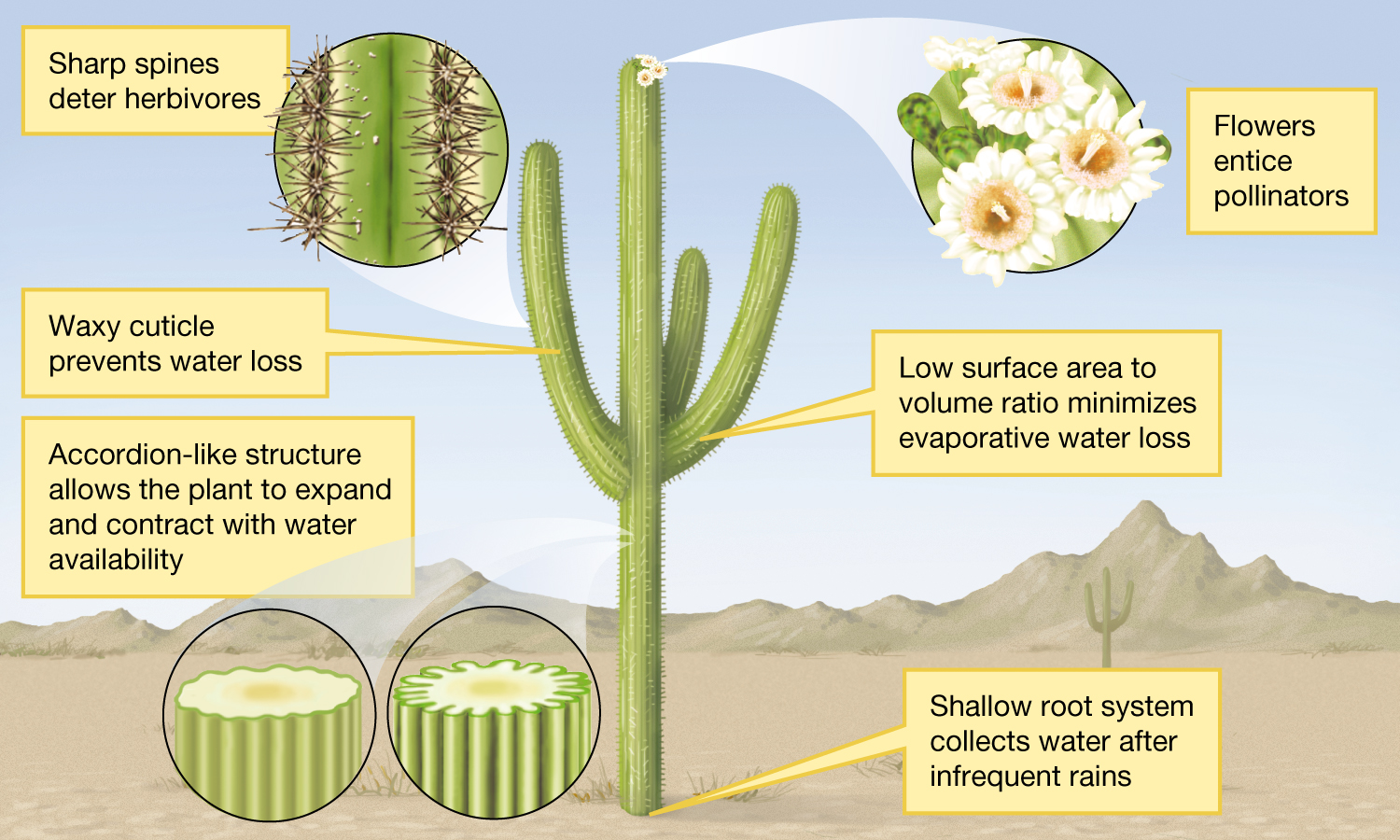
A diagram showing the adaptations of a cactus in a desert. The cactus has sharp spines to deter herbivores, a waxy cuticle to prevent water loss, an accordion-like structure that allows the plant to expand and contract with water availability, flowers at the top to entice pollinators, low surface area to volume ratio to minimize evaporation from water loss, and a shallow root system to collect water after infrequent rains.
To be considered an adaptation, a trait must have been shaped by natural selection to serve the same primary function or functions that make it beneficial today (Sober 1984). Picture a bird soaring gracefully through the air. It is hard to watch such a wonder of nature without thinking of how wonderfully suited feathers are for flying. And it is tempting to assume that because the primary function of feathers today is related to flight, the primary function of feathers has always been their effect on flight. But this need not be the case. A feather, or more generally any trait, may serve one function today, yet have evolved under different selection conditions and served a different function in the past. Such traits are called exaptations (Simpson 1953; Bock 1959; Gould and Vrba 1982), and we return to exaptations when we discuss the evolution of feathers in Section 3.5.
The term adaptation has a long history in the field of evolutionary biology, and it has been used in different ways by different people. Here we define an adaptation as an inherited trait that makes an organism more fit in its abiotic (nonliving) and biotic (living) environment and that has arisen as a result of the direct action of natural selection for its primary contemporary function.
With this definition we can generate and test hypotheses about how natural selection produces adaptations. In the next section, we examine how such studies are designed, what hypotheses they test, and how the data collected have helped biologists understand the process of natural selection.
KEYCONCEPT QUESTION
3.2 Explain why hooves would be considered adaptations of horses but horseshoes would not.