More information
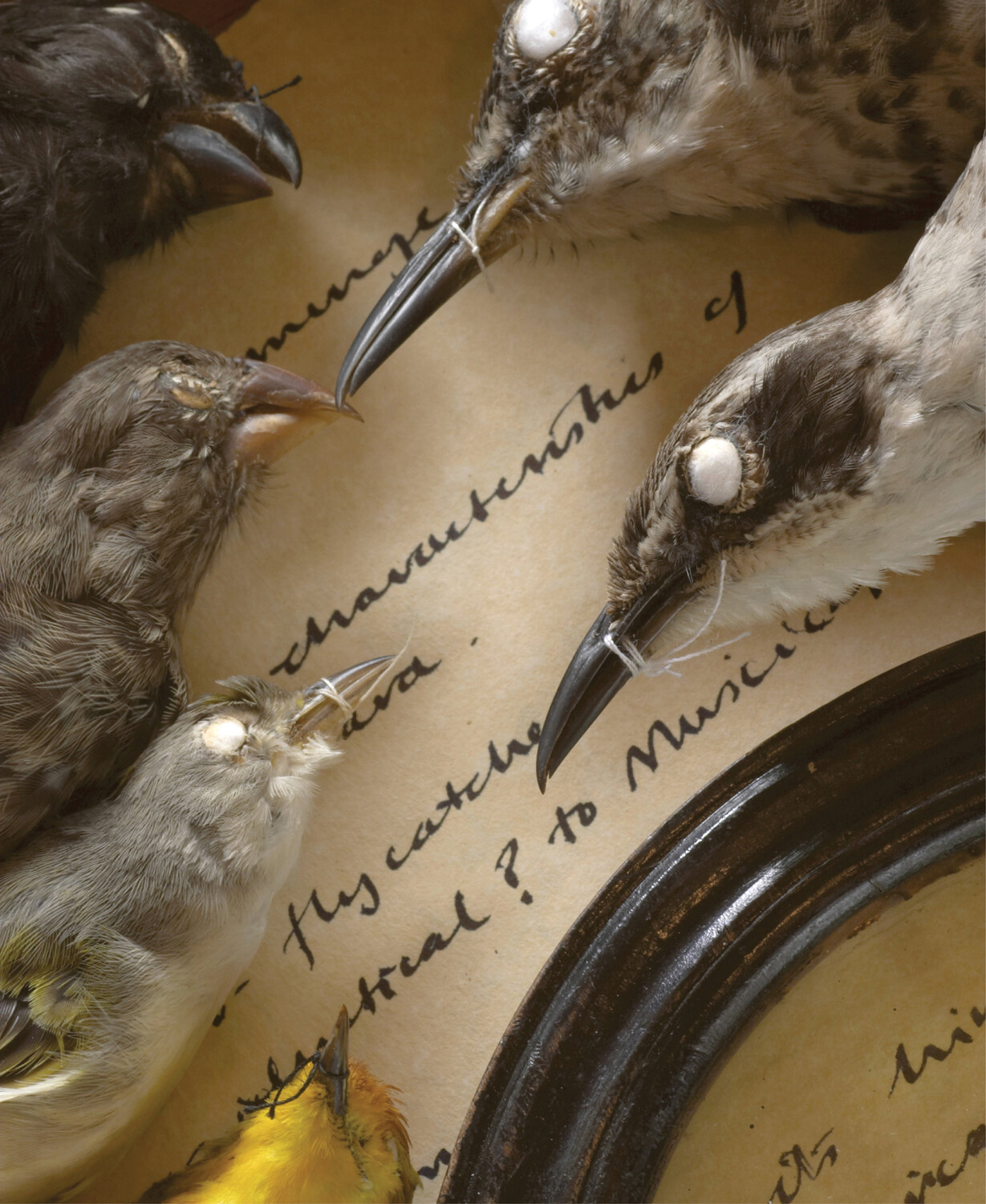
There are six stuffed dead birds with different beaks and colorings lying on a manuscript. They are all lying facing the center of the page.
Some of the Galápagos finch species that so fascinated Darwin on his voyage aboard HMS Beagle. These specimens are from the Charles Darwin Research Station, Puerto Ayora, Santa Cruz Island, Galápagos Islands.
- The Nature of Science: Natural versus Supernatural Explanations
- Time and a Changing World
- The Origins and Diversity of Life
- Organisms Are Well Suited to Their Environments
- Darwin’s Theory
- Darwin on Natural Selection
- Darwin on Common Ancestry
- Problems with Darwin’s Theory
- The Reaction to Darwin and Early History of the Modern Synthesis
Long before there was a science of evolutionary biology, people contemplated both the origin of life and why it was that organisms seem so well suited for the environments in which they live. More than two millennia ago, the Greek philosopher Empedocles (ca. 492–432 B.C.E.) proposed that body parts arose independently from the ground, describing organisms
where many heads grew up without necks, and arms were wandering about naked, bereft of shoulders, and eyes roamed about alone with no foreheads. (Empedocles, in Fairbanks 1898, p. 189)
These unattached parts, Empedocles continued, then wandered Earth before reassorting, sometimes into monstrous combinations such as creatures with two faces and animals with human heads, and sometimes into the well-proportioned forms that we observe in the animal world. When we read of such theories, we need to be careful not to fall into the trap of judging them based on what we know today. At the time, Empedocles was making a serious attempt to understand the origin of animals. He might have been correct, he just wasn’t; but most ideas turn out to be wrong in the long run.
Empedocles’ ideas did more than suggest how animal life originated: They also provided an explanation for why organisms seem to be so well adapted to their environments. Empedocles argued that if individuals were assembled from parts that were unable to function together to reproduce, they died off and their types became extinct. Without turning to supernatural intervention, Empedocles sought to explain not only why we observe an incredible diversity of living forms, but also why the component parts of individuals tend to be well suited to one another as well as to the habitat in which their species lives (O’Brien 2012).
Empedocles and his ideas remind us that science has a rich and deep history. Sir Isaac Newton, the great physicist and mathematician, famously wrote that if he had seen farther than others, it was only “by standing on the shoulders of giants.” Therein lies the tremendous power of the scientific approach. Scholars can build on decades, or even centuries, of previous work without needing to reinvent every step themselves. And yet, each of these previous discoveries or theories remains continually open to challenge, revision, and reinterpretation based on new evidence. Like all other great scientific ideas, Darwin’s ideas of evolution by natural selection did not arise in a vacuum. Instead, the idea of natural selection—as a process in which forms that are better suited to their environment increase in frequency in a population—emerged from a rich philosophical and scientific tradition that came before it.
Given that many of the ideas and hypotheses about evolution from this pre-Darwinian tradition have since been discredited, why should a contemporary biologist study them? Why pause in assessing the view from our time to look back at the figures that came before us?
We study the past to improve our work in the present. We hone our own scientific thinking by following the reasoning that led to both correct and incorrect conclusions, and we come to appreciate the intellectual risks that sparked the theories that we now take for granted. We learn from the work of those who came before us to be flexible in our current thinking. Exploring the debates underlying our assumptions reminds us to question our understanding and to approach contemporary problems from new angles.
And so, before investigating Darwin’s groundbreaking ideas and the developments in biology that have followed from it, we will examine the ideas about the nature of the biological world that preceded the publication of Darwin’s book, On the Origin of Species, in 1859. The first part of this chapter will serve as an introduction to how thinkers before Darwin tried to answer the big questions about life and biology, including these:
- What separates science from mythology?
- How should scientists reach conclusions about the natural world?
- How does the natural world change, and over what length of time?
- Why is the world filled with an astonishing diversity of living forms instead of a few basic types?
- Where do species come from?
- Why are organisms well suited to the environments in which they live?
Once we have tackled these questions, in the second part of the chapter we will introduce Darwin’s ideas on the evolutionary process.
We begin by briefly addressing what separates science from mythology, and what sorts of explanations scientists can pursue.