Describe what resonance structures are, and determine whether two given structures are indeed resonance structures.
Explain the significance of a resonance hybrid and how the resonance hybrid relates to the resonance structures of a species.
Evaluate the relative contributions of resonance structures to the resonance hybrid.
Explain how the number of resonance structures and the equivalence of resonance structures impact resonance stabilization.
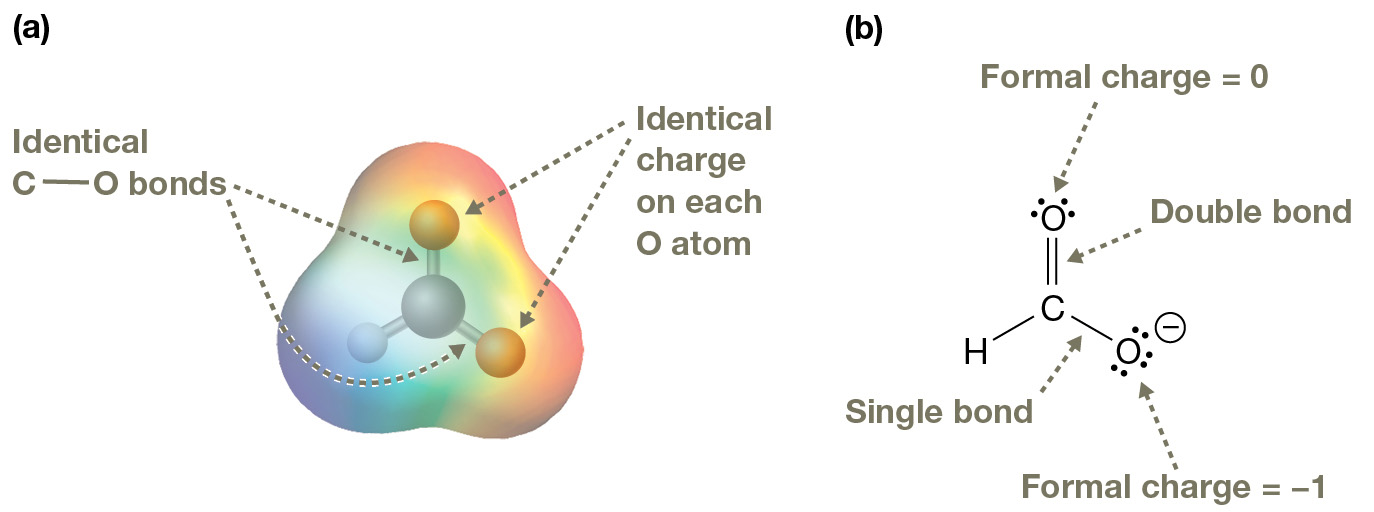
Some species are not described well by Lewis structures. In HCO2–, for example (refer to Solved Problems 1.4 and 1.8), both of the C—O bonds are identical experimentally; they have the same bond length and bond strength, intermediate between those of a single and a double bond (Figure 1-24a, next page). However, the Lewis structure of HCO2– (Fig. 1-24b) shows one C—O single bond and one C═O double bond, suggesting that the two bonds are different. Furthermore, experiments show that both oxygen atoms carry an identical partial negative charge (δ–), whereas the Lewis structure suggests that one oxygen atom bears a full negative charge and the other is uncharged. In other words, the Lewis structure suggests that the C═O double bond and the –1 charge are both confined to a specific region in space, or localized, whereas in the real species, they are spread out, or delocalized.
More information
An electrostatic potential map and a Lewis structure of the formate ion comparing the types of bonds and charges involved. The electrostatic potential map shows ball-and-stick model of the ion within the electron cloud. The structure shows a central carbon atom bonded to two oxygen atoms and a hydrogen atom. The color of the electron cloud toward both the oxygen atoms is of same intensity representing identical charge on each oxygen atom and the ball-and-stick model shows identical carbon-oxygen bonds. Lewis structure shows a central carbon atom single bonded to a hydrogen atom and an oxygen atom, and double bonded to an oxygen atom. The double bonded oxygen atom carries two lone pairs of electrons with formal charge, zero. The single bonded oxygen atom carries three lone pairs of electrons with formal charge, negative 1. The caption reads, Limitations of Lewis structures: The actual features of formate ion with negative charge (a) disagree with those suggested by the Lewis structure (b) In the actual structure, both carbon-oxygen bonds are identical and the charge on each oxygen atom is the same. The Lewis structure indicates a carbon-oxygen single bond and a carbon-oxygen double bond, as well as different charges on each oxygen atom.
FIGURE 1-24Limitations of Lewis structures The actual structure of HCO2− differs from that suggested by the Lewis structure. (a) In the actual structure, both carbon–oxygen bonds are identical and the charge on each O atom is the same. (b) The Lewis structure, on the other hand, suggests the species has a C—O single bond and a C═O double bond, as well as different charges on each O atom.
How, then, do we reconcile the differences between the Lewis structures of species like and their observed characteristics? The answer is through resonance theory, the key points of which can be summarized by the following four rules:
Rule 1: When Resonance Applies
The idea of resonance applies to species for which there are two or more valid Lewis structures.
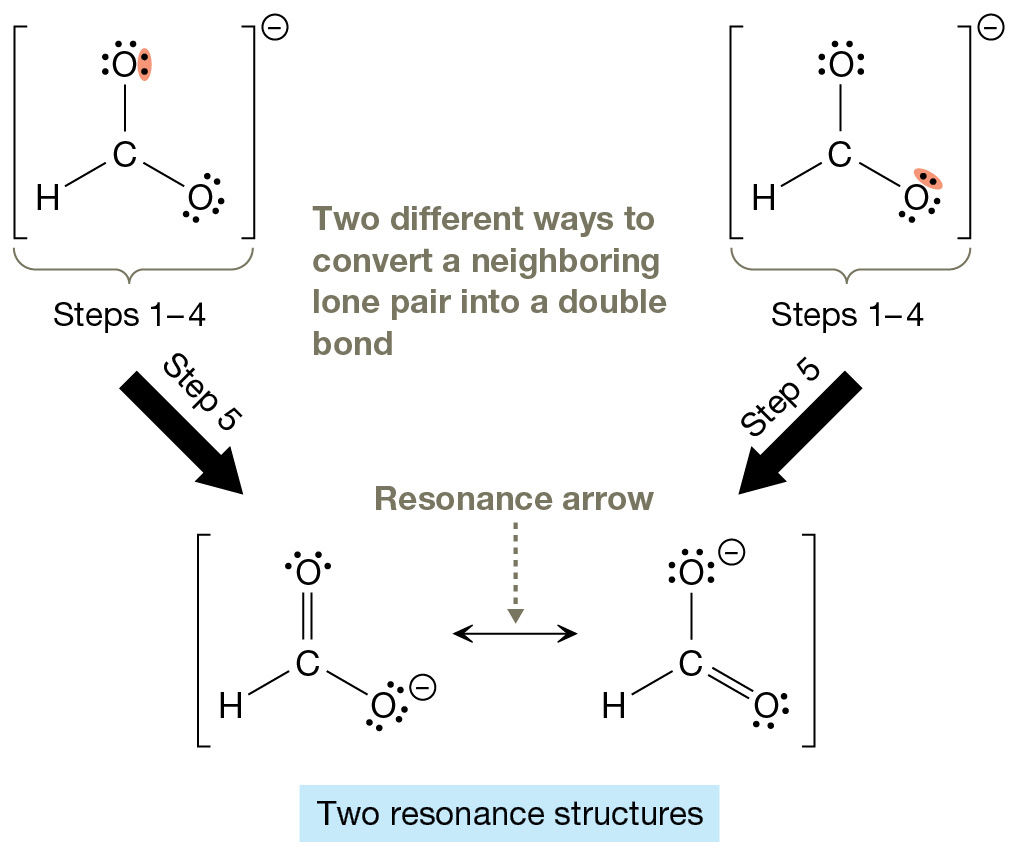
For such species, each valid Lewis structure is called a resonance structure or a resonance contributor. For, there are two possible resonance contributors. As shown in Figure 1-25, we can think of the two resonance structures resulting from two different ways to complete Step 5 (the final step) of drawing Lewis structures (p. 12)—that is, using lone pairs from two different neighboring atoms to construct the C═O double bond and complete carbon’s octet. As a result:
Resonance structures differ only in the placement of their valence electrons, not their atoms.
More information
Lewis structures show how to obtain the two resonance structures of the H C O 2 anion. The two different Lewis structures for the H C O 2 anion are drawn according to steps 1 to 4. Each has a central carbon atom that is bonded to a hydrogen atom and two oxygen atoms, one above and one on the right, by single bonds. Each oxygen atom has three lone pairs. In the first structure, the oxygen atom above the carbon has a lone pair highlighted, while in the second, the oxygen atom on the right has a lone pair highlighted. A label reads two different ways to convert a neighboring lone pair into a double bond. An arrow labeled “step 5” leads from each Lewis structure to two resonance structures with a double-headed arrow between them. The arrow is a resonance arrow. Each resonance structure has a central carbon atom bonded to a hydrogen atom and an oxygen atom by single bonds, and to another oxygen atom by a double bond. The highlighted lone pairs have been converted into double bonds. In the first resonance structure, the oxygen atom above the carbon is connected to it by a double bond, while in the second, the oxygen atom on the right is bonded by a double bond. In each resonance structure, the oxygen atom bonded to the carbon by a single bond carries a negative charge.
FIGURE 1-25Resonance structures of HCO2– Each of the identical structures at the top is the outcome of carrying out Steps 1–4 of drawing Lewis structures (p. 12). To complete the octet on carbon, Step 5 of drawing Lewis structures can be applied in two ways. A lone pair from the oxygen on top can be converted into a C═O double bond, resulting in the first resonance structure. Alternatively, a lone pair from the oxygen on the right can be converted into a C═O double bond, resulting in the second resonance structure.
Rule 2: Significance of the Resonance Hybrid
An individual resonance structure does not accurately describe the structure of the species; the one, true species is better characterized by the resonance hybrid, which is a weighted average of all resonance structures.
More information
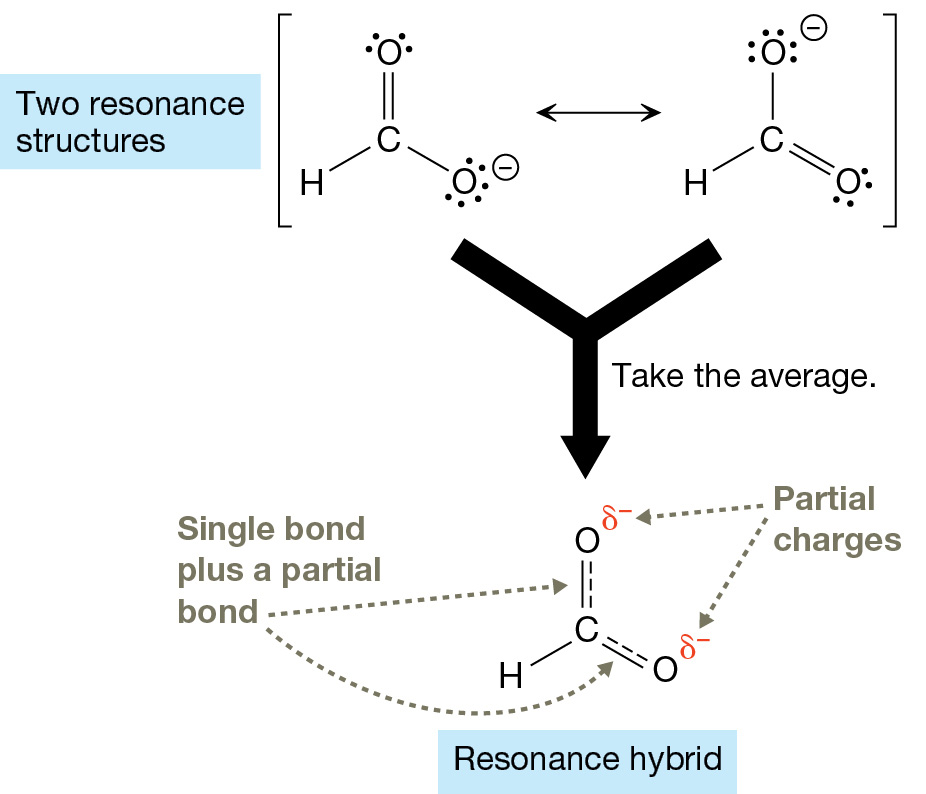
Lewis structures show how to obtain the resonance hybrid from the two resonance structures of the H C O 2 anion. Each resonance structure has a central carbon atom bonded to a hydrogen atom and an oxygen atom with three lone pairs by single bonds, and to another oxygen atom with two lone pairs by a double bond. In the first resonance structure, the oxygen atom above the carbon is connected to it by a double bond, while in the second, the oxygen atom on the right is bonded by a double bond. In each resonance structure, the oxygen atom bonded to the carbon by a single bond carries a negative charge. An arrow labeled “take the average” leads from the two resonance structures to the resonance hybrid, which has a central carbon atom that is bonded to a hydrogen atom by a single bond and to two oxygen atoms each by a single bond combined with a partial double bond. This is represented by a single solid line and a dashed line. The two oxygen atoms each carry a partial negative charge.
FIGURE 1-26The resonance hybrid of HCO2− Each resonance structure of HCO2− (top) is averaged to arrive at the resonance hybrid (bottom).
In the case of HCO2–, the hybrid is an average of two resonance structures, as shown in Figure 1-26. Averaging the two C—O bonds (a single and a double bond) makes each one an identical 1.5 bond, which is more than a single bond but less than a double bond. (A partial bond is represented in a resonance hybrid by a dashed line connecting the two atoms, -----.) Averaging the charge on each oxygen atom gives each an identical –0.5 charge. This resonance hybrid is now consistent with experimental results.
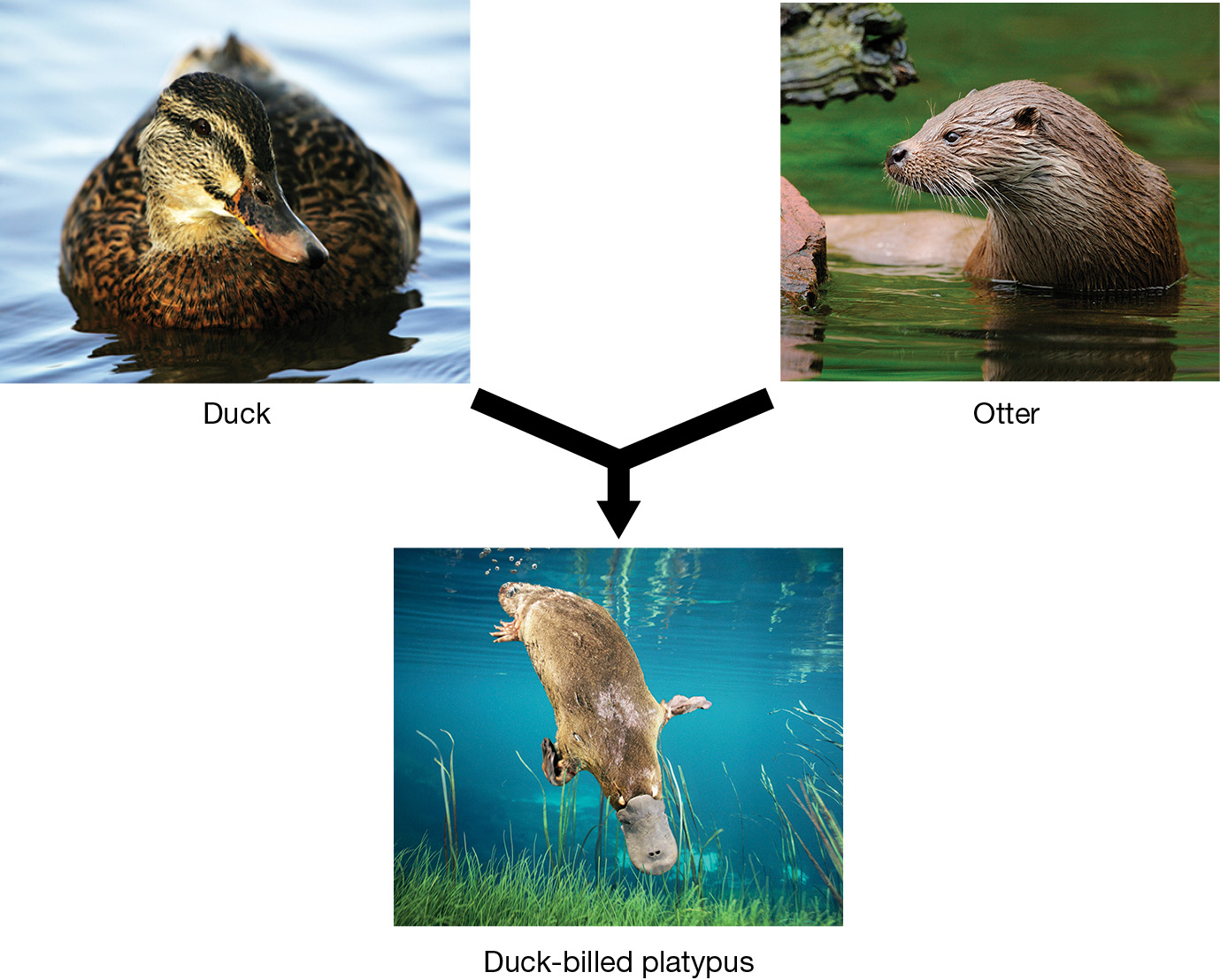
To help us remember that resonance structures are hypothetical and contribute to the same hybrid, we draw square brackets, [ ], around the group of resonance structures and we place double-headed resonance arrows (↔) between them, as shown previously in both Figures 1-25 and 1-26. These are not equilibrium arrows (⇌), which indicate a chemical reaction, because a compound does not rapidly interconvert between its resonance structures. Rather, think of a resonance hybrid in the same way as you might think of a duck-billed platypus (Figure 1-27). That is, a platypus has characteristics of both a duck and an otter, but it is a unique species that does not rapidly interconvert between those two animals!
More information
A photo of a duck. The caption reads, “An analogy of resonance: A duck-billed platypus has characteristics of a duck and an otter, just as a resonance hybrid has characteristics from its resonance contributors.” A photo of an otter. The caption reads, “An analogy of resonance: A duck-billed platypus has characteristics of a duck and an otter, just as a resonance hybrid has characteristics from its resonance contributors.” A photo of a duck billed platypus.. The caption reads, “An analogy of resonance: A duck-billed platypus has characteristics of a duck and an otter, just as a resonance hybrid has characteristics from its resonance contributors.”
FIGURE 1-27An analogy of resonance A duck-billed platypus has characteristics of a duck and an otter, just as a resonance hybrid has characteristics from its resonance contributors.
Rule 3: Relative Contribution to the Resonance Hybrid
The resonance hybrid resembles the lowest energy (most stable) resonance structure the most.
The two resonance contributors of HCO2− are equivalent. Each is composed of one H—C bond, one C═O double bond, and one C—O single bond, and each has a –1 formal charge on the singly bonded O. As a result, the resonance structures have identical energies and they contribute equally to the resonance hybrid.
In cases in which resonance structures are not equivalent, we must be able to determine their relative energies to determine their relative contributions to the hybrid. In general:
When two resonance structures are compared, the more stable structure (i.e., the one lower in energy) is the one that has:
More atoms with a completed octet.
Fewer atoms with a nonzero formal charge.
A −1 formal charge appearing on the more electronegative atom and/or a +1 formal charge appearing on the less electronegative atom.
These factors are presented in order of importance, which will help you predict the lower energy resonance structure when two factors contradict each other. We deal with such a contradiction in Solved Problem 1.9.
SOLVED PROBLEM 1.9
How to determine the more important resonance contributor
Break It Down Which of these resonance structures makes a greater contribution to the resonance hybrid?
More information
Lewis structures show two resonance structures separated by a double-headed arrow. Each resonance structure shows a carbon atom bonded to another, which is further bonded to an oxygen atom. The oxygen is bonded to a third carbon atom. In the first structure, which consists of only single bonds, the oxygen atom has two lone pairs and the second carbon carries a positive charge. In the second structure, the second carbon atom is connected to the oxygen atom by a double bond. The oxygen atom has one lone pair and carries a positive charge.
Think
Solve
Which resonance structure has more atoms with an octet?
➤
The resonance structure on the right has more atoms with octets, because the positively charged carbon in the resonance structure on the left lacks an octet.
Which resonance structure has fewer atoms with a nonzero formal charge?
➤
Neither does, because each resonance structure has one atom with a +1 formal charge.
Which resonance structure has the +1 formal charge on the less electronegative atom?
➤
The resonance structure on the left does, given that carbon is less electronegative than oxygen.
Is there a contradiction among these factors? If so, which factor is more important?
➤
We see a contradiction between the first factor (octets) and the third factor (electronegativity). The first factor is more important, so the resonance structure on the right is lower in energy and makes a greater contribution to the hybrid.
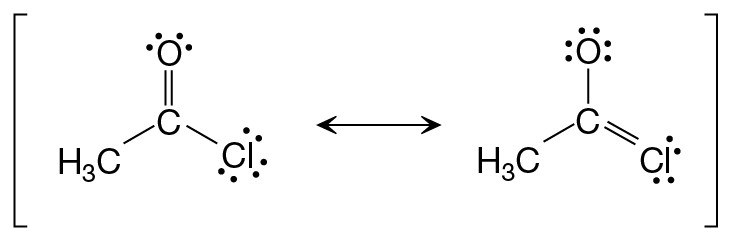
Try ItWhich of these resonance structures makes a greater contribution to the resonance hybrid? Note: Formal charges are not shown.
More information
Lewis structures show two resonance structures separated by a double-headed arrow. Each resonance structure shows a central carbon atom bonded to a methyl group, an oxygen atom, and a chlorine atom. In the first structure, the oxygen atom has two lone pairs and is bonded to the carbon by a double bond, while the chlorine atom has three lone pairs and is bonded to the carbon by a single bond. In the second structure, the oxygen atom has three lone pairs and is bonded to the carbon by a single bond, while the chlorine atom has two lone pairs and is bonded to the carbon by a double bond.
Rule 4: Resonance and Stabilization
A species that exhibits resonance tends to be more stable than a similar species that does not.
As the number of resonance structures increases, the species tends to be more stable.
A species that has equivalent resonance structures tends to be highly stabilized.
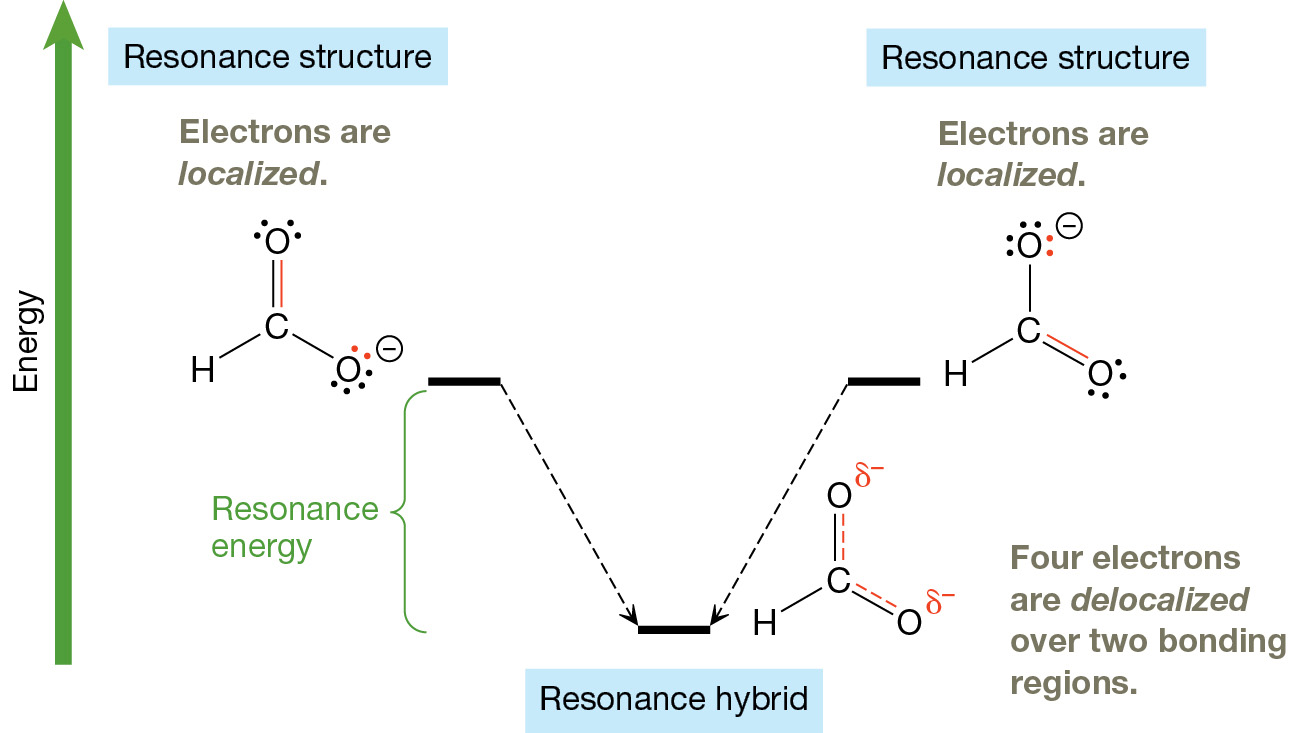
The stabilization due to resonance is an outcome of the delocalization of electrons; that is, electrons have lower energy when they are less confined. In the resonance hybrid of HCO2−, we can see that four electrons are delocalized over two bonding regions (Figure 1-28). In one of the hypothetical resonance structures, on the other hand, those electrons would be localized. The extent by which a species is stabilized in this fashion is called its resonance energy or its delocalization energy.
More information
An energy diagram shows the difference in energy levels of the resonance structures of an H C O 2 anion and its resonance hybrid. An upward arrow indicates increasing energy levels. Each resonance structure has a central carbon atom bonded to a hydrogen atom and an oxygen atom with three lone pairs by single bonds, and to another oxygen atom with two lone pairs by a double bond. In the first resonance structure, the oxygen atom above the carbon is connected to it by a double bond, while in the second, the oxygen atom on the right is bonded by a double bond. In each resonance structure, the oxygen atom bonded to the carbon by a single bond carries a negative charge. The resonance structures have localized electrons, and are located higher on the energy scale than the resonance hybrid, which has a central carbon atom that is bonded to a hydrogen atom by a single bond and to two oxygen atoms each by a single bond combined with a partial double bond. This is represented by a single solid line and a dashed line. The two oxygen atoms each carry a partial negative charge. Here, the four electrons are delocalized over three atoms. A bracket spans from the energy level of the resonance structure to the energy level of the resonance hybrid. The bracket is labeled resonance energy. The caption reads, Resonance stabilization: In each resonance structure of H C O 2 minus, the four electrons in red are localized. In the resonance hybrid, those four electrons are delocalized over three atoms. Delocalization results in lower energy and greater stability.
FIGURE 1-28Resonance stabilization In each resonance structure of HCO2–, the four electrons in red are localized. In the resonance hybrid, those four electrons are delocalized over three atoms. Delocalization results in lower energy and greater stability.
Resonance stabilization increases with additional resonance structures because each additional resonance structure allows electrons to be delocalized over a greater amount of space. Similarly, resonance stabilization tends to be large when a species has equivalent resonance structures because equivalent resonance structures contribute equally to the hybrid, which maximizes electron delocalization.
▶ LOOKING AHEAD
We will discuss benzene in greater detail in Chapter 14, where we explain that much of benzene’s resonance energy is due to a phenomenon called aromaticity.
CONNECTIONS 1.9
More information
A photo of gasoline coming out of a gas pump.
Benzene and gasoline Benzene (Fig. 1-29) is an aromatic hydrocarbon that is naturally found in crude oil and, because of its high octane number, is an important component of gasoline.
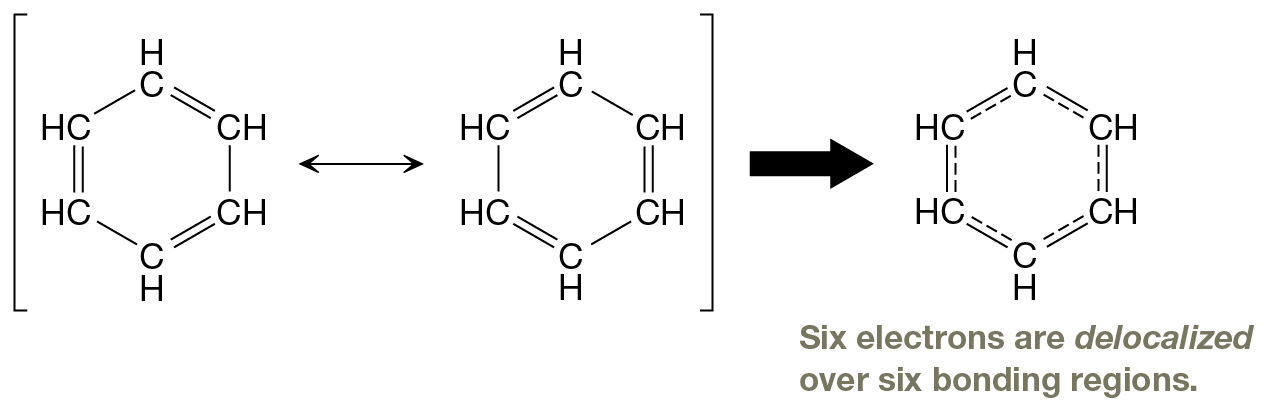
We saw previously that the two resonance structures of HCO2− are equivalent, so its resonance energy is quite substantial. Another example is benzene, whose resonance structures and hybrid are shown in Figure 1-29 (see Looking Ahead box).
More information
Condensed structural formulas show the two resonance structures and the resonance hybrid of benzene. The two resonance structures of benzene are separated by a double headed arrow, and each shows a six-carbon ring with alternating single and double bonds. An arrow from these resonance structures leads to the resonance hybrid, which shows a ring of six carbon atoms connected by single bonds and partial double bonds. These bonds are each represented by a single solid line and a dashed line. The six electrons in the resonance hybrid are delocalized over six bonding regions. The caption reads, Equivalent resonance structures: The two resonance structures of benzene on the left are equivalent, so they contribute equally to the resonance hybrid on the right.
FIGURE 1-29Equivalent resonance structures The two resonance structures of benzene (left) are equivalent, so they contribute equally to the resonance hybrid (right).
CONNECTIONS 1.10
Acetic acid and its uses Acetic acid (Fig. 1-30), when it is diluted to about 5% by volume, is familiar to us as vinegar. In organic chemistry, acetic acid is used as a reagent in a wide variety of organic reactions. It can also be used as a solvent.
More information
Photo of a bottle of white distilled vinegar. The label on the bottle shows the name of the brand “Supreme Star,” and reads, “White Distilled Vinegar: Vinagre Blanco Destilado.”
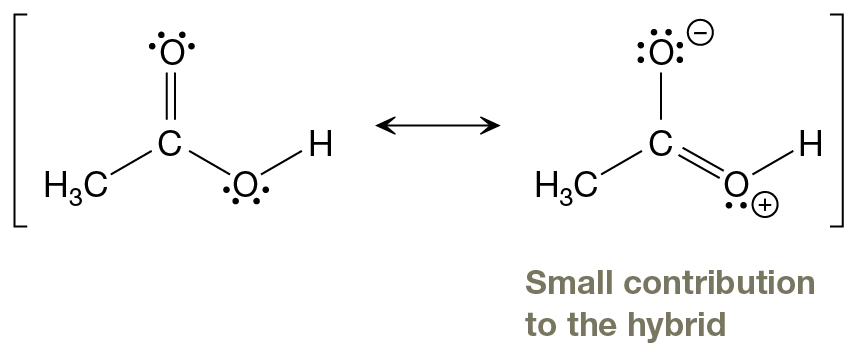
Acetic acid (CH3CO2H) is not stabilized greatly by resonance. Although it has two resonance structures, only the one on the left in Figure 1-30 contributes significantly. The one on the right is much higher in energy because two charges are present. Therefore, the electrons involved in resonance in this compound are not very highly delocalized.
More information
Lewis structures show the two resonance structures of acetic acid with a double-headed arrow between them. Each structure shows a carbon atom bonded to three hydrogen atoms and a carboxyl group, which basically consists of a carbonyl group bonded to a hydroxyl group. In the first structure, the carbon atom in the carboxyl group is bonded by a double bond to one of the oxygen atoms, and by a single bond to the other oxygen, which is further bonded to a hydrogen atom. Both the oxygen atoms have two lone pairs each. In the second structure, the oxygen atom bonded to the hydrogen atom has one lone pair, carries a positive charge, and is bonded to the carbon atom by a double bond. The other oxygen atom has three lone pairs, carries a negative charge, and is bonded to the carbon atom by a single bond. The caption reads, “Nonequivalent resonance structures: The two resonance structures of acetic acid are nonequivalent, so they contribute unequally to the resonance hybrid. The one on the left is lower in energy, so it has the greater contribution.”
FIGURE 1-30Nonequivalent resonance structures The two resonance structures of acetic acid are nonequivalent, so they contribute unequally to the resonance hybrid. The one on the left is lower in energy, so it has the greater contribution.
the theory that reconciles the differences between multiple Lewis structures of a species and its observed characteristics. Resonance exists when two or more valid Lewis structures can be drawn for a given molecular species. (Ch. 1)
(also known as resonance contributor) one of two or more valid Lewis structures that represent a species. Resonance structures are imaginary and are related by the movement of valence electrons, not atoms; the one, true species is represented by the resonance hybrid. (Ch. 1)