MLA-c List of Works Cited
CITATION KEY
author
title
publication
A works-cited list provides full bibliographic information for every source cited in your text. See page 43 for guidelines on formatting this list and page 50 for a sample works-cited list.
Core Elements
MLA style provides a list of core elements for documenting sources in a works-cited list. Not all sources will include each of these elements; include as much information as is available for any title you cite. For guidance about specific sources you need to document, see the templates and examples on pages 17–41, but here are some general guidelines for how to treat each of the core elements.
CORE ELEMENTS FOR ENTRIES IN A WORKS-CITED LIST
- Author
- Title of the source
- Title of any “container,” a larger work in which the source is found—an anthology, a website, a journal or magazine, a database, a streaming service like Netflix, or a learning management system, among others
- Editor, translator, director, or other contributors
- Version
- Number of volume and issue, episode and season
- Publisher
- Date of publication
- Location of the source: page numbers, DOI, permalink, URL, etc.
The above order is the general order MLA recommends, but there will be exceptions. To document a translated essay that you found in an anthology, for instance, you’d identify the translator after the title of the essay rather than after that of the anthology. You may sometimes need additional elements as well, either at the end of an entry or in the middle—for instance, a label to indicate that your source is a map, or an original year of publication. Remember that your goal is to tell readers what sources you’ve consulted and where they can find them. Providing this information is one way you can engage with readers—and enable them to join in the conversation with you and your sources.
AUTHORS AND CONTRIBUTORS
- An author can be any kind of creator—a writer, a musician, an artist, and so on.
- If there is one author, put the last name first, followed by a comma and the first name: Morrison, Toni.
- If there are two authors, list the first author last name first and the second one first name first: Lunsford, Andrea, and Lisa Ede. Put their names in the order given in the work. For three or more authors, give the first author’s name followed by “et al.”: Greenblatt, Stephen, et al.
- Include any middle names or initials: Toklas, Alice B.
- If the author is a group or organization, use the full name, omitting any initial article: United Nations.
- If an author uses a handle that is significantly different from their name, include the handle in square brackets after the name: Ocasio-Cortez, Alexandria [@AOC].
- If there’s no known author, start the entry with the title.
- If there’s an editor but no author, put the editor’s name in the author position and specify their role: Lunsford, Andrea, editor.
- If you’re citing someone in addition to an author—an editor, translator, director, or other contributors—specify their role. If there are multiple contributors, put the one whose work you wish to highlight before the title, and list any others you want to mention after the title. If you don’t want to highlight one particular contributor, start with the title and include any contributors after the title. For contributors named before the title, specify their role after the name: Fincher, David, director. For those named after the title, specify their role first: Directed by David Fincher.
TITLES
- Include any subtitles and capitalize all the words except for articles (“a,” “an,” “the”), prepositions (“to,” “at,” “from,” and so on), and coordinating conjunctions (“and,” “but,” “for,” “or,” “nor,” “so,” “yet”)—unless they are the first or last word of a title or subtitle.
- Italicize the titles of books, periodicals, websites, and other long works: Pride and Prejudice, Wired.
- Put quotation marks around the titles of articles and other short works: “Letter from Birmingham Jail.”
- To document a source that has no title, describe it without italics or quotation marks: Letter to the author, Photograph of a tree. For a short, untitled email, text message, tweet, or poem, you may want to include the text itself instead: Dickinson, Emily. “Immortal is an ample word.” American Poems, www.americanpoems.com/poets/emilydickinson/immortal-is-an-ample-word.
VERSIONS
- If you cite a source that’s available in more than one version, specify the one you consulted in your works-cited entry. Write ordinal numbers with numerals, and abbreviate “edition”: 2nd ed. Write out names of specific versions, and capitalize following a period or if the name is a proper noun: King James Version, unabridged version, director’s cut.
NUMBERS
- If you cite a book that’s published in multiple volumes, indicate the volume number. Abbreviate “volume,” and write the number as a numeral: vol. 2.
- Indicate volume and issue numbers (if any) of journals, abbreviating both “volume” and “number”: vol. 123, no. 4.
- If you cite a TV show or podcast episode, indicate the season and episode numbers: season 1, episode 4.
PUBLISHERS
- Write publishers’, studios’, and networks’ names in full, but omit initial articles and business words like “Inc.” or “Company.”
- For academic presses, use “U” for “University” and “P” for “Press”: Princeton UP, U of California P. Spell out “Press” if the name doesn’t include “University”: MIT Press.
- Many publishers use “&” in their name: Simon & Schuster. MLA says to use “and” instead: Simon and Schuster.
- If the publisher is a division of an organization, list the organization and any divisions from largest to smallest: Stanford U, Center for the Study of Language and Information, Metaphysics Research Lab.
DATES
- Whether to give just the year or to include the month and day depends on the source. In general, give the full date that you find there, or a date of revision. If the date is unknown, simply omit it.
- Abbreviate the months except for May, June, and July: Jan., Feb., Mar., Apr., Aug., Sept., Oct., Nov., Dec.
- For books, give the publication date on the copyright page: 1948. If a book lists more than one date, use the most recent one.
- Periodicals may be published annually, monthly, seasonally, weekly, or daily. Give the full date that you find there: 2019, Apr. 2019, 16 Apr. 2019. Do not capitalize the names of seasons: spring 2021.
- For online sources, use the copyright date or the full publication date that you find there, or a date of revision. If the source does not give a date, use the date of access: Accessed 6 June 2020. Give a date of access as well for online sources you think are likely to change, or for websites that have disappeared.
LOCATION
- For most print articles and other short works, give a page number or range of pages: p. 24, pp. 24-35. For articles that are not on consecutive pages, give the first page number with a plus sign: pp. 24+.
- If it’s necessary to specify a section of a source, give the section name before the page numbers: Sunday Review sec., p. 3.
- Indicate the location of an online source by giving a DOI if one is available; if not, give a URL—and use a permalink if one is available. MLA notes that URLs are not always reliable, so ask your instructor if you should include them. DOIs should start with “https://doi.org/”—but no need to include “https://” for a URL, unless you want the URL to be a hyperlink.
- For a geographical location, give enough information to identify it: a city (Houston), a city and state (Portland, Maine), or a city and country (Manaus, Brazil).
- For something seen in a museum, archive, or elsewhere, name the institution and its location: Maine Jewish Museum, Portland, Maine.
- For performances or other live presentations, name the venue and its location: Mark Taper Forum, Los Angeles.
PUNCTUATION
- Use a period after the author name(s) that start an entry (Morrison, Toni.) and the title of the source you’re documenting (Beloved.).
- Use a comma between the author’s last and first names: Ede, Lisa.
- Some URLs will not fit on one line. MLA does not specify where to break a URL, but we recommend breaking it before a punctuation mark. Do not add a hyphen or a space.
- Sometimes you’ll need to provide information about more than one work for a single source—for instance, when you cite an article from a periodical that you access through a database. MLA refers to the periodical and database (or any other entity that holds a source) as “containers” and specifies certain punctuation. Use commas between elements within each container, and put a period at the end of each container. For example:
Semuels, Alana. “The Future Will Be Quiet.” The Atlantic, Apr. 2016, pp. 19-20. ProQuest, search.proquest.com/docview/1777443553?accountid+42654.
The guidelines that follow will help you document the kinds of sources you’re likely to use. The first section shows how to acknowledge authors and other contributors and applies to all kinds of sources—print, online, or others. Later sections show how to treat titles, publication information, location, and access information for many specific kinds of sources. In general, provide as much information as possible for each source—enough to tell readers how to find a source if they wish to access it themselves.
SOURCES NOT COVERED
These guidelines will help you cite a variety of sources, but there may be sources you want to use that aren’t mentioned here. If you’re citing a source that isn’t covered, consult the MLA style blog at style.mla.org, or ask them a question at style.mla.org/ask-a-question.
Authors and Contributors
When you name authors and other contributors in your citations, you are crediting them for their work and letting readers know who’s in on the conversation. The following guidelines for citing authors and contributors apply to all sources you cite: in print, online, or in some other media.
1. ONE AUTHOR
Author’s Last Name, First Name. Title. Publisher, Date.
Anderson, Chris. The Long Tail: Why the Future of Business Is Selling Less of More. Hyperion, 2006.
2. TWO AUTHORS
1st Author’s Last Name, First Name, and 2nd Author’s First and Last Names. Title. Publisher, Date.
Lunsford, Andrea, and Lisa Ede. Singular Texts/Plural Authors: Perspectives on Collaborative Writing. Southern Illinois UP, 1990.
3. THREE OR MORE AUTHORS
1st Author’s Last Name, First Name, et al. Title. Publisher, Date.
Sebranek, Patrick, et al. Writers INC: A Guide to Writing, Thinking, and Learning. Write Source, 1990.
4. TWO OR MORE WORKS BY THE SAME AUTHOR
Give the author’s name in the first entry, and then use three hyphens in the author slot for each of the subsequent works, listing them alphabetically by the first word of each title and ignoring any initial articles.
Author’s Last Name, First Name. Title That Comes First Alphabetically. Publisher, Date.
---. Title That Comes Next Alphabetically. Publisher, Date.
Kaplan, Robert D. The Coming Anarchy: Shattering the Dreams of the Post Cold War. Random House, 2000.
---. Eastward to Tartary: Travels in the Balkans, the Middle East, and the Caucasus. Random House, 2000.
5. AUTHOR AND EDITOR OR TRANSLATOR
Author’s Last Name, First Name. Title. Role by First and Last Names, Publisher, Date.
Austen, Jane. Emma. Edited by Stephen M. Parrish, W. W. Norton, 2000.
Dostoevsky, Fyodor. Crime and Punishment. Translated by Richard Pevear and Larissa Volokhonsky, Vintage Books, 1993.
Start with the editor or translator, followed by their role, if you are focusing on that contribution rather than the author’s. If there is a translator but no author, start with the title.
Pevear, Richard, and Larissa Volokhonsky, translators. Crime and Punishment. By Fyodor Dostoevsky, Vintage Books, 1993.
Beowulf. Translated by Kevin Crossley-Holland, Macmillan, 1968.
6. NO AUTHOR OR EDITOR
When there’s no known author or editor, start with the title.
The Turner Collection in the Clore Gallery. Tate Publications, 1987.
“Being Invisible Closer to Reality.” The Atlanta Journal-Constitution, 11 Aug. 2008, p. A3.
7. ORGANIZATION OR GOVERNMENT AS AUTHOR
Organization Name. Title. Publisher, Date.
Diagram Group. The Macmillan Visual Desk Reference. Macmillan, 1993.
For a government publication, give the name that is shown in the source.
United States, Department of Health and Human Services, National Institute of Mental Health. Autism Spectrum Disorders. Government Printing Office, 2004.
When a nongovernment organization is both author and publisher, start with the title and list the organization only as the publisher.
Stylebook on Religion 2000: A Reference Guide and Usage Manual. Catholic News Service, 2002.
If a division of an organization is listed as the author, give the division as the author and the organization as the publisher.
Center for Workforce Studies. 2005-13: Demographics of the U.S. Psychology Workforce. American Psychological Association, July 2015.
Articles and Other Short Works
Articles, essays, reviews, and other shorts works are found in journals, magazines, newspapers, other periodicals, and also in books—all of which you may find in print, online, or in a database. For most short works, you’ll need to provide information about the author, the titles of both the short work and the longer work where it’s found, any page numbers, and various kinds of publication information, all explained below.
8. ARTICLE IN A JOURNAL
Author’s Last Name, First Name. “Title of Article.” Name of Journal, Volume, Issue, Date, Pages.
Cooney, Brian C. “Considering Robinson Crusoe’s ‘Liberty of Conscience’ in an Age of Terror.” College English, vol. 69, no. 3, Jan. 2007, pp. 197-215.
Documentation Map (MLA)
ARTICLE IN A PRINT JOURNAL
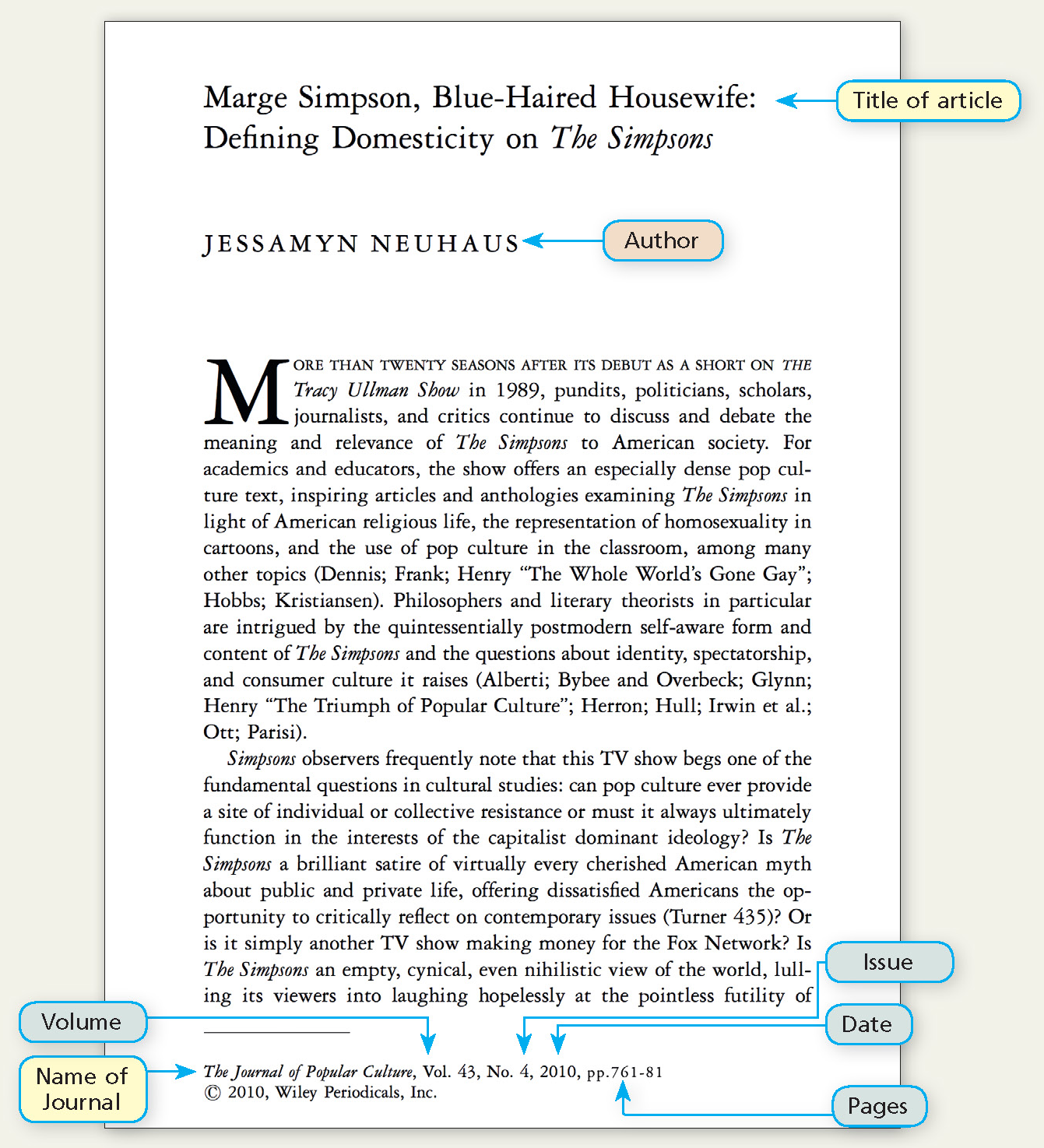
Neuhaus, Jessamyn. “Marge Simpson, Blue-Haired Housewife: Defining Domesticity on The Simpsons.” The Journal of Popular Culture,vol. 43, no. 4, 2010, pp. 761-81.
Documentation Map (MLA)
ARTICLE IN AN ONLINE MAGAZINE
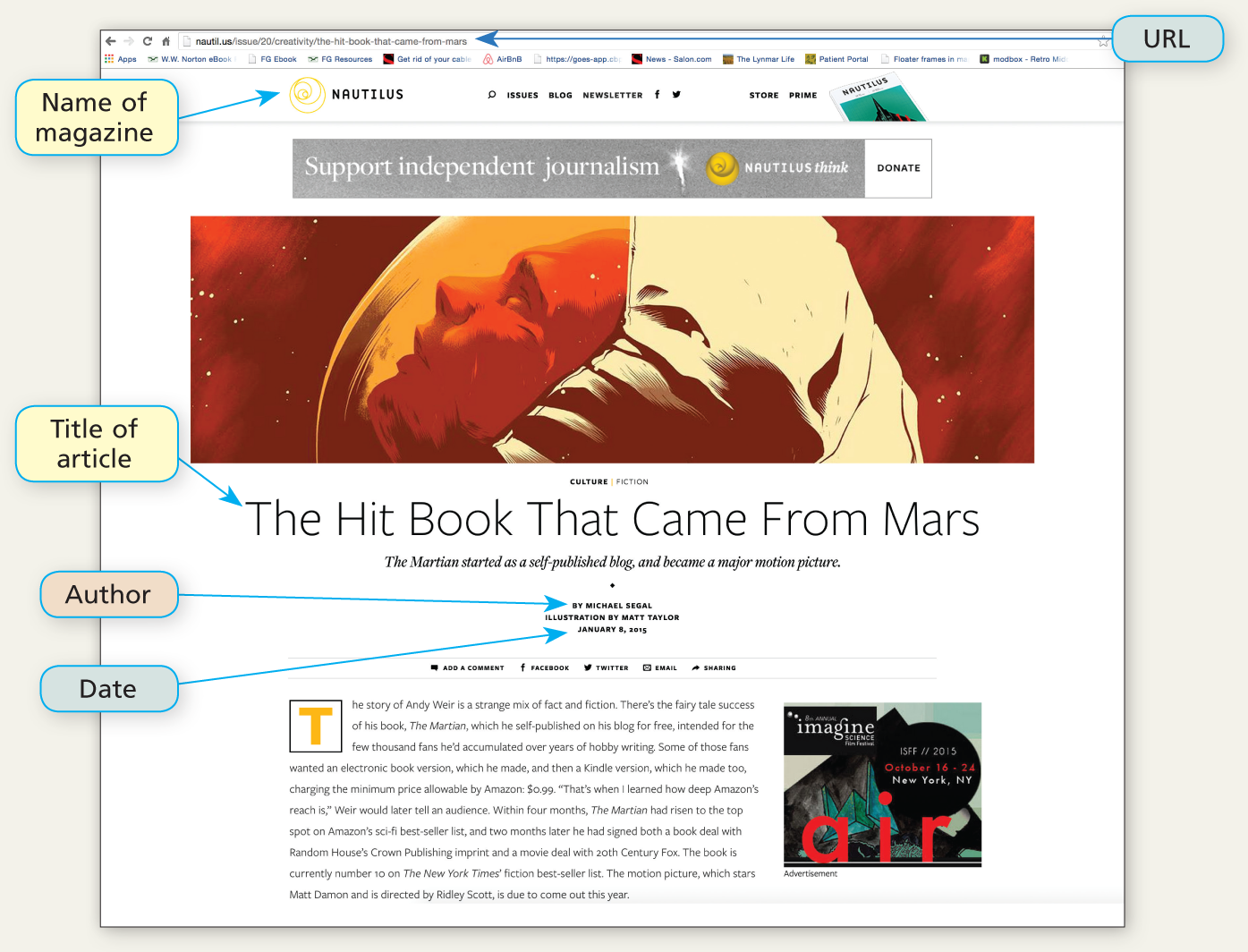
Segal, Michael. “The Hit Book That Came from Mars.” Nautilus, 8 Jan. 2015, nautil.us/issue/20/creativity/the-hit-book-that-came-from-mars.
ONLINE
Author’s Last Name, First Name. “Title of Article.” Name of Journal, Volume, Issue, Date, DOI or URL.
Schmidt, Desmond. “A Model of Versions and Layers.” Digital Humanities Quarterly, vol. 13, no. 3, 2019, www.digitalhumanities.org/dhq/vol/13/3/000430/000430.html.
9. ARTICLE IN A MAGAZINE
Author’s Last Name, First Name. “Title of Article.” Name of Magazine, Volume (if any), Issue (if any), Date, Pages.
Burt, Tequia. “Legacy of Activism: Concerned Black Students’ 50-Year History at Grinnell College.” Grinnell Magazine, vol. 48, no. 4, summer 2016, pp. 32-38.
ONLINE
Author’s Last Name, First Name. “Title of Article.” Name of Magazine, Volume (if any), Issue (if any), Date, DOI or URL.
Brooks, Arthur C. “The Hidden Toll of Remote Work.” The Atlantic, 1 Apr. 2021, www.theatlantic.com/family/archive/2021/04/zoom-remote-work-loneliness-happiness/618473.
10. ARTICLE IN A NEWS PUBLICATION
Author’s Last Name, First Name. “Title of Article.” Name of Publication, Date, Pages.
Saulny, Susan, and Jacques Steinberg. “On College Forms, a Question of Race Can Perplex.” The New York Times, 14 June 2011, p. A1.
To document a particular edition of a newspaper, list the edition before the date. If a section name or number is needed to locate the article, put that detail after the date.
Burns, John F., and Miguel Helft. “Under Pressure, YouTube Withdraws Muslim Cleric’s Videos.” The New York Times, late ed., 4 Nov. 2010, sec. 1, p. 13.
ONLINE
Author’s Last Name, First Name. “Title of Article.” Name of Publication, Date, URL.
Banerjee, Neela. “Proposed Religion-Based Program for Federal Inmates Is Canceled.” The New York Times, 28 Oct. 2006, www.nytimes.com/2006/10/28/us/28prison.html.
11. ARTICLE ACCESSED THROUGH A DATABASE
Author’s Last Name, First Name. “Title of Article.” Name of Periodical, Volume, Issue, Date, Pages. Name of Database, DOI or URL.
Stalter, Sunny. “Subway Ride and Subway System in Hart Crane’s ‘The Tunnel.’” Journal of Modern Literature, vol. 33, no. 2, Jan. 2010, pp. 70-91. JSTOR, https://doi.org/: 10.2979/jml.2010.33.2.70.
12. ENTRY IN A REFERENCE WORK
Author’s Last Name, First Name (if any). “Title of Entry.” Title of Reference Book, edited by First and Last Names (if any), Edition number, Volume (if any), Publisher, Date, Pages.
Fritz, Jan Marie. “Clinical Sociology.” Encyclopedia of Sociology, edited by Edgar F. Borgatta and Rhonda J. V. Montgomery, 2nd ed., vol. 1, Macmillan Reference USA, 2000, pp. 323-29.
“California.” The New Columbia Encyclopedia, edited by William H. Harris and Judith S. Levey, 4th ed., Columbia UP, 1975, pp. 423-24.
Documentation Map (MLA)
JOURNAL ARTICLE ACCESSED THROUGH A DATABASE
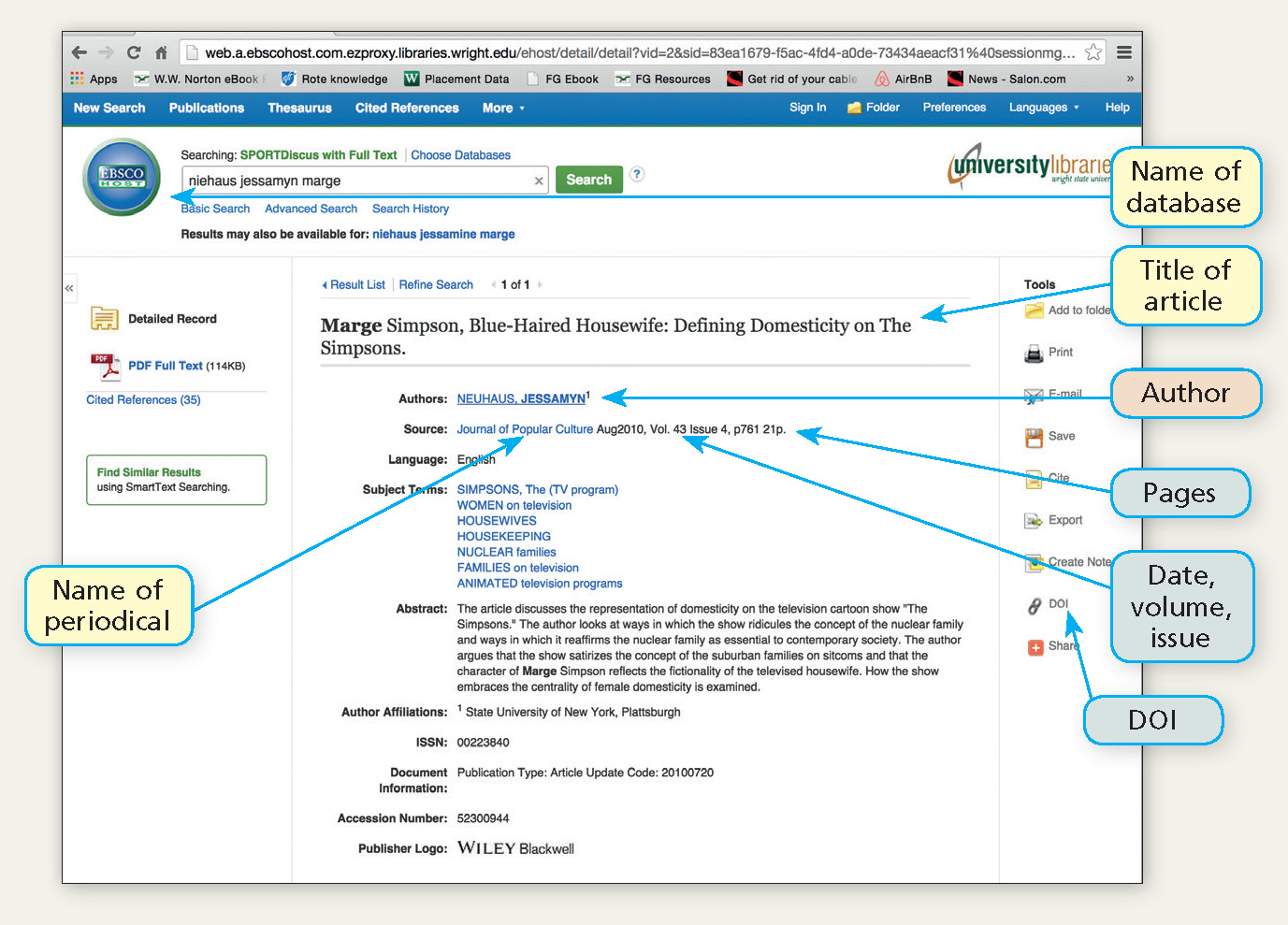
Neuhaus, Jessamyn. “Marge Simpson, Blue-Haired Housewife: Defining Domesticity on The Simpsons.” Journal of Popular Culture, vol. 43, no. 4, Aug. 2010, pp. 761-81. EBSCOhost, http://doi.org/10.1111/j.1540-5931.2010.00769.x.
ONLINE
Document online reference works the same as print ones, adding the URL after the date of publication.
“Baseball.” The Columbia Electronic Encyclopedia, edited by Paul Lagassé, 6th ed., Columbia UP, 2012, www.infoplease.com/encyclopedia.
13. EDITORIAL OR OP-ED
EDITORIAL
Editorial Board. “Title.” Name of Periodical, Date, Page or URL.
Editorial Board. “A New Look for Local News Coverage.” The Lakeville Journal, 13 Feb. 2020, p. A8.
Editorial Board. “Editorial: Protect Reporters at Protest Scenes.” Los Angeles Times, 11 Mar. 2021, www.latimes.com/opinion/story/2021-03-11/reporters-protest-scenes.
OP-ED
Author’s Last Name, First Name. “Title.” Name of Periodical, Date, Page, or URL.
Okafor, Kingsley. “Opinion: The First Step to COVID Vaccine Equity Is Overall Health Equity.” The Denver Post, 15 Apr. 2021, www.denverpost.com/2021/04/15/covid-vaccine-equity-kaiser.
If it’ not clear that it’s an op-ed, add a label at the end.
Balf, Todd. “Falling in Love with Swimming.” The New York Times, 17 Apr. 2021, p. A21. Op-ed.
14. LETTER TO THE EDITOR
Author’s Last Name, First Name. “Title of Letter (if any).” Name of Periodical, Date, Page or URL.
Pinker, Steven. “Language Arts.” The New Yorker, 4 June 2012, p. 10.
If the letter has no title, include “Letter” after the author’s name.
Fleischmann, W. B. Letter. The New York Review of Books, 1 June 1963, www.nybooks.com/articles/1963/06/01/letter-21.
15. REVIEW
Reviewer’s Last Name, First Name. “Title of Review.” Name of Periodical, Date, Pages.
Frank, Jeffrey. “Body Count.” The New Yorker, 30 July 2007, pp. 86-87.
ONLINE
Reviewer’s Last Name, First Name. “Title of Review.” Name of Periodical, Date, URL.
Donadio, Rachel. “Italy’s Great, Mysterious Storyteller.” The New York Review of Books, 18 Dec. 2014, www.nybooks.com/articles/2014/12/18/italys-great-mysterious-storyteller.
If a review has no title, include the title and author of the work being reviewed after the reviewer’s name.
Lohier, Patrick. Review of Exhalation, by Ted Chiang. Harvard Review Online, 4 Oct. 2019, www.harvardreview.org/book-review/exhalation/.
16. COMMENT ON AN ONLINE ARTICLE
Commenter’s Last Name, First Name or Username. Comment on “Title of Article.” Name of Periodical, Date posted, Time posted, URL.
ZeikJT. Comment on “The Post-Disaster Artist.” Polygon, 6 May 2020, 4:33 a.m., www.polygon.com/2020/5/5/21246679/josh-trank-capone-interview-fantastic-four-chronicle.
Books and Parts of Books
For most books, you’ll need to provide information about the author, the title, the publisher, and the year of publication. If you found the book inside a larger volume, a database, or some other work, be sure to specify that as well.
17. BASIC ENTRIES FOR A BOOK
Author’s Last Name, First Name. Title.Publisher, Year of publication.
Watson, Brad. Miss Jane. W. W. Norton, 2016.
EBOOK
Author’s Last Name, First Name. Title. Ebook ed., Publisher, Year of Publication.
Watson, Brad. Miss Jane. Ebook ed., W. W. Norton, 2016.
ON A WEBSITE
Author’s Last Name, First Name. Title. Publisher, Year of publication, DOI or URL.
Ball, Cheryl E., and Drew M. Loewe, editors. Bad Ideas about Writing. West Virginia U Libraries, 2017, textbooks.lib.wvu.edu/badideas/badideasaboutwriting-book.pdf.
WHEN THE PUBLISHER IS THE AUTHOR
Title. Edition number (if any), Publisher, Year of publication.
MLA Handbook. 9th ed. Modern Language Association of America, 2021.
18. ANTHOLOGY OR EDITED COLLECTION
Last Name, First Name, editor.Title.Publisher, Year of publication.
Kitchen, Judith, and Mary Paumier Jones, editors. In Short: A Collection of Brief Nonfiction. W. W. Norton, 1996.
Documentation Map (MLA)
PRINT BOOK

Fontanella-Khan, Amana. Pink Sari Revolution: A Tale of Women and Power in India. W. W. Norton, 2013.
19. WORK IN AN ANTHOLOGY
Author’s Last Name, First Name. “Title of Work.” Title of Anthology,edited by First and Last Names,Publisher, Year of publication, Pages.
Achebe, Chinua. “Uncle Ben’s Choice.” The Seagull Reader: Literature, edited by Joseph Kelly, W. W. Norton, 2005, pp. 23-27.
TWO OR MORE WORKS FROM ONE ANTHOLOGY
Prepare an entry for each selection by author and title, followed by the anthology editors’ last names and the pages of the selection. Then include an entry for the anthology itself (see no. 18).
Author’s Last Name, First Name. “Title of Work.” Anthology Editors’ Last Names, Pages.
Hiestand, Emily. “Afternoon Tea.” Kitchen and Jones, pp. 65-67.
Ozick, Cynthia. “The Shock of Teapots.” Kitchen and Jones, pp. 68-71.
20. MULTIVOLUME WORK
ALL VOLUMES
Author’s Last Name, First Name. Title of Work. Publisher, Year(s) of publication. Number of vols.
Churchill, Winston. The Second World War. Houghton Mifflin, 1948-53. 6 vols.
SINGLE VOLUME
Author’s Last Name, First Name. Title of Work. Vol. number, Publisher, Year of publication.
Sandburg, Carl. Abraham Lincoln: The War Years. Vol. 2, Harcourt, Brace and World, 1939.
If the volume has its own title, include it after the author’s name, and indicate the volume number and series title after the year.
Caro, Robert A. Means of Ascent. Vintage Books, 1990. Vol. 2 of The Years of Lyndon Johnson.
21. BOOK IN A SERIES
Author’s Last Name, First Name. Title of Book. Edited by First and Last Names, Publisher, Year of publication. Series Title.
Walker, Alice. Everyday Use. Edited by Barbara T. Christian, Rutgers UP, 1994. Women Writers: Texts and Contexts.
22. GRAPHIC NARRATIVE OR COMIC BOOK
Author’s Last Name, First Name. Title.Publisher, Year of publication.
Barry, Lynda. One! Hundred! Demons! Drawn and Quarterly, 2005.
If the work has both an author and an illustrator, start with the one you want to highlight, and label the role of anyone who’s not an author.
Pekar, Harvey. Bob and Harv’s Comics. Illustrated by R. Crumb, Running Press, 1996.
Crumb, R., illustrator. Bob and Harv’s Comics. By Harvey Pekar, Running Press, 1996.
To cite several contributors, you can also start with the title.
Secret Invasion. By Brian Michael Bendis, illustrated by Leinil Yu, inked by Mark Morales, Marvel, 2009.
23. SACRED TEXT
If you cite a specific edition of a religious text, you need to include it in your works-cited list.
The New English Bible with the Apocrypha. Oxford UP, 1971.
The Torah: A Modern Commentary. W. Gunther Plaut, general editor, Union of American Hebrew Congregations, 1981.
24. EDITION OTHER THAN THE FIRST
Author’s Last Name, First Name. Title. Edition name or number, Publisher, Year of publication.
Smart, Ninian. The World’s Religions. 2nd ed., Cambridge UP, 1998.
25. REPUBLISHED WORK
Author’s Last Name, First Name. Title. Year of original publication. Current publisher, Year of republication.
Bierce, Ambrose. Civil War Stories. 1909. Dover, 1994.
26. FOREWORD, INTRODUCTION, PREFACE, OR AFTERWORD
Part Author’s Last Name, First Name. Name of Part. Title of Book, by Author’s First and Last Names, Publisher, Year of publication, Pages.
Tanner, Tony. Introduction. Pride and Prejudice, by Jane Austen, Penguin, 1972, pp. 7-46.
27. PUBLISHED LETTER
Letter Writer’s Last Name, First Name. “Title of Letter.” Day Month Year. Title of Book, edited by First and Last Names, Publisher, Year of publication, Pages.
White, E. B. “To Carol Angell.” 28 May 1970. Letters of E. B. White, edited by Dorothy Lobrano Guth, Harper and Row, 1976, p. 600.
28. PAPER HEARD AT A CONFERENCE
Author’s Last Name, First Name. “Title of Paper.” Conference, Day Month Year, Location.
Hern, Katie. “Inside an Accelerated Reading and Writing Classroom.” Conference on Acceleration in Developmental Education, 15 June 2016, Sheraton Inner Harbor Hotel, Baltimore.
29. DISSERTATION
Author’s Last Name, First Name. Title. Year. Institution, PhD dissertation. Name of Database, URL.
Simington, Maire Orav. Chasing the American Dream Post World War II: Perspectives from Literature and Advertising. 2003. Arizona State U. PhD dissertation. ProQuest, search.proquest.com/docview/305340098.
For an unpublished dissertation, end with the institution and a description of the work.
Kim, Loel. Students Respond to Teacher Comments: A Comparison of Online Written and Voice Modalities. 1998. Carnegie Mellon U, PhD dissertation.
Websites
Many sources are available in multiple media—for example, a print periodical that is also on the web and contained in digital databases—but some are published only on websites. A website can have an author, an editor, or neither. Some sites have a publisher, and some do not. Include whatever information is available. If the publisher and title of the site are essentially the same, omit the name of the publisher.
30. ENTIRE WEBSITE
Editor’s Last Name, First Name, role. Title of Site.Publisher, Date, URL.
Proffitt, Michael, chief editor. The Oxford English Dictionary. Oxford UP, 2021, www.oed.com.
PERSONAL WEBSITE
Author’s Last Name, First Name. Title of Site. Date, URL.
Park, Linda Sue. Linda Sue Park: Author and Educator. 2021, lindasuepark.com.
If the site is likely to change, if it has no date, or if it no longer exists, include a date of access.
Archive of Our Own. Organization for Transformative Works, archiveofourown.org. Accessed 23 Apr. 2021.
31. WORK ON A WEBSITE
Author’s Last Name, First Name (if any). “Title of Work.” Title of Site, Publisher (if any), Date, URL.
Documentation Map (MLA)
WORK ON A WEBSITE
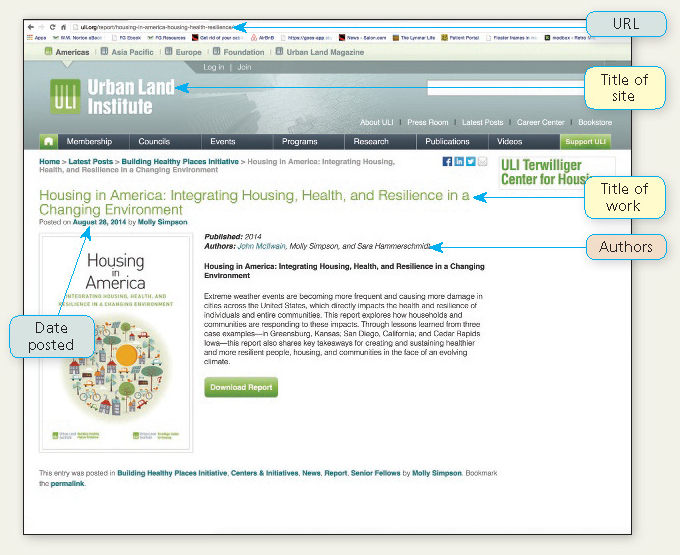
McIlwain, John, et al. “Housing in America: Integrating Housing, Health, and Resilience in a Changing Environment.” Urban Land Institute,28 Aug. 2014, uli.org/report/housing-in-america-housing-health-resilience.
Cesareo, Kerry. “Moving Closer to Tackling Deforestation at Scale.” World Wildlife Fund, 20 Oct. 2020, www.worldwildlife.org/blogs/sustainability-works/posts/moving-closer-to-tackling-deforestation-at-scale.
32. BLOG ENTRY
Author’s Last Name, First Name. “Title of Blog Entry.” Title of Blog, Date, URL.
Hollmichel, Stefanie. “Bring Up the Bodies.” So Many Books, 10 Feb. 2014, somanybooksblog.com/2014/02/10/bring-up-the-bodies/.
Document a whole blog as you would an entire website (no. 30) and a comment on a blog as you would a comment on an online article (no. 16).
33. WIKI
“Title of Entry.” Title of Wiki, Publisher, Date, URL.
“Pi.” Wikipedia, Wikimedia Foundation, 28 Aug. 2013, en.wikipedia.org/wiki/Pi.
Personal Communication and Social Media
34. PERSONAL LETTER
Sender’s Last Name, First Name. Letter to the author. Day Month Year.
Quindlen, Anna. Letter to the author. 11 Apr. 2013.
35. EMAIL OR TEXT MESSAGE
Sender’s Last Name, First Name. Email or Text message to First Name Last Name or to the author.Day Month Year.
Smith, William. Email to Richard Bullock. 19 Nov. 2013.
Rombes, Maddy. Text message to Isaac Cohen. 4 May 2021.
O’Malley, Kit. Text message to the author. 2 June 2020.
You can also include the text of a short email or text message, with a label at the end.
Rust, Max. “Trip to see the cows tomorrow?” 27 Apr. 2021. Email.
36. POST TO TWITTER, INSTAGRAM, OR OTHER SOCIAL MEDIA
Author. “Title.” Title of Site, Day Month Year, URL.
Oregon Zoo. “Winter Wildlife Wonderland.” Facebook, 8 Feb. 2019, www.facebook.com/80229441108/videos/2399570506799549.
If there’s no title, you can use a concise description or the text of a short post.
Millman, Debbie. Photos of Roxane Gay. Instagram, 18 Feb. 2021, www.instagram.com/p/CLcT_EnhnWT.
Obama, Barack [@POTUS44]. “It’s been the honor of my life to serve you. You made me a better leader and a better man.” Twitter, 20 Jan. 2017, twitter.com/POTUS44/status/822445882247413761.
Audio, Visual, and Other Sources
37. ADVERTISEMENT
Description of ad. Title of Periodical, Date, Page.
Advertisement for Grey Goose. Wine Spectator, 18 Dec. 2020, p. 22.
VIDEO
“Title.” Title of Site, uploaded by Company, Date, URL.
“First Visitors.” YouTube, uploaded by Snickers, 20 Aug. 2020, www.youtube.com/watch?v=negeco0b1L0.
38. ART
ORIGINAL
Artist’s Last Name, First Name. Title of Art. Year created, Location.
Van Gogh, Vincent. The Potato Eaters. 1885, Van Gogh Museum, Amsterdam.
IN A BOOK
Artist’s Last Name, First Name. Title of Art. Year created, Location. Title of Book, by First and Last Names, Publisher, Year of publication, Page.
Van Gogh, Vincent. The Potato Eaters. 1885, Scottish National Gallery. History of Art: A Survey of the Major Visual Arts from the Dawn of History to the Present Day, by H. W. Janson, Prentice Hall / Harry N. Abrams, 1969, p. 508.
ONLINE
Artist’s Last Name, First Name. Title of Art. Year created. Title of Site, URL.
Warhol, Andy. Self-portrait. 1979. J. Paul Getty Museum, www.getty.edu/art/collection/objects/106971/andy-warhol-self-portrait-american-1979.
39. CARTOON
Author’s Last Name, First Name. Cartoon or “Title of Cartoon.” Name of Periodical, Date, Page.
Mankoff, Robert. Cartoon. The New Yorker, 3 May 1993, p. 50.
ONLINE
Author’s Last Name, First Name. Cartoon or “Title of Cartoon.” Title of Site, Date, URL.
Munroe, Randall. “Up Goer Five.” xkcd, 12 Nov. 2012, xkcd.com/1133.
40. SUPREME COURT CASE
United States, Supreme Court. First Defendant v. Second Defendant. Date of decision. Title of Source Site, Publisher, URL.
United States, Supreme Court. District of Columbia v. Heller. 26 June 2008. Legal Information Institute, Cornell Law School, www.law.cornell.edu/supremecourt/text/07-290.
41. FILM
Name individuals based on the focus of your project—the director, the screenwriter, or someone else.
Title of Film. Role by First and Last Names, Production Company, Date.
Breakfast at Tiffany’s. Directed by Blake Edwards, Paramount, 1961.
ONLINE
Title of Film. Role by First and Last Names, Production Company, Date. Title of Site, URL.
Interstellar. Directed by Christopher Nolan, Paramount, 2014. Amazon Prime Video, www.amazon.com/Interstellar-Matthew-McConaughey/dp/B00TU9UFTS.
If your essay focuses on one contributor, you may put their name before the title.
Edwards, Blake, director. Breakfast at Tiffany’s. Paramount, 1961.
42. TV SHOW EPISODE
Name contributors based on the focus of your project—director, creator, actors, or others. If you don’t want to highlight anyone in particular, don’t include any contributors.
BROADCAST
“Title of Episode.” Title of Program, role by First and Last Names (if any), season, episode, Production Company, Date.
“The Storm.” Avatar: The Last Airbender, created by Michael Dante DiMartino and Bryan Konietzko, season 1, episode 12, Nickelodeon Animation Studios, 3 June 2005.
DVD
“Title of Episode.” Broadcast Date.Title of DVD, role by First and Last Names (if any), season, episode, Production Company, Release Date, disc number. DVD.
“The Storm.” 2005. Avatar: The Last Airbender: The Complete Book 1 Collection, created by Michael Dante DiMartino and Bryan Konietzko, episode 12, Nickelodeon Animation Studios, 2006, disc 3. DVD.
STREAMING ONLINE
“Title of Episode.” Title of Program, role by First and Last Names (if any), season, episode, Production Company, Date. Title of Site, URL.
“The Storm.” Avatar: The Last Airbender, season 1, episode 12, Nickelodeon Animation Studios, 2005. Netflix, www.netflix.com.
STREAMING ON AN APP
“Title of Episode.” Title of Program, Role by First and Last Names (if any), season, episode, Production Company, Date. Name of app.
“The Storm.” Avatar: The Last Airbender, season 1, episode 12, Nickelodeon Animation Studios, 2005. Netflix app.
If you’re focusing on a contributor who’s relevant specifically to the episode you’re citing, include their name after the episode title.
“The Storm.” Directed by Lauren MacMullan. Avatar: The Last Airbender, season 1, episode 12, Nickelodeon Animation Studios, 3 June 2005.
43. ONLINE VIDEO
“Title of Video.” Title of Site, uploaded by Uploader’s Name, Day Month Year, URL.
“Everything Wrong with National Treasure in 13 Minutes or Less.” YouTube, uploaded by CinemaSins, 21 Aug. 2014, www.youtube.com/watch?v=1ul-_ZWvXTs.
44. PRESENTATION ON ZOOM OR OTHER VIRTUAL PLATFORM
MLA doesn’t give specific guidance on how to cite a virtual presentation, but this is what we recommend. See style.mla.org for more information.
Author’s Last Name, First Name. “Title.” Sponsoring Institution, Day Month Year. Name of Platform.
Budhathoki, Thir. “Cross-Cultural Perceptions of Literacies in Student Writing.” Conference on College Composition and Communication, 9 Apr. 2021. Zoom.
45. INTERVIEW
If it’s not clear that it’s an interview, add a label at the end. If you are citing a transcript of an interview, indicate that at the end as well.
PUBLISHED
Subject’s Last Name, First Name. “Title of Interview.” Interview by First Name Last Name (if given). Name of Publication, Date, Pages or URL.
Whitehead, Colson. “Colson Whitehead: By the Book.” The New York Times, 15 May 2014, www.nytimes.com/2014/05/18/books/review/colson-whitehead-by-the-book.html. Interview.
PERSONAL
Subject’s Last Name, First Name. Concise description. Day Month Year.
Bazelon, L. S. Telephone interview with the author. 4 Oct. 2020.
46. MAP
If the title doesn’t make clear it’s a map, add a label at the end.
Title of Map. Publisher, Date.
Brooklyn. J. B. Beers, 1874. Map.
47. MUSICAL SCORE
Composer’s Last Name, First Name. Title of Composition. Publisher, Year of publication.
Frank, Gabriela Lena. Compadrazgo. G. Schirmer, 2007.
48. ORAL PRESENTATION
Presenter’s Last Name, First Name. “Title of Presentation.” Sponsoring Institution, Date, Location.
Cassin, Michael. “Nature in the Raw—The Art of Landscape Painting.” Berkshire Institute for Lifelong Learning, 24 Mar. 2005, Clark Art Institute, Williamstown, Massachusetts.
49. PODCAST
If you accessed a podcast on the web, give the URL; if you accessed it through an app, indicate that instead.
“Title of Episode.” Title of Podcast, hosted by First Name Last Name, season, episode, Production Company, Date, URL.
“DUSTWUN.” Serial, hosted by Sarah Koenig, season 2, episode 1, WBEZ / Serial Productions, 10 Dec. 2015, serialpodcast.org/season-two/1/dustwun.
“DUSTWUN.” Serial, hosted by Sarah Koenig, season 2, episode 1, WBEZ / Serial Productions, 10 Dec. 2015. Spotify app.
50. RADIO PROGRAM
“Title of Episode.” Title of Program, hosted by First Name Last Name, Station, Day Month Year.
“In Defense of Ignorance.” This American Life, hosted by Ira Glass, WBEZ, 22 Apr. 2016.
51. SOUND RECORDING
If you accessed a recording on the web, give the URL; if you accessed it through an app, indicate that instead.
Artist’s Last Name, First Name. “Title of Work.” Title of Album, Label, Date, URL.
Beyoncé. “Pray You Catch Me.” Lemonade, Parkwood Entertainment / Columbia Records, 2016, www.beyonce.com/album/lemonade-visual-album/songs.
Simone, Nina. “To Be Young, Gifted and Black.” Black Gold, RCA Records, 1969. Spotify app.
ON A CD
Artist’s Last Name, First Name. “Title of Work.” Title of Album, Label, Date. CD.
Brown, Greg. “Canned Goods.” The Live One, Red House, 1995. CD.
52. VIDEO GAME
Title of Game. Version, Distributor, Date of release.
Animal Crossing: New Horizons. Version 1.1.4, Nintendo, 6 Apr. 2020.