 getting started
 fundamentals
 content
 delivery
 engaging your audience
 speaking to inform
 speaking to persuade
 speaking occasions
Elements of the Rhetorical Situation
More information
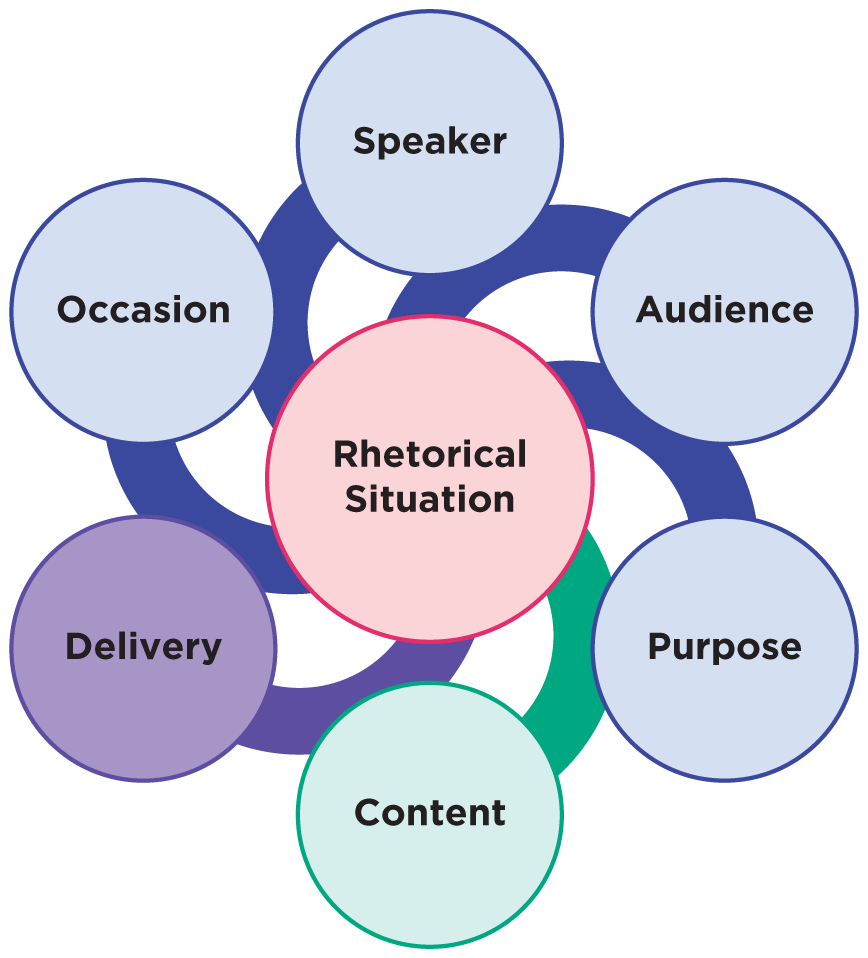
A graphic with Rhetorical Situation at the center and facets branching out to form a circle around it. The facets are Occasion, Speaker, Audience, Purpose, Content, and Delivery.
Effective presentation speaking is a rhetorical process. It includes a set of decisions that work together in each unique speaking situation to achieve a speaker’s intended purpose. Every rhetorical situation includes six core elements that embody this process: your occasion, audience, purpose, content, and delivery—and you, the speaker.
As you prepare for your presentations, you’ll find that each of these elements is multifaceted, and none are independent from the rest. The decisions you make about one will affect all the other decisions for your presentation. The chapters that follow will provide specific advice for helping you do just that, but let’s start by taking a brief look at each element.
OCCASION
All presentations occur for a particular reason. They also happen at a specific time in a particular setting, using a particular medium. These four factors—reason, time, setting, and medium—constitute a presentation’s occasion.
Based on the occasion, your audience will have certain expectations about what you’ll say and how you’ll say it. The norms and expectations of a toast will be quite different, for example, from those of a eulogy.
Chapter 2.1 OCCASION (61–68) explores the following questions to help you adapt your presentation for your occasion:
- Why am I speaking on this occasion?
- What does the audience expect for this occasion?
- What is appropriate for this occasion?
- Where will I speak and how many people will be there?
- When and for how long should I speak?
- What equipment and accommodation services will be available?
SPEAKER
All presentations require a speaker, so ask yourself, “Why am I here speaking to this audience on this occasion?” What do you bring to the occasion? Just as no two people are exactly alike, no two speakers communicate identically or from the same perspective. Your personal characteristics, skills, and experiences affect the way you speak to others and, as a result, how others react to you.
Chapter 2.2 SPEAKER (72–85) will help you answer the following questions about how to be seen as a trustworthy, likable, and dynamic speaker:
- How do my personal characteristics, traits, skills, attitudes, values, and level of confidence affect my credibility?
- How can I present myself as a competent speaker: knowledgeable, experienced, qualified, and well prepared?
- How can I demonstrate that I am a trustworthy speaker?
- What can I do to be a likable and dynamic speaker?
AUDIENCE
When you speak, the members of your audience—the people whose knowledge, beliefs, feelings, or actions you seek to influence—are not passive. They will react in a variety of ways to what you say, and their reactions will be shaped by their unique mix of attitudes, values, experiences, and characteristics. No two audiences are exactly alike, and they are the ones who will decide whether you are worth believing, admiring, and supporting.
Chapter 2.3 AUDIENCE (88–105) will help you answer the following questions to become an audience-centered speaker:
- How do I analyze my audience: who are they, why are they here, and what do they know?
- How do I analyze and adapt to the interests, attitudes, and values of my audience?
- How will the audience likely respond to what I say?
- What strategies should I use to adapt my presentation to my audience?
- How can I find common ground, respect audience diversity and differences, and be mindful of and responsive to audience feedback?
PURPOSE
What do you want your audience to know, think, believe, or do as a result of your presentation? That’s your purpose. In short, your purpose is the desired outcome of your presentation; your purpose is not the same as your presentation’s topic, subject matter, or occasion.
A speaker’s purpose usually has an overarching goal: to inform and explain, persuade and influence, inspire and motivate, entertain and please. Effective speakers identify a more specific, relevant, and achievable purpose statement and use it to guide all other major decisions for their presentation.
Chapter 2.4 PURPOSE (109–18) will help you answer the following questions about determining and achieving your purpose:
- What is my general speaking objective: to inform, persuade, entertain, or inspire?
- What do I want my audience to know, think, believe, or do a result of my presentation?
- How will achieving my purpose benefit me and my audience?
- Is my purpose appropriate for my occasion, myself, and my audience?
- What is my purpose statement? Is it specific, achievable, and relevant?
CONTENT
Every presentation conveys a message—the ideas and information you want to share with your audience. Knowing your occasion, your credibility as a speaker, your audience, and your purpose, you can then decide what to include and how to organize your presentation.
Your presentation should include key ideas and relevant information that supports your purpose and is appropriate for your occasion and audience. You should also organize your ideas and information into a coherent and compelling message. To achieve those goals, you will have to decide which ideas, facts, information, arguments, quotations, definitions, examples, visuals, and stories you do or don’t want to include in your presentation.
Part 3 CONTENT (123–207) will help you answer the following questions about choosing a topic, finding and using appropriate supporting material, and organizing your presentation effectively:
- Where and how can I find appropriate and meaningful ideas and information for my presentation?
- How much and what kind of supporting material do I need?
- Is my supporting material valid, appropriate, believable, and engaging?
- Do I have a clear central idea and relevant key points?
- What is the most effective way to organize my presentation?
- What should I say in the introduction and conclusion of my presentation?
DELIVERY
Delivery is what audience members see and hear when you speak. It’s how you use your voice, face, body, notes, and presentation aids to convey your message to your audience.
What medium or media will you use to transmit your message? In other words, what channel or channels will you use? Messages can be sent via all five senses—and electronically. Most presentations use sight and sound, and many use presentation aids. Speaking to a live audience in person is different from delivering to a live audience online. Recording and posting a presentation for later viewing requires different strategies than giving a real-time, in-person speech.
Part 4 DELIVERY (209–301) will help you answer the following questions about practicing your delivery, using presentation aids, and preparing to deliver a speech online:
- How can I improve my vocal delivery with appropriate volume, rate, pitch, and fluency?
- Should I deliver my speech memorized, from a manuscript, or using notes?
- How much should I practice?
- What level of eye contact, facial expressions, gestures, posture, and movement should I use?
- How should I design and use presentation aids?
- How can I adapt my delivery for an online presentation?
Glossary
- rhetorical situation
- The particular circumstance in which you speak to influence what your listeners know, believe, feel, and/or do. The six core elements of the rhetorical situation are AUDIENCE, CONTENT, DELIVERY, OCCASION, PURPOSE, and SPEAKER.
- message
- The synthesis of ideas and information a SPEAKER shares verbally and nonverbally with an AUDIENCE.
- channel
- The medium or media used by SPEAKERS and AUDIENCE members to transmit MESSAGES to one another.