 getting started
 fundamentals
 content
 delivery
 engaging your audience
 speaking to inform
 speaking to persuade
 speaking occasions
Shared Listening Responsibilities
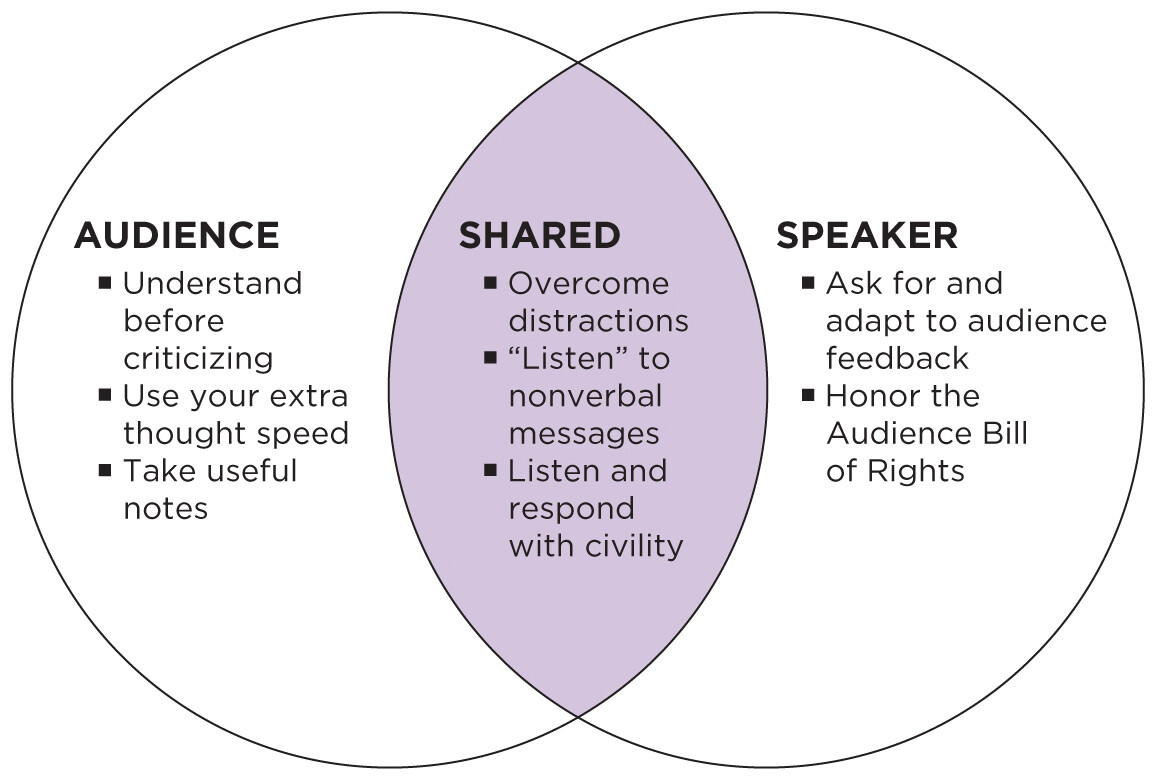
As you work to improve your general listening skills, consider the responsibilities unique to the audience and to the speaker in any given speaking situation. Let’s begin with the listening responsibilities shared by both audience members and the speaker. Three of the most important responsibilities are overcoming distractions, “listening” to nonverbal messages, and listening with civility.
More information
A Venn diagram with detailing strategies and skills that should be employed by audiences and speakers. Items unique to the audience are: Understand before criticizing, Use your extra thought speed, and Take useful notes. Items unique to the speaker are: Ask for and adapt to audience feedback, and Honor the Audience Bill of Rights. Items shared by both audiences and speakers are: Overcome distractions, “Listen” to nonverbal messages, and Listen and respond with civility.
OVERCOME DISTRACTIONS
Distractions take many forms and can be caused by a speaker, an audience member, or outside interference. Depending on the circumstances and setting of a presentation, you may be able to take direct action to reduce behavioral noise. If an audience member is distracting, you could ask them to stop talking or moving around—after all, if they’re distracting you, they’re probably distracting others. If a presenter speaks too softly or uses visual aids that are too small, a conscientious audience member may ask the speaker to use more volume or further explain what is being shown.
When distractions are environmental, you are well within your rights as a speaker or audience member to shut a door, open a window, turn on more lights, and (of course) turn off cell phone sounds. In large facilities, you may need to ask permission to improve the group’s surroundings. And during ONLINE PRESENTATIONS (282–301), it’s helpful for both speakers and audience members to close extraneous browser tabs, turn off notifications, and participate from a private, quiet location.
“LISTEN” TO NONVERBAL MESSAGES
Speakers and audience members don’t put everything important into words. Often, you can understand a speaker’s meaning or gauge audience members’ reactions by noting and interpreting their nonverbal behavior.
Good listeners pay attention to the combined meaning of verbal and nonverbal messages, and they notice any mismatch between the two, such as if a speaker said, “I’m delighted to see you here today,” while slouching and speaking in a dull voice.
A change in a speaker’s INFLECTION (239–40) or volume may indicate “Listen up—this is important!” A presenter’s sustained EYE CONTACT (249–51) may be a way of saying “I’m talking to you!” FACIAL EXPRESSIONS (251–52) can reveal whether a thought is painful, joyous, exciting, serious, or boring. Effective listeners pay attention to all aspects of a speaker’s delivery.
In turn, effective speakers pay attention to audience members’ nonverbal behaviors. Are listeners frowning in puzzlement or nodding their heads in agreement? What about their posture—are they sitting straight, leaning forward, and ready to engage, or are they slumping in their seats, looking like they hope to catch a nap? (It happens!) Is their full attention on the speaker, or are they preoccupied with their cell phones and tablets? All these nonverbal behaviors send messages about whether the presentation is on track or if changes are necessary to recapture the audience’s attention and interest, and if we—as listeners and as speakers—fail to “listen” to each other’s telling clues, we may be missing the intended meaning of a message.
LISTEN AND RESPOND WITH CIVILITY
For a successful presentation, both speakers and audience members must also listen respectfully to one another. In other words, they need to listen and respond with civility. In his book Choosing Civility, P. M. Forni defines civility as “being constantly aware of others and weaving restraint, respect, and consideration into the very fabric of this awareness.”4 In the context of presentation speaking, this can mean expressing empathy for a speaker who shares a personal story or being considerate of an audience who may hold very different beliefs than you do.
Listening to others with full attention is the hallmark of civility. It might seem easy, even enjoyable, to listen with civility when you completely agree with someone. But there’s value, too, in listening with civility even when you disagree, as difficult as it may be. To cultivate a genuine, shared civility, we suggest two related strategies:
- Be open to disagreement. As a speaker it is your responsibility—even if your topic is controversial—to treat your audience with respect. If you advocate for something you know your listeners disagree with, you may be more effective if you listen to and respectfully acknowledge their point of view. And as an audience member, it’s important to listen with the intent to understand, correctly interpret, and fairly evaluate what the speaker is saying. If you disagree after listening with an open mind, you still benefit from considering another person’s point of view. In the words of author-scholar Roxane Gay: “Disagreement is wonderful. When someone disagrees, we try to reach common ground. That’s good.”5
- Disagree without being disagreeable. You can disagree with a speaker’s message instead of disagreeing with the speaker. Try to empathize and understand even if you don’t agree. As a speaker, you can share valid evidence and let facts do the talking. As an audience member, try to avoid criticizing, correcting, or dismissing what a speaker says; respond respectfully instead. Civility requires that both sides have the right to disagree without resorting to misinterpreting or disrespecting each other.
But what if your point of view is being attacked, even as you do your best to listen and respond with civility? What if—in disagreeing without being disagreeable—an audience’s point of view has been continually dismissed or ignored?
Although listening and responding with civility means valuing empathy over anger, some studies show that there are circumstances where “outrage can serve as an important catalyst for collective action.”6 The upside of outrage is that it may encourage people to care, to sign petitions, or to volunteer. In fact, social psychologist Victoria Spring believes that expressing outrage has often been a way for marginalized groups to mobilize people to act. Arguably, listening and responding with civility isn’t achieved with a one-size-fits-all approach to every speaking situation. The challenge is knowing when expressing empathy and/or anger will help or harm. The responsibility falls on all of us, as speakers and listeners, to hold ourselves to ETHICAL COMMUNICATION (44–48) standards wherever possible, even if we intensely disagree.
Glossary
- civility
- An awareness of others expressed by behavior that shows respect and restraint.
Endnotes
- P. M. Forni, Choosing Civility: The Twenty-Five Rules of Considerate Conduct (New York: St. Martin’s Press, 2002), 9.Return to reference 4
- Christopher Borrelli, “Essayist Roxane Gay’s Critical Voice Is Booming,” Chicago Tribune, updated December 18, 2018, https://www.chicagotribune.com/2014/10/24/essayist-roxane-gays-critical-voice-is-booming/.Return to reference 5
- Victoria L. Spring, C. Daryl Cameron, and Mina Cikara, “The Upside of Outrage,” Trends in Cognitive Sciences 22, no. 12 (2018): 1067–69, https://doi.org/10.1016/j.tics.2018.09.006.Return to reference 6