 getting started
 fundamentals
 content
 delivery
 engaging your audience
 speaking to inform
 speaking to persuade
 speaking occasions
Evaluating Your Sources
Whenever you encounter new information, whether in the brainstorming phase or the research phase, you must evaluate all supporting material to ensure it’s valid. By valid, we mean that the ideas, opinions, and information are well founded, justified, and true. This goes well beyond testing the accuracy of an AI response. It applies to any source, idea, and information you reference or use in a presentation. That includes all written material as well as audio, video, and images. No matter how and where you find supporting material, check its validity before adding it to your presentation. Failing to do so can seriously undermine your credibility as a speaker.
So how do you determine whether a source is valid? It may seem too easy to find information and too hard to evaluate everything you find. The massive amount of information from print and online sources is overwhelming. Even skilled researchers can find it difficult to differentiate between good and bad information or biased and unbiased sources. Two strategies (and the ones used by professional fact-checkers) can help you determine whether a source and its output is valid: lateral reading and using the SIFT method.
LATERAL READING
Lateral reading is “the practice of doing a quick initial evaluation of a website by spending . . . more time reading what others say about the source or related issue.”5 While lateral reading was developed to test the credibility of online sources, it can be used to determine whether any source is worth paying attention to or not.
When you locate a new source of information, search for other sources on that same topic. Look for consistencies or discrepancies in each. If a source claims something questionable or shocking, see if other sources make similar claims. If they do not, the original source is likely unreliable; use a fact-checking site to verify. You should also research the publication itself to determine if it has a particular agenda or exhibits some other kind of bias. Research the names of the authors to see if they are qualified to provide information and opinions about your topic.
THE SIFT METHOD
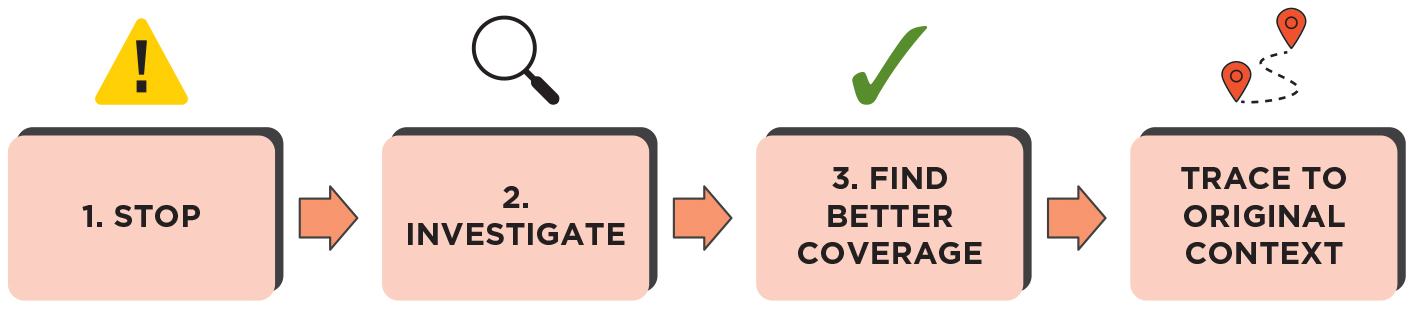
Mike Caulfield, a digital literacy expert at the University of Washington, has transformed the principle of lateral reading into four moves that you can use to initially evaluate the credibility and accuracy of online sources. He calls it the SIFT method, which stands for “stop, investigate, find, and trace.”6
More information
A flowchart with four steps shows the SIFT method. The steps in order are Stop, Investigate, Find better coverage, and Trace to original context.
1. Stop When you first land on a page, stop and consider the source: Do you recognize the information’s source, and do you know if the site verifies its content and authors? Who is the author? In short, don’t just assume that the information is correct. If you can’t find an author’s name and credentials, it’s probably best to look for another source with an identifiable author. There are, however, exceptions when an online source identifies only the company or institution responsible for the message. Treat these sources as authors and check their legitimacy.
2. Investigate the Source Next, investigate the source to determine if it’s credible, unbiased, and up to date.
- Is the source credible? Is the author or speaker a recognized expert, a firsthand observer, a scientist, or a respected journalist? Can you confirm that expertise, experience, or reputation by looking at several sources other than the one you’re testing? Wikipedia is one easy tool to find more information about a source—its publication history, current circulation, and possible controversies. At this point, your goal is to determine if the publication is credible enough to consider as potential supporting material.
- Is the source biased? After testing the credibility of the publication, check for bias. A source with a consistent bias—a prejudice for or against something or an unreasonable partiality, opinion, or feeling—may express claims and opinions so slanted that they are neither objective nor fair. Check an author’s biographical information, recent publications, website, social media account, or LinkedIn profile—and keep in mind that an author can be an individual or an organization. Does the author have agendas or interests that might cause them to make a strong or questionable claim?
- Is the information recent? Note the date of the information you want to use. When was the study conducted? When was the article published? If you find a source that is older but otherwise looks credible, check more recent publications for updated information—keeping in mind that more recent information is not necessarily more accurate. Of course, some supporting material may come from historical sources, but it’s worth checking contemporary coverage for more recent findings on historical events, findings, and accounts.
3. Find Better Coverage If your source seems credible, look to see if other credible sources cite the same facts and make the same claims. A simple search of key terms will usually provide a quick overview of how the topic is viewed by other sources. As you look across other sources, check the credibility of each new source you encounter. To help, you might use fact-checking sites like FactCheck.org, PolitiFact, and Snopes. If you find inconsistencies, the source or claim you’re investigating may not be credible. Consider if your personal viewpoints lead you to trust a particular source, even if other respected sources criticize its accuracy, truthfulness, and biases. This step can be especially effective when trying to recognize and avoid hallucinated sources produced by generative AI.
4. Trace to the Original Context Finally, examine the original context of the claim, quote, or media. Consider if the source is primary or secondary information.
A primary source is an original document or material that is produced from firsthand experience. Examples include an article from a researcher reporting the findings of their own research, an interview on a podcast, and the diary of someone who lived through World War I. Other primary sources include speeches, eyewitness accounts, and recordings or transcripts of statements and events.
A secondary source is a document or material that is created by someone who does not have firsthand knowledge of an experience or event. Secondary sources often describe, report, repeat, or summarize information from one or more other sources. Examples include a news article that summarizes someone else’s scientific research and a description of an event by someone who was not there.
If possible, follow secondary sources of information back to their primary source. Look for hyperlinks in a source that direct you to the original. Perform a search on key terms used in the source. You can identify the original source of most photos by doing a reverse image search using a tool like Google Images or TinEye. Once you verify that the actual photo exists, confirm that it hasn’t been cropped or altered in any other way. If there are differences between the primary and secondary sources, is there a valid explanation for those differences? Has the source or photo purposefully been removed or modified in a way that distorts or contradicts the original context?
To maintain your CREDIBILITY (74–81) and ETHICS (43–57) as a speaker, verify all sources—and don’t take words or photos out of context to support your purpose, especially if it’s not the original speaker or writer’s intended meaning.
Glossary
- valid
- When a FACT, OPINION, recommendation, or piece of information is well founded and justified because it is based on truth and/or effective reasoning.
- lateral reading
- Strategically evaluating the credibility of an online source by investigating what others have said about the source or a related issue.
- SIFT method
- A method for evaluating the credibility and accuracy of messages you find online. SIFT stands for “Stop, Investigate, Find, and Trace.”
- bias
- A prejudice for or against something, often held by SPEAKERS and organizations whose MESSAGES have a self-centered PURPOSE rather than an audience-centered one.
- primary source
- An original document or material that is produced from firsthand experience, such as a speech, eyewitness account, recording, transcript or other TESTIMONY.
- secondary source
- A document or publication that describes, reports, repeats, or summarizes information from primary sources and other secondary sources.
Endnotes
- Andrea Baer and Dan Kipnis, “Evaluating Online Sources: Simple Strategies for Complex Thinking,” Campbell Library, Rowan University, last updated September 7, 2023, https://libguides.rowan.edu/EvaluatingOnlineSources.Return to reference 5
- Mike Caulfield, “SIFT (The Four Moves),” Hapgood (blog), June 19, 2019, https://hapgood.us/?s=SIFT+%28The+Four+Moves%29.Return to reference 6