 getting started
 fundamentals
 content
 delivery
 engaging your audience
 speaking to inform
 speaking to persuade
 speaking occasions
Identifying Key Points and the Central Idea
Inexperienced speakers often feel overwhelmed by all the facts, ideas, opinions, and data that they’ve assembled during their RESEARCH (134–51). So how do you make sense of it all? How do you select the information that will best support your PURPOSE (109–18)? Start by determining the key points and central idea for your presentation.
IDENTIFYING KEY POINTS
Key points are the main ideas or most important issues you want your audience to understand and remember. They are the basic building blocks of your presentation. To identify your key points, look for patterns or natural groupings of ideas and information. Two methods in particular—chunking and mind mapping—can help.
The Chunking Method Chunking is the process of recording and sorting the ideas and supporting material you’ve gathered so far. This simple method helps you identify your key points, then arrange and rearrange them until you’ve found a natural order.
Here’s how it’s done: During the research and planning stage of speech preparation, record each good idea and strong piece of SUPPORTING MATERIAL (135–39) on a single note card, sticky note, or virtual note. Put only one idea, point, phrase, example, statistic, quotation, or story on each card or note.
Once you have gathered and recorded your ideas and supporting material as separate notes, spread them out and look for relationships among them. You’ll notice that some supporting material will back up specific ideas, some ideas will overlap or repeat one another, and some ideas and supporting material will prove to be unrelated to your topic or purpose. For each group of notes that belong together, create a unique category label, or key point. For instance, if you’re preparing a presentation on flying cars, you might discover that you’ve chunked your ideas and supporting material into three key points:
- Technological development of flying cars
- Infrastructure required for using flying cars
- Benefits of developing flying cars
If some of your notes don’t fit into a distinct category with the others, keep them nearby in a pile of “leftovers.” As your presentation develops, some categories might become more important and others less so, and these leftover ideas and supporting material may end up being relevant again.
The Mind Mapping Method Another method for identifying key ideas—mind mapping—produces a visual representation of potential key points and related supporting materials that clearly link to your topic and purpose.
The most common mind mapping method requires only a piece of paper and a writing tool. There are also dozens of mind mapping software tools available. The mind mapping steps that follow use the paper method.1
- Record your topic, ideas, and supporting material. On a single, clean sheet of paper, write your TOPIC (125–33) in the middle of the page and circle it. Everything on your mind map should stem from this word or phrase. Experiment with the ideas that might become candidates for the key points in your presentation. Write down these ideas in the open spaces on the page. Then record the SUPPORTING MATERIAL (135–39) you wish to use near a relevant idea. You may find it necessary to add other ideas that capture the essence of the supporting material. Feel free to be messy. Neatness doesn’t count. Initially, there are no bad ideas. What is important is that at the end of this initial step, you should have a one-page conglomeration of topic-related ideas and supporting material that you might include in your presentation.
- Connect related ideas. Draw a circle around individual ideas and related supporting material. If two ideas are closely related, let your circles overlap or draw lines between those circles. Eventually, they may be combined into a single key point. Now examine ideas and supporting materials that aren’t circled. Are they important? Do they support your purpose? If so, you may need to create a new idea or find more supporting material.
- Refine your mind map. Critically analyze your mind map. Which ideas seem most significant and necessary as key points? Which ones can be discarded? If they’re not important, cross them out. In some cases, you may want to redo your map to organize it further. In a second draft, you can concentrate on making sure that your mind map has adequate and appropriate supporting material for each key point.
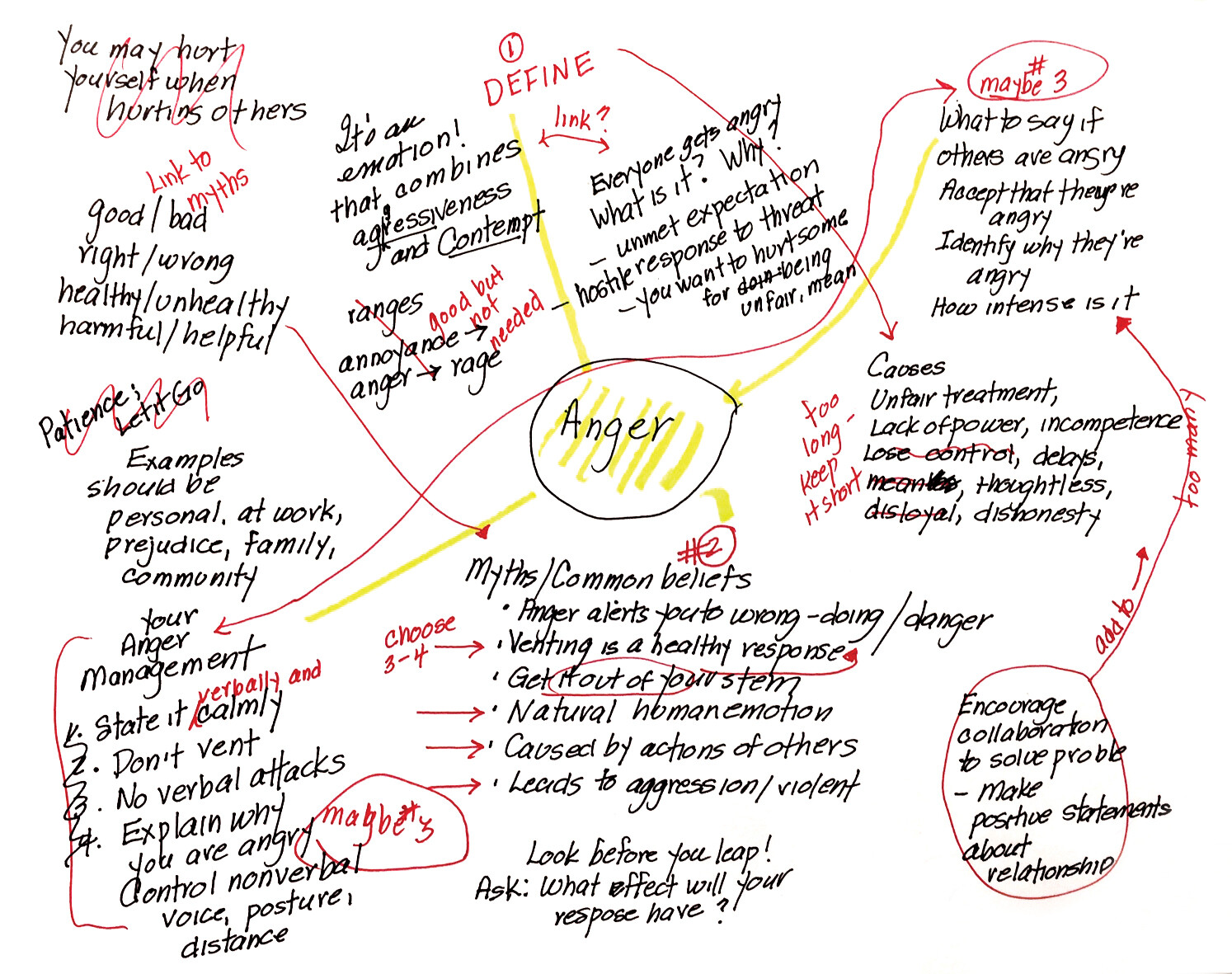
The following figure is a mind map created by a student for a presentation about anger. The mind map is a hodgepodge of words, phrases, lists, circles, and arrows. After analyzing what was on her mind map, she identified and circled ideas and supporting materials for each of her key points and put them in a logical order. Given the large amount of interrelated material she found, mind mapping was a useful way to decide how much information she had time to include, identify her key points, and begin the organizational process.
More information
A mind map about anger with annotations to organize notes for a presentation. A circle labeled anger is in the middle of the map and lines and arrows are drawn to notes on various aspect relating to anger. Sections are numbered to indicate an order for the presentation. Definitions of anger are marked with a 1. Myths and common beliefs about anger are marked with a 2. Methods for addressing anger are marked with maybe 3. Other parts of the map are crossed out indicating they will be omitted, or linked to other sections to be incorporated there.
CONSIDER THE RULE OF THREE
You may be tempted to include all your key points and supporting material in your presentation. Resist that temptation. Even the most attentive listeners in your audience will not remember everything you say. Ask yourself: Which key points are the most essential?
Generally, communication experts agree that an effective presentation should offer at least two key points and no more than five. Three key points is ideal, according to the rule of three. In fact, audience members frequently expect speakers to make three points in their speeches. This is a guideline, not an absolute, unbreakable rule—but in general, keeping the number of key points between two and five will ensure that your presentation remains interesting and memorable.
THE CENTRAL IDEA
Whether you use chunking, mind mapping, or some other method to start organizing your ideas and supporting material, you will eventually determine the key ideas that reflect your PURPOSE STATEMENT (115–17). Now it’s time to write out your central idea.
Your central idea (sometimes called the thesis or preview statement) summarizes your overall message and tells the audience what your main points will be—it describes specifically what you intend to say.
PURPOSE:
To spread awareness about the ways we benefit from earthworms
CENTRAL IDEA:
You may know that earthworms are helpful for fishing and gardening, but you may not know how they can enhance composting and provide a protein-rich meal.
Compare the preceding statements. Which would you rather say to an audience? That’s your central idea. When you’ve finished your presentation, audience members should be able to remember and rephrase your central idea in their own words.
Writing down your central idea is a useful test to determine if you have, in fact, captured the core meaning of your message and previewed your main points. If it takes more than one sentence to state your central idea, you may be trying to do too much with your presentation, or you may not have a clear purpose or discrete set of key points.
The following example illustrates how topic, purpose, and central idea are different but closely related.
TOPIC AREA:
Muzak
PURPOSE:
To make the audience more aware of the purpose and power of Muzak
CENTRAL IDEA:
The next time you hear Muzak playing, you will remember how pervasive it is, how it originated, and how it tries to lift your spirits and productivity.
Once you have drafted a central idea that captures what you want to say in your presentation, you can turn to the details of organization. Keep in mind that your initial central idea is not set in stone. As you organize your content or revise your presentation, you may find that you’ll need to modify your central idea.
Glossary
- key points
- The main ideas and/or most important issues you want your AUDIENCE to understand and remember.
- chunking
- A method for identifying potential SUPPORTING MATERIAL by recording distinct ideas on separate note cards or sticky notes and sorting the best of them into separate KEY POINTS.
- mind mapping
- A method for organizing presentation CONTENT into a visual representation of potential KEY POINTS and related SUPPORTING MATERIALS linked to a specific TOPIC and PURPOSE.
- rule of three
- A general guideline stating that AUDIENCES are more likely to understand and remember three KEY POINTS (as well as three words, phrases, or items in a row) instead of two, four, or more.
- central idea
- A single-sentence summary of your overall MESSAGE and KEY POINTS. Also called a thesis statement.
- thesis
- A single-sentence summary of your overall MESSAGE and KEY POINTS.
Endnotes
- Michael J. Gelb, Present Yourself! Capture Your Audience with Great Presentation (Rolling Hills Estates, CA: Jalmar Press, 1988), 10–15.Return to reference 1