Intersectionality
1.1 A Feminist Psychology
What is feminist psychology, and why is it important?
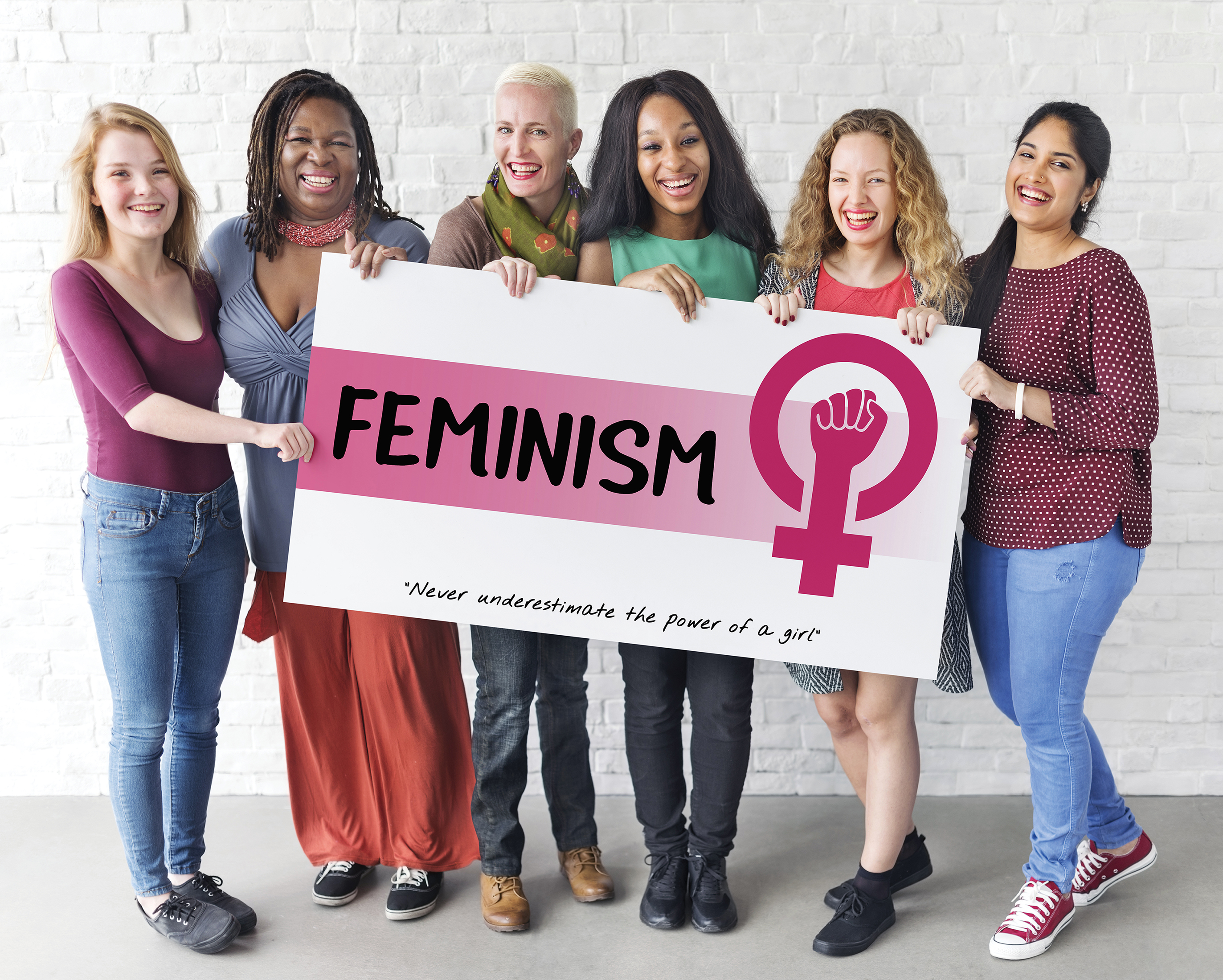
Psychology of women and gender is a subfield of psychology. Historically, it focused on the lives and experiences of girls and women and has expanded to include the exploration of gender more broadly (e.g., masculinity, the experiences of those who are trans and/or gender nonbinary). It emerged and continues to grow alongside many of the political and social movements connected to feminism (Rutherford & Granek, 2010). Although feminism has been defined in many ways, we prefer author and social activist bell hooks’ version: “Simply put, feminism is a movement to end sexism, sexist exploitation, and oppression” (hooks, 2000, p. 26). As we’ll soon discuss, there are multiple feminist perspectives, but all feminisms share the goal of ending sex/gender bias and inequitable treatment (Enns & Forrest, 2005) (Figure 1.2).
More information
A photo shows a group of women, belonging to different ethnicities, smiling and holding a board that reads “Feminism.” The board also shows a raised fist within Venus symbol and the tagline that reads “Never underestimate the power of a girl.”
Figure 1.2 Feminism
What comes to mind when you think of feminism—just one single, clear definition? In actuality, there are multiple feminist perspectives, though they all share the goal of ending sex/gender bias and the unequal treatment of girls and women.
Some psychologists use the term feminist psychology to signal psychological research and theory that are explicitly informed by feminism and to distinguish them from more general work about sex and gender (Parlee, 1975; Rutherford & Granek, 2010). Feminist psychologists argue that psychological research is never value-neutral or objective (Wigginton & Lafrance, 2019). As a result, feminist psychologists make their theoretical positions explicit so as to create transparency and genuine equity, fairness, and respect among people (Matsick, Kruk, Oswald, & Palmer, 2021). Feminist psychologists are also particularly attentive to issues of oppression—the ways in which certain people experience degradation because of political, economic, or social realities (e.g., poverty, lack of access to health care). Feminist psychologists believe that by addressing oppression, both through research and in the practice of psychology, everyone’s well-being will improve. The field of psychology relies on a scientific approach, but the use of the scientific method to study people is not bias-free. One goal of this book is to help you develop skills in uncovering hidden biases and appreciating the complexities associated with conducting psychological research. We will more systematically discuss how to identify biases throughout the research process in Chapter 3.
Another goal of this book is for you to understand socially responsible approaches to psychological research—ones that don’t shy away from a complicated exploration of sex and gender. Some researchers and theorists have argued that the term sex should be used to refer to biological differences (e.g., one’s external genitalia) and gender should be used to indicate those aspects that are socially or culturally produced (e.g., how one acts or expresses oneself). However, contemporary scholars have noted that the terms sex and gender are often used interchangeably and in a confusing way (Muehlenhard & Peterson, 2011). Furthermore, attempting to differentiate between aspects governed by biology and aspects governed by social factors is overly simplistic. Our biology is influenced by social factors just as our socialization is influenced by biological factors. For this reason, we often use the term sex/gender to signify the interdependence of the two categories, a practice that is increasingly popular among contemporary feminist researchers (Hyde et al., 2019; van Anders, 2015).
Further, as we will discuss in Chapter 2, most contemporary feminist researchers move beyond defined categories of sex/gender and, instead, focus on intersectionality—that is, the ways in which different types of oppression (e.g., racism, classism, heterosexism, transphobia, ableism, sexism) are interconnected and therefore cannot be studied separately. An intersectional approach recognizes that identities are formed and shaped through larger social structures, and since structures can change over time or by geographic location, identity is fluid and dynamic (Rutherford & Granek, 2010). Although we’ll explore this concept in more detail in Chapter 2, it’s important to remember that in this view a person doesn’t just have a sex/gender. They also have an age, a cultural identity, a race and ethnicity, a religion, and many other social identity characteristics. Because these other aspects of identity influence and shape how a person experiences sex/gender, there can be no universal experience of sex/gender that is generalizable.
Kimberlé Crenshaw coined the term intersectionality to highlight people’s experiences with multiple systems of oppression.
Video courtesy of National Association of Independent Schools
Intersectionality in Brief
How would you explain intersectionality clearly and concisely to a friend or family member?
Video courtesy of Desiree Coleman-Fry @deisireecoleman
As you begin to read this book, you’ll notice that gender roles in society are complicated. Within the last several decades, girls and women have made substantial strides in creating more opportunities for themselves. Consider, for example, that in 1970 only 14% of U.S. women graduated from college and only 38% of U.S. women worked outside the home (Chronicle of Higher Education, 2015; Cohn et al., 2014). Compare this with statistics from 2021, when 46% of women and only 36% of men between the ages of 25 and 34 held a bachelor’s degree and 59.5% of students enrolled in college in the United States were women (Parker, 2021). In the 2020 general election, U.S. voters elected six trans and/or nonbinary representatives to state office in Arkansas, California, Colorado, Delaware, Illinois, Kansas, New Hampshire, and Vermont, making the total number of trans and/or nonbinary elected officials ever elected a historic high of 32 members (McDaniel & Garcia, 2020).
Men’s roles have changed too. For example, only 10% of stay-at-home parents were fathers in 1989; this number rose to 17% in 2016 (Livingston & Parker, 2019). Additionally, most fathers (57%) see fathering as central to their identity, and half of working fathers say they have a difficult time balancing work and family (Livingston & Parker, 2019). These rates are similar to those reported for women: 58% of women see mothering as central to their identity, and 60% of women say it is difficult balancing work and family. Overall, these data show that women and men alike are experiencing similar desires and struggles regarding parenting.
We might look at this progress, wipe our brows, and think: “Phew . . . thank goodness discrimination and bias are ending. The world is finally changing, and gender restrictions are no longer interfering with people’s ability to have productive and happy lives.” Well . . . not so fast. While some things have changed for the better, there’s still a long way to go. If we aren’t careful, this “half-changed world” might cause us to unquestioningly accept some gains without examining whom these gains benefit and whether they actually provide equity (Orenstein, 2000, p. 11). It could also keep us from recognizing some of the harmful, at times even life-threatening, situations that certain people still face. Consider these statistics:
- In the United States, women are the fastest-growing group who are incarcerated, increasing 700% over the last 40 years (Dholakia, 2021). Incarcerated women are disproportionately women of color and/or low-income, and 86% have experienced sexual violence in their lifetime.
- In 2021, more than 50 trans and/or gender nonbinary people were murdered in the United States (Human Rights Campaign Foundation, n.d.). The majority of these were Black and Latine trans women. This was the most violent year since these murders started being tracked in 2013.
- Eating disorders have been consistently increasing over the past 20 years (Galmiche et al., 2019). In 2021, it was revealed that Facebook had long known, but kept quiet, the fact that Instagram was harming teen girls’ mental health and body image (Wells et al., 2021).
- The COVID-19 pandemic has caused women to drop out of the workforce at unprecedented rates due to layoffs, burnout at work, and difficulty balancing work and family demands (Bateman & Ross, 2020). Globally, COVID-19 put more than 47 million women and girls into extreme poverty (United Nations, 2021).
- The United States continues to be the only industrialized nation that does not offer paid parental leave. Of the other 40 nations in the Organisation for Economic Cooperation and Development, the smallest amount of paid leave is two months (Livingston & Thomas, 2019). Only 16% of U.S. workers have access to paid parental leave, and approximately 23% of U.S. mothers return to work within 10 days of giving birth. Paid leave is associated with decreased depression and partner violence, improved child attachment, and improved physical health of both mothers and children (Van Niel et al., 2020).
- As of January 2023, 19 states had passed legislation that prevents trans and/or gender nonbinary students from joining sports teams that align with their gender identity (Bans on transgender youth participation, n.d.). Such laws require a student to present a physician statement indicating their sex assigned at birth before they can participate in sports. According to the U.S. Centers for Disease Control and Prevention, 27% of trans students felt unsafe at school and 35% reported being bullied (Johns et al., 2019).
- Only 28 countries have women serving as heads of state or government as of September 2022 (U.N. Women, 2022). Moreover, only 21% of government ministers were women, and 36% of people serving in local government were women. The United Nations estimates that equality will not be achieved for another 130 years.
- In June 2022, the Supreme Court ruling in the case of Dobbs v. Jackson Women’s Health Organization overturned Roe v. Wade, the decision that made abortion legal in the United States in 1973. With abortion laws now left up to states, many have banned abortion with no exception for rape and incest. Women who miscarry or experience ectopic pregnancies have reported delays in ability to access care due to physicians’ fears of legal consequences. One woman in Wisconsin bled for 10 days because doctors refused to remove fetal tissue after she experienced a miscarriage (Sellers & Nirappil, 2022).
These statistics remind us that sex/gender continues to shape people’s lives and psychological well-being. In the past, sex/gender bias was much more direct and obvious. For example, employers were free to ask female job applicants about their marital status and childbearing plans, and women weren’t allowed, among other things, to apply for credit or file a sexual harassment lawsuit (Chrisler et al., 2013). By contrast, bias today often takes the form of subtle incidents. For example, women are often expected to do low-status tasks such as setting up meetings, serving as notetaker, or planning office parties (Grant & Sandberg, 2015). The cumulative effect can be costly if women spend more time doing mundane tasks that don’t typically result in high-profile recognition or financial bonuses within a company. Because such subtle experiences are more common than the obvious ones, a course like Psychology of Women and Gender is even more necessary now than in the past.
Your Turn
Reflect on a time when you felt empowered. Was the feeling based on an individual accomplishment or a collective accomplishment? What does power mean to you? Now ask five other people who differ from you on some dimension (e.g., gender, age, race, ethnic background, sexual orientation). What similarities and differences among people’s perspectives do you notice?
More information
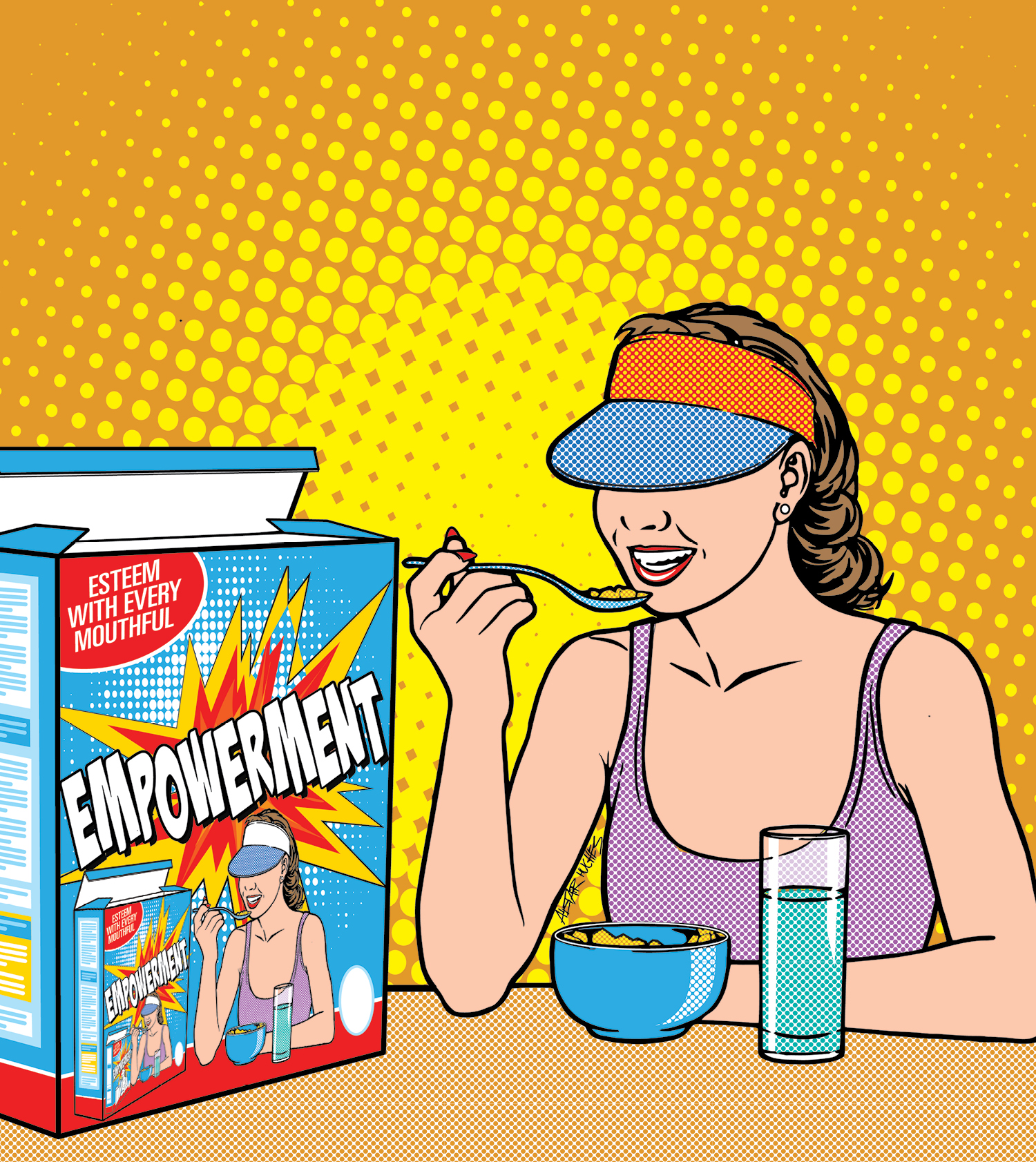
A colorful cartoon shows a woman eating cereal with a copy of the same image of the woman eating cereal on the cereal box in front of her. The cereal box reads “Empowerment” and has the tagline “Esteem with Every Mouthful.”
Figure 1.3 Empowertising
While this image is satire, it reflects a common phenomenon known as empowertising. Companies selling everything from Barely There push-up bras to Lean Cuisine microwavable meals have featured themes of female empowerment to market their products. However, this consumer-based approach generally doesn’t lead to substantial changes in the lives of girls and women.
This book and course will help you develop skills for thinking critically about how gender biases shape our everyday lives and interactions, our institutions, and the field of psychology. Exactly how equity can be achieved is a difficult question—one that will come up repeatedly throughout the course. For example, let’s consider the word empowerment, which refers to the capacity to attain power. It’s a buzzword these days, but it isn’t always well defined and applied (Hirschmann, 2018). As we noted in the beginning of the chapter, a consumer-based approach toward empowerment generally doesn’t lead to substantial changes in people’s lives (Figure 1.3). The word empowerment is also often used to discuss the achievements of individuals, usually those who succeed in predominantly male domains. When the capacity to gain power is used only in this way, it limits the potential for larger-scale change. For example, a single mother may feel powerful when she receives a promotion in a predominantly male law firm, or a girl may feel empowered when she strikes out a male batter during a baseball game. Although these are excellent accomplishments, they’re often isolated from the experiences of other women, and they continue to uphold male domains as powerful. Some women will succeed in predominantly male domains, but most women will not.
With such a focus on the individual, there is little expectation that the system will change, and this realization places a huge burden on individuals with the least amount of power. The saying “the personal is political” was a rallying cry during the women’s movement in the 1960s and 1970s (Collins, 2009). It means that our personal lives are interconnected with larger social systems. A trans girl who thinks she’s unattractive may feel alone with her worries, but her thoughts are driven by countless messages—from peers, parents, the media, and more—that girls should conform to unrealistic ideals of beauty. A working-class mother who struggles to manage her work hours, get dinner on the table, and find appropriate childcare may think that these are her problems alone, but they should be understood within a social context in which (a) the availability of childcare is inadequate, (b) inflexible work hours are the norm, (c) women are primarily responsible for household management, and (d) women are paid less than men. As these examples show, individual struggles are part of larger social struggles. Therefore, even today what seems personal is actually political.
More information
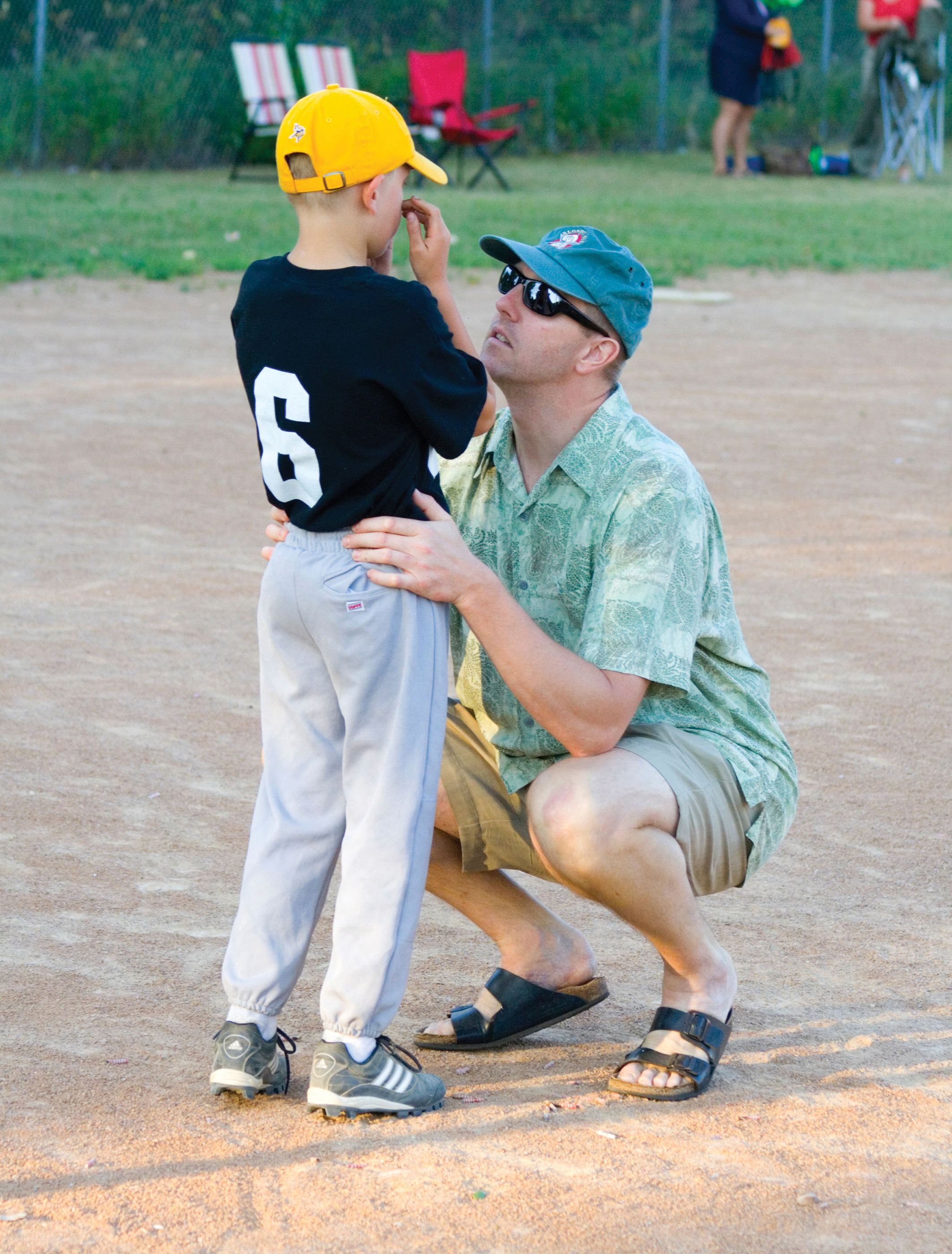
A photo shows a father on a baseball field kneeling to comfort his son, dressed in his baseball uniform, who is crying.
Figure 1.4 Boys Don’t Cry
How does seeing this image make you feel? Do you feel more comfortable seeing girls cry than boys? How do you think you’d feel if the picture showed a distressed man crying rather than a boy?
In men’s lives, too, the personal can be political. Popular sayings like “boys don’t cry” teach boys to act stoic and suppress emotions like sadness and fear (Santiago-Menendez & Campbell, 2013) (Figure 1.4). School-age boys who cry or act in ways identified as feminine in front of their peers often face serious repercussions (Masters et al., 2021), and these consequences continue into adulthood, where the expectation is for men to be powerful and dominant in work and in their families (Motro & Ellis, 2017). Consequently, boys and men often experience shame when expressing vulnerability and are reluctant to disclose feelings or seek therapeutic support when dealing with mental health concerns (Call & Shafer, 2018). All of these issues are connected to the larger gender-role expectations of masculinity, in which rewards are bestowed on those who conform and punishments are given to those who do not (Levant & Richmond, 2007). An individual boy who is teased for being “girly” may think that he is alone with his problems, but his problems are actually part of the larger gender system: His personal problems are really political.
For this reason, feminist psychologists believe that research focusing on both the individual and the culture in which that individual lives is important (Grzanka, 2018). Power doesn’t only exist within an individual; it also exists in relationship with other people and larger social structures. If we don’t focus on the entire picture, we risk having a shallow, and ultimately problematic, approach to advancing psychological well-being for all people. Therefore, feminist psychologists are attentive to many disciplinary perspectives (e.g., history, sociology, political science, religion, economics) in order to engage in sophisticated research and well-rounded practice.
Glossary
- psychology of women and gender
- A subfield of psychology that historically focused on the lives and experiences of girls and women and since has expanded to include the exploration of gender more broadly.
- feminism
- A social movement to end sexism, sexist exploitation, and oppression.
- feminist psychology
- A perspective within the field of psychology in which work is explicitly informed by feminism, in contrast to more general research and theory about girls and women.
- oppression
- The ways in which certain people experience degradation because of political, economic, or social realities (e.g., poverty, lack of access to health care).
- intersectionality
- The ways in which different types of oppression (e.g., racism, classism, heterosexism, transphobia, ableism, sexism) are interconnected and, therefore, cannot be examined separately; also the way multiple social identity variables influence any psychological variable being studied.
- empowerment
- The capacity to attain power.