2 Power and Privilege
More information
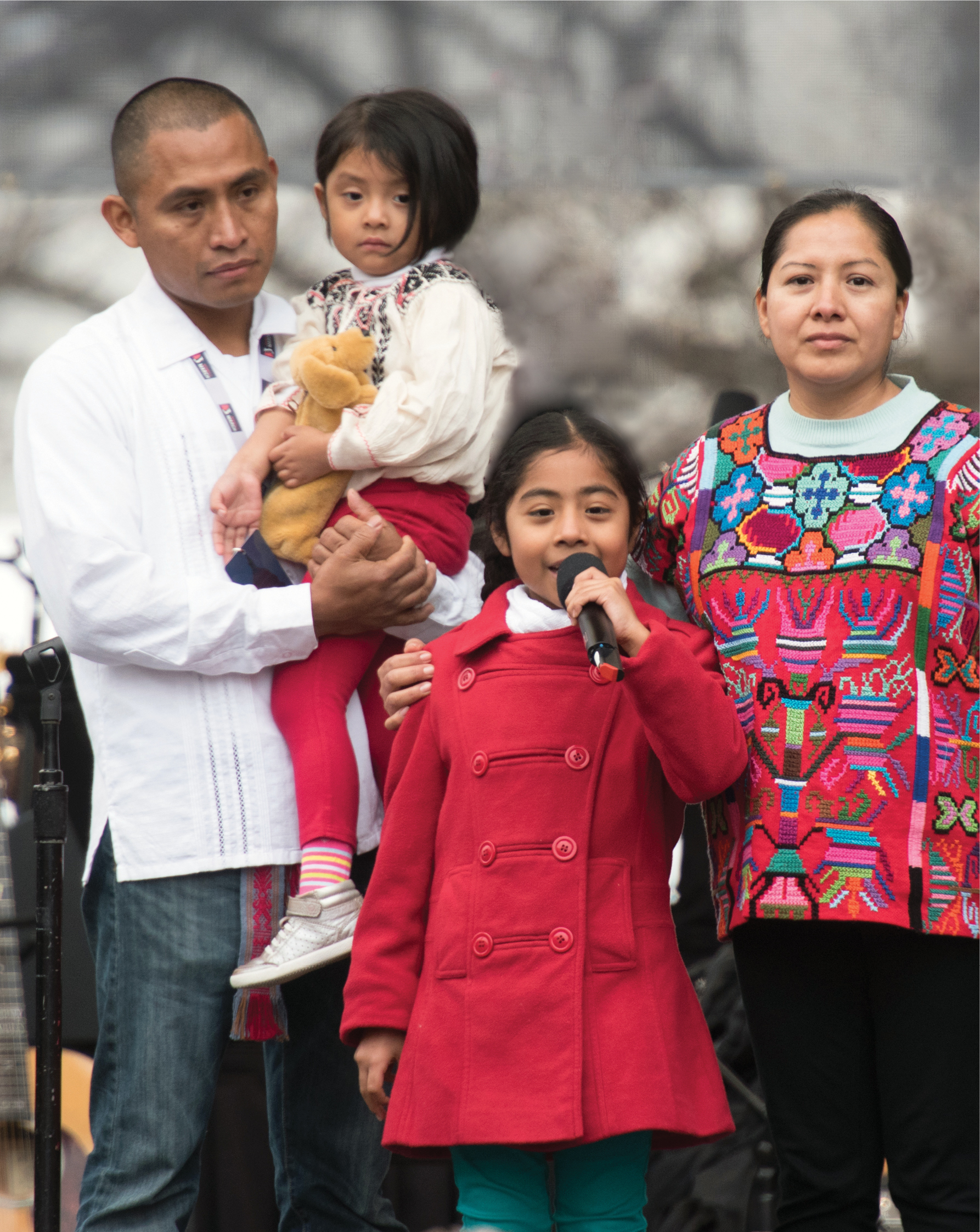
A photo shows a family of four on a stage while a young girl speaks into a microphone.
- 2.1 Not Just One
- 2.2 Sexism and Stereotypes
- 2.3 Prejudice and Discrimination
- 2.4 Language as a Source of Power
AT SIX YEARS OF AGE, Sophie Cruz (see above) appeared small, but her voice was gigantic when she addressed the 500,000-plus people who gathered for the Women’s March in Washington, D.C., in January 2017. In both Spanish and English, she called on people to “fight with love, faith and courage so that our families will not be destroyed” (Blay, 2017, para. 3). Sophie spoke about the urgency of immigration reform, one of the many social issues elevated at the Women’s March. Along with 2.6 million people worldwide, Sophie showed up to demand recognition for a series of principles uniting women that were outlined on the march’s official website (Rogers, 2016). These principles included ending violence and advocating for reproductive freedoms, LGBTQ+ rights, workers’ rights, civil rights, disability rights, women’s rights, immigrant rights, and environmental justice (Our mission, n.d.). Sophie was the youngest speaker that day, showing that involvement in feminist activism can occur at any age.
For some, this march was a great success—a resurgence of feminist activism. The New York Times reported that it was the largest single-day demonstration in U.S. history (Chenoweth & Pressman, 2017). Many sister marches took place on the same day, and at least 261 solidarity marches occurred outside the United States, from Antarctica to Zimbabwe. The momentum was undeniable, but critics raised concerns about the march’s inclusivity and messaging (Tolentino, 2017). Since these criticisms started at the origin of the march, it’s helpful to understand the evolution of the event.
The Women’s March started as a grassroots initiative when Teresa Shook, a retired attorney and grandmother, created a Facebook event suggesting that friends rally in Washington, D.C., against what she saw as the biased and inflammatory rhetoric that occurred during the 2016 U.S. presidential campaign. Her message went viral, and overnight more than 10,000 people agreed to attend. Shook wanted to call the event a Million Woman March, a name originally claimed by a famous Black women’s unity march held in Philadelphia in 1997. As interest in Shook’s event grew, however, contentious conversations began (Stockman, 2017). Author Mariella Mosthof (2017) reported that many women of color felt white women’s use of this name was an example of appropriation, especially given the concern that the rally would primarily focus on issues that affected white women and the fact that the march’s initial leadership consisted solely of white women (Desmond-Harris, 2017; Ramanathan, 2017). Racial tensions flared up on social media when some white women became defensive and angry after being “asked to check their privilege” (Stockman, 2017, para. 15). Eventually, the name was changed to the Women’s March, and the planning became more sophisticated when three experienced and well-respected female community leaders of color—Tamika Mallory, Carmen Perez, and Linda Sarsour—joined as co-chairs.
Other critics of the march were angered by the prominent use of genitalia imagery (Goins-Phillips, 2017). On the day of the march, many participants wore pink “pussy” hats. While this seemed fun and empowering to some of the participants, the use of genitalia as a political symbol seemed exclusionary to other participants, especially to trans women. Some also felt that emphasizing women’s genitalia to symbolize women’s rights was an act of objectification rather than a symbol of empowerment (Perlmutter, 2017).
Figuring out the best way to mobilize women in order to combat oppression is challenging and complex. Much of the complexity arises because sources of inequality are not simply based on sex/gender; they’re also based on race, socioeconomic status, religion, age, and a multitude of other variables. Failing to pay careful attention to how systems of power and oppression work can lead to a problematic tendency to replicate exclusionary and oppressive practices. The organizers of the march wanted to make clear that “women’s rights” meant those of all girls and women of all backgrounds. This was an important goal, but it led to conflict when the effort to balance the interests and needs of many diverse women became a source of tension among would-be participants.
Conflict like this is an inevitable part of organizing people from a variety of backgrounds with different levels of power and representation. Yet antifeminist critics used the within-group conflict as evidence that the march lacked a unified or justifiable message (Christie, 2017; Dalmia, 2017; May, 2017; Van Laar, 2017). Interestingly, media scholars have since identified that bots from Russia, Iran, and Venezuela had generated tweets accusing feminists of ignoring women of color, poor women, and conservative women to create animosity toward feminist organizers and leaders (Bradshaw & Henle, 2021). These tweets amplified and exploited ongoing conflicts within feminism.
Antifeminist critics also wondered why women were marching at all. They felt that the rally promoted a false sense of victimhood on the part of women who were looking for a reason to be angry (Christie, 2017). From these critics’ perspective, it was inappropriate for women participating in the march to claim disenfranchisement because, as the critics saw it, the only thing that would stop a woman from achieving empowerment is her own inabilities—a postfeminist argument, as discussed in Chapter 1.
Even some feminist critics felt that a focus on so many principles within a single event spread feminism too thin, making it politically useless. Brittany Cooper, a professor of Women’s and Gender Studies and Africana Studies, disagreed. She said, “When we organize under the banner of shared womanhood, acknowledging all these moving parts makes our collective work not weaker but stronger” (Desmond-Harris, 2017, para. 49).
The conflicts surrounding the march demonstrate some of the critical issues facing contemporary feminism. Many dynamics are involved, as well as dozens of urgent social concerns. In 1984, the feminist writer and activist Audre Lorde said, “There is no such thing as a single-issue struggle because we do not live single-issue lives” (Lorde, 2007, p. 138). As a result, figuring out how to be inclusive and attentive to many different issues, while staying unified enough to actually get something done, continues to be one of the most pressing challenges for feminists.
In this chapter, we’ll explore what it means to say that some people have more power than others. First, we’ll examine people’s varied social identities and how they’re connected to larger social systems that give some people more access to power than other people—and, in general, give men more power than people with other gender identities. We’ll also explore how these power dynamics are often difficult to see. We’ll then consider how certain stereotypical assumptions contribute to maintaining power dynamics among groups of people. Finally, we’ll explore how power relates to sexism and how sexism is sometimes so subtle that it is difficult to detect.