Sub-Saharan Africa in 1400 already had considerable links to the Old World web, across the Sahara and via the sailing routes of the Indian Ocean. Only the southernmost reaches, and a few pockets here and there, may be said to have been truly isolated from the wider world. However, after 1450, as trans-Saharan travel became more common and Portuguese mariners began to visit its coasts, nearly every part of Africa tightened its connections to what was rapidly becoming a global web. The process, as usual, was a rough one, featuring war, empire building, epidemics, and enslavement, as well as heightened trade and cultural exchange. The main components of the process were, first, the gradual and ongoing spread of Islam through the northern half of Africa, which in places was coupled with wider use of the Arabic language. Second, in a few locations, small colonies of European settlers took root, creating altogether new societies. Third, Africans, especially those living near the coasts, became increasingly active in maritime trade circuits, not only of the Indian Ocean (which had been going on for centuries) but also of the Atlantic. The largest part of this commerce was the transatlantic slave trade.
ISLAM IN AFRICA
Islam, as we have seen, spread from its Arabian homeland into North Africa, largely by conquest, during the seventh century. It subsequently seeped into sub-Saharan Africa along two main paths: by sea to the Swahili coast and across the desert into the western and central Sahel (the southern edge of the Sahara). In both cases, Islam’s spread usually occurred not by conquest but through efforts of merchants, rulers, and missionaries—categories that overlapped in many cases.
Merchants from North Africa and Arabia brought their varieties of Islam with them when visiting Sahelian towns or Swahili ports. Since they generally stayed for months and interacted daily with locals, they had plenty of opportunity to demonstrate the attractions of Islam to urban Africans. Merchants in Africa, as in South, Southeast, and Central Asia, often found it both agreeable and convenient to adopt Islam. Many were naturally curious about an unfamiliar religion and welcomed instruction. For many, Islam’s tenets held genuine appeal. The Qur’an portrays commerce and merchants (Muhammad was one, after all) in a favorable light. It spells out suitable practices with respect to contracts, money lending, and other business procedures. In addition, treating visiting Muslims and Islam with respect was good for business. Converting to Islam was even better, as it smoothed relations by binding all parties together with the same concepts of law spelled out in shari’a.
Rulers, too, often found advantage in becoming Muslim and proclaiming themselves sultan or emir. They too, no doubt, embraced Islam out of genuine conviction. But doing so could also improve their political position, providing prestige through connections to distant centers of power and learning. Having literate people around was always helpful to monarchs, so Muslim scholars often found employment at African courts. Islam also suited rulers, as all durable religions do, by offering justification (or spiritual compensation) for hierarchy and inequality. Kings and chiefs needed less raw power or personal charisma if their subjects believed it was normal, natural, and divine will that they should be subjects.
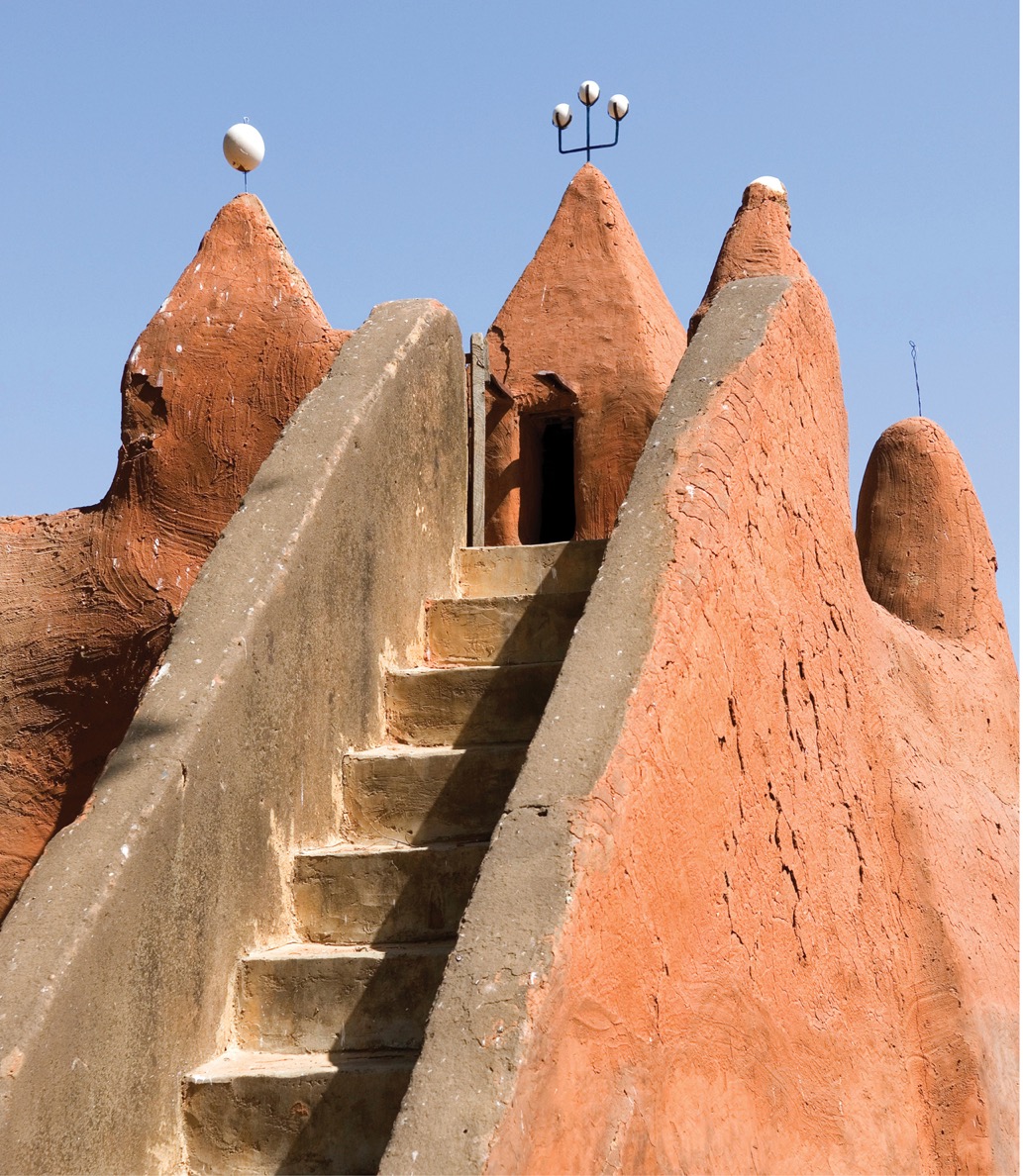
Islam in Africa This eighteenth-century Bambara kingdom mosque in present-day Mali shows how African kingdoms that adopted Islam built mosques reflecting local architectural traditions.
The experiences of East and West Africa illustrate the economic and political factors at work in the spread of Islam. In East Africa, the influence of Islam was already widespread before 1400. After 1500, the Portuguese incursions on the Swahili coast that began with Vasco da Gama inadvertently helped to promote Islam, which provided a rallying point for resistance to Portuguese attacks. By the seventeenth century, growing trade links with Oman tightened Swahili cultural connections to the Arabian Peninsula. Swahili and Omani forces drove the Portuguese out of East African coastal cities between 1650 and 1730, opening the door to a wave of immigrants from southern Arabia. Omani merchants, generally trading cloth for ivory and slaves, took up residence on the coast, especially its offshore islands such as Zanzibar. Clerics and holy men, often Sufi mystics, came too. The Omanis gradually extended their operations into the East African interior. Everywhere they went, they interested locals in their religion.
In West Africa, Muslim traders crossing the Sahara had found a welcome reception since at least the eighth century, as we have seen in the history of Ghana and Mali. The Songhai Empire, a successor to Mali that took shape in the 1460s and 1470s, became an active promoter of Islam. Its founder, Sunni Ali, based his new state at Gao and soon conquered the other Niger River trading cities including Timbuktu and Jenne. By most accounts, he practiced multiple religions, was an indifferent Muslim, and clashed with the Islamic scholars of Timbuktu. But under his rule, and especially that of a later king, Askia Muhammad (r. 1493–1528), Songhai used all available means to spread Islam. A firm Muslim, Askia Muhammad supported Islamic scholars, built mosques, and encouraged conversion. He launched wars against infidels wherever they might be found. His success helped to spread Islam widely in the West African Sahel and to revive Timbuktu as a major center of Islamic learning. A Moroccan army, invading across the Sahara, ended the Songhai Empire in 1591, but smaller successor states continued to promote Islam in West Africa.
To the east, in the central Sudan, other, smaller, Muslim states, most notably Bornu in the sixteenth through the eighteenth centuries, promoted Islam much as Songhai had done. South of the Sahel, in West Africa’s forest zone, Muslim traders (called Dyula or Juula in West Africa) served as informal ambassadors of Islam. Muslim communities developed along the trade routes. Where trade and states did not figure prominently, Islam had less impact in West Africa before 1800.
Merchants and rulers both, when accepting Islam, did not necessarily renounce their former ways. From their point of view, Islam was one of several spiritual options. Many continued to celebrate feasts; venerate stars, sun, moon, and ancestors; or call upon spirits long familiar to them. Like Sunni Ali, rulers especially might find it politically prudent to become bicultural, both Islamic and non-Islamic, for different audiences and occasions.
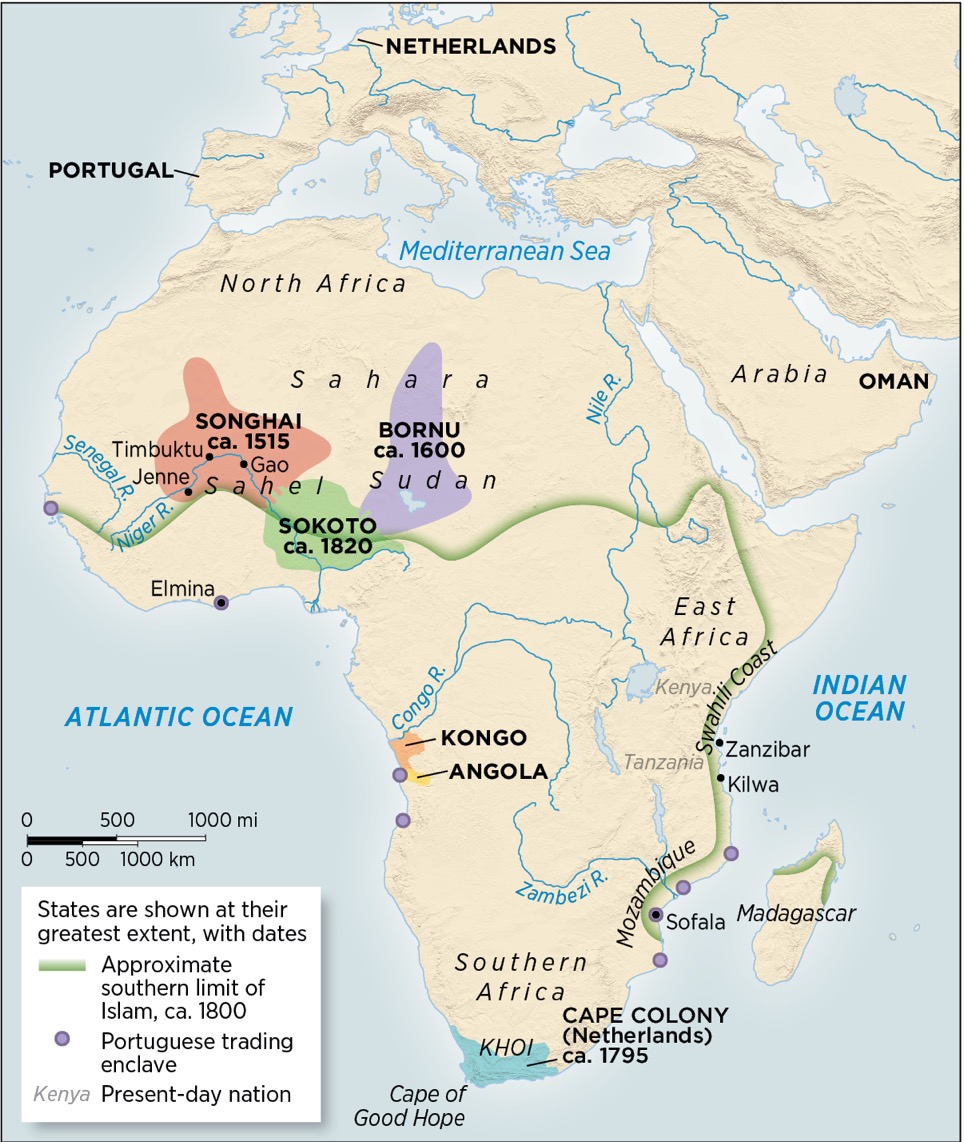
Africa: The Spread of Islam and the European Presence, 1450–1800 Connections between Africa and other parts of the world strengthened in the centuries after 1450. Many Africans along the Swahili Coast and across the Sahel embraced Islam, typically modifying its practices to suit their own traditions. Meanwhile, European mariners, especially Portuguese and Dutch, set up fortified trading posts (and in the Dutch case, an entire colony) in places along coastal Africa.
Wherever Islam spread in Africa, it acquired local characteristics: just as parts of Africa were Islamized, Islam was in those places Africanized. African Muslims built mosques out of mud brick in the western Sahel or of coral on the Swahili coast. Muslim African women rarely dressed as modestly as women did in Islam’s heartlands. In what is now northern Nigeria, African Muslims designated some non-Muslim Africans as “people of the book,” a category that previously in Islam was used only for Jews, Christians, and Zoroastrians, and in India for Hindus and Buddhists.
Such adjustments to Islam offended purists. Ibn Battuta, the great world traveler, was one of many outsiders irritated by the unorthodox, Africanized versions of Islam practiced on the Swahili coast and in the West African Sahel. Centuries later in what is now northern Nigeria, a poet, scholar, and reformer, Uthuman dan Fodio, launched a rebellion against rulers he judged insufficiently Islamic and went on to found the Sokoto caliphate in 1804. He condemned the local sultans as unbelievers who “raise the flag of a worldly kingdom above the banner of Islam.” His daughter, Nana Asma’u (1793–1864), a considerable scholar and poet, carried on the work of purifying the practice of Islam in West Africa, organizing Qur’anic schools for girls and women. Tensions persisted between champions of Islamic orthodoxy and supporters of a more adaptable and Africanized Islam.
In the process of Africanizing Islam, many prominent African Muslims claimed descent from the Prophet or from his inner circle. Prestigious ancestors were important credentials in most African societies, as in most Islamic communities. Even if these claims were not genealogically correct, over time some came to be believed and therefore served their purpose. For example, the ruling house of Mali, the sprawling empire in West Africa, claimed descent from Bilal, one of the Prophet’s faithful companions and originally an Ethiopian slave. In these ways and many more, Islam acquired new forms and features drawn from African traditions and practices.
EUROPEAN AND CHRISTIAN INFLUENCES ON COASTAL AFRICA
While Islamic and Arab influence trickled into both East and West Africa, after 1440 Portuguese and then Dutch influence crashed into coastal Africa. In 1462, Portuguese mariners established a fortified post called Elmina on West Africa’s coast. Their impact was greater still farther south, in the region of Kongo and Angola, and on the Indian Ocean coasts of Mozambique. Dutch involvement in Africa focused on the area around the Cape of Good Hope.
KONGO AND ANGOLA Just south of the mammoth Congo (or Zaire) River’s mouth, Portuguese seagoing expeditions encountered a welcoming king, whom they called the manicongo. He ruled over half a million people in a kingdom that had been founded late in the fourteenth century. In the 1490s, Portuguese missionaries convinced a manicongo to convert to Catholicism. His son learned to speak, read, and write Portuguese, adopted European dress, and took the name Afonso. The Portuguese helped Afonso to seize the throne in conflicts with his brothers. Subsequently, King Afonso (r. 1506–1543) prospered with their continuing help, using Portuguese advisors, military officers, and muskets against neighboring peoples whose weaponry did not include firearms.
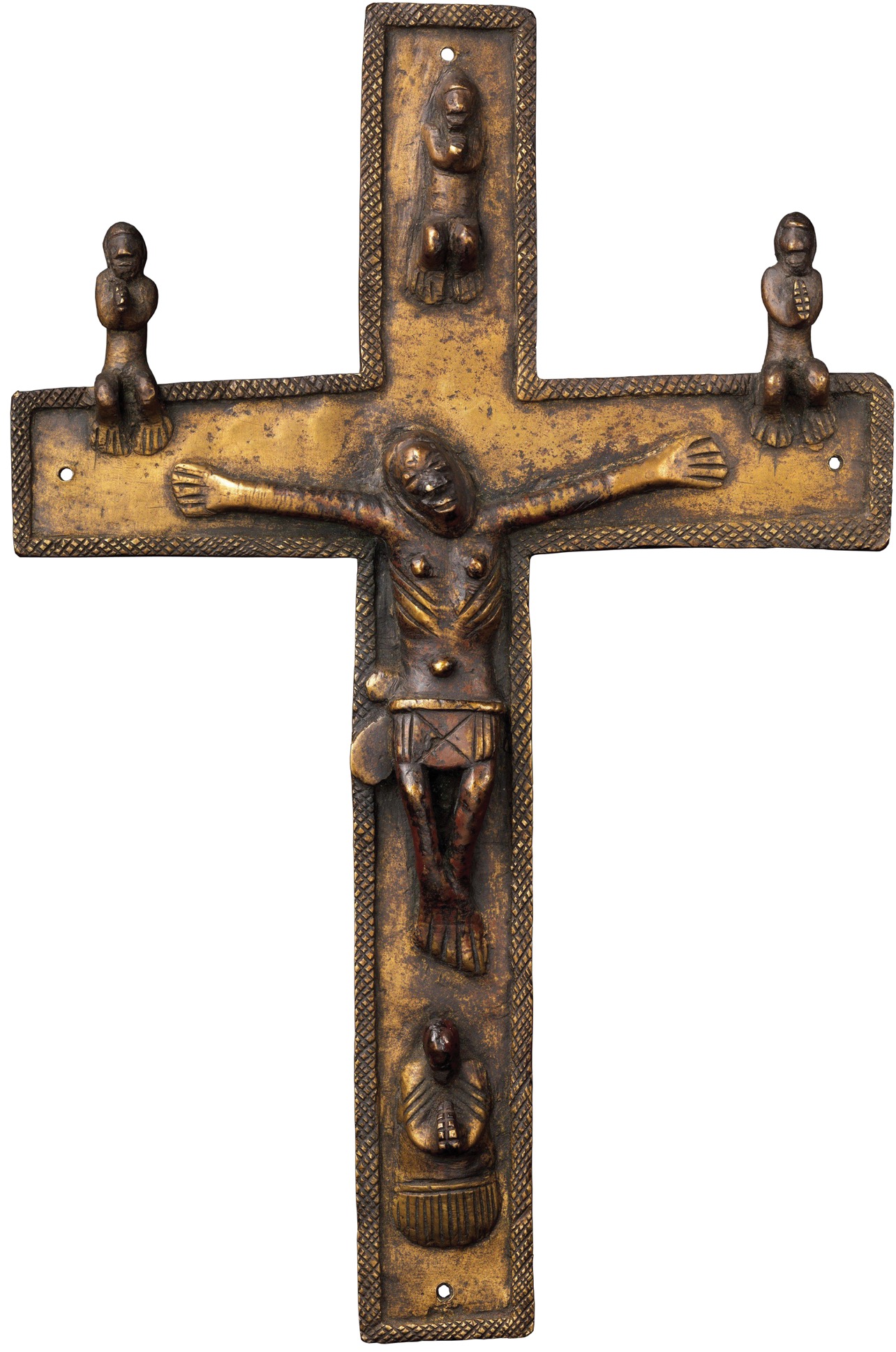
Part of the Portuguese interest in Kongo was religious, and in King Afonso they had an eager partner. While Askia Muhammad was using his power in Songhai to spread Islam in West Africa, King Afonso made Catholicism the state religion in Kongo, using it to bolster his legitimacy as ruler. By the 1520s the Pope named King Afonso’s son Henrique, who had studied theology in Portugal, bishop of Kongo. Thereafter missionaries from Portugal poured into the kingdom, although most of them quickly died from malaria, yellow fever, or other unfamiliar diseases. Catholicism gradually blended with local traditions and became the dominant religion.
Christianity in West Central Africa A bronze crucifix from sixteenth- or seventeenth-century Kongo demonstrates how Christianity had become an integral part of Kongolese artistic and cultural tradition.
Eventually the kings of Kongo and Portugal fell out, and Portuguese interest in West Central Africa shifted south to Angola. Here too Portugal allied with a local king, called the ngola, which became the name for the country. Portuguese helped him in his political struggles and in exchange won the right to preach Catholicism and conduct trade. Soon several local leaders accepted baptism, although they often kept their old ways as well, to the dismay of Catholic missionaries. Rumors of vast silver mines proved unfounded, and efforts to establish Portuguese immigrants as farmers failed miserably, mainly the result of the disease environment.
So in Angola, as in Kongo, the Portuguese turned to the economic activity that yielded the most reliable profit: slaving. They encouraged wars and slave raids among peoples in Kongo and Angola. Local kings (and one highly successful queen, known as Nzinga or Njinga), seeking Portuguese support and military expertise, eagerly enslaved their enemies. They sold war captives to Afro-Portuguese slave traders, the sons of Portuguese men and African women. As we shall see, Angola became one of the biggest sources of slaves sent to the Americas. Kongo too became a major exporter. By 1660, half the population of Kongo were slaves captured from neighboring peoples.
CONSIDERING THE EVIDENCE
The Perils of Trade in Kongo
After Afonso I defeated his half-brother to gain control of Kongo, he emulated the Catholic king of Portugal. Though Kongolese, Afonso appointed officials with Portuguese titles, corresponded with the Pope, and requested priests to conduct Christian Mass with wine and grain imported from Portugal. He also bolstered his prestige by distributing merchandise imported from Portugal that he paid for with ivory, copper, and enslaved men and women who had followed his political rivals. Although Afonso initially benefited from the slave trade, the following letters between him and King João III of Portugal show that he had reservations about the trade. In the end, Afonso agreed with King João III that the slave trade should be continued, but he appointed officials to witness every sale in an effort to ensure that merchants would not capture and sell his own subjects.
Letter of the King of Kongo to [King of Portugal] Dom João III, 1526
[O]ur kingdom is being lost in so many ways...; this is caused by the boldness your...officials give to the...merchants who come to this kingdom to set up shops with merchandise...that we forbid, which they spread...in so great abundance that many vassals that we held in our obedience elevate themselves [i.e., are no longer obedient] by obtaining those things in greater quantities than we possess. With those things we had kept them content, and subjected under our vassalage and jurisdiction, so now there is great damage to the service of God as well as for the security and orderliness of our kingdoms and state.
And we cannot reckon how great this damage is, since these same merchants each day take our native people, sons of the land and sons of our nobles and vassals, and our relatives, because the thieves...steal them with the desire to have the things and merchandise of this kingdom that they covet....[O]ur lands are entirely depopulated....[W]e do not need...merchandise, other than wine and bread for the holy sacrament. For this we are asking of Your Highness...not to send either merchants or merchandise, because our will is that in these kingdoms there is no trade in slaves nor outlet for them.
Letter of Dom João III to the King of Kongo, 1529
You say in your letters that you do not want there to be any slave trade in your kingdom because it is depopulating your land....I am told of the great size of Kongo and how it is so populated that it appears that not a single slave has left it. They also tell me that you send to buy them [slaves] outside [the country] and that you marry them and make them Christian....
If...as you request,...there shall not be any trade in slaves in your kingdom, I will still want to provide wheat and wine for use at Mass, and for this only one caravel [ship] a year will be necessary....However,...it would be more praiseworthy to draw each year from the Kongo 10,000 slaves and 10,000 manilhas [copper bracelets] and as many tusks of ivory....If you do not want anyone to bring merchandise to Kongo, this would be against the custom of every country....[A]nd if a fidalgo [noble] of yours rebels against you and receives merchandise from Portugal, where will be your power and greatness....
Sources: “Letter of the King of Kongo to [King of Portugal] Dom João III, 6 July 1526,” trans. Jared Staller, in Converging on Cannibals: Terrors of Slaving in Atlantic Africa, 1509–1670 (Athens, OH: 2019); “The Slave Trade Is Good for the Kongo, Extract from a letter of Dom João III to the King of Kongo, 1529,” trans. Malyn Newitt, in The Portuguese in West Africa, 1415–1670 (Cambridge: 2010).
QUESTIONS FOR ANALYSIS
How did trade in merchandise, as well as enslaved people, threaten Afonso I’s rule?
What arguments did the king of Portugal use to convince the king of Kongo to continue trading?
Do these letters indicate that these kings dealt with each other as equals?
The Portuguese also brought new strains of smallpox to Kongo and Angola. Sub-Saharan Africans had long experience with the virus, and many peoples regularly used inoculation (the practice of deliberately infecting bodies with weak strains of a pathogen in hopes of triggering immunity without a serious case of disease). But apparently mariners brought a new variety, for major epidemics struck the region in the years 1625–1628 and 1655–1660. Some evidence suggests that tuberculosis and a form of pneumonia also hit Angola in the seventeenth century. For Kongo and Angola, inclusion into the Global web meant new diseases, one additional religion, and much more trade, enslavement, and warfare.
MOZAMBIQUE The Portuguese also took a strong interest in Mozambique. Unlike Angola or Kongo, Mozambique—located in southeastern Africa—had a history of involvement in maritime trade circuits. When da Gama passed by in 1498, its seaborne trade was in the hands of Swahili, Arab, and Indian merchants based at Sofala and Kilwa. Sea power enabled Portuguese merchants to convert Sofala into their own trade enclave, exporting gold and ivory and importing Indian cloth. The Portuguese occasionally sent military missions inland, hoping to seize the goldfields, but these efforts always met with disaster in the form of African armed resistance and deadly disease.
The Portuguese Crown issued land grants to Portuguese settlers who made themselves into local lords and merchants. Their connections to India and Europe—market knowledge and military hardware proved most useful—gave them an edge in dealing with African populations. Unlike Kongo and Angola, Mozambique’s commerce consisted mainly of gold and ivory until after 1700, when demand for slaves in the Americas led to a growing slave trade in Mozambique. Meanwhile, Christian conversion made little headway there, and indeed many Portuguese and Afro-Portuguese abandoned Catholicism for either Islam or local African religious culture.
THE CAPE OF GOOD HOPE From the 1620s onward, the Portuguese had a seafaring rival, the Dutch, seeking toeholds in southern Africa. They conquered, and briefly held, some Portuguese coastal outposts in the 1630s and 1640s. But in 1652 the Dutch East India Company—a quasi-governmental trading company known by its Dutch initials as the VOC—founded a base near the southern tip of Africa, at the Cape of Good Hope. It originated as a way station for ships headed from Dutch ports to the East Indies (mainly Java), supplying water, fresh fruit, vegetables, wine, and meat to desperate crews—the death rate on these long voyages ran at 15 to 20 percent. The Cape grew into a full-fledged colony of settlement. Here, unlike in most of tropical Africa, there was no malaria or yellow fever, and foreigners could flourish. While Portuguese traders and missionaries frequently died soon after arrival in Kongo or Mozambique—mainly from mosquito-borne diseases—Dutch settlers at the Cape survived about as well as their relatives at home.
The Africans who lived at the Cape, hunters and cattle keepers called the Khoi, numbered perhaps 50,000 to 100,000 in 1652. At first, the Khoi and the Dutch found they could coexist: the Dutch would buy any extra cattle the Khoi could raise and would pay the Khoi to work on their farms. But soon the Dutch were claiming more land and seeking more labor. The Khoi recognized the threat and attacked the Dutch in 1659 and 1673—unsuccessfully.
The Dutch began to import slaves, mainly from Madagascar, Indonesia, and India in the seventeenth century, and from Mozambique in the eighteenth. This arrangement set the Cape on the path toward a sharply stratified society in which concepts of race mattered fundamentally. By 1700, the colony officially contained some 4,000 people—not including the Khoi, whom officials didn’t bother to count. During the next century, population surged because of slave imports, immigration from Europe (often French or German), and social norms of early marriage and big families. With European women scarce, marriage often crossed racial lines, making the Cape not just racially stratified but also racially complex. By the mid-eighteenth century, the whites came to call themselves Afrikaners.
For the Khoi, despite new goods and opportunities, the Dutch colony proved a disaster. They lost control of the best lands to the newcomers. They lost their autonomy if they integrated themselves into Dutch society as laborers. In 1713, a large proportion of them lost their lives in a smallpox epidemic. Within weeks the virus killed a quarter of the Dutch colonists, many of whom had enjoyed rural childhoods without exposure to smallpox and thus remained vulnerable as adults. All the Khoi were equally vulnerable, and as many as 90 percent died in the epidemic of 1713–1714, a mortality rate possible only because of widespread malnutrition. Further epidemics in 1755, 1767, and the 1780s burned through the remaining Khoi population. Little of their way of life survived, and Dutch settlers moved into the interior of South Africa with less resistance than ever before. They also imported more slaves to do the work the Khoi no longer could: as in the Caribbean, the disastrous decline of indigenous population inspired an expanded slave trade. By 1800, the Cape region contained about 20,000 settlers, maybe 25,000 slaves, and very few Khoi. In the taverns of Cape Town, which one VOC official described as the “mother of all scandalous practices,” one might hear Malay, Tamil, Arabic, Portuguese, German, Dutch, and a dozen other languages. But one was unlikely to hear Khoi. The Cape settlement was an island of cosmopolitan, globalized society, now thoroughly enmeshed in the Global web.
THE TRANSATLANTIC SLAVE TRADE
The most visible, and for world history the most important, way in which large parts of Africa joined the Global web was through the slave trade. As in most lands, slavery had been a fact of life in Africa long before 1400. In Africa, people became slaves if captured by slave raiders or in war, if they couldn’t pay their debts, or if their family or lineage gave them away as compensation for harm done to another family or lineage. In some societies, enslavement was also punishment for certain crimes. Most children of slaves were legally free (a big difference from many other slave systems), but these children could perform useful labor for slave owners, their families, and their communities. Slave owners in Africa preferred women and children for working in the fields, tending animals, making cloth, and doing domestic chores. Above all, they valued young women for reproduction. Only in a few places were male slaves more valued than females, such as the salt mines of the Sahara.
African slave exports to the Mediterranean world, Southwest Asia, and India had a long history. Ancient Egypt had imported African slaves. During the eighth and ninth centuries, many thousands of African slaves had been sold to landowners in Abbasid Iraq. Between 1400 and 1900, perhaps 5 to 6 million Africans were enslaved for sale to these markets.
DIMENSIONS OF THE TRADE The size and significance of African slave exports changed when European mariners connected Africa’s coasts to the Americas. Portuguese sailors seized Africans beginning in 1441 and sold some of them on islands such as Madeira—500 miles (800 km) west of Morocco—where sugar plantations were developing. Meanwhile, Moroccan entrepreneurs organized sugar-and-slave plantations supplied with labor by trans-Saharan slave caravans. The success of sugar plantations worked by enslaved Africans in Morocco and Madeira inspired larger-scale imitation, first on the island of São Tomé off the coast of Kongo.
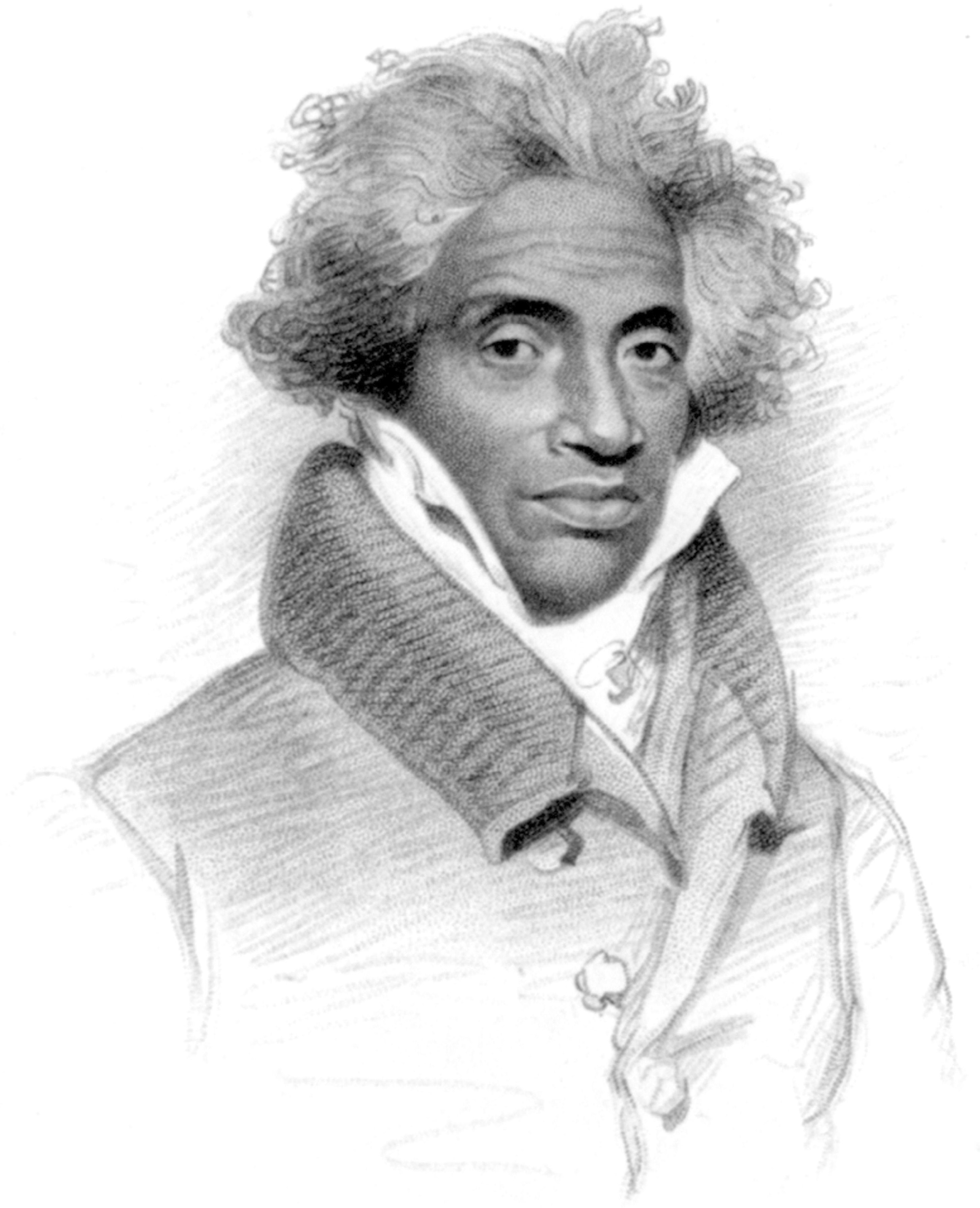
Abdul Rahaman ibn Sori A prince in what is now Guinea, in West Africa, Abdul Rahaman was captured in a local war in 1788. His captors sold him to British slave traders, who sold him to the owner of a Mississippi plantation, where Rahaman worked for 38 years. He was freed at age 67, through the intervention of a Moroccan Sultan and the U.S. president, on the condition that he return to Africa, which he did shortly before his death.
Then, in 1518, a king of Spain authorized the first direct slave trading voyages from Africa to the Americas. The first recorded voyage arrived in Puerto Rico in 1519, and others to Caribbean islands followed. The population catastrophe in the Caribbean that we saw in the previous chapters was already well under way. The Spanish interest in transatlantic slaving arose from concern that mines and agricultural estates in the Caribbean might languish for lack of labor. In this way, the misfortune of the Americas became the misfortune of Africa.
The first transatlantic slaving voyages to Brazil’s sugar plantations began in 1534. Thereafter, the size of the transatlantic trade began to grow rapidly. Before long, the African coast from Senegal to Angola was exporting slaves across the Atlantic, and by the late seventeenth century the coasts of Mozambique and Madagascar were as well.
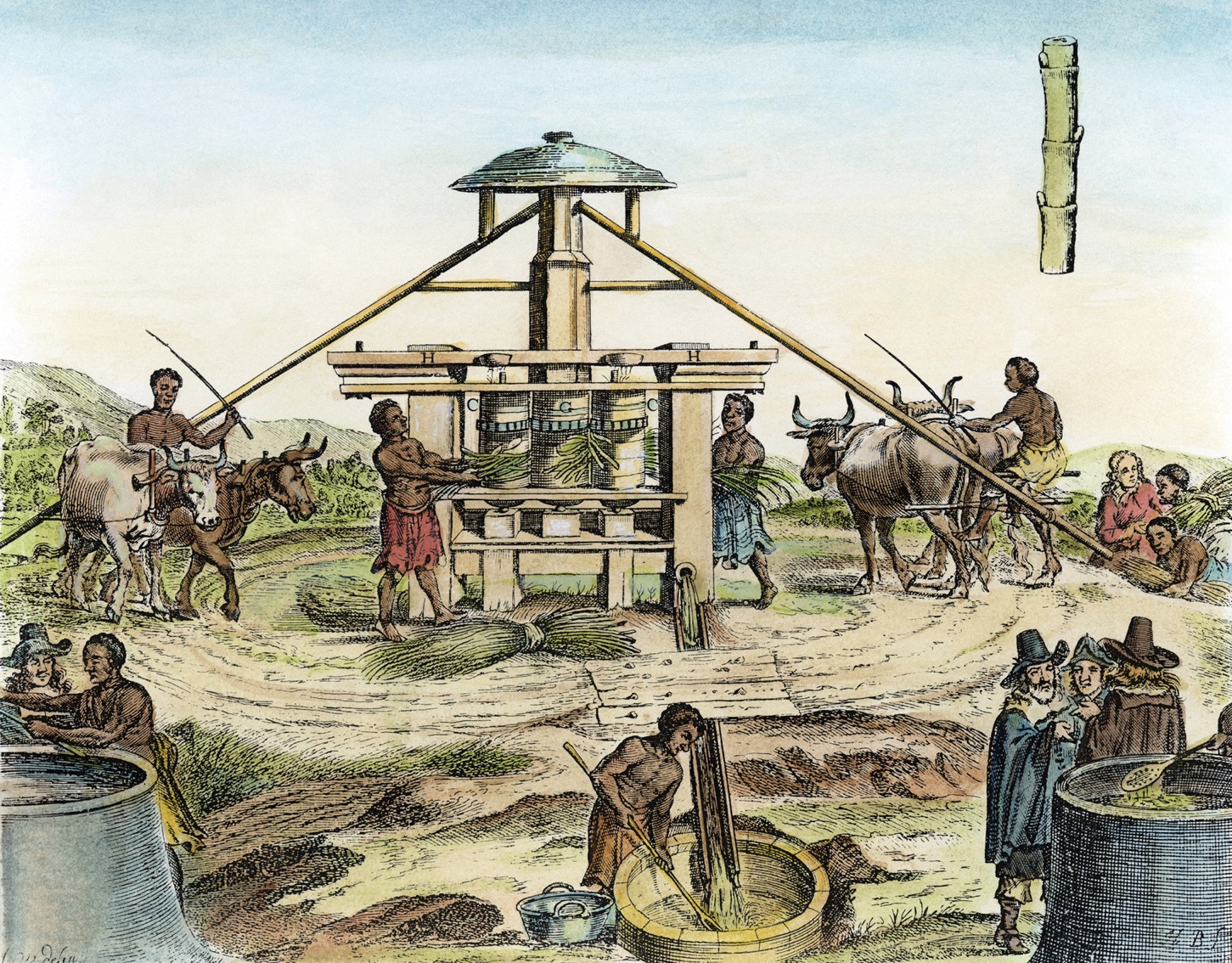
Slavery and Sugar Enslaved Africans work a sugar mill in the Dutch Caribbean in the seventeenth century. The grinding mill shown was a dangerous machine that could easily injure or kill its operators.
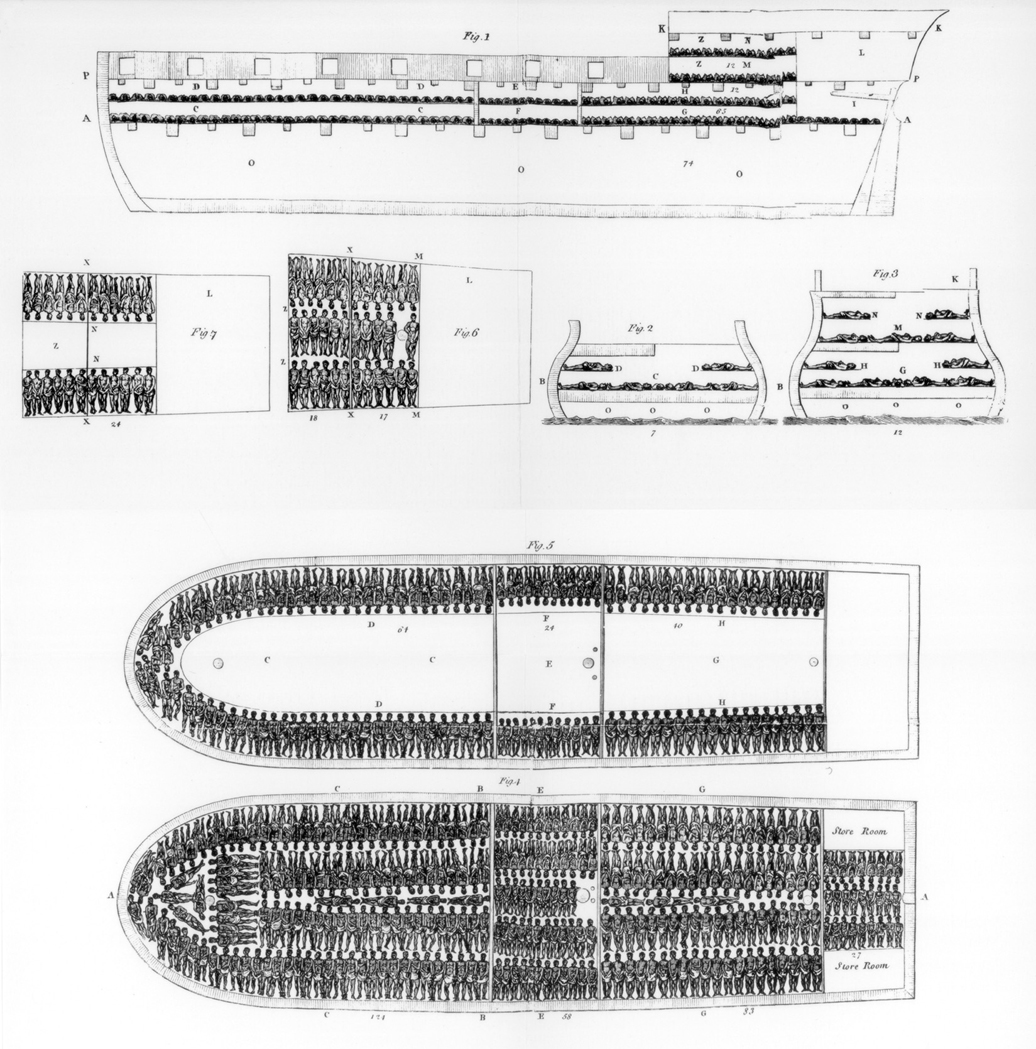
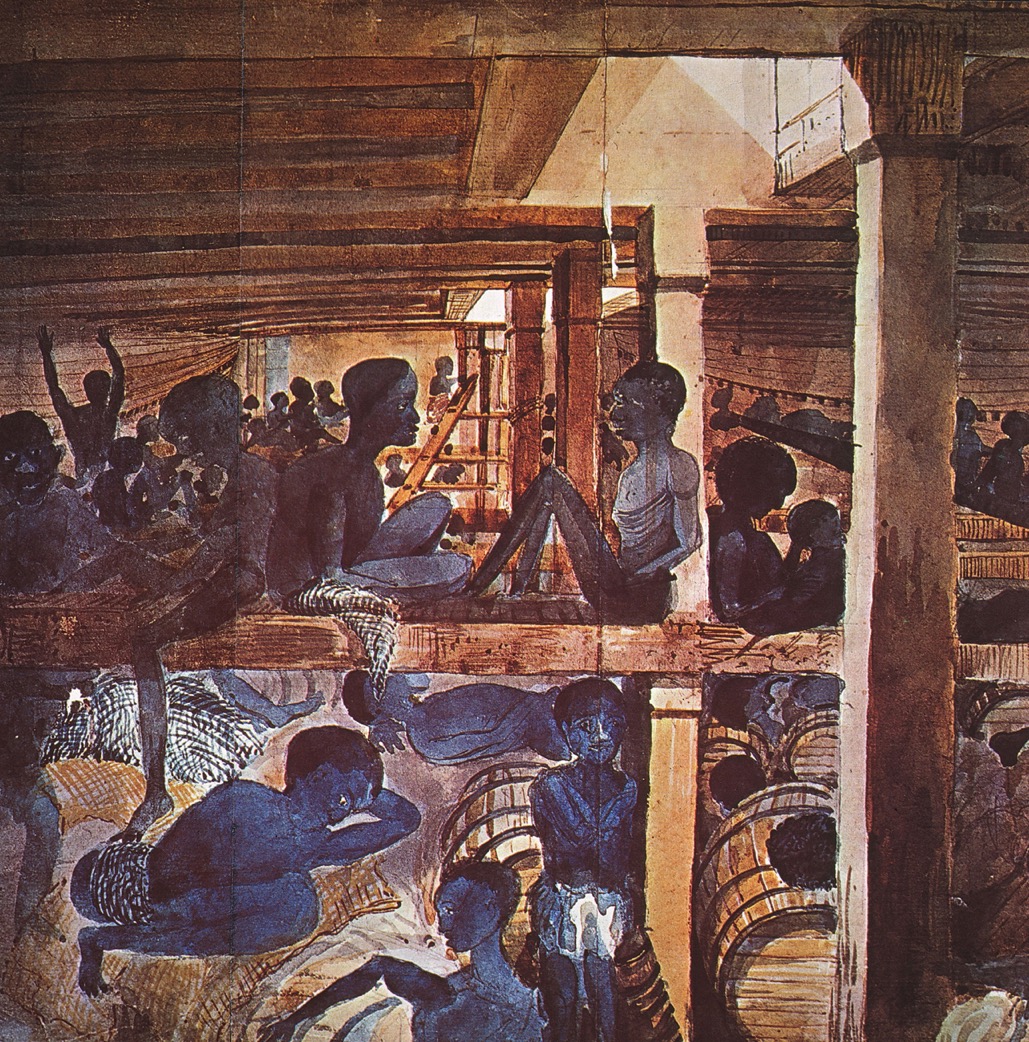
The transatlantic slave trade, the largest forced migration in world history, lasted until about 1860. In all, some 12 to 14 million slaves departed Africa’s shores, of whom about 85 to 88 percent—10 to 11 million—survived what is called the Middle Passage across the Atlantic. The survival rate improved over the centuries, but the voyage remained hazardous to the end, especially lengthy crossings. The average trip required about two months at sea, after which food and fresh water often ran short. A three- or four-month trip usually killed a large proportion of both slaves and crew. Slaves were kept below decks, usually naked, packed like “books on a shelf” as one observer put it. Men were often kept in chains for most of the voyage, women usually not. Sanitation was negligible. Dysentery was the foremost killer on the Middle Passage, but violence and other diseases took their toll as well.
Slaves attempted uprisings on perhaps as many as one in ten slave ships. Ottobah Cugoano, born in what is now Ghana, survived the Middle Passage in 1770 en route to the Caribbean and remembered a planned uprising: “And when we found ourselves at last taken away, death was more preferable than life, and a plan was concerted amongst us, that we might burn and blow up the ship, and to perish all together in the flames; but we were betrayed by one of our own countrywomen, who slept with some of the head men of the ship, for it was common for the dirty filthy sailors to take the African women and lie upon their bodies; but the men were chained and pent up in holes.” Successful uprisings were rare.
Of the 10 to 11 million Africans who survived the Middle Passage, about 44 percent landed in Brazil, another 40 percent in the Caribbean, and 4 percent in what would become the United States. The remainder were scattered among Mexico, Colombia, and other parts of mainland Spanish America. Among slaves sold across the Atlantic, about two-thirds were male and one-third female. Children constituted one-fifth to one-quarter.
The Middle Passage The conditions aboard slave ships on the Middle Passage are evident in these two illustrations: a diagram prepared by British antislavery activists in 1808, and a watercolor made in 1846 by a British naval officer who assisted in the capture of an illegal slave ship. Both show enslaved men and women packed together in inhumane conditions.
The transatlantic traffic peaked in the 1780s at nearly 87,000 slaves per year. It gradually became illegal, outlawed by various countries beginning in 1807, but a secondary peak occurred in the 1820s at 86,000 annually. During the seventeenth century, the transatlantic trade outstripped the size of the combined trans-Saharan, Red Sea, and Indian Ocean slave trades, and cumulatively between 1400 and 1900 was twice as large.
THE SLAVING BUSINESS The transatlantic slave trade was big business. In 1750, about one-third of the British merchant fleet took part, and for Portugal it was even bigger. In West African states such as Oyo or Dahomey, capturing and selling slaves was the main source of mercantile wealth. European slavers, with their newfound global reach, had much to offer African dealers. Cloth from India became the chief West African import, supplemented by iron, copper, guns, tobacco, liquor, and cowrie shells collected in the Indian Ocean. Ottobah Cugoano, enslaved at age 13, recalled that he was sold for “a gun, a piece of cloth, and some lead.” A slaver visiting the coast of what is now Nigeria in about 1680 noted that one could buy a male slave for about the same price as 40 baskets of plantains. Cowrie shells came to serve as money in parts of West Africa, and by 1720 about one-third of slaves bought on West Africa’s coasts were purchased for cowries. To acquire the cloth and cowries from the Indian Ocean world, European merchants generally sold silver mined in the Americas. Thus the slave trade evolved into a large-scale business linked to trade circuits spanning three oceans and all continents except Australia and Antarctica.
The cloth, cowries, and other items on offer provided reason enough for African rulers and entrepreneurs to capture and enslave as many people as possible. In Africa, as we saw in Chapter 9, ambitious men normally sought prosperity in the form of people—wives, children, servants, slaves—as was typical of places where land was abundant and people scarce. Accumulating large numbers of dependent followers meant status, power, wealth, and security. To achieve such a following, paradoxically, it made sense to sell slaves, especially males. Women and children were usually more useful as slaves within Africa, and less likely to try to escape. If an African entrepreneur could accumulate slaves cheaply through capture or could buy them at a good price and then sell them for guns, iron, cloth, cowries, or horses, then he could use these goods to attract more followers and either purchase or raid more effectively for more slaves. He could reinvest in his business with little risk of diminishing returns because European slavers, and American markets, maintained a voracious demand for ever more slaves. And he could use his growing wealth to support more wives, father more children, and build his retinue and status: in short, he could sell people in order to accumulate more useful people.
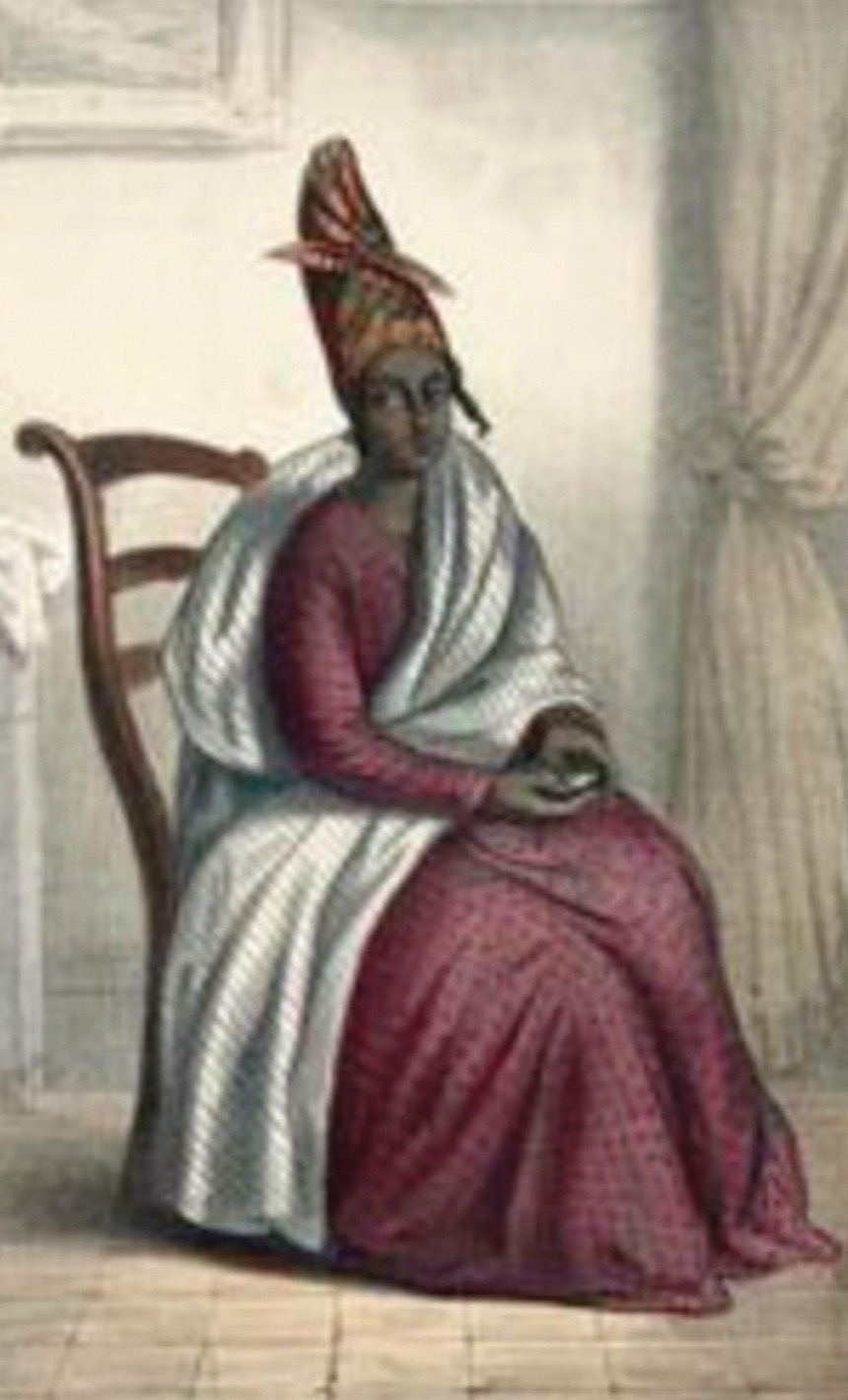
African slave traders were overwhelmingly men, but women also took part in the business. European slavers visiting West Africa often formed alliances with local merchant families by “marrying” into them, if only temporarily in most cases. The French called women in these marriages signares; the English called them wives of the coast. As European slavers died or moved away, wives of the coast found replacements, new European men, who needed the business connections these women and their families provided. Most wives of the coast were content to remain informal wives or married according to local practices. But some insisted that representatives of a Christian church recognize their marriages.
ESTIMATED VOLUME OF THE SLAVE TRADES FROM AFRICA, 1400–1900
1400–1599
1600–1699
1700–1799
1800–1899
TOTAL
TRANS-ATLANTIC
199,000
1,523,000
5,610,000
3,371,000
10,703,000
TRANS-SAHARAN
675,000
450,000
900,000
1,099,000
3,124,000
RED SEA
400,000
200,000
200,000
505,000
1,305,000
INDIAN OCEAN
200,000
100,000
260,000
380,000
940,000
TOTAL
1,474,000
2,273,000
6,970,000
5,355,000
16,072,000
Sources: Nathan Nunn, “The Long-Term Effects of Africa’s Slave Trades” (2007), Data Appendix, http://scholar.harvard.edu/files/nunn/files/empirical_slavery_appendix.pdf; and the Slave Trade Database maintained by David Eltis: https://www.slavevoyages.org/voyage/database
Note: The reliability of the transatlantic estimates is much greater than that for the other slave trades. These figures represent disembarkations: those who arrived alive.
Two men who knew the slave trade inside out were Little Ephraim Robin John and his nephew Ancona Robin Robin John. They were elite men of the Efik people, living at the mouth of the Cross River (in today’s Nigeria). They made a fine living seizing and buying Africans, usually Igbo-speakers, and selling them to English ship captains. They spoke, wrote, and read English, and when dealing with English slavers they dressed as English gentlemen and followed English manners and customs. In 1767, to their horror, an English captain seized them, crossed the Atlantic, and sold them to a French doctor in the Caribbean. They soon escaped, but instead of freedom they found themselves sold again, this time in Virginia. After further misadventures brought them to England, a judge ruled them free men. They took ship back home to Cross River, where, well acquainted with the horrors of American slavery, they returned to their old business and sold thousands more Africans into the Atlantic slave trade. There was no surer way to sustain elite status on the West African coast than to deal in slaves.
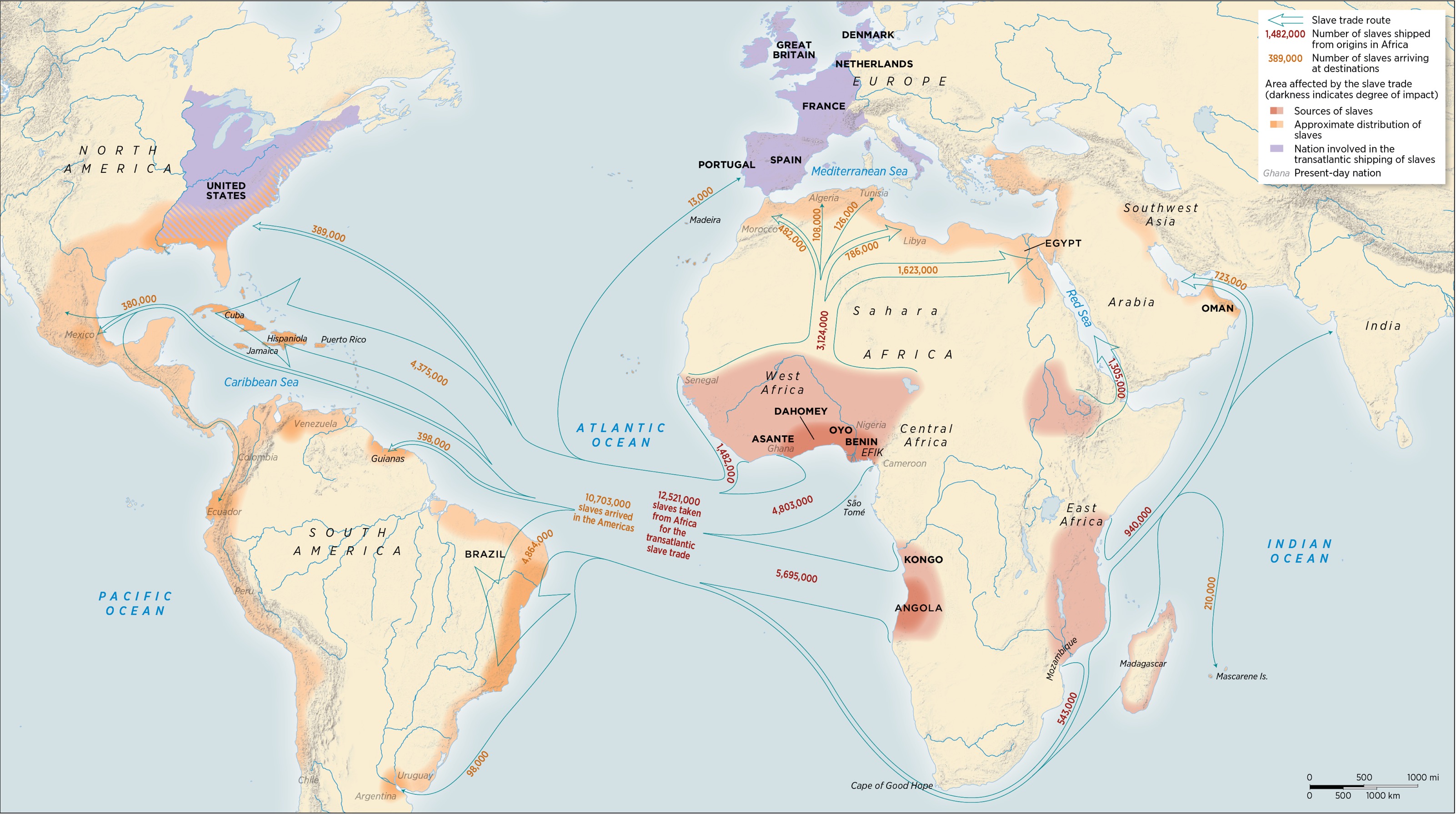
African Slave Trades, 1400–1900 Over these 500 years, roughly 16 million sub-Saharan Africans were enslaved and exported. Brazil, the Caribbean, and Egypt purchased the most Africans. West Central and West Africa supplied the most. The width of the arrows in this map is proportional to the number of people sold on each route.
CONSEQUENCES IN AFRICA The impact of the slave trade on the population of Africa is a controversial subject among historians. In the 1780s, at the height of the trade, 87,000 slaves crossed the Atlantic annually—roughly 1/1,000 (or 0.1 percent) of Africa’s estimated population of 75 to 125 million. However, for each slave who stepped off a ship in the Americas, two Africans had been enslaved, and one had died en route to the African coast or on the Middle Passage. So on account of the transatlantic slave trade, Africans in the worst years stood a 1/500 chance of being enslaved. On a continental basis, the transatlantic slave trade probably did not have much impact on the size of Africa’s population; but at certain times and places, such as Angola between 1750 and 1850, the demographic effects were
substantial.
The transatlantic slave trade also spurred the growth of slavery within Africa. During the centuries of the slave trade, far more enslaved Africans lived out their lives within Africa than were transported across the Atlantic. The typical fate of an enslaved African was to be traded (or given to someone) somewhere else within Africa. But the scale of slavery within Africa grew as a result of the export trade, which provided strong incentives for slavers to build their businesses in order to reap economies of scale. The more slaves became available in Africa, the more uses were found for them.
SignaresSignares were the African wives of French traders on the West African coast. Many signares owned houses and operated businesses in their own right, and they often established independent households when their husbands died or returned to France. This elegant signare was painted in the 1840s by Abbé David Boilat of Senegal, who was himself the son of a signare.
The transatlantic slave trade had other major impacts on Africa. Politically, it encouraged the development of larger and more militaristic states. Stateless societies with weak defenses, such as the Igbo of what is now southeastern Nigeria, suffered as a result. Igbo farmers had to take weapons with them into their fields and lock children in fortified places at night. Predatory states prospered, such as Asante (Ashante) and Dahomey in West Africa, which specialized in seizing people from less militarily adept neighbors. One state that refused to export male slaves, the Kingdom of Benin after 1516, built up a slave army to defend itself.
Economically, the slave trade encouraged predatory people—African warlord-entrepreneurs who invested in guns, horses, and violence. This diverted effort and investment from other endeavors that might have proven more socially useful than slaving. It also promoted commercialization, adding traffic to long-distance trade routes. As we have seen, the slave trade also affected African agriculture, making both maize and manioc more appealing crops.
Culturally, the slave trade hastened the spread of Islam in Africa. By law, Muslims may not enslave fellow Muslims, so in those areas where slave raiders were mainly Muslims, such as the western and central Sahel, people fearing enslavement had strong incentives to become Muslim themselves. Socially, the slave trade was divisive. Some people became extremely rich and powerful by conducting it; ordinary people who didn’t became more fearful and mistrustful. To this day in many parts of Africa, people remember whose ancestors were slave traders and whose were slaves.
The effects of the slave trade were geographically uneven, as the map on pages 496–97 shows. Peoples within reach of armed horsemen, as in the Sahelian regions, were at great risk. The region most affected was Atlantic Africa, from Angola to Senegal—and within that, Angola itself and West Africa from what is now Ghana across to Cameroon. People living deep in central African rain forests remained almost fully out of reach.
The growth in maritime trade and the spread of Islam helped tighten Africa’s connections to the Global web after 1450. Both developments brought some regions that had formerly been remarkably isolated, such as the zone around the Cape of Good Hope, into sustained contact with the wider world. The new maritime links undercut the Sahelian empires that had for centuries enjoyed a stranglehold on the trans-Saharan gold, salt, horse, and slave trades. After Songhai’s demise at the end of the sixteenth century, no great Sahelian empire arose again. Instead, many smaller kingdoms emerged, competing for influence, subjects, and control over trade.
For Atlantic Africa, the slave trade stood at the center of tightening webs of interaction. Together with the importance of American food crops explained in Chapter 16, the slave trade’s impacts make it sensible to think of pre-Columbian and post-Columbian periods in African history (which Africanists do not typically do) as well as in the history of the Americas (as is commonly done).
A king in Kongo, West Central Africa, whose father, also a king, had converted to Catholicism. Afonso learned to speak, read, and write Portuguese, and as king he made Catholicism the state religion in Kongo. His power grew with the help of Portuguese advisers and military technology.
African hunters and cattle raisers who lived in the southern tip of Africa and clashed with Dutch colonists. Many Khoi eventually died, and their culture largely disappeared due to dispossession and disease epidemics.
The transportation by European traders of 12 to 14 million slaves from Africa to the Americas, mainly to work on plantations. This trade constituted the largest forced migration in world history.
The months-long journey of slave ships between Africa and the Americas. Slaves were tightly packed below deck, usually naked and in chains, and many died due to unsanitary conditions and violence.