 Describe the Main Differences between Mesopotamian and Egyptian Civilizations
The Development of Civilization in Egypt
At about the time that Sumerian civilization was transforming Mesopotamia, another civilization was taking shape in a different part of the world and in very different ways. Unlike the Sumerians, the Egyptians did not have to wrest survival from a hostile and unpredictable environment. Instead, their land was renewed every year by the flooding of the Nile River. The fertile black soil that was left behind every summer made theirs the richest agricultural region in the entire Mediterranean world.
Egypt’s distinctive civilization rests on this fundamental ecological fact. It also explains why ancient Egypt was a narrow, elongated kingdom, running along the Nile north from the First Cataract (a series of rapids near the ancient city of Elephantine) toward the Mediterranean Sea for a distance of more than 600 miles (some 965 km). Outside this narrow band of territory—14 miles (23 km) at the widest—lay uninhabitable desert. This contrast between the fertile Nile Valley and the desiccated land beyond deeply influenced the Egyptian worldview, in which the Nile itself was the center of the cosmos and the lands beyond were hostile.
In many respects, ancient Egyptian civilization enjoyed a remarkable continuity. Its roots date back to at least 5000 B.C.E., and Egypt continued to thrive as an independent and distinctive entity even after it was conquered by Alexander the Great in 331 B.C.E. (see Chapter 4) and then subsumed into the Roman Empire after 30 B.C.E. (see Chapter 5). The defining element of this civilization would be the pervasive influence of a powerful, centralized bureaucratic state headed by a pharaoh (FARE-oh), a ruler who was regarded as a living god. No other civilization in world history has ever been governed so steadily, for so long.
For convenience, historians have traditionally divided ancient Egyptian history into distinctive “kingdoms” and “periods.” Following ancient chroniclers, modern historians have also tended to portray these Old, Middle, and New Kingdoms as characterized by unity and prosperity, punctuated by chaotic interludes known as Intermediate Periods. Like all attempts at periodization, these divisions do not capture the complexities or real pace of historical development.
PREDYNASTIC EGYPT, C. 10,000–3100 B.C.E.
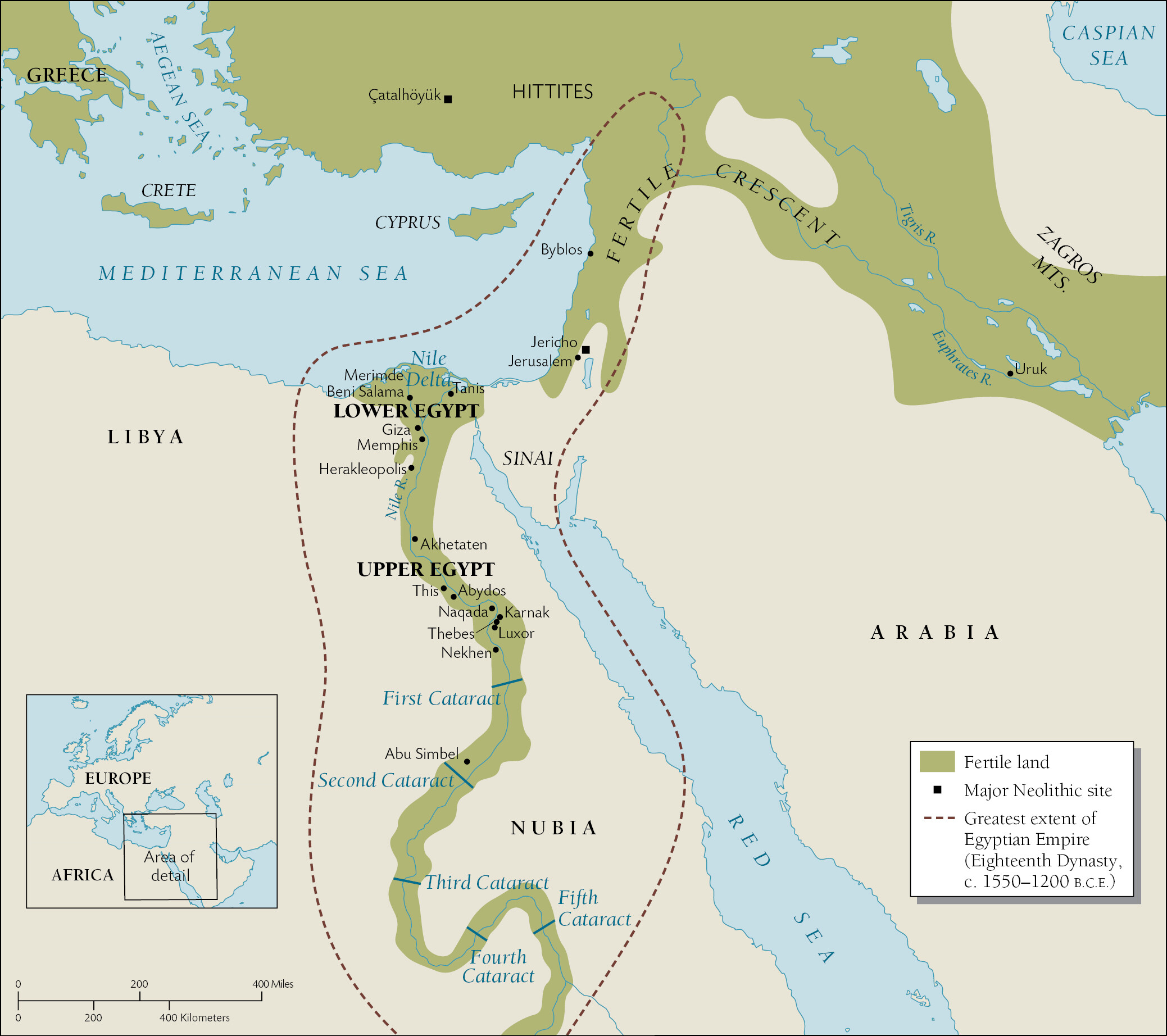
Predynastic Egypt refers to the period before the emergence of the pharaohs and their royal dynasties, an era for which archaeological evidence is scarce. Many predynastic settlements were destroyed by the waters of the Nile and are now buried under layers of silt. The first known permanent settlement, situated at the southwestern edge of the Nile Delta (near the modern town of Merimde Beni Salama: see the map on page 25), dates to approximately 4750 B.C.E. It was a farming community that may have numbered as many as 16,000 residents, which means that some Egyptian communities were much larger than those of Mesopotamia at the same time. By around 3500 B.C.E., evidence shows that the Egyptian economy rapidly became more diversified and that the residents of the delta had extensive commercial contacts with the Sinai Peninsula, the eastern Mediterranean, and the upper reaches of the Nile some several hundred miles to the south. This northern area is known as Lower Egypt because it was downstream. Comparable developments were also occurring upstream, and by the end of this Predynastic Period, Egyptian culture was more or less uniform from the southern edge of the delta throughout the vast length of the Nile known as Upper Egypt.
Although settlements in Lower Egypt were more numerous, it was in Upper Egypt that the first Egyptian cities developed. By 3200 B.C.E.—when the Sumerian city of Uruk had been thriving for a thousand years—important communities such as Nekhen, Naqada, This, and Abydos had all developed high degrees of occupational and social specialization. They had encircled themselves with sophisticated fortifications and built elaborate shrines to honor their gods. Indeed, as in Mesopotamia, a city’s role as the center of a prominent religious cult attracted travelers and encouraged the growth of industries. And compared with travel in Mesopotamia, travel in Egypt was relatively easy: the Nile bound cities together, and the lack of competition for resources fostered peace.
More information
The map shows the Egyptian empire in the eighteenth century that covered northern Africa and parts of Europe with fertile land and major Neolithic sites. The fertile land included the areas surrounding the Nile, Tigris, and Euphrates Rivers in addition to Greece and to the land north of the Fertile Crescent that was in the possession of the Hittites. The major Neolithic sites in Lower Egypt along the Nile River include Tanis, Merimde Beni Salama, Giza, Memphis, and Herakleopolis. In Upper Egypt, also along the Nile, are Akhetaton, This, Abydos, Nagada, Karnak, Thebes, Luxor, and Nekhen. Jericho, located north of Sinai, and Catalhoyuk, located east of the Hittites, are major Neolithic sites. The Nile River is divided into five cataracts south of Upper Egypt. The Greatest extent of the Egyptian Empire during the eighteenth dynasty that reigned from around 1550 to 1200 B.C.E. includes a large region around the Nile River and north into Jericho, Jerusalem, and Byblos
ANCIENT EGYPT AND THE EASTERN MEDITERRANEAN. Notice the peculiar geography of ancient Egypt and the role played by the Nile River. Identify the Nile on the map. › In what direction does the Nile flow? › How did the lands on either side help to isolate Egyptian culture from outside influences? › Consider how the Nile helped forge Egypt into a unitary state under a powerful centralized government. Yet how might Egypt’s relationship to the Nile be potentially hazardous as well as beneficial?
Importance of the Nile River in Egyptian society
It was due to the Nile, therefore, that the region south of the delta was able to forge a cultural and political unity, despite its enormous length. The Nile fed Egypt and was a conduit for people, goods, and information. Centralizing rulers could project their power quickly and effectively up and down its course. Within a remarkably short time, then, just a century or two after the first cities’ appearance in Upper Egypt, they had banded together in a confederacy under the leadership of the city of This. The pressure exerted by this confederacy in turn forced the towns of Lower Egypt to adopt their own form of political organization. By 3100 B.C.E., the rivalry between these regions had given rise to the two nascent kingdoms of Upper and Lower Egypt.
THE POWER OF THE PHARAOH, c. 3100–c. 2686 B.C.E.
With the rise of powerful rulers in these two kingdoms, Egyptian history enters a new phase, one that can be chronicled with unusual precision. The system for numbering the ruling dynasties that emerged in this era—known as the Archaic Period—was actually devised nearly 3,000 years later by a historian named Manetho (mahn-EH-thoh), who wrote in the third century B.C.E. By and large, Manetho’s work has withstood the scrutiny of modern historians, although recent research has added a “Zero Dynasty” of early kings whom Manetho did not record because he didn’t know about them; we know them almost exclusively through archaeological evidence. Among them was an Upper Egyptian warlord dubbed King Scorpion because the image of a scorpion accompanies engravings that assert his authority. Another warlord, King Narmer, appears to have ruled both Upper and Lower Egypt. His exploits, too, come down to us in powerful pictures (see Interpreting Visual Evidence on page 28). Both these kings probably came from Abydos in Upper Egypt, where they were later buried. Their administrative capital, however, was at Memphis, the capital city of Lower Egypt and an important center for trade with the wider region.
Following the political unification of Upper and Lower Egypt, the basic features of Egypt’s distinctive centralized kingship took shape along lines that would persist for the next 3,000 years. The title used to describe this kingship was pharaoh, a word that actually means “great household” and thus refers not merely to an individual but to the whole apparatus that sustained his rule. This fact helps to explain the extraordinary stability of Egyptian civilization. Kingship in Mesopotamia was a form of personal rule, and even the empires of Sargon and Ur-Nammu scarcely survived another generation or two after their deaths. But in Egypt, the office of the pharaoh was durable enough to survive the deaths of many individual successors, facilitating the peaceful transition of power to new rulers and withstanding the incompetence of many.
This was partly accomplished by the efficiency of palace bureaucracy, but it was also a function of the pharaoh’s close identification with the divine. Like the seasons, the pharaoh died only to be born again, renewed, and empowered. Egyptian rulers thus laid claim to a sacred nature quite different and more powerful than that governing Sumer. By the end of the Second Dynasty, which coincides with the end of the Archaic or Early Dynastic Period (2686 B.C.E.), the pharaoh was not just the ruler of Egypt, he was Egypt: a personification of the land, the people, and their gods.
THE OLD KINGDOM, c. 2686–2160 B.C.E.
Because few written documents of the Old Kingdom survive, historians have to rely on surviving funerary texts from the tombs of the elite. These sources have tended to convey the impression that Egyptians were obsessed with death; and they also tell us little about the lives of ordinary people. Further complicating the historian’s task is the early Egyptians’ own belief in the unchanging, cyclical nature of the universe.
However, the surviving inscriptions and art of the Third Dynasty (c. 2686–2613 B.C.E.) do tell us a great deal about the workings of the “great household” that undergirded the vast power of the pharaoh who, as the embodiment of Egypt, was the intermediary among the land, its people, and their gods. Hence, all the resources of Egypt belonged to him. Long-distance trade was entirely controlled by pharaohs, as were systems of taxation and conscripting labor. To administer these, the pharaohs installed provincial governors, many of whom were members of the royal family.
Old Kingdom pharaohs kept tight control over their lesser officials, to prevent them from establishing local roots in the territories they administered. Writing was therefore critical to communication and the management of Egypt’s wealth. This dependence on writing gave rise to a whole class of scribal administrators who enjoyed the power, influence, and status that went along with literacy: a skill few people could command, since few could master the intricate writing Egyptian system (see below). Even a child just beginning his scribal education was considered worthy of great respect because the training was so difficult. But it carried great rewards. According to the author of a document called “The Satire of the Trades,” the beginning student should persevere because, in the end, he would be so much better off than everyone else.
More information
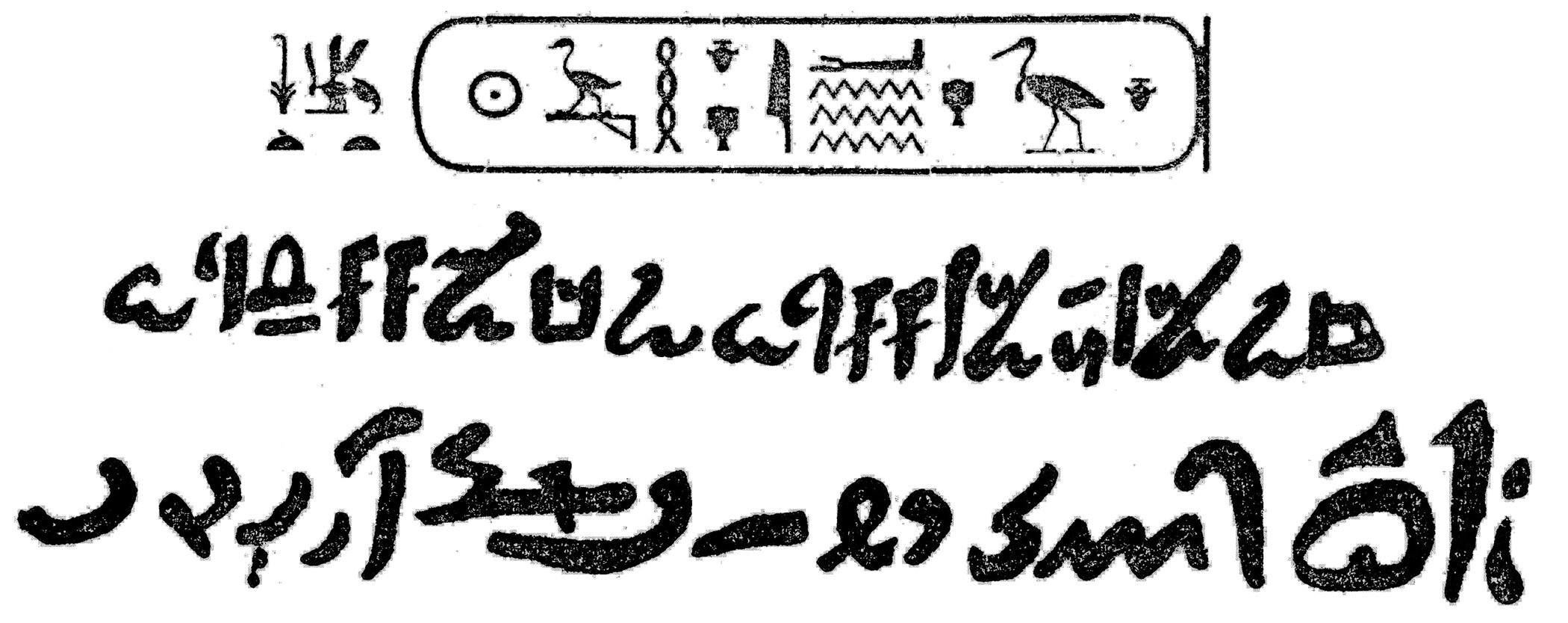
EGYPTIAN WRITING. Egyptian scribes used a variety of scripts: hieroglyphs for inscriptions and religious texts (top row), a cursive hieratic script for administrative documents (middle row), and a more informal shorthand for note-taking (bottom row). › What are the relationships among these three forms of writing?
THE POWER OF WRITING
Among the many fascinating facets of ancient Egyptian culture is the system of pictographic writing. Called hieroglyphs (HI-eroh-glifs) or “sacred carvings” by the Greeks, these elaborate symbols remained completely mysterious to modern scholars until the nineteenth century, when a Frenchman named Jean François Champollion deciphered them with the help of history’s most famous decoding device, the Rosetta Stone. This stele preserves three versions of the same decree issued by one of the Ptolemaic rulers of Egypt in 196 B.C.E. (see Chapter 3), written in ancient Greek, demotic (a later Egyptian script), and hieroglyphs—still in use after more than 3,000 years. Because he could read the text in Greek, Champollion was eventually able to translate the demotic and hieroglyphic texts as well.
The development of hieroglyphic writing in Egypt dates to around 3200 B.C.E., about the time when pictograms began to appear in Mesopotamia. But the two scripts are so different that they probably developed independently, and the uses of writing certainly developed far more quickly in Egypt. And unlike Sumerian cuneiform, Egyptian hieroglyphs never evolved into a system of simplified phonograms. Instead, the Egyptians developed a faster, cursive script for representing hieroglyphs, called hieratic, which they employed for everyday business. They also developed a shorthand version that scribes could use for rapid note-taking.

INTERPRETING VISUAL EVIDENCE
The Narmer Palette

Tutorial
Available
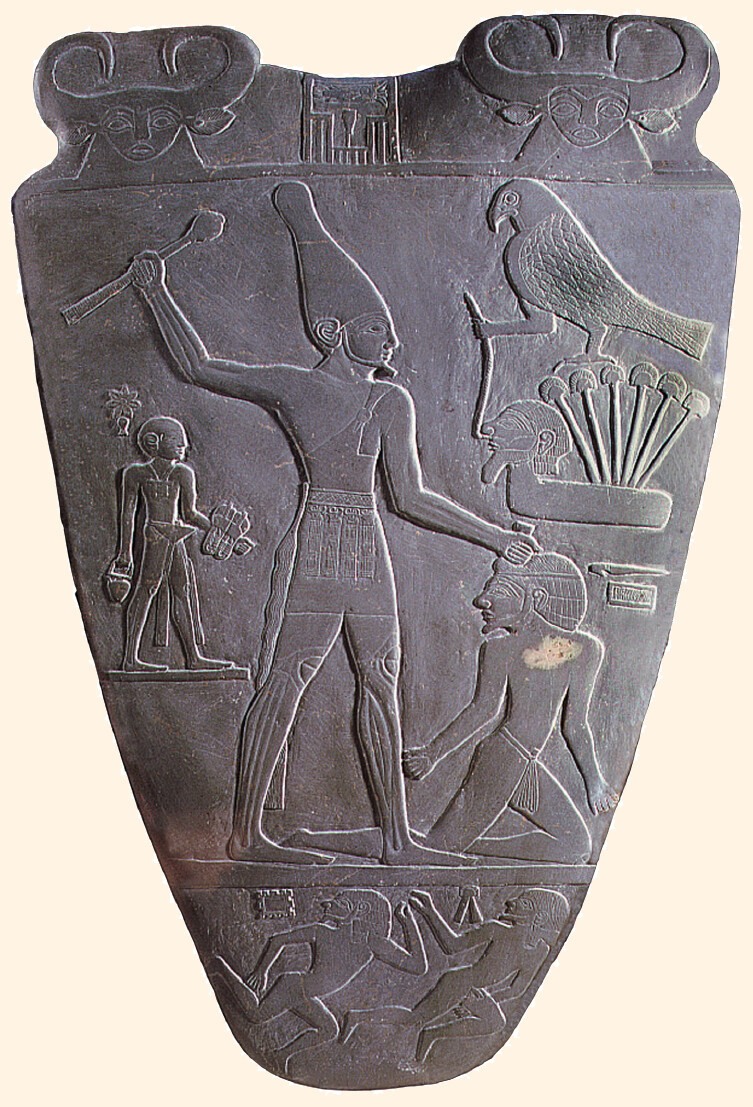
The Narmer Palette (c. 3100 B.C.E.) is a double-sided carving made of green siltstone. Palettes were used to grind pigments for the making of cosmetics, but the large size (63 cm; over 2 feet) of this one is unusual. It was discovered in 1897 by archaeologists excavating a temple dedicated to the god Horus at Nekhen, the capital of Upper Egypt. Found nearby were other artifacts, including the so-called Narmer Macehead, thought to depict the marriage of Narmer, king of Upper Egypt, to a princess of Lower Egypt.
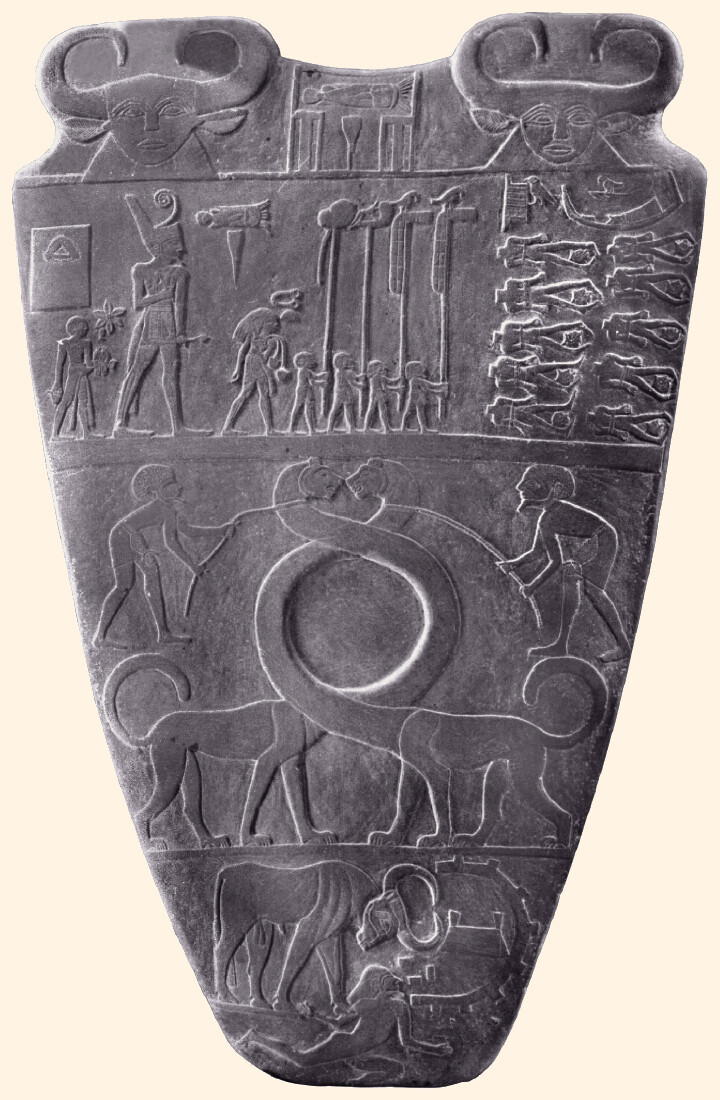
On the left, dominating the central panel, Narmer wears the White Crown of Upper Egypt. He wields a mace and seizes the hair of a captive kneeling at his feet. Above the captive’s head is a cluster of lotus leaves (a symbol of Lower Egypt) and a falcon representing the god Horus, who may be drawing the captive’s life force (ka) from his body. The figure behind Narmer is carrying the king’s sandals; he is depicted as smaller because he is an inferior. The two men in the lower panel are either running or sprawling on the ground, and the symbols above them indicate the name of a defeated town. On the right, the other side of the palette shows Narmer as the chief figure in a procession. He now wears the Red Crown of Lower Egypt and holds a mace and a flail, symbols of conquest. Behind him is the same servant carrying his sandals, and in front of him are a man with long hair and four standard-bearers. There are also ten headless corpses. Below, the entwined necks of two mythical creatures (serpopards, leopards with serpents’ heads) are tethered to leashes held by two men. In the lowest section, a bull tramples the body of a man whose city Narmer is destroying.
Questions for Analysis
- This artifact has been called “the first historical document in the world,” but scholars are still debating its meanings. For example, does it represent something that actually happened? Or is it political propaganda? In your view, is this proof that Narmer has united the two kingdoms? Why or why not?
- Do the two sides of the palette tell a coherent story? If so, on which side does that story begin?
- What might be significant about the site where the palette was found? Should the palette be interpreted as belonging with the mace, found nearby? If so, how might that change your interpretation of the palette’s significance?
More information
The palette shows Narmer as the chief figure in a procession. He now wears the Red Crown of Lower Egypt and holds a mace and a flail, symbols of conquest. Behind him, a servant carries his sandals, and in front of him are a man with long hair and four standard-bearers. There are also ten headless corpses. Below, the entwined necks of two mythical creatures, serpopards, the leopards with serpents’ necks, are tethered to leashes held by two men. In the lowest section, a bull tramples the body of a man whose city is destroyed by the bull.
More information
The palette shows Narmer as the chief figure in a procession. He now wears the Red Crown of Lower Egypt and holds a mace and a flail, symbols of conquest. Behind him, a servant carries his sandals, and in front of him are a man with long hair and four standard-bearers. There are also ten headless corpses. Below, the entwined necks of two mythical creatures, serpopards, the leopards with serpents’ necks, are tethered to leashes held by two men. In the lowest section, a bull tramples the body of a man whose city is destroyed by the bull.
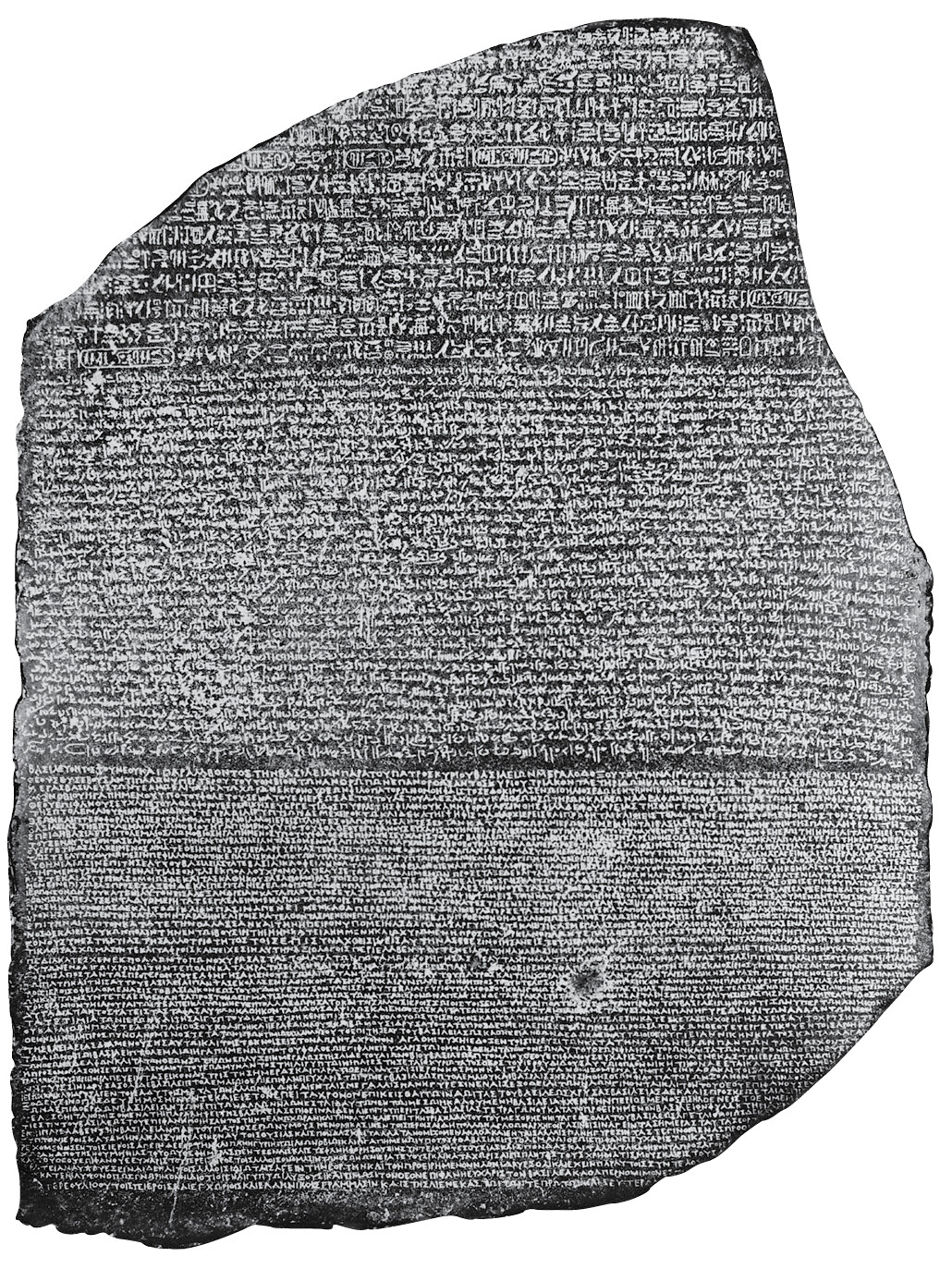
THE ROSETTA STONE. This famous stone, carved in 196 B.C.E., preserves three translations of a single decree in three different forms of writing: hieroglyphs (top), demotic Egyptian (middle), and classical Greek (bottom). › Why would scholars be able to use the classical Greek text to decipher the hieroglyphic and demotic scripts?
Little of this hieratic script remains, however, owing to the perishable nature of its written support: papyrus. Produced by hammering, drying, and processing river reeds, papyrus was much lighter, easier to write on, and more transportable than the Sumerians’ clay tablets. When sewn together into scrolls, papyrus also made it possible to record and store large quantities of information in a rolled, portable package. Production of this versatile writing material remained one of Egypt’s most important industries and exports into the Middle Ages. Yet even in the arid environment of Egypt, papyrus is fragile and subject to decay. Compared with the huge volume of papyrus documents that would have been produced, therefore, the quantity that survives is small, and this significantly limits our understanding of Old Kingdom Egypt.
The origins of the ancient Egyptian language in which these texts were written have long been a matter of debate. It can be plausibly linked to both the Semitic languages of western Asia and a number of African language groups. Whatever its origins, the Egyptian language has enjoyed a long history. Eventually, it became the tongue known as Coptic, which is still used today in the liturgy of the Coptic Christian church, in Ethiopia.
IMHOTEP AND THE STEP PYRAMID
One of the greatest administrators in the history of Egypt exemplifies both the skills and the possibilities for advancement that a talented scribe could command. Imhotep (im-HO-tep) rose through the ranks to become the right-hand man to Djoser (ZOH-ser), a pharaoh of the Third Dynasty (c. 2686–2613 B.C.E.). Imhotep’s expertise embraced medicine, astronomy, and mathematics; above all, he was an architect. It was Imhotep who designed the Step Pyramid, the first extant building in history constructed entirely of dressed stone. It was not only to be the final resting place of Djoser but an expression of his transcendent power as pharaoh.
Built west of the administrative capital at Memphis, the Step Pyramid towers over the desert to a height of 200 feet (61 m). Its design was based on an older form of burial monument, the mastaba, a low rectangular structure built entirely of brick with a flat top and sloping sides. Imhotep probably began with this model in mind, but he radically altered it by stacking one smaller mastaba on top of another and constructing each entirely of limestone. Surrounding this structure was a huge temple and mortuary complex whose buildings served two purposes. First and foremost, they would provide Djoser’s ka, his spirit or life force, with a home and sustenance in the afterlife. Second, the design of the buildings, with their immovable doors and labyrinthine passageways, would (it was hoped) thwart tomb robbers.
Imhotep set a precedent to which all other pharaohs would aspire. The pyramids on the plain of Giza, built during the Fourth Dynasty (2613–2494 B.C.E.), are a case in point. The Great Pyramid itself, built for the pharaoh Khufu (KOO-foo; called Cheops by the Greeks), was originally 481 feet high and 756 feet along each side of its base (147 by 235 m) and was constructed from more than 2.3 million limestone blocks, enclosed a volume of about 91 million cubic feet (2.6 million cubic meters). Originally, the entire pyramid was encased in gleaming white limestone and topped by a gilded capstone, as were the two massive but slightly smaller pyramids built for Khufu’s successors. During the Middle Ages, the Muslim rulers of nearby Cairo had their builders strip off the pyramid’s casing stones and used them to construct their new city. (The gold capstones had probably disappeared already.) But in antiquity, these pyramids would have glistened brilliantly by day and glowed by night, making them visible for miles. The Greek historian Herodotus (heh-RAH-duh-tuhs), who toured Egypt more than 2,000 years after the pyramids were built, estimated that it must have taken a hundred thousand laborers twenty years to build the Great Pyramid.
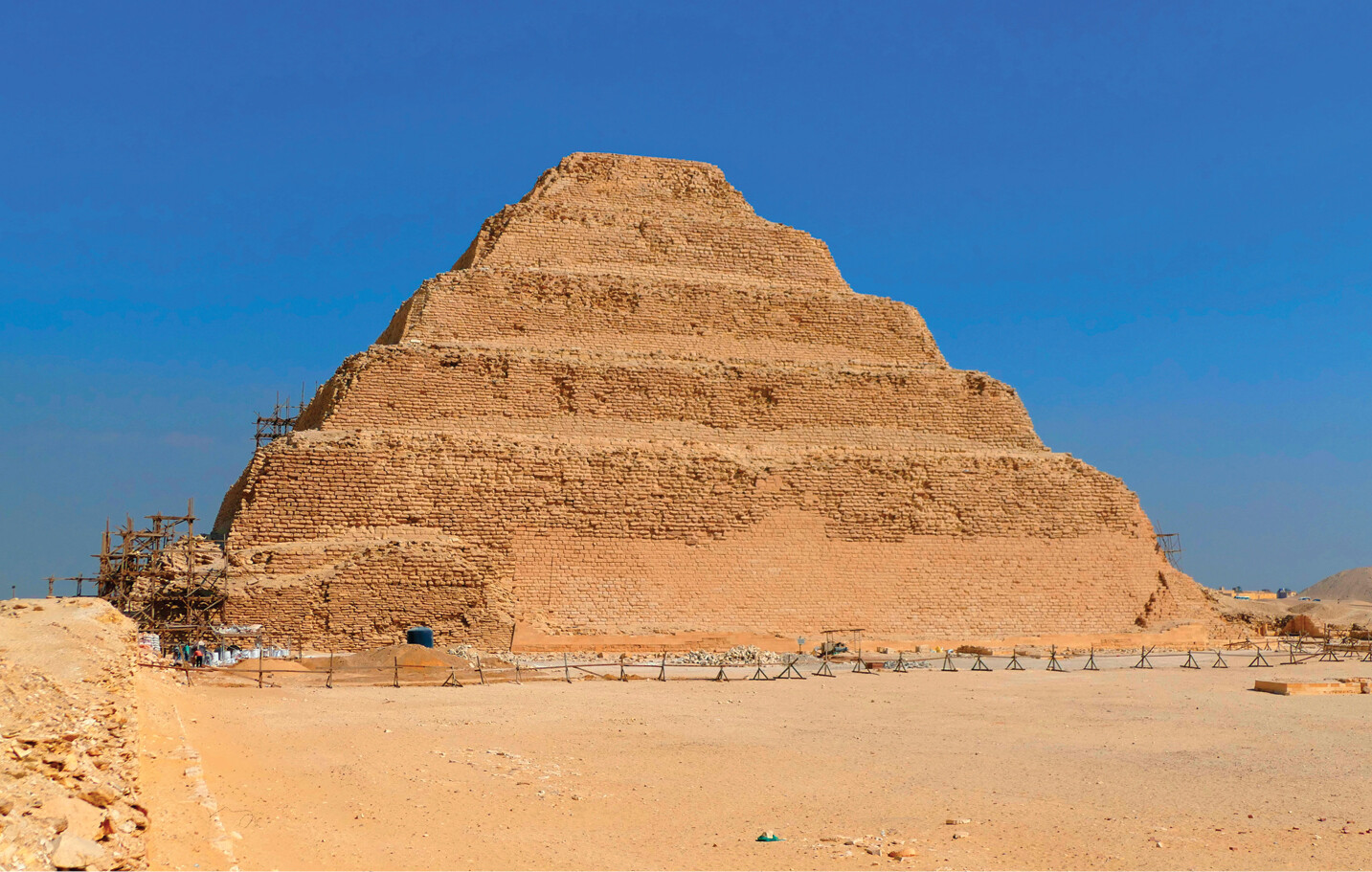
Once thought to have been the work of enslaved laborers, the pyramids were in fact raised by tens of thousands of peasants. Some workers may have been conscripts, but most probably participated willingly, since these projects glorified the living god who served as their link to the cosmic order. Still, the investment of human and material resources required to build the pyramids put strains on Egyptian society. Control over the lives of individual Egyptians increased, and the number of administrative officials employed by the state grew ever larger. So too did the contrast between the lifestyle of the pharaoh’s splendid court at Memphis and that of Egyptian society as a whole. A gap was opening between the pretensions of the pharaohs and the continuing loyalties of Egyptians to their local gods and local leaders.
THE END OF THE OLD KINGDOM
Perhaps as a result of these disparities, the Fifth and Sixth Dynasties of the Old Kingdom (2494–2181 B.C.E.) witnessed the slow erosion of pharaonic power. Although pyramid construction continued, the monuments of this period are less impressive in design, craftsmanship, and size. Meanwhile, the priesthood of the sun god Ra at Nekhen, which was also the center of worship for the great god Horus and the place where Narmer’s unification of Egypt was memorialized, began to assert its own authority. Ultimately, it declared that the pharaoh was not a god, but merely the god’s earthly son. This was a blow to the heart of the pharaoh’s political power. A more practical threat was the growing power of the pharaoh’s provincial governors, whose increased authority had enabled them to become a hereditary local nobility. Some of these nobles became so influential that one Sixth Dynasty pharaoh even married into their ranks.
It appears that the extraordinarily costly building efforts of the Fourth Dynasty had overtaxed the economy, while the channeling of resources to the royal capital at Memphis increased shortages and resentments in the provinces. Other evidence points to changing climatic conditions that may have disrupted the regular inundations of the Nile, leading to famine. Meanwhile, small states were beginning to form to the south in Nubia, perhaps in response to Egyptian aggression. With better organization and equipment, the Nubians may even have restricted Egyptian access to precious-metal deposits around the First Cataract, further crippling the Egyptian economy.
As a result of these developments, local governors and religious authorities began to emerge as the only effective guarantors of stability and order. By 2160 B.C.E., the beginning of what historians call the First Intermediate Period, Egypt had effectively ceased to exist as a unified entity. The central authority of the pharaoh in Memphis collapsed, and a more ancient distribution of power reemerged: a northern center of influence was opposed by a southern regime headquartered at Thebes, with families from each region claiming to be the legitimate pharaohs of all Egypt.
The First Intermediate Period: Egyptian central authority collapses
Compared with the centralized authority of the Old Kingdom, this looks like chaos. But redistribution of power always leads to the opening of new opportunities. In Egypt, wealth became more widely and evenly distributed than it had been, as did access to education and possibilities for personal advancement. Resources that the pharaoh’s court at Memphis had once monopolized now remained in the provinces, enabling local elites to emerge as both protectors and as patrons. The result was a much wider and more rapid dispersal of cultural forms and goods throughout Egyptian society. Many of these arts and luxuries—including elaborate rites for the dead—had been developed originally at the pharaoh’s court and limited to it. Now, however, they became available to Egyptian society at large.
Glossary
- pharaoh
- The title borne by the rulers of ancient Egypt. The pharaoh was regarded as the divine representative of the gods and the embodiment of Egypt itself.
- Old Kingdom
- During this period, c. 2686–2160 B.C.E., the pharaohs of ancient Egypt controlled a powerful and centralized bureaucratic state with vast human and material resources.
- hieroglyphs
- Writing system of ancient Egypt, based on a complicated series of pictorial symbols, that developed around 3200 B.C.E.