3
The Civilization of Greece, 1000–400 B.C.E.
More information
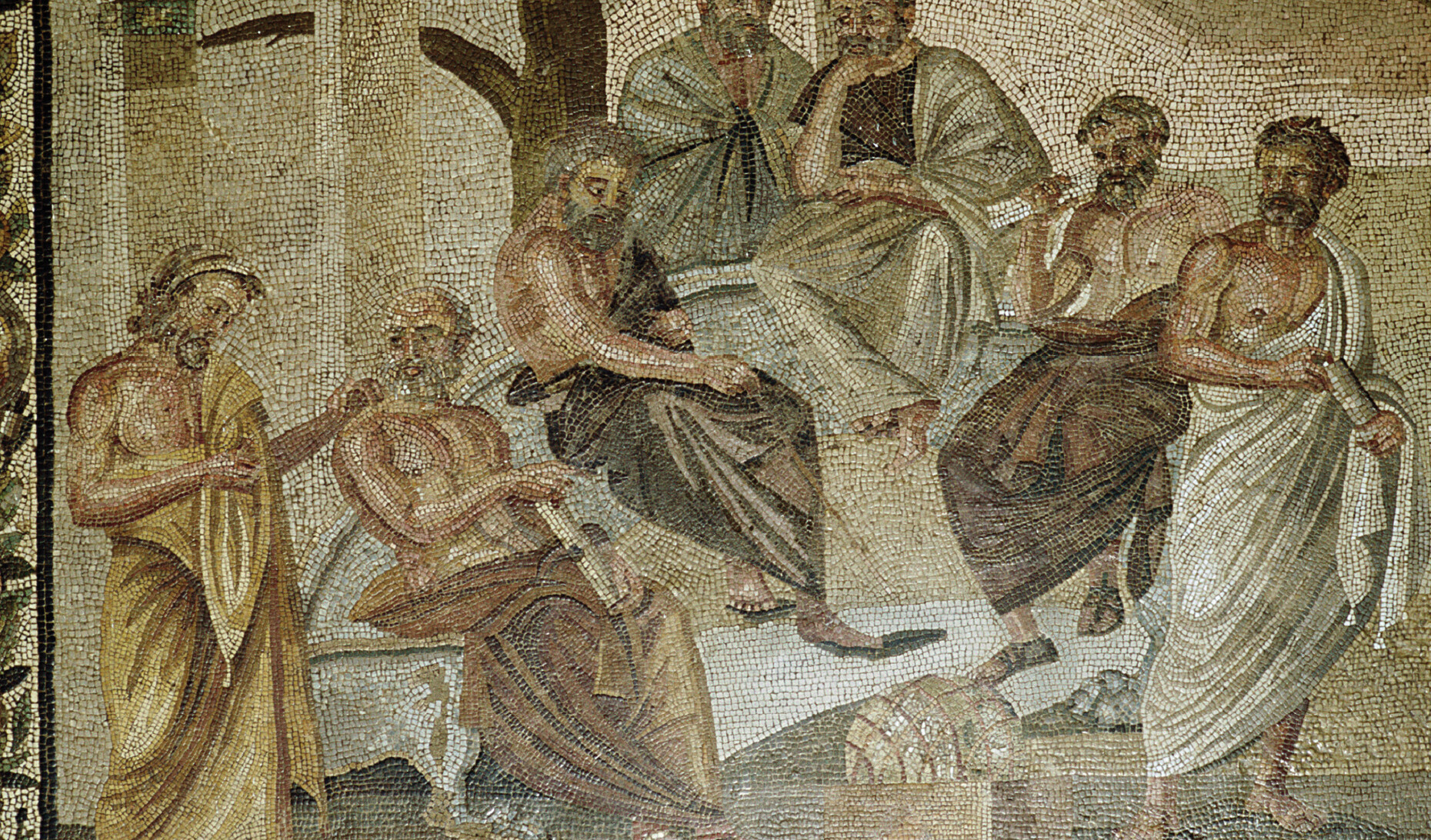
The mosaic shows a group of seven bearded men gathered beneath an olive tree. A sundial rests on a column behind them. Five of the men are focused on a globe located near the lower center of the image, while a pair of men on the right gesture to each other and appear to be in discussion about a scroll. Two men on the far right also hold scrolls. The central image is framed by a lush border of pomegranates, apples, berries, leaves, and ribbons punctuated by eight male and female comic masks.

BEFORE YOU READ THIS CHAPTER |
 |
STORY LINES
- Although the different Greek poleis (city-states) did not share a common political structure, they shared a strong sense of identity and were united by their belief in the superiority of Greek language and culture.
- The emergence of a political system known as democracy in some ancient Greek poleis was dependent on specific historical circumstances, which included reliance on slavery and the exclusion of women from public life.
- The cultural achievements of the fifth century B.C.E., as exemplified by Athens, glorified the individual male citizen, his male ancestors, and his role in the community and governance of the polis.
- The Athenians’ leadership in the Persian Wars and their subsequent imperial expansion enabled them to dominate the Mediterranean and also, through the use of writing, to influence our understanding of their role in history.
CORE OBJECTIVES
- DESCRIBE the factors that led to the emergence of the Greek polis.
- EXPLAIN the importance of hoplite warfare and its effects on democratic politics and military tactics.
- DEFINE the key differences among the poleis of Athens, Sparta, and Miletus.
- IDENTIFY the ways in which Athenian culture, philosophy, and art reflect democratic ideals.
- UNDERSTAND the impact of the Persian and Peloponnesian Wars on Greek civilization.
IN THE FIFTH CENTURY B.C.E., a Greek-speaking subject of the Persian Empire began to write a book. He had been to Egypt and the African coast, the Greek colonies of Italy, the wilds of Thrace, and all over the Aegean. He had collected stories about peoples even farther afield, in Ethiopia, India, and the Black Sea. We have already met this traveler, Herodotus (c. 484–c. 425 B.C.E.), who marveled at the pyramids (see Chapter 1) and told how the king of Lydia lost his power (see Chapter 2). His motive was to write a history of recent events, as he put it, “with the aim of preventing the great and wonderful deeds of both Greeks and barbarians from losing their glory; and in particular to examine the causes that made them fight one another.”
Herodotus’s fascination with the peoples he calls “barbarians” underscores the extent to which the Greeks regarded themselves as different. While they struggled to cooperate politically, they were able to forge a common language and culture distinct from peoples whose speech, to Greek ears, sounded like gibberish (“bar-bar-bar”). Greeks viewed free men as superior and valued their individual liberty, participatory government, artistic innovation, and the powers of the masculine mind. Our own civilization would be unimaginable without the political experiments and cultural achievements of ancient Greece.