 The Rapid Spread of the Black Death
FROM THE GREAT FAMINE TO THE BLACK DEATH
By 1300, Europe was connected to Asia and the lands between by an intricate network that fostered connections of all kinds. At the same time, Europe was reaching its own ecological limits. Between 1000 and 1300, the population had tripled; a sea of grain fields stretched, almost unbroken, from Ireland to Ukraine; and forests had been cleared, marshes drained, and pastureland reduced by generations of peasants performing lifetimes of backbreaking labor. Yet Europe was barely able to feed its people. At the same time, the Medieval Warm Period was coming to an end, and with it the favorable climatic conditions that had enabled the agricultural revolution of the previous three centuries. Even a reduction of 1 or 2° C is enough to cause substantial changes in rainfall patterns, shorten growing seasons, and decrease agricultural productivity. So it did in Europe, with disastrous consequences.
Past and Present
Global Pandemics
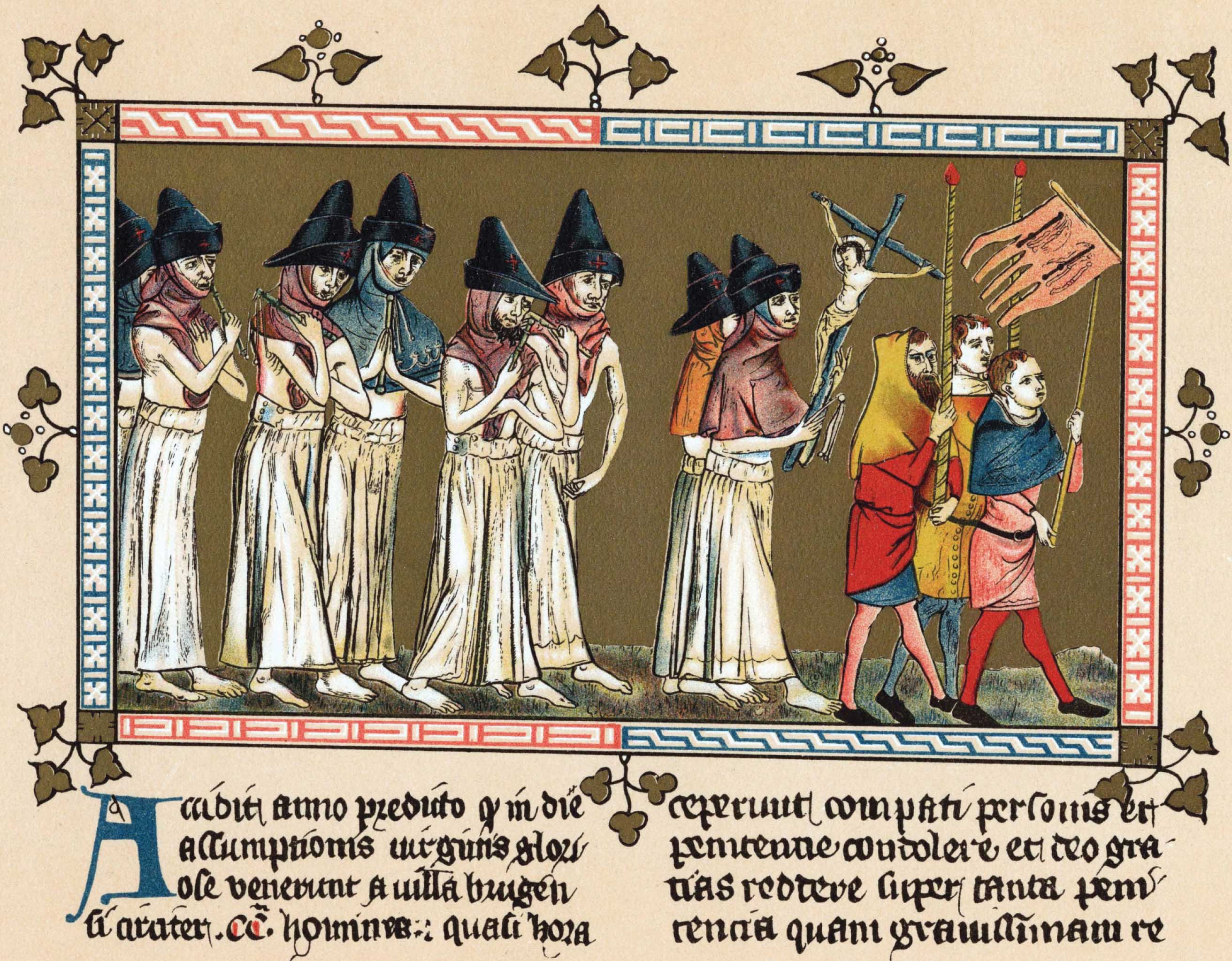
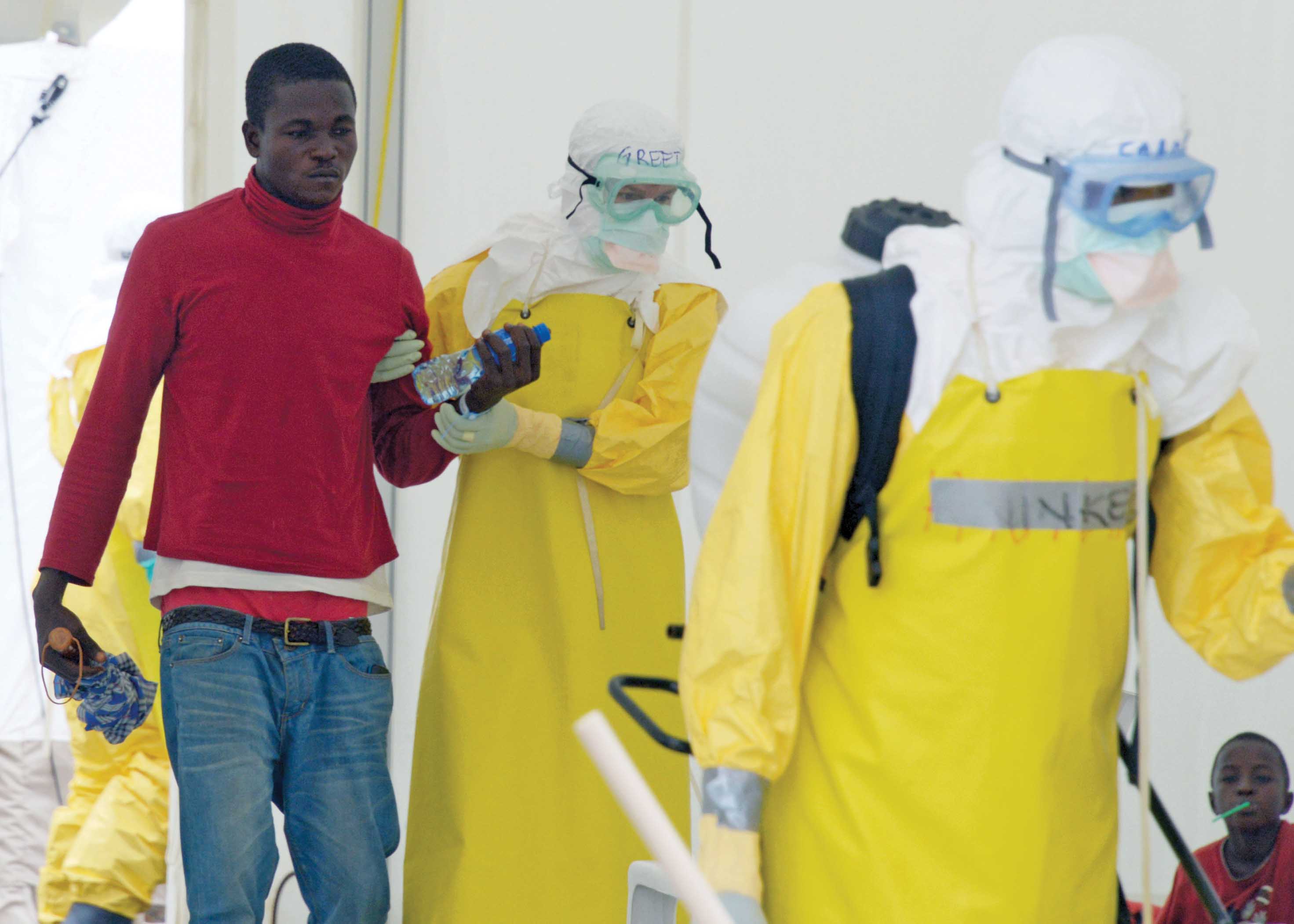
Although advances in medical science have made the causes of disease less mysterious, the rapid spread of new viruses is still terrifying and the variety of human responses to the possibility of sudden infection have changed little over time. The image on the left shows citizens from the town of Tournai (now in Belgium) marching in a procession to ward off the plague: they are praying and doing penance for their sins by beating their own bodies with whips, a practice called flagellation. The image on the right shows health care workers donning hazmat suits to protect themselves from the deadly Ebola virus outbreak of 2014–2015. By now, we are all familiar with images of masking and other public responses to the COVID-19 pandemic.
 Video: From the Great Famine to the Black Death/Past and Present
Evil Times: The Seven Years’ Famine
Between the years 1315 and 1322, the cooling global climate caused nearly continuous adverse weather conditions in the northern hemisphere. In Europe, winters were extraordinarily severe: in 1316, the Baltic Sea froze over and ships were trapped in the ice. For many years, unseasonal rains prevented planting in spring or summer, and when a crop did manage to struggle through, it would be dashed by rain and hail in autumn. Amid these natural calamities, dynastic warfare continued in the sodden farmlands of northern and eastern Europe, as the princes of Scandinavia and the Holy Roman Empire fought for supremacy and succession there. In the once-fertile fields of Flanders, French armies slogged through mud in continued efforts to subdue the Flemish population. On the Scottish and Welsh borders, uprisings were ruthlessly suppressed, and the paltry storehouses of the natives were pillaged to feed the English raiders.
The result was human suffering more devastating than that caused by any famine affecting Europe since that time; hence the name “Great Famine” to describe this terrible crisis. Weakened by years of malnutrition and relentless efforts to counteract the climatic effects on the landscape, between 10 and 15 percent of northern Europe’s population perished. Many starved, while others fell victim to epidemic diseases that affected both animals and people. In southern Europe, around the shores of the Mediterranean, the effects of climate change were more muted, and food could be distributed through different channels. Nonetheless, the overall health of this region also suffered from the disruption of trade and the shortage of some staple goods, as well as from the highly unstable political situation we have discussed.
As food grew scarcer, prices climbed unpredictably, making even staple goods unobtainable by the poor. Plans for future crops, which kept hope alive, would be dashed when spring arrived and flooded fields prevented seeds from germinating. People then spent cold summers and autumns foraging for food. Hunting was restricted to the nobility, but even those who risked the death penalty for poaching found little game. Wages did not keep pace with rising costs, and so those who lived in towns and depended on markets had less to spend on scarce provisions. Only a year after the famine began, townspeople were dying of ailments that would not have been fatal in good years.
The effects of the famine were especially devastating for children, since even those who survived were highly susceptible to disease, owing to the severe impairment of their immune systems. It may have been the Great Famine, then, that paved the way for the even more horrific destruction of the Black Death.
A Crisis of Connectivity: Tracking the Black Death
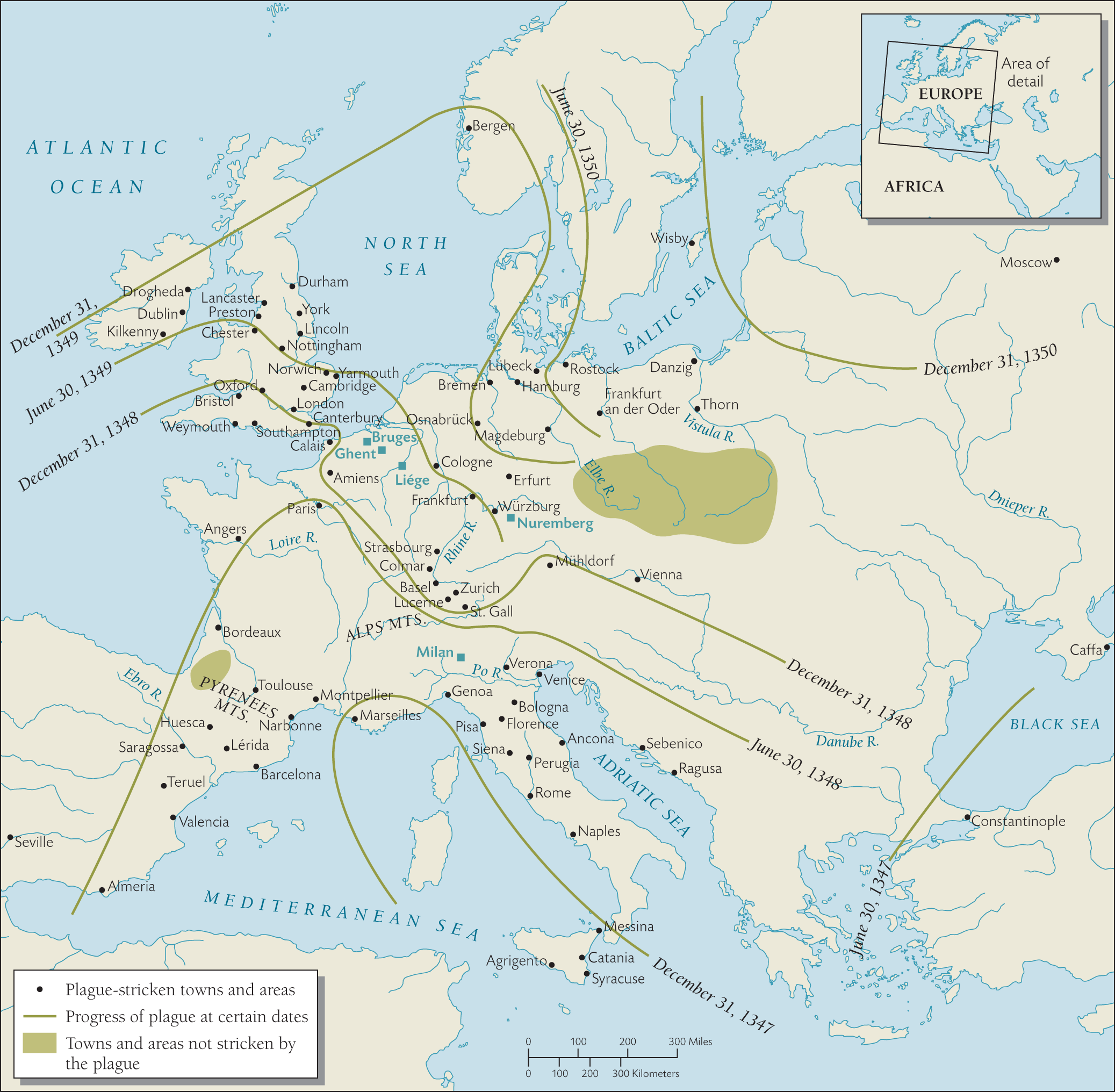
The Black Death is the name given to a global plague pandemic that spread from central Asia to China, northern India, and western Asia with the Mongol conquests, after which it moved into Africa and Europe. Research by teams of historians and scientists over just the past few years has led to the realization that this outbreak of the plague was caused by the same Yersinia pestis microbe responsible for the Justinianic plague of the sixth century. Moreover, this research suggests that it may already have been active by the end of the twelfth century, and decimating Asian communities in the early thirteenth. By 1346, it had reached the Black Sea, where it was transmitted to the Genoese colonists at Caffa and transported by their ships to North Africa, Sicily, and northern Italy. From there, it spread rapidly along global trade routes, advancing about two miles per day on average. By 1350, it had reached Scandinavia and northern Russia, then spread southward again until it linked up with the original waves of infection in its breeding grounds in central Asia, probably somewhere in the region of modern Kyrgyzstan. In Europe, it continued to erupt in local epidemics until the eighteenth century. In Asia and Africa, it was still causing devastating losses of life into the nineteenth century.
Although the absolute (total) mortality caused by other global pandemics has been greater—including the influenza pandemic of 1918–1919 and the ongoing HIV/AIDS pandemic—the percentage of the population affected by the Black Death was higher. In the space of a few decades, 40 to 60 percent of all people in these affected areas had died. The tremendous consequences of this catastrophe and the survivors’ responses to the world left behind will be explored in Chapter 2. But what made this pandemic so deadly, even compared to its early medieval predecessor?
The Yersinia pestis genome was sequenced in 2013 using aDNA from the teeth of Black Death victims buried in London. Epidemiologists have since been able to show that it morphed rapidly into multiple strains after the Justinianic plague. Its bubonic form, which attacks the lymph nodes and produces painful pus-filled buboes in the groin, neck, and armpits, had probably developed in antiquity, and this was the form in which it spread during the sixth century. Thereafter, however, it morphed into even more virulent septicemic and pneumonic variants.
In its bubonic form, the plague microbe is carried by fleas that can live and travel in the fur or feathers of many different animals, including rats, marmots, hamsters, rabbits, camels, and birds. Humans contract it through flea bites or contact with an animal host. Septicemic plague occurs when an infected flea introduces the microbe directly into the human bloodstream, causing death within hours, usually before any symptoms of the disease are obvious. Pneumonic plague, perhaps the most frightening variation, results when particles of Y. pestis are inhaled and infect the lungs, allowing the contagion to spread silently and invisibly, in the same ways as the common cold. Other forms of plague can be contracted by eating an infected animal, and many of its animal hosts were common dietary staples in medieval societies.
One of the things that made the Black Death so terrifying, therefore, was that it was mysteriously inconsistent. Those afflicted by the hideous bubonic plague might actually recover, whereas others—seemingly untouched—might die suddenly, from no apparent cause. Immediate reactions to the plague thus ranged from panic to anger to resignation. Observers quickly realized that the plague was contagious, but precisely how it spread remained unknown. Some believed that it was caused by breathing “bad air” and so urged people to flee from stricken areas, which caused the disease to spread even faster. Another response was the flagellant movement, so called because of the whips (flagella) with which traveling bands of penitents lashed themselves in order to appease the wrath of God. The unruly and sometimes hysterical mobs that gathered around the flagellants aroused the concern of both ecclesiastical and secular authorities, and the movement was suppressed by papal order.
Competing Viewpoints
The Black Death and the Jews: Christian Responses to Antisemitic Violence
When the Black Death began to devastate Europe after 1347, it fueled a wave of violence against Jews. Jews were often accused of being the catalysts for the plague, for allegedly poisoning water supplies or through other nefarious means, or by taking undue advantage of the Christians who were dependent on them for financial reasons. In the small Catalonian town of Tàrrega, a massacre of Jews by their Christian neighbors is documented both in the royal inquest that condemned it and in a series of mass graves, dug by survivors, in which their slaughtered loved ones were carefully buried. In the German cities of the Rhineland, where Jews had also thrived for centuries under the protection of local rulers or municipal authorities, attempts were made to pre-empt such massacres by spreading the news of their occurrence in other parts of Europe, as we see in a letter from the town council of Cologne to their counterparts in nearby Strasbourg.
The Slaughter Of The Jews Of Tàrrega By Their Christian Neighbors, July 1348
Listen as You Read
In the year just passed [i.e. 1348], some individuals of this town strongly aroused its people to put aside the fear of God and our authority, not hesitating to offend our majesty. Incited by a diabolical spirit, with armed hand and deliberate intent, they came maliciously to the call of the Jewish community [aljama] and with unwarranted recklessness they violently broke down and destroyed the gates of this call with axes and other types of weapons, and they even destroyed the call itself, entering into it all together and shouting loudly with raised voices, “Kill the traitors” [Muyren los traydors]. And not satisfied with that, but rivaling terrible acts with even worse things, they ruthlessly raided Jewish homes with spears, stones, and arrows. And, finally entering the said houses, they took away all the goods and property of the Jews, just as if they were thieves, and lawlessly they tore and burned many legal instruments and various written contracts of the Jews and they senselessly murdered many Jews in this community, and others were beaten mercilessly and were wounded, and they inflicted many terrible evils, grave injuries, offenses, robberies, harms, and atrocities and on these Jews.
Source: Anna Colet, et al. “The Black Death and Its Consequences for the Jewish Community in Tàrrega: Lessons from History and Archeology,” The Medieval Globe. Latin text trans. Monica H. Green and Carol Symes (Yorkshire, UK: 2014): pp. 71–2.
A Letter from the Town Council of Cologne to the Town Council of Strasbourg (Germany), 12 January 1349
Listen as You Read
Very dear friends, all sorts of rumours are now flying about against Judaism and the Jews prompted by this unexpected and unparalleled mortality of Christians. . . . Throughout our city, as in yours, many-winged Fame clamours that this mortality was initially caused, and is still being spread, by the poisoning of springs and wells, and that the Jews must have dropped poisonous substances into them. When it came to our knowledge that serious charges had been made against the Jews in several small towns and villages on the basis of this mortality, we sent numerous letters to you and to other cities and towns to uncover the truth behind these rumours, and set a thorough investigation in train. . . .
If a massacre of the Jews were to be allowed in the major cities (something which we are determined to prevent in our city, if we can, as long as the Jews are found to be innocent of these or similar actions) it could lead to the sort of outrages and disturbances which would whip up a popular revolt among the common people—and such revolts have in the past brought cities to misery and desolation. In any case we are still of the opinion that this mortality and its attendant circumstances are caused by divine vengeance and nothing else. Accordingly we intend to forbid any harassment of the Jews in our city because of these flying rumours, but to defend them faithfully and keep them safe, as our predecessors did—and we are convinced that you ought to do the same. . . .
Source: From Rosemary Horrox, ed. and trans., The Black Death (Manchester, 1994), pp. 219–20.
Questions for Analysis
- How does the report of the massacre in Tàrrega describe the motives of the Christian murders? What are their apparent grievances against their Jewish neighbors?
- Why does the Council of Cologne wish to quell violence against the city’s Jews? How does this reasoning complement or challenge what we have learned so far about the treatment of Jews in medieval Europe?
- In your view, do these two perspectives display a rational approach to the horrors of the Black Death? Why or why not? What are their wider implications for our understanding of antisemitic tropes and forms of violence?
Still others looked for scapegoats and revived old conspiracy theories that implicated Jews in the poisoning of communal water sources. Scores of Jewish communities were attacked and thousands of their inhabitants massacred in parts of the Rhineland, southern France, and the Christian kingdoms of Spain. For example, an important archaeological and forensic study published in 2014 reveals that hundreds of Jews—including children, the elderly, and the disabled—were brutally clubbed and hacked to death by their Christian neighbors in the small Catalonian town of Tàrrega (see Competing Viewpoints on page 34). The papacy and some local authorities tried to halt such attacks, but these efforts usually came too late.
Glossary
- Great Famine
- A period of terrible hunger and deprivation in Europe that peaked between 1315 and 1317, caused by a cooling of the climate and by soil exhaustion due to overfarming. It is estimated to have reduced the population of Europe by 10 to 15 percent.
- Black Death
- The epidemic of bubonic plague that ravaged Europe, Asia, and North Africa during the fourteenth century, killing one third to one half of the population.
- nefarious
- Wicked or criminal.
- Catalonian town of Tàrrega.
- In Spain.
- preempt
- Take action in order to prevent.
- aroused
- To stir or to excite.
- our authority
- That of the king.
- with armed hand and deliberate intent
- Premeditated.
- call of the Jewish community [aljama].
- Jewish ghetto.
- many legal instruments and various written contracts of the Jews
- Many Jews were lawyers and accountants who offered loans to Christians.
- by this unexpected and unparalleled mortality of Christians
- Referencing the swift and large numbers of death caused by the Black Plague.
- clamours
- Shouts.
- by divine vengeance
- A punishment from God.