The Second Founding: From Compromise to Constitution
Describe the political context of the Constitutional Convention and the compromises achieved there
As we have seen, the Americans prevailed and won the Revolutionary War, thereby securing their independence. However, a series of developments in the 1780s highlighted the shortcomings of the Articles of Confederation in holding the former colonies together as an independent and effective nation-state. These shortcomings led to what was essentially a second founding.
First, the United States had great difficulty conducting its foreign affairs successfully, as there was no national military, and competition among the states for foreign commerce allowed the European powers to play them off against one another. At one point, John Adams, who had become a leader in the independence struggle, was sent to negotiate a new treaty with Britain, one that would cover disputes left over from the war. The British Parliment responded that since the United States under the Articles was unable to enforce existing treaties, it would negotiate with each of the 13 states separately. At the same time, the young nation faced a threat from Spain, which still held vast territories in North and South America. Without a national military, the nation’s borders were difficult to protect against this potentially hostile foreign power.
Second, the power that states retained under the Articles of Confederation began to alarm well-to-do Americans—in particular, New England merchants and southern planters—when radical forces gained power in a number of state governments. As a result of the Revolution, one key segment of the colonial elite—the royal land, office, and patent holders—was stripped of its economic and political privileges. While the elites were weakened, the radicals had gained strength and now controlled key states, including Pennsylvania and Rhode Island, where they pursued policies that struck terror in the hearts of business and property owners throughout the country. In Pennsylvania, the government redistributed land from large landowners to small farmers. The central government under the Articles was powerless to intervene.
As a result of the Articles’ limitations, the political and economic position of the new American states deteriorated during the 1780s. Europe’s great powers—Britain, France, and Spain—adopted policies that excluded Americans from commerce, while political unrest at home further undermined trade and investment. Continuing international weakness and domestic economic turmoil led many Americans to consider whether their newly adopted form of government might already require revision. In the fall of 1786, the Virginia legislature invited representatives of all the states to a convention in Annapolis, Maryland. It was established at the Annapolis Convention that a future constitutional convention would need to address how to create a stronger central government.
Shays’ Rebellion
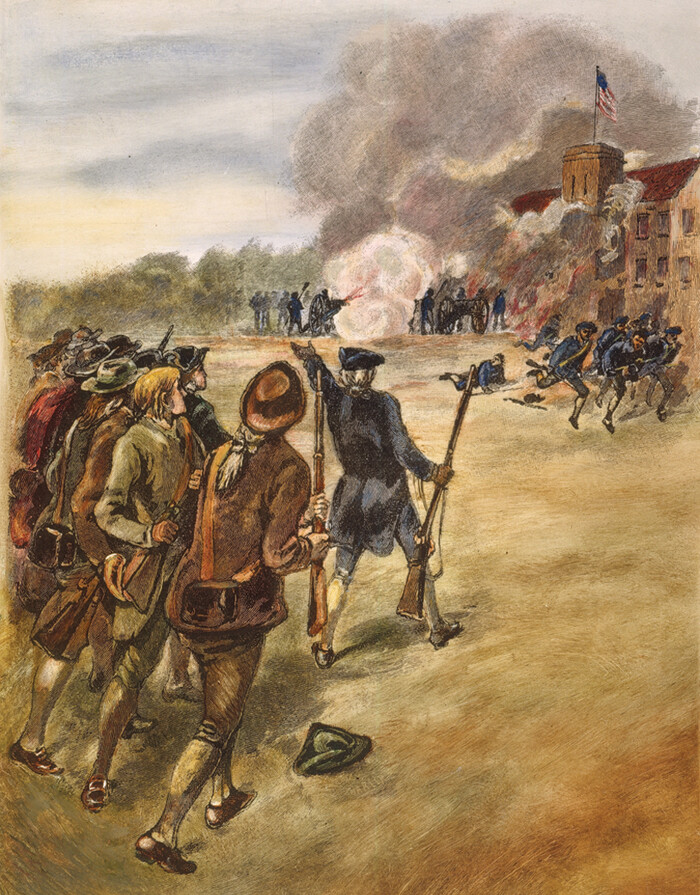
It’s quite possible that the Constitutional Convention of 1787 in Philadelphia would never have taken place except for Shays’ Rebellion. In the winter following the Annapolis Convention, Daniel Shays, a former army captain, led a mob of debt-ridden farmers in an effort to prevent foreclosures on their land. A militia organized by the state governor and funded by a group of prominent merchants dispersed the mob, but Shays and his followers then attempted to capture the federal arsenal at Springfield. Within a few days the state government regained control and captured 14 of the rebels. But later that year, a newly elected Massachusetts legislature granted some of the farmers’ demands.
More information
A painting shows a scene where Daniel Shays leads his makeshift army against a federal arsenal in Springfield, Massachusetts. Shays lifts a musket and calls his troops on as smoke billows in the distance.
Daniel Shays’ rebellion proved the Articles of Confederation were too weak to protect the fledgling nation.
George Washington summed up the effects of the incident on the new nation’s leaders: “I am mortified beyond expression that in the moment of our acknowledged independence we should by our conduct verify the predictions of our transatlantic foe, and render ourselves ridiculous and contemptible in the eyes of all Europe.”19 The Congress under the Confederation had shown itself unable to act decisively in a time of crisis. In response to the escalating crisis surrounding the Articles, the states were asked to send representatives to Philadelphia to discuss constitutional revision. Seventy-four delegates were chosen. Of these, 55 would actually attend the convention, representing every state except Rhode Island, and 39 would eventually sign the newly drafted Constitution (see the Who Are Americans? feature on p. 49).
The Constitutional Convention and the Great Compromise
The delegates who convened in Philadelphia in May 1787 had political strife, international embarrassment, national weakness, and local rebellion on their minds. Recognizing that these issues were symptoms of fundamental flaws in the Articles of Confederation, the delegates soon abandoned the plan to revise the Articles and committed themselves to a new founding—a transformed, and ultimately successful, attempt to create a legitimate and effective national system of government. This effort would occupy the convention for the next five months.
More information
The present-day exterior of the Independence Hall building in Philadelphia. It is a two-story structure with two one-story wings and a roof tower in the center, topped by a cupola.
The Constitutional Convention took place from May to September 1787 at Independence Hall in Philadelphia, where the Declaration of Independence had been signed 11 years prior. In order to keep their deliberations secret, the delegates voted to keep the hall’s windows shut throughout the hot summer.
The Great Compromise
The proponents of a new government fired their opening shot on May 29, 1787, when Edmund Randolph of Virginia offered a resolution proposing corrections and additions to the Articles of Confederation. Randolph represented the Virgina delegation, which also included James Madison and George Washington. The proposal, drafted by the Virginia delegation, provided for virtually every aspect of a new government.
The most controversial portion of Randolph’s motion was called the Virginia Plan. It provided for representation in the national legislature to be based on the population of each state or the proportion of each state’s revenue contribution to the national government, or both. Randolph also proposed a second chamber of the legislature, to be elected by the members of the first chamber. Therefore, Congress would have two chambers and take the form of a bicameral legislature. Since the states varied enormously in population and wealth, the Virginia Plan was heavily biased in favor of the large states. The Virginia Plan also called for ratification of the Constitution by the people rather than by the states. This form of ratification would make it clear that the new government would be a national government, not a compact among the states.
While the convention was debating the Virginia Plan, opposition began to mount as more delegates arrived in Philadelphia. William Paterson of New Jersey introduced a competing resolution, the New Jersey Plan. Its main proponents were delegates from the less populous states, including Delaware, New Jersey, Connecticut, and New York, who asserted that the more populous states—Virginia, Pennsylvania, North Carolina, Massachusetts, and Georgia—would dominate the new government if representation were determined by population. The smaller states argued that each state should be equally represented regardless of its population. Under the New Jersey Plan, there would be one chamber, a system known as a unicameral legislature.
The issue of representation threatened to wreck the entire constitutional enterprise. As factions maneuvered and tempers flared, the Union was on the verge of falling apart. Finally, the debate was settled by the Connecticut Compromise, also known as the Great Compromise. Under its terms, there would be a bicameral legislature. Yet, in one chamber of Congress—the House of Representatives—seats would be apportioned according to population, as delegates from the large states had wished. But in a second chamber—the Senate—each state would have equal representation, as the small states preferred.
The Constitution and Slavery
The institution of slavery, as we previously discussed, was crucial to the colonial economy. However, it was an institution whose future was uncertain. By the late eighteenth century, attitudes toward the acceptability of slavery, especially in northern cities, was shifting. And calls to end the transatlantic slave trade and slavery in America became louder after the Declaration of Independence declared that “all men are created equal.” But it’s important to recognize that pressure to end slavery came as well from enslaved people themselves.
Enslaved Black people strategically resisted their treatment through both obvious and subtle ways. The more explicit forms of resistance included running away and armed mass uprisings. Other discreet acts of rebellion included secretly learning how to read, destroying tools, and slowing down work pace.20 Together, these forms of resistance were instrumental in pointing out the brutality of the institution of slavery and how it ran counter to the professed democratic ideals of the young country.
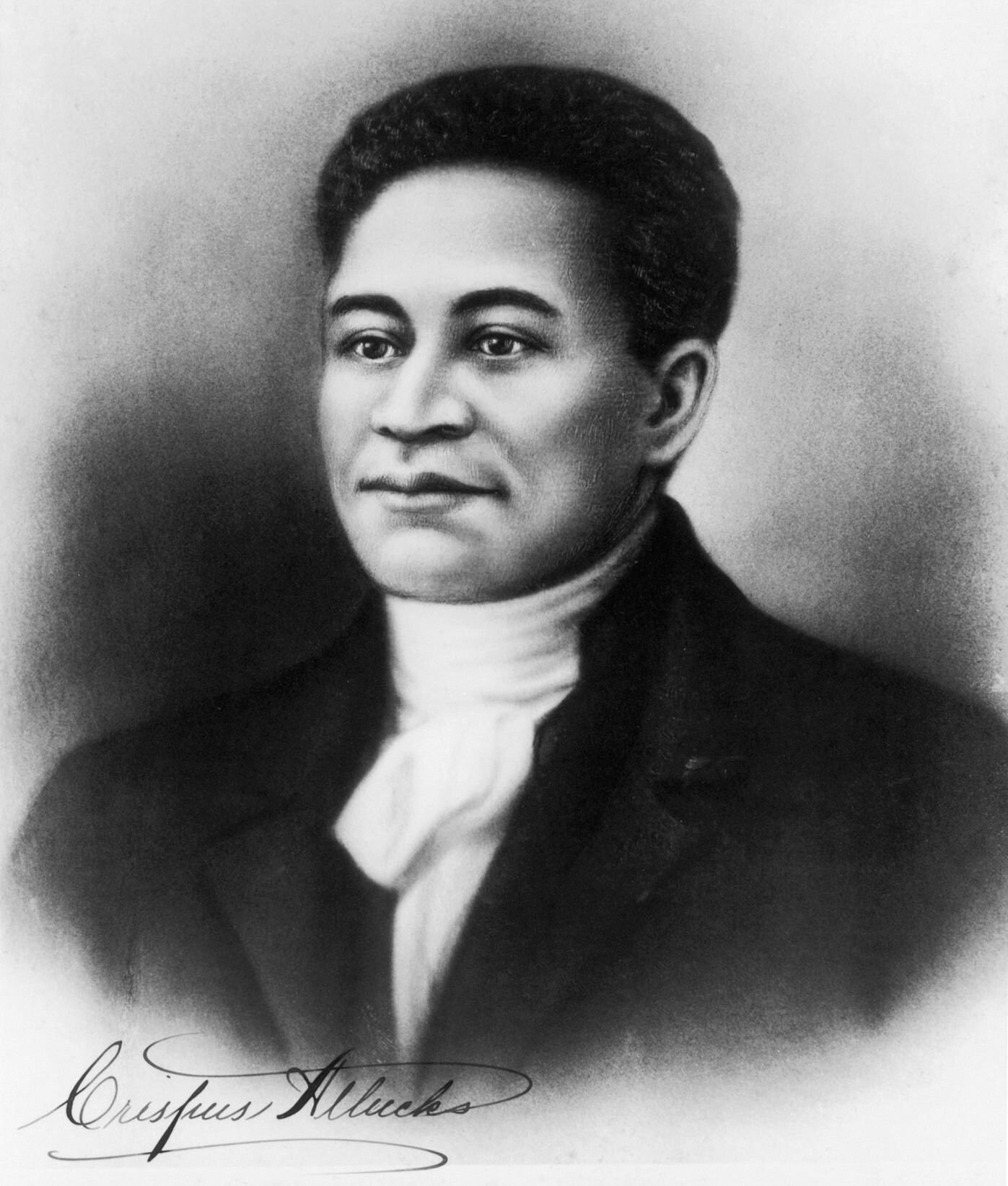
The discomfort around slavery became more pronounced with the onset of the Revolutionary War. After the British encouraged enslaved Black people to fight on the British side in exchange for their freedom, many of the 13 colonies countered that if enslaved people served in the Continental Army they could have their freedom. As a result, thousands of Black soldiers fought alongside White colonists in the Continental Army. In fact, Crispus Attucks, a man of African and Native background who had escaped from slavery, was the first person killed in the American Revolution. The active involvement of Black soldiers, fighting alongside the colonists, weakened support for slavery. As historian Leslie Harris details, “the Revolutionary War became a primary disrupter of slavery in the North American Colonies.”21 Indeed, the combined pressure between the resistance of enslaved people and their service as soldiers in the Continental Army helped to propel the end of slavery in northern colonies such as Vermont, Rhode Island, Massachusetts, and Pennsylvania.
WHO ARE AMERICANS?
Who Were the Framers of the Constitution?
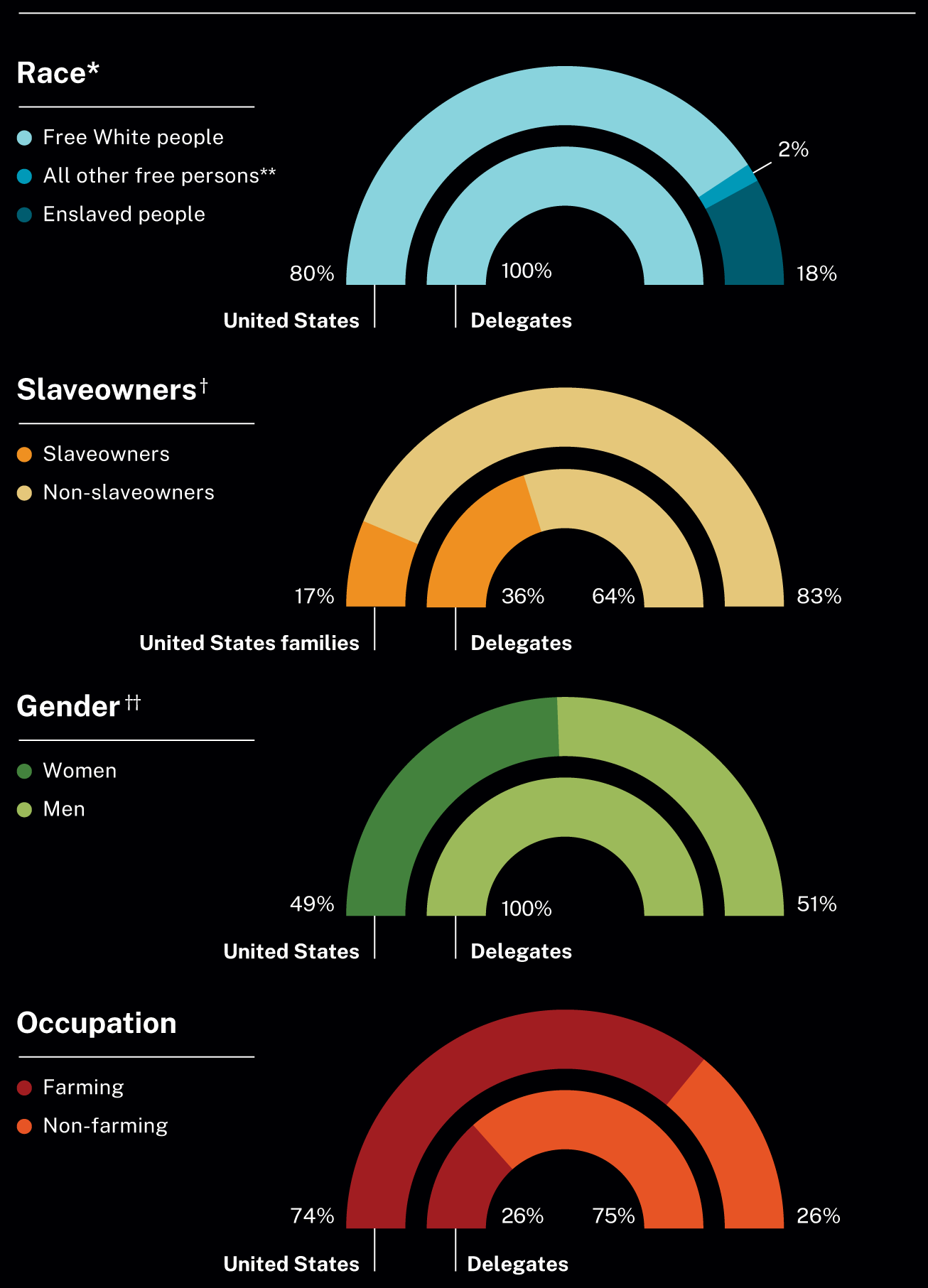
During the drafting and ratification of the Constitution, the demographics of the framers were quite different in comparison to the overall population of the United States. The 55 delegates to the 1787 Constitutional Convention were all White and male, whereas the American people were more diverse. The contrast between who was writing and designing the Constitution (a document that emphasized freedom, equality, and justice) and the composition of the U.S. population overall illustrates the contradictions in American political life and provides the foundation for conflicts and debates we have seen throughout American history.
The Delegates to the Constitutional Convention (1787) and the U.S. Population (1790)
More information
A Who Are Americans? infographic. Graphics compare makeup of The Delegates to the Constitutional Convention of 1787 with the U.S. Population in 1790, with regard to race, slaveowning status, gender, and occupation. The population was 80% free whites, 2% other free persons, and 18% enslaved persons. The convention delegates were all free whites. Slaveowners represented 17% of the general population but 36% of the convention delegates. The population was 51% male, but all convention delegates were male. Farming was the occupation of 74% of the population but only 26% of the convention delegates. NOTES: The 1790 census had no category to count Native peoples living in the general population, even though an estimated 600,000 Native peoples lived in the United States. The 1790 census defined “all other free persons” as free Black people, people of mixed race, and a small number of Native peoples who lived among White people. For this graphic, slaveowning delegates are delegates who owned slaves at the time of the 1787 Constitutional Convention. The 1790 census only recorded gender data for the White population.
SOURCES: 1790 census, full data tables, p. 4: www.census.gov/library/publications/1793/dec/number-of-persons.html; Russell Thornton, American Indian Holocaust and Survival: A Population History Since 1492 (University of Oklahoma Press, 1990); Dorothy S. Brady, ed., “Output, Employment, and Productivity in the United States after 1800,” NBER, 1966.
* The 1790 census had no category to count Native peoples living in the general population, even though an estimated 600,000 Native peoples lived in the United States.
** The 1790 census defined “all other free persons” as free Black people, people of mixed race, and a small number of Native peoples who lived among White people.
† For this graphic, slaveowning delegates are delegates who owned slaves at the time of the 1787 Constitutional Convention.
†† The 1790 census only recorded gender data for the White population.
NOTE: Numbers may not add up to 100 percent due to rounding.
FOR CRITICAL ANALYSIS
Compare the demographic data of the framers of the Constitution with the overall population data from the time. Do these data confirm or contradict what you know about the framers? Use the data to explain your answer.
Do you think the Constitution would be different if the framers were more representative of the population? How so? How well did the framers of the Constitution represent the people?
More information
A black and white drawing of Crispus Attucks. He wears a formal coat over a white formal shirt and cravat.
Crispus Attucks, a man of Native and African descent, is considered to be the first person killed by British forces in the American Revolution.
As the 13 states moved from the end of the Revolutionary War into the process of drafting a new constitution, the Founders faced a nation divided over slavery.22 Many of the conflicts that emerged during the Constitutional Convention reflected fundamental differences between southern and northern states related to slavery. From an economic perspective, southerners wanted to protect slavery, and while it made northerners uneasy, many of them benefited from investments in the institution of slavery. From a moral perspective, the issue was more complicated. There was widespread acknowledgment that slavery was incompatible with democratic principles and should not be legitimized in the Constitution. Even southern delegates such as James Madison from Virginia, who owned over 100 enslaved Black people, argued that the slave trade was “dishonorable to the National character.” Embarrassment about protecting the institution of slavery led to the omission of the words “slavery” and “slave” from the Constitution. Despite this, constitutional experts have drawn attention to two important provisions related to slavery: the Three-Fifths Compromise and the extension of the slave trade.
Three-Fifths Compromise
Slavery was at the center of the debate about representation in the House of Representatives. More than 90 percent of the country’s enslaved people lived in five states (Georgia, Maryland, North Carolina, South Carolina, and Virginia), where they accounted for 30 percent of the total population. Delegates from these states wanted enslaved people to be counted as free persons for the purposes of determining representation in the House of Representatives. Were they to be counted as part of a state’s population even though they weren’t citizens, thereby giving southern states increased representation in the House?
While delegates from the northern states held a range of opinions about the morality of slavery, most opposed counting the population of enslaved people in the apportionment of congressional seats. James Wilson of Pennsylvania, for example, argued that if enslaved people were counted for this purpose, other forms of property should be as well. But southern delegates insisted they would never agree to the new government if the northerners refused to give in. Northerners and southerners eventually reached agreement through the Three-Fifths Compromise: seats in the House of Representatives would be apportioned according to a “population” in which only “three-fifths” of enslaved people would be counted (Article 1, Section 2). As a result, the southern states gained added influence in the House of Representatives, but not as much as they wanted and not as much as the northern states feared. The Three-Fifths Compromise would remain in effect until the Fourteenth Amendment repealed it in 1868.
More information
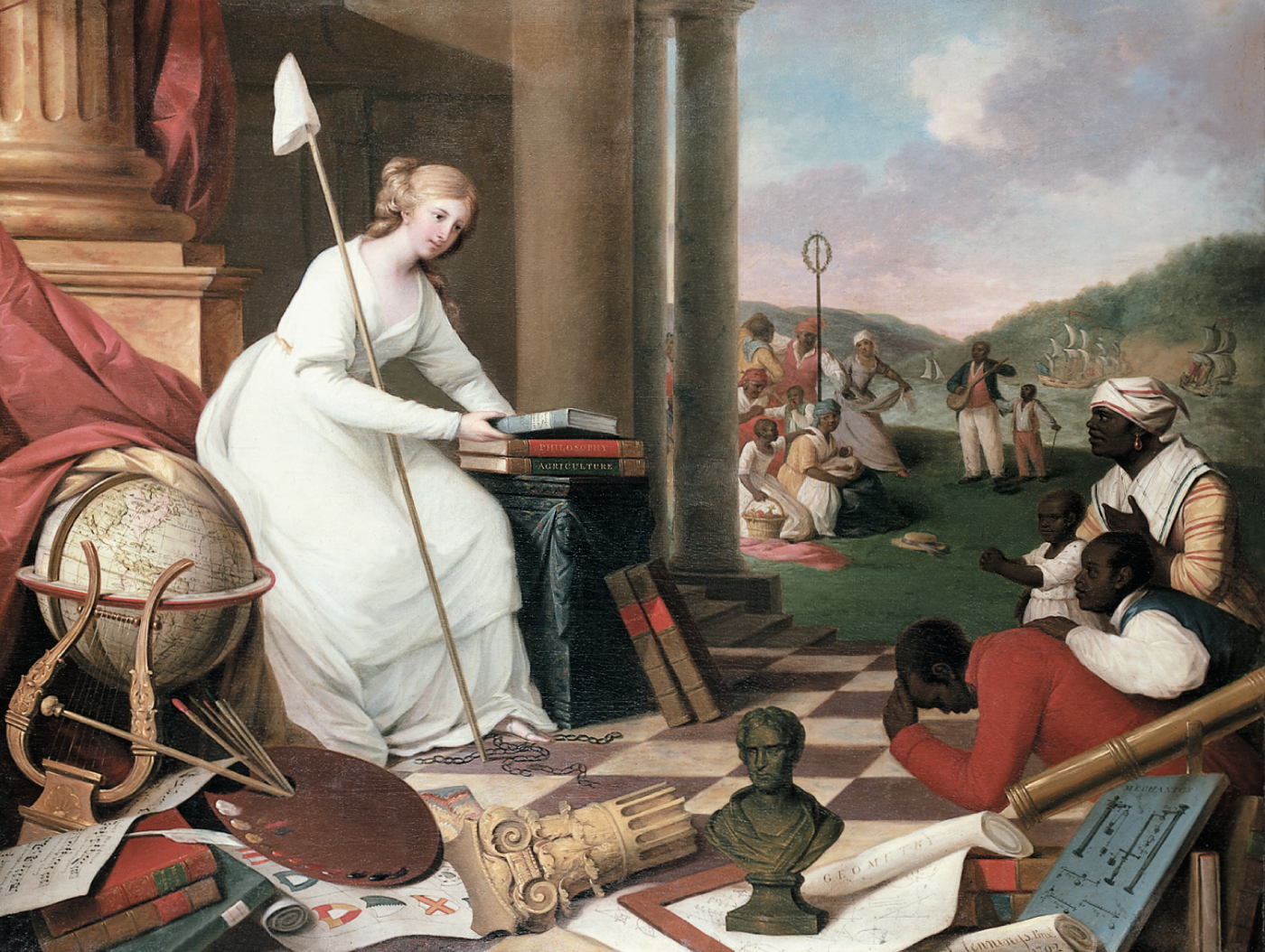
A painting shows a group of slaves looking upon Lady Liberty, who is sitting amidst books, a globe, and other symbols of antiquity. She is lifting a book as if preparing to instruct the slaves.
Despite the Founders’ emphasis on liberty, the new Constitution allowed slavery, counting three-fifths of all enslaved people in apportioning seats in the House of Representatives. In this 1792 painting, Liberty Displaying the Arts and Sciences, the books, instruments, and classical columns at the left contrast with the kneeling enslaved people at the right—illustrating the divide between America’s rhetoric of liberty and equality and the reality of slavery.
Extension of the Slave Trade
After the issue of representation was resolved, the question arose of how long the trade of enslaved Africans would continue. The slave trade was violent. It involved forcibly removing people from their African homelands (often tearing them from their families), transporting them across the Atlantic Ocean in brutal, inhumane conditions, selling those who survived in slave auctions, and threatening them with violence and death if they attempted to escape. Many delegates were appalled at the idea of accommodating an extension of the slave trade in the new Constitution; others considered it key to their future economic livelihood. In hopes of protecting their economic interests, the South Carolina delegates proposed to ban the federal government from regulating the importation of enslaved Africans.
At the time of the Convention, 10 states had already outlawed the importation of African captives. Delegates from these states objected to the South Carolina proposal, which would have allowed the transatlantic slave trade to continue indefinitely. Referring to the slave trade, delegate Luther Martin considered it “dishonorable to the American character to have such a feature in the Constitution.”23 In the end, protecting the slave trade proved pivotal to keeping the union intact. Delegates from the three states where it was legal—Georgia, North Carolina, and South Carolina—threatened to walk out of the Convention if the Constitution banned it. To keep these states in the union, a deal was struck whereby the trade or “importation” of enslaved Black people was allowed to continue uninterrupted for another 20 years (Article 1, Section 9, Clause 1). As part of this compromise, the federal government was granted increased authority to tax the imports of enslaved Africans.
Slavery was one of the most complicated issues the framers faced, and it nearly destroyed the Union. Despite good intentions, the compromises the Founders made at the Constitutional Convention around slavery have had lasting consequences. First, by allowing the slave trade to continue, the Constitution entrenched and protected a dehumanizing institution that violated the liberties of Black people. According to a new study, more than 1,700 men who served in the U.S. Congress in the eighteenth and nineteenth centuries owned enslaved Black people.24 Second, it wove white supremacy into the fabric of the new nation, solidifying a system of racial hierarchy that is still in the process of being unraveled (this will be discussed more in Chapter 5). Even Madison acknowledged: “The institution of slavery and its consequences form the line of discrimination.”25 The compromises over slavery demonstrate the importance of racial issues to the founding of the United States and the American political experience.
the agreement reached at the Constitutional Convention of 1787 that gave each state an equal number of senators regardless of its population but linked representation in the House of Representatives to population
the agreement reached at the Constitutional Convention of 1787 that stipulated that for purposes of apportioning congressional seats only three-fifths of enslaved people would be counted
Endnotes
Quoted in Samuel Eliot Morrison, Henry Steele Commager, and William Edward Leuchtenburg, The Growth of the American Republic, 5th ed. (New York: Oxford University Press, 1962), 242.Return to reference 19
Peter H. Wood, Black Majority: Negroes in Colonial South Carolina from 1670 through the Stono Rebellion (New York: W. W. Norton, 1996); Sylvia R. Frey, Water from the Rock: Black Resistance in a Revolutionary Age (Princeton, NJ: Princeton University Press, 2020).Return to reference 20
Leslie Harris, “I Helped Fact-Check the 1619 Project. The Times Ignored Me,” Politico, March 6, 2020, www.politico.com/news/magazine/2020/03/06/1619-project-new-york-times-mistake-122248 (accessed 11/2/21).Return to reference 21
Alfred F. Young, Ray Raphael, and Gary Nash, eds., Revolutionary Founders: Rebels, Radicals, and Reformers in the Making of the Nation (New York: Vintage, 2011).Return to reference 22
James Madison, Notes on the Debates in the Federal Convention of 1787, https://avalon.law.yale.edu/subject_menus/debcont.asp (accessed 11/1/21).Return to reference 23
Julie Zauzmer and Adrian Blanco, “More than 1,700 Congressmen Once Enslaved Black People. This Is Who They Were, and How They Shaped the Nation,” Washington Post, January 10, 2022, www.washingtonpost.com/history/interactive/2022/congress-slaveowners-names-list/?itid=hp-top-table-main (accessed 1/11/22).Return to reference 24
James Madison, Madison Debates, July 14, 1787, https://avalon.law.yale.edu/18th_century/debates_714.asp (accessed 11/2/21).Return to reference 25