Chapter 2
Culture
More information
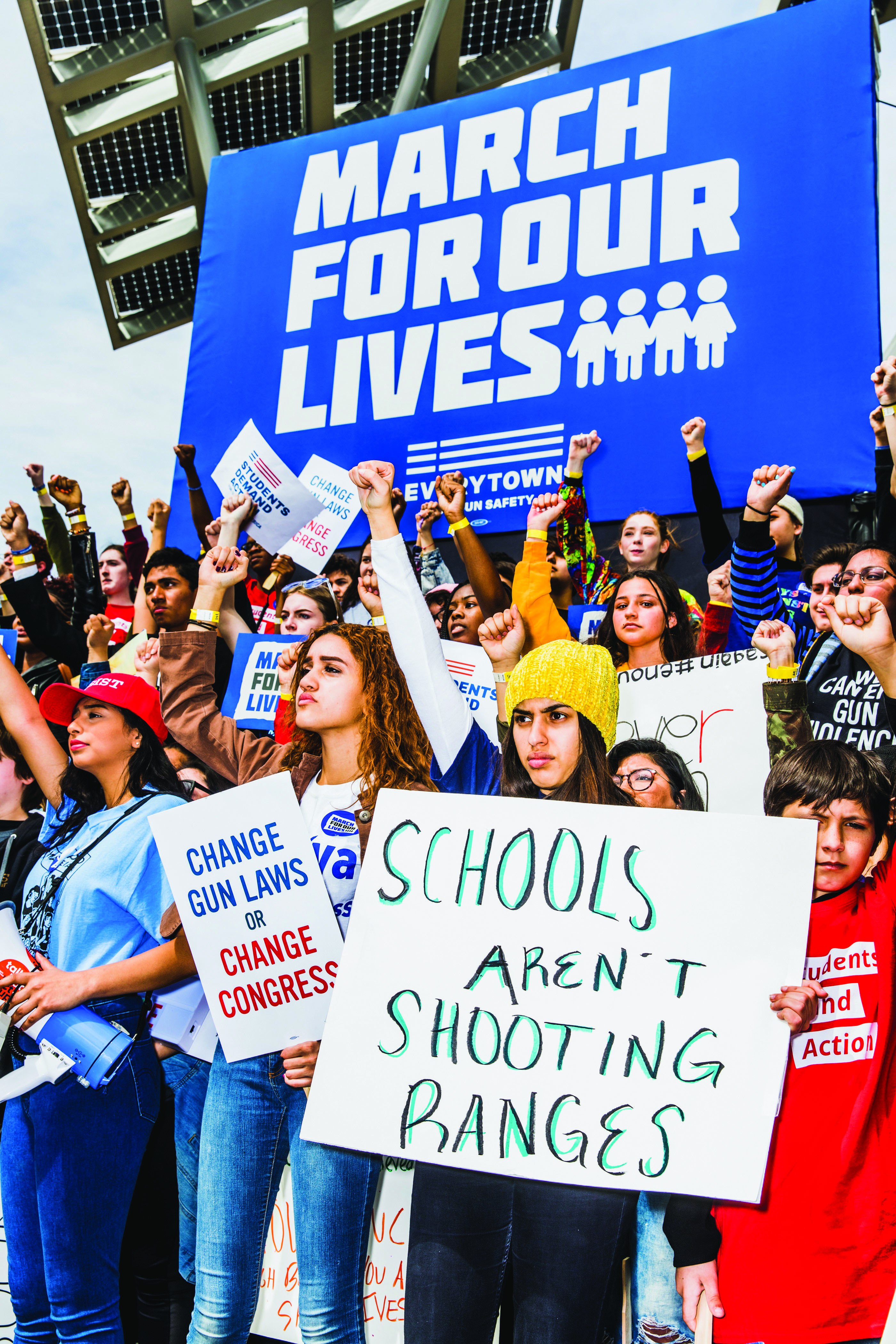
Students in Las Vegas, Nevada, demand tougher gun laws after the fatal 2018 school shooting in Parkland, Florida. As anthropologists, how do we understand gun culture in the United States?
Early in the afternoon of February 14, 2018, a nineteen-year-old former student walked into Marjory Stoneman Douglas High School in Parkland, Florida, pulled the fire alarm and began shooting. He fired continuously for six minutes. Seventeen students and staff were killed.
Alyssa Alhadeff, age 14. Scott Beigel, 35. Martin Duque, 14. Nicholas Dworet, 17. Aaron Feis, 37. Jaime Guttenberg, 14. Chris Hixon, 49. Luke Hoyer, 15. Cara Loughran, 14. Gina Montalto, 14. Joaquin Oliver, 17. Alaina Petty, 14. Meadow Pollack, 18. Helena Ramsay, 17. Alex Schachter, 14. Carmen Schentrup, 16. Peter Wang, 15.
Seventeen more were injured.
The young gunman set down his AR-15-style semi-automatic rifle made by Smith and Wesson Corporation, along with multiple ammunition clips, and blended in with the hundreds of students fleeing the campus.
This was the twenty-fifth fatal school shooting in the 20 years since the massacre at Columbine High School in Colorado gripped the nation in 1999. Said one Parkland student, “For our generation, it’s not a question of if there will be a shooting, but when.”
Americans own an estimated 400 million firearms for a population of 320 million people, more than double the ratio per capita of any country in the world. Forty percent of households and thirty percent of individuals own guns. In 2015 the U.S. Centers for Disease Control reported 36,252 deaths by firearms, including 22,018 suicides and nearly 14,000 homicides. Since 1968, the year statistics began to be recorded, there have been 1,516,863 gun-related deaths on U.S. territory, more than in all the wars in U.S. history.
As anthropologists, how do we understand the roots of American gun culture? A device designed to penetrate and rip apart flesh at a distance has become more than its component parts. Owners say they buy guns for protection, hunting and sports. For some men, hunting together is an outdoor tradition, an expression of their masculinity, and a kind of social glue connecting generations of men and families and communities. But when we look at the victims of gun violence we see that guns disproportionately take the lives of young people, poor people, and people of color.
In the aftermath of the Marjory Stoneman Douglas High School shooting, survivors and students began to organize. While many politicians offered their thoughts and prayers and the National Rifle Association mobilized to defend gun rights, MSD students demanded legislative action on gun safety measures. They marched, organized, lobbied, and generated a mass movement on social media, #NeverAgain. Never Again MSD pushed the Florida legislature to raise the minimum age to purchase a gun from eighteen to twenty-one, impose a waiting period and require a background check. Students across the country walked out of classes, demanding action. And on March 24, 2018, at March For Our Lives rallies across the country, student leaders pleaded for common sense gun control and to protect their lives.
Anthropologists work to understand complex and diverse human experiences. We conduct reasoned, careful research into people’s cultures, their norms, values, symbols, and ways of seeing the world. We carefully consider the cultural organizations people create to promote and sustain certain cultural norms and values. And we look at the strategies people use to challenge and renegotiate those norms. By the end of the chapter you will gain a new set of tools, both research strategies and analytical perspectives, to make sense of “senseless” gun violence in American culture and, if you choose, to engage this uniquely American cultural phenomenon to make your community, your country and your world safer.
In this chapter, we will apply an anthropologist’s viewpoint to culture and consider its crucial role in shaping how we behave and what we think. In particular, we will consider:
By the end of the chapter you should have a clear sense of how anthropologists think about culture and use culture to analyze human life. By exploring this seemingly familiar concept, you can become conscious of the many unconscious patterns of belief and action that you accept as normal and natural. You can also begin to see how such patterns shape your everyday choices and even your basic conceptions of what is real and what isn’t. By examining the rich diversity and complexity of human cultural expressions, you may also begin to grasp more fully the potential and possibilities for your own life.