Chapter 2
Culture
More information
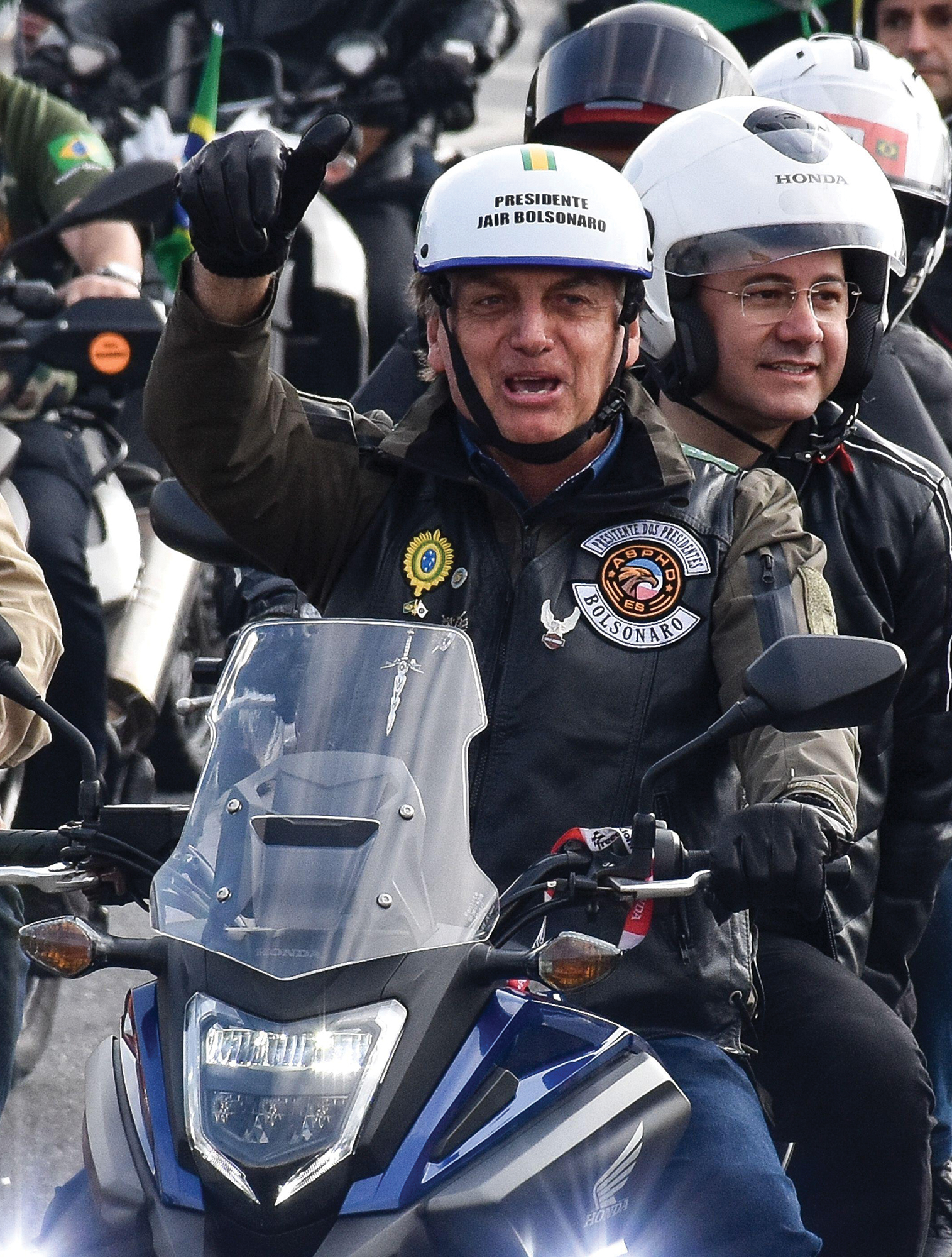
Brazilian President Jair Bolsonaro leading a group of motorcycle drivers. He’s wearing a decorated black jacket, gloves, and a white helmet with the Brazilian flag and “Presidente Jari Bolsonaro” written on it. His right thumb is pointed up in the air.
Learning Objectives
How did a simple piece of fabric—a face mask—become a cultural battlefield?
The international scientific and medical community considers wearing a face mask to be one of the simplest and most effective ways that people can avoid respiratory infections and reduce their risk of infecting others. But during the global COVID-19 pandemic, in countries like Brazil, the United Kingdom, Mexico, and the United States, masks became highly symbolic and highly politicized. In June 2021, Brazilian president Jair Bolsonaro, maskless and waving to the crowds, led a throng of 12,000 anti-mask motorcyclists on a ride through the streets of São Paulo. From atop a sound truck in the city’s Ibirapuera Park, Bolsonaro spoke to a largely unmasked (but helmeted) audience to denounce the use of masks among vaccinated people, an assertion disputed by public health experts.
Brazil has struggled to fight off the coronavirus. Low vaccination rates and limited vaccine availability have combined with Bolsonaro’s efforts to minimize the dangers of COVID-19 to create the third highest infection and death rates in the world, behind only those of the United States and India. Still, Bolsonaro and local Brazilian politicians have fought over what restrictions might best protect the country’s population. After Bolsonaro’s motorcycle ride and speech in the city park, the city of São Paulo fined him the equivalent of $110. São Paulo requires mask wearing in public spaces, even by a president.
The coronavirus relies on human behavior to spread. After initial COVID-19 outbreaks in 2020, and before the introduction of vaccines, countries like Italy, France, Germany, Hong Kong, South Korea, Senegal, Liberia, Rwanda, and New Zealand successfully employed social distancing, hand washing, isolation contact tracing, and mask wearing to curb the virus’s spread. Hong Kong residents, familiar with managing infectious disease outbreaks, quickly and uniformly donned masks and maintained social distance long before their government imposed mandates to do so. Over the first five months of the pandemic, the densely populated city of 7.5 million had a total of 4,300 infections and only sixty-three deaths. In contrast, New York City, population 8.8 million, with no previous mask-wearing experience, delayed its mask mandate for a month during the peak of its infections and deaths. During its first five months up against the virus, the city suffered 233,000 infections and 23,602 deaths. In these cases, different cultural attitudes toward mask wearing, among other factors, had a significant impact on infection rates and deaths.
Today in the United States, most Americans have adopted regular mask wearing to protect against the spread of COVID-19 and its variants. Yet despite ongoing community transmission, a vocal minority continues to reject this simple, effective tool: They refuse to wear masks in stores, bars, and churches; march in protests and attend political rallies without them; demand to send their unvaccinated children to school without them; and shout at one another to put them on or take them off. As anthropologists, we might consider how meanings associated with masks have shifted so quickly. Before COVID-19, masks in the United States were often associated with tough guys, bandits, bank robbers, construction workers, professional wrestlers, dentists, and surgeons. How did masks become items of contestation about values like masculinity, femininity, freedom, individualism, liberty, strength, weakness, collective responsibility, and care for family? How did a core value like freedom become associated with the expression of individual liberties rather than a commitment to public health and a collective effort to keep everyone free from the virus during the pandemic?
Anthropologists work to understand complex and diverse human behaviors and experiences. We conduct reasoned, careful research into people’s cultures, norms, values, symbols, and ways of seeing the world. We carefully consider the cultural organizations people create to promote and sustain certain cultural norms and values. And we look at the strategies people use to challenge and renegotiate those norms. This chapter will give you a new set of tools—both research strategies and analytical perspectives—to make better sense of the mask battles in the United States and cultures around the world; to recognize how powerful cultural institutions like governments, political parties, public health officials, the media, religion, schools, and the family have been working to establish and contest the meanings of masks; and, if you choose, to engage with this cultural phenomenon to make your community, your country, and your world safer.
In this chapter, we will apply an anthropologist’s perspective to culture and consider its crucial role in shaping how we behave and what we think. In particular, we will consider:
- What is culture?
- How has the culture concept developed in anthropology?
- How are culture and power related?
- How much of who you are is shaped by biology, and how much by culture?
- How is culture created?
- How is globalization transforming culture?
By the end of this chapter, you should have a clear sense of how anthropologists think about culture and use culture to analyze human life. By exploring this seemingly familiar concept, you can become conscious of the many unconscious patterns of belief and action that you accept as normal and natural. You can also begin to see how such patterns shape your everyday choices and even your basic conceptions of what is real and what isn’t. By examining the rich diversity and complexity of human cultural expressions, you may also begin to grasp more fully the potential and possibilities for your own life.