Chapter 3
Fieldwork and Ethnography
More information
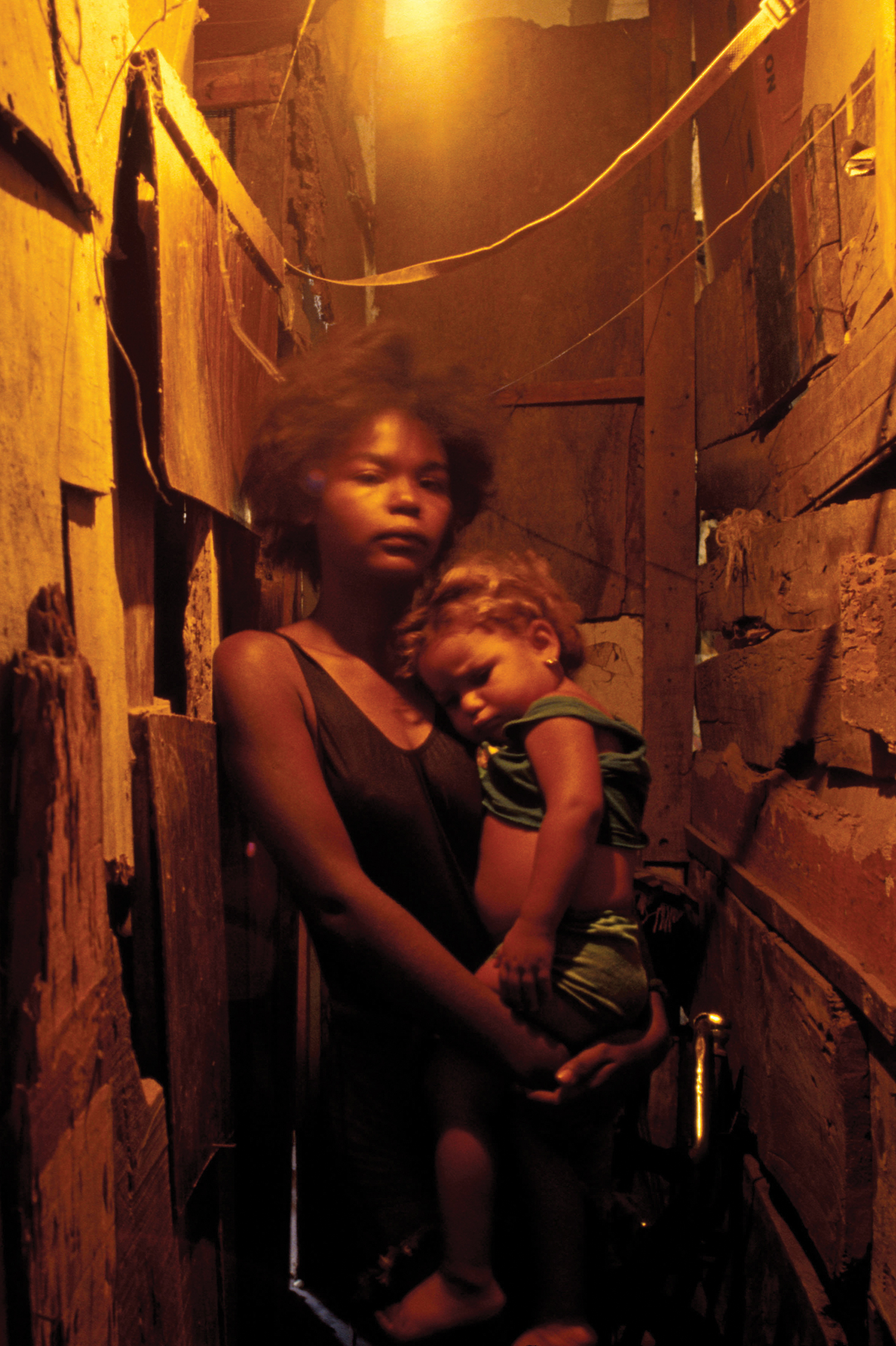
A young mother holding her toddler in her arms. They are standing in a dimly lit shack made from old wooden boards.
Learning Objectives
Over many years, anthropologist Nancy Scheper-Hughes invested herself in trying to understand the lives of the women and children of one particular shantytown in Brazil. Her research resulted in numerous articles and an award-winning ethnography, Death Without Weeping: The Violence of Everyday Life in Brazil (1992). Scheper-Hughes’s efforts reflect the deep commitment of anthropologists to ethnographic fieldwork—a research strategy for understanding the world through intense interaction with a local community of people over an extended period.

More information
South America is labeled. Brazil is highlighted and labeled.
Scheper-Hughes first arrived in Brazil’s Alto do Cruzeiro (Crucifix Hill) in 1965 as a Peace Corps volunteer to assist in community development and health promotion. That year, a severe drought had created food and water shortages, and a military coup had spread political and economic chaos throughout the country. In the Alto, more than 350 babies died in 1965 out of a total population of a little more than 5,000. Scheper-Hughes later wrote, “There were reasons enough for the deaths in the miserable conditions of shanty-town life. What puzzled me was the seeming indifference of Alto women to the death of their infants and their willingness to attribute to their own tiny offspring an aversion to life that made their deaths seem wholly natural, indeed all but anticipated” (1989, 10).
This puzzle crystallized her research agenda as she returned to the Alto many times over the ensuing years to conduct ethnographic fieldwork. Scheper-Hughes found that it was possible to reduce diarrhea and dehydration-induced death among infants and toddlers in the shantytown with a simple solution of sugar, salt, and water. But it was more difficult to convince a mother to rescue a child she perceived as likely to die, a baby she already thought of as “an angel rather than a son or daughter.” The high expectancy of death led mothers to differentiate between infants whom they saw as “thrivers and survivors” and those seen as born already “wanting to die.” Scheper-Hughes found that in this environment, part of learning to be a mother was learning which babies to let go of and which ones it was safe to love.

More information
A black and white image of a young boy standing with his hands placed on a wooden cross marking a grave. There are two other people and two little girls standing behind him.
Scheper-Hughes’s experience in the Alto led her to rethink “mother love.” What does the idea of mother love mean in the impoverished context of Alto do Cruzeiro?
Scheper-Hughes suggests that Alto women were doing what must be done given their context, where the real dangers were “poverty, deprivation, sexism, chronic hunger, and economic exploitation.” Reflecting on this high-risk environment, she asks, “If mother love is, as many psychologists and some feminists believe, a seemingly natural and universal maternal script, what does it mean to women for whom scarcity, loss, sickness, and deprivation have made that love frantic and robbed them of their grief, seeming to turn hearts to stone?” (1989, 14).
Their experience, suggests Scheper-Hughes, compares more aptly to a battlefield or an overcrowded emergency room where actions are guided by the practice of triage—prioritizing the treatment of those who can be saved. “In their slowness to anthropomorphize and personalize their infants, everything is mobilized so as to prevent maternal overattachment and, therefore, grief at death. The bereaved mother is told not to cry, that her tears will dampen the wings of her little angel so that she cannot fly up to her heavenly home” (16). Scheper-Hughes suggests that in these difficult conditions, Alto women are left with no choice but to find the best way to carry on with their lives and nurture those children who have the best chance of survival.
What can you learn about fieldwork by reading about Scheper-Hughes’s research? A middle-class woman from the United States, Scheper-Hughes traveled to one of the poorest places in the world, learned the language, lived in the community, built relationships of trust, accompanied local people through the births and deaths of their children, and searched for meaning amid the pain. As you might imagine, the fieldwork experience can become more than a strategy for understanding human culture. Fieldwork has the potential to radically transform the anthropologist. Can you imagine making the same commitment Scheper-Hughes did?
The term fieldwork implies going out to “the field” to do extensive research. Although in the history of anthropology this has often meant going a long way from home, as Scheper-Hughes did, contemporary anthropologists also study human culture and activities in their own countries and local contexts. By exploring the practice of fieldwork, you will gain a deeper understanding of how anthropologists go about their work. In particular, in this chapter we will consider:
- What is unique about ethnographic fieldwork, and why do anthropologists conduct this kind of research?
- How did the practice of fieldwork develop?
- How do anthropologists get started conducting fieldwork?
- How do anthropologists write ethnography?
- What moral and ethical concerns guide anthropologists in their research and writing?
- How have fieldwork strategies changed in response to globalization?
By the end of the chapter, you will see both how professional anthropologists employ fieldwork strategies and how fieldwork can provide a valuable toolkit for gathering information to make decisions in your own life. Fieldwork skills and strategies can help you navigate the many unfamiliar or cross-cultural experiences you will encounter at work or school, in your neighborhood, or in your family. And hopefully you will see how key fieldwork strategies can help you become a more engaged and responsible citizen of the world.