THE PERSON-SITUATION DEBATE
Whether or not it violates your intuition to claim that behavior is so inconsistent that, for all intents and purposes, personality traits do not exist, an argument about just this point occupied a large number of personality psychologists for more than two decades, and the argument continues to simmer under the surface of modern personality psychology. The person-situation debate focuses on this question: Which is more important for determining what people do: the person or the situation (Figure 4.1)?

More information
A photo shows a man in a road blocking the path of 4 military tanks.
To a considerable degree, the debate was triggered by the publication in 1968 of a book by Walter Mischel entitled Personality and Assessment.4 The book was a landmark in the history of personality psychology because it cut to the core of the most fundamental question about personality: How important is it? Mischel’s answer was, not much, because behavior is too inconsistent to allow individual differences to be characterized accurately in terms of global personality traits. Other psychologists including, not surprisingly, those who were heavily invested in the technology and practice of personality assessment emphatically disagreed. Thus began the person-situation debate.
Ordinarily, arguments among psychologists are one of the things I am trying to spare you in this book. I would rather teach you about psychology than about what psychologists do, much less what they argue about. But I hope to convince you that this one is different. It is not just an undue commotion over a technical point, as arguments among specialists so often are, nor is it even one of those issues that we can simply settle and then move beyond. Rather, the consistency controversy goes to the heart of how everybody thinks about people and has important implications for understanding individual differences and the bases of important life outcomes.
The belief that behavior is largely driven by the situation, and that personality is relatively unimportant, is sometimes called “situationism” (Bowers, 1973). Stripped to its essentials, the situationist argument has three parts:
- There is an upper limit to how well one can predict what a person will do based on any measurement of that person’s personality. This upper limit is a low upper limit.
- Therefore, situations are more important than personality traits.
- Therefore, not only is the professional practice of personality assessment a waste of time, but also everyday intuitions about people are wrong, because people see others as being more consistent across situations than they really are. The “fundamental attribution error” is to believe that behavior is importantly influenced by personality (Ross & Nisbett, 1991).
Strong stuff! But each of these claims wilts a bit under closer scrutiny.
Predictability
THE SITUATIONIST ARGUMENT
The definitive test of the usefulness of a personality trait is whether it can be used to predict behavior. If you know somebody’s level or score on a trait, you should be able to forecast what that person will do. Situationists argue that this predictive capacity is severely limited.
In psychological research, predictability and consistency are indexed by the correlation coefficient. As you will recall from Chapter 3, this is a number that ranges from +1 to –1 that indexes the association or relationship between two variables, such as a personality score and a behavioral measurement. If the correlation is positive, it means that as one variable increases, so does the other: The higher someone’s “sociability” score is, the more parties this person is likely to attend. If the correlation is negative, it means that as one variable increases, the other decreases: The higher someone’s “shyness” score is, the fewer parties the person is likely to attend. Both positive and negative correlations imply that one variable can be predicted from the other. But if the correlation is near zero, it means the two variables are unrelated; perhaps scores on this particular sociability test have nothing to do with how many parties one attends.
The basis of the argument that personality traits don’t matter was the claim that correlations between personality and behavior, or between behavior in one situation and behavior in another, seldom exceed .30, or at most .40 (Mischel, 1968; Nisbett, 1980). The implication is that such correlations are so small that personality traits don’t matter.
THE RESPONSE
The first counterargument that defenders of personality made was that the .30 or .40 estimate of the correlation between personality and behavior is lower than would be shown if all the evidence were considered. After all, the relevant research literature goes back more than 80 years and contains literally thousands of studies.
This is a difficult point to prove or disprove, however. One complication is that some people might be more consistent than others, especially those who prefer to be consistent (Guadagno & Cialdini, 2010) (Try for Yourself 4.1). Another complication is that some behaviors might be more consistent than others. Elements of expressive behavior, such as how much a person gestures or how loudly a person talks, are likely to be consistent across situations, whereas more goal-directed behaviors, such as trying to impress someone, are more likely to depend on the situation (Funder & Colvin, 1991; see also Allport & Vernon, 1933).
TRY FOR YOURSELF 4.1

The picture clears a bit if the focus shifts from single actions to general behavioral trends. Do you remember the meter sticks that illustrated the idea of aggregation in Chapter 3? Just as my fellow high-school students and I sometimes placed our sticks too close together and sometimes too far apart, so, too, do behaviors of a person vary around their average level from occasion to occasion. Sometimes, because the situations you encounter in life vary, you are a little more assertive than usual, and sometimes less; sometimes you are shyer than usual, and sometimes less shy, and so on. This is why your average level of aggressive or shy behavior is more predictable than what you do in any particular moment or place; on average, variations around the mean tend to cancel out (Epstein, 1979).
The issue is more than just a matter of statistics. It concerns the whole meaning and purpose of judging personality traits. When you say that somebody is friendly or conscientious or shy, are you making a prediction of one specific behavior at one specific time, or are you saying something about how you expect the person to act in general, over the long haul (McCrae, 2002)? In most cases, I think, the answer is the latter. When you wish to understand someone, or need to select a roommate or an employee, it is not so critical to know what the person will do at a particular place and time because that will always depend on the specific circumstances at the moment. Rather, you need to know how the person will act, in general, across the various relevant situations of life.
These are important points to understand, but they still miss a more basic point.
A Correlation of .40 Is Not Small
Remember that to be impressed (or depressed) by the situationist critique of personality traits, you must believe two things: (1) A correlation of .40 represents the true upper limit to which one can predict behavior from personality or see consistency in behavior from one situation to another; and (2) this limit is a small upper limit. The discussion so far has concentrated on responses to point 1. But if you were to conclude that a correlation of .40 was not small in the first place (point 2), then the limit would cease to be so worrisome, and the force of the situationist critique would largely dissipate.
However, to evaluate whether a correlation of .40 is big or small or to assess any other statistic, you need a standard of comparison. Two standards are possible: absolute and relative. To evaluate this correlation against an absolute standard, you could calculate how many correct and incorrect predictions of behavior a trait measurement with this degree of validity would yield in a hypothetical context. To evaluate this correlation against a relative standard, you can compare this degree of predictability for personality traits with the accuracy of other methods used to predict behavior or other outcomes. Let’s do both.
An absolute evaluation of a .40 correlation can be obtained from a simple statistical tool called the Binomial Effect Size Display (BESD; Rosenthal & Rubin, 1982). I won’t go into details here (I encourage you to look up Rosenthal and Rubin’s article) but will go straight to the bottom line: According to the BESD, a correlation of .40 means that a prediction of behavior based on a personality-trait score is likely to be accurate 70 percent of the time (assuming a chance accuracy rate of 50 percent). Seventy percent is far from perfect, but it is enough to be useful for many purposes. For instance, an employer choosing an employee to put through an expensive training program could save money by being able to predict with 70 percent accuracy who will or will not be a successful employee at its conclusion.5
What about a relative standard? Well, what is the most appropriate basis for comparison when trying to evaluate the predictive ability of personality traits? Situationists, you will recall, believe that the situation, not the person, is all-important in the determination of behavior. To evaluate the ability of personality traits to predict behavior, therefore, it seems appropriate to draw a comparison with the ability of situational variables to predict behavior.
Early in our careers, my longtime colleague and friend Daniel Ozer and I conducted and published some very simple calculations (Funder & Ozer, 1983). We reconsidered three classic studies in social psychology, which demonstrated effects of the situation on attitude change, bystander intervention, and obedience (Darley & Latané, 1968; Festinger & Carlsmith, 1959; Milgram, 1975). In a nutshell, our finding was, going back to the original data, each of these effects could be calculated to have an effect size equivalent to a correlation of about .40 or less (Table 4.1).
Table 4.1 BEHAVIOR AS A FUNCTION OF THE SITUATION
|
Situational Variable |
Behavioral Variable |
Effect Size r |
|
Incentive |
Attitude change |
−.36 |
|
Hurry |
Helping |
−.39 |
|
Number of bystanders |
Helping |
−.38 |
|
Isolation of victim |
Obedience |
.42 |
|
Proximity of authority figure |
Obedience |
.36 |
Note: The negative sign of some correlations means those situational variables were inversely associated with behavior (e.g., people in more of a hurry were less likely to help someone in distress).
Sources: Festinger & Carlsmith (1959); Darley & Batson (1967); Darley & Latané (1968); and Milgram (1975). Adapted from Funder & Ozer (1983), p. 110.
When put on a common scale for comparison, the sizes of these and other effects of the person and of the situation are much closer than many had assumed. Indeed, a wide-ranging literature review concluded that the typical size of a situational effect on behavior, in a social psychological experiment, corresponds to r = .21,6 noticeably lower than the average of the three studies Dan Ozer and I reanalyzed (Richard et al., 2003). The difference is not surprising. The studies that we chose were classics, after all. And such effect sizes—or smaller—are typical of many other important findings (Table 4.2). Correlations outside the realm of psychology can also be illuminating. For example, consider the correlation between a weather station’s elevation above sea level and its average daily temperature. As everyone knows, it tends to be cooler at higher elevations. The actual correlation between these variables is r = –.34 (Meyer et al., 2001, p. 132). In this light, calling a correlation of .40 a “personality coefficient” loses a little of its pejorative edge.
Table 4.2 EFFECT SIZES OF SOME IMPORTANT RESEARCH FINDINGS
|
Finding |
Effect Size (r) |
|
People are aggressive when they are in a bad mood. |
.41 |
|
More credible individuals are more persuasive. |
.10 |
|
Scarcity increases the value of a commodity. |
.12 |
|
People attribute failures to bad luck. |
.10 |
|
People behave as others expect them to behave. |
.33 |
|
Members of a group influence one another. |
.33 |
|
Married people report higher life satisfaction than others. |
.14 |
|
People are likely to help others when they are in a good mood. |
.26 |
|
People usually prefer their own group to other groups. |
.35 |
|
Boys are more competitive than girls. |
.03 |
|
Women smile more than men. |
.23 |
Source: Richard et al. (2003), pp. 353–363.
Absolute Versus Relative Consistency
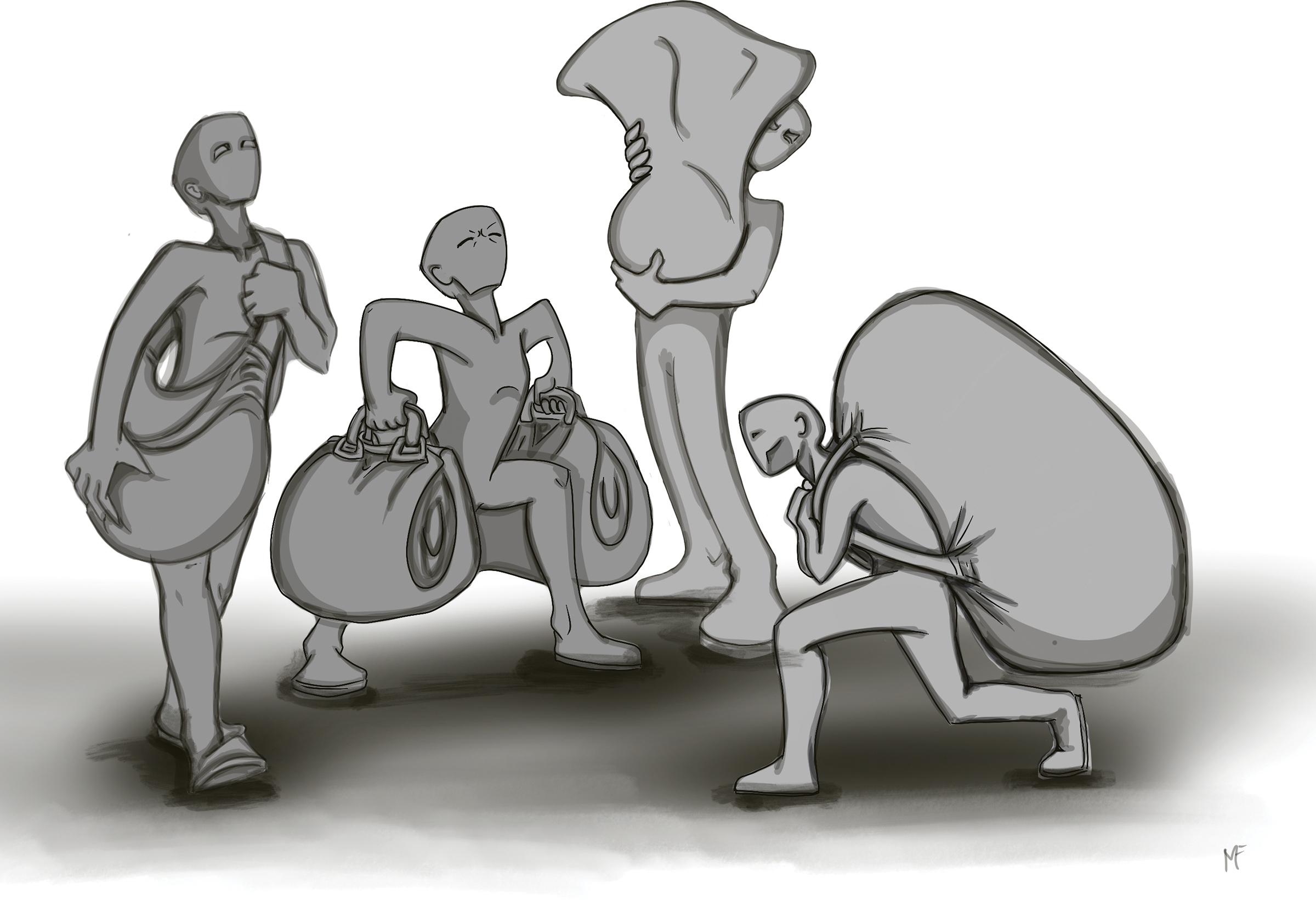
Without a doubt, people change their behavior from one situation to the next. This obvious fact is sometimes paired with the misunderstanding that personality consistency somehow means “acting the same way all the time.” But that’s not what it means at all. Almost everybody will be more talkative at a party than when standing in line at the Department of Motor Vehicles (DMV). But the most talkative person at the party will probably also be the most talkative person at the DMV (see Funder & Colvin, 1991). In this way personality manifests relative consistency rather than absolute consistency (Fleeson & Law, 2015). As was pointed out at the beginning of this chapter, the concept of the personality trait involves individual differences.
More information
A cartoon shows four figures carrying heavy baggage.
Both everyday experience and any fair reading of the research literature make one conclusion abundantly clear: When it comes to personality, one size does not fit all. Even when they are all in the same situation, some individuals will be more sociable, nervous, talkative, or active than others. And when the situation changes, those differences will still be there (Funder & Colvin, 1991). You may travel the world, but your personality is the baggage you will always have with you.
Now we are ready to consider the third and perhaps most important part of the situationist argument.
Are Person Perceptions Fundamentally Mistaken?
Recall the argument that the ability of personality variables to predict behavior is limited, if not nonexistent; that situations are much more important; and that people’s everyday perceptions of one another, which consist to a large degree of judgments of personality traits, are therefore largely erroneous, or even “fundamentally” mistaken (Ross & Nisbett, 1991). Now that we have dealt with the first two parts of this argument, the third falls of its own weight. The effects of personality on behavior do seem sufficient to be perceived accurately. Despite the situationist critique, human intuitions about personality are entirely reasonable. And you can find these intuitions enshrined in language.
The 17,953 trait terms in the English language, and the similar terms that can be found in many other languages, arose because personality traits are important everywhere, and languages develop words as they are needed to describe what matters. Consider the Indigenous Peoples of northern Canada and snow. It has long been noted that their languages have many more words to describe snow than do languages that arose in warmer climes (H. H. Clark & Clark, 1977; Whorf, 1956).7 Snow matters a lot in northern Canada; you build shelters from it, travel across it, use it as a source of water, and so forth. (Skiers also have a specialized vocabulary for types of snow.) The need to discriminate between many different kinds of snow has led to the development of words to communicate and think better about this important topic.
The same thing seems to have happened with the language of personality. Although English may have an unusually large number of words for personality traits, such words appear in languages around the world (J. K. Wood et al., 2020). People are psychologically different, and it is important and interesting to note just how. So, words have arisen in all languages to describe these differences and make it possible to talk about them.
Endnotes
- Despite the title, the book argues that personality traits are less important than usually thought and that assessment is not very useful.Return to reference 4
- The .40 correlation on which this example is based is not an unreasonable number. Ones et al. (1993) surveyed a large number of tests and measures of job performance and found that predictive validity of some kinds of tests averaged .41.Return to reference 5
- The standard deviation was .15, which means that about two-thirds of social psychological experiments yield an effect size between .06 and .36.Return to reference 6
-
This long-standing, famous claim stirred a controversy when linguist Geoffrey Pullum (1991) denied that Indigenous Peoples have a particularly large number of words for snow. In response, Cecil Adams (2001), author of the Chicago newspaper column The Straight Dope, reported that he was able to find “a couple of dozen terms for snow, ice, and related subjects” in a dictionary of the Indigenous languages of northern Canada, and that these languages are “synthetic,” meaning new words are constructed as the need arises, making it impossible to count how many snow words actually exist. Another observer counted 49 words for snow and ice in West Greenlandic, including qaniit (falling snow), qinuq (rotten snow), and sullarniq (snow blown in a doorway) (Derby, 1994).Return to reference 7