Chapter 5
Race and Racism
More information
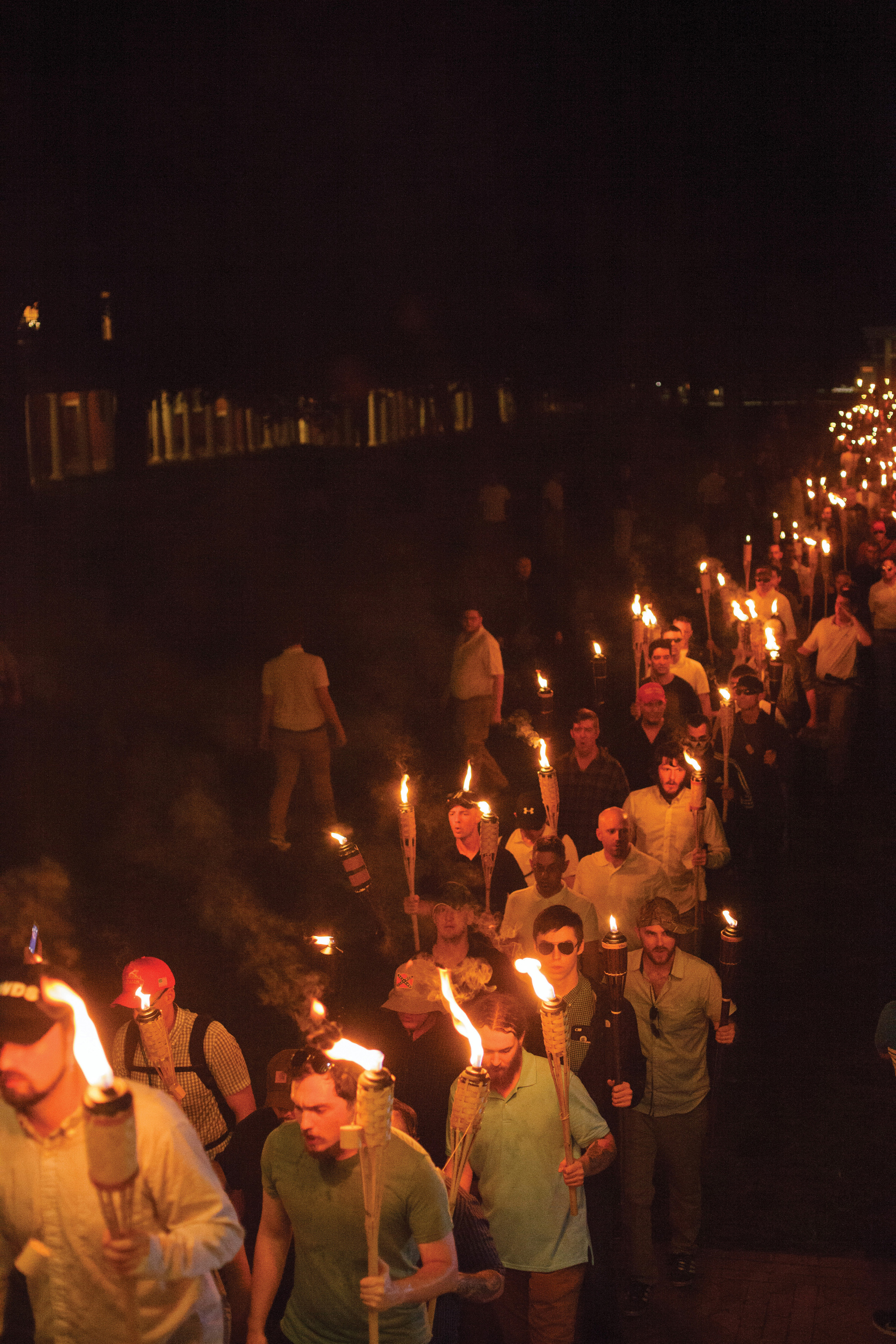
White nationalists carry torches and chant Nazi-era slogans as they march through Charlottesville on August 11, 2017. What does the battle over Confederate monuments tell us about race, racism, and whiteness in the United States?
On February 6, 2017, the Charlottesville, Virginia, City Council voted to remove the statue of Confederate general Robert E. Lee from its downtown park. Commissioned in 1917 and erected in 1924, 60 years after the end of the Civil War, the Lee statue was part of a vast wave of Confederate monument building between 1898–1924 at a time of rising white nationalism and white supremacy in the United States. Now, one hundred years later, it had become a flashpoint in the U.S. national conversation about race and racism.
The Charlottesville vote continued a wave of efforts to remove Confederate symbols from public spaces that gained urgency after twenty-one-year-old self-described white supremacist Dylann Roof massacred nine black church goers at Emmanuel AME Church in Charleston, South Carolina on June 17, 2015. Roof later confessed that he had hoped to start a race war and thought blacks were taking over the world. Roof’s self-portrait posing with a .45 caliber Glock pistol and a Confederate flag led to increasing calls to remove Confederate symbols from public monuments, streets, parks, schools, government office buildings and army bases.
Organized resistance to the removal of Charlottesville’s Lee statue, including months of lawsuits and demonstrations, turned violent on the evening of August 11, as hundreds of young white men dressed in khakis and polo shirts, many openly carrying semi-automatic weapons and lit torches reminiscent of a Ku Klux Klan rally, streamed onto the main campus of the University of Virginia. “White lives matter! You will not replace us! Jews will not replace us! Blood and soil!” they chanted as they taunted a small group of counterdemonstrators. Their slogans evoked Nazi-era calls to link white racial purity with the motherland and conspiracy theories about Jews and Blacks displacing whites in a takeover of the United States.
The following morning, hundreds of white nationalist and white supremacist marchers returned to downtown Charlottesville for the Unite the Right rally, again chanting racist and anti-Semitic slogans while carrying swastikas, Confederate battle flags, guns, and wearing red “Make America Great Again” hats. Thousands of counterdemonstrators, including UVA students, Charlottesville clergy, anti-fascist groups, and local residents challenged them at the Lee statue. Dozens were injured in clashes throughout the city, including Deondre Harris, an African American counterdemonstrator who was badly beaten by a group of white men. White supremacists, dressed in army fatigues and carrying weapons, surrounded a Jewish synagogue, forcing worshippers to flee out a back door. Blocks from the Lee statue, a white supremacist drove his car into unsuspecting counterdemonstrators as they left the area, killing 32-year-old Heather Heyer and injuring 19 others.
The tragic events of Charlottesville, like the torrent of deadly encounters between police and African Americans across the country and the growth of the Black Lives Matter movement continue to push race and racism directly into the U.S. national spotlight. Race and racism are incredibly difficult topics of conversation in U.S. culture, whether we are in a classroom, a courtroom, a religious setting, the halls of Congress, the streets of Charlottesville, Virginia, or our own local communities. How do we create opportunities to explore ideas of race and the way those ideas shape our lives and culture? In a country that likes to think of itself as color blind, how do we as anthropologists make sense of the continuing inequality in income, wealth, education, access to health care, police enforcement, and incarceration rates that breaks so clearly along color lines (Shanklin 1998)?
Anthropologists view race as a framework of categories created to divide the human population. Western Europeans originally developed this framework as part of their global expansion beginning in the 1400s (Sanjek 1994). As they encountered, mapped, and colonized people in Africa, Asia, the Pacific, and the Americas, Europeans placed them into an “international hierarchy of races, colors, religions and cultures” (Trouillot 1994, 146). The exact labels and expressions have varied over time and place as colonial powers engaged with local cultures and confronted local resistance. But the underlying project—to stratify people into groups based on assumptions of natural differences in intelligence, attractiveness, capacity for civilization, and fundamental worth in relation to people of European descent—has been remarkably consistent (Mullings 2005a).
As we will explore in this chapter, anthropologists today find no scientific basis for classifications of race. Genetically there is only one race—the human race, with all its apparent diversity. Yet despite consistent efforts over the last century by anthropologists and others to counter the inaccurate belief that races are biologically real, race has remained a powerful framework through which many people see human diversity and through which those in power organize the distribution of privileges and resources. Race—which is scientifically not real—has become culturally real in the pervasive racism found in many parts of the globe, including the United States.
Over the past 500 years, race as a way of organizing the world has been put to destructive use, wreaking an enormous toll on both its victims and its proponents. Race and racism have justified the conquest, enslavement, forced transportation, and economic and political domination of some humans by others. Today, race and racism have become so integral to patterns of human relations in many parts of the world that inherited racial categories may seem to be natural, and the inequality built on racism may seem to represent “real” differences among “real” races.
In this chapter, we will critique arguments for the existence of discrete biological human groups called “races.” We will consider the roots of race and racism in the European colonial past and their expression in various places today. We will examine the construction of race in the United States over the past 400 years and the ways race and racism continue to shape U.S. culture. And we will explore the ways race and racism intersect with class and other systems of power. In particular, we will consider the following questions:
We will examine race as a flawed system of classification, created, and recreated over time, that uses certain physical characteristics (such as skin color, hair texture, eye shape, and eye color) to divide the human population into a few supposedly discrete biological groups and attribute to them unique combinations of physical ability, mental capacity, personality traits, cultural patterns, and capacity for civilization. Drawing on anthropological research, we will see, however, that racial categories have no biological basis. We might even say that races, as a biological concept, do not exist. The danger in this statement about biological race is that it may lead us to the mistaken conclusion that race does not exist. On the contrary, race has very real consequences.
Race is a deeply influential system of thinking that affects people and institutions. Over time, imagined categories of race have shaped our cultural institutions—schools, places of worship, media, political parties, economic practices—and have organized the allocation of wealth, power, and privilege at all levels of society. Race has served to create and justify patterns of power and inequality within cultures worldwide, and many people have learned to see those patterns as normal and reasonable. So, in this chapter, we will also examine racism: individuals’ thoughts and actions, as well as institutional patterns and policies, that create or reproduce unequal access to power, privilege, resources, and opportunities based on imagined differences among groups (Omi and Winant 1994).
By the end of the chapter you will have the anthropological tools to understand not only the flaws in arguments for biologically discrete races but also the history and current expressions of race and racism globally and in the United States. You will be prepared to apply those tools, if you so choose, to engage in efforts against racism on your college campus, in your community, and throughout the world.
Glossary
- race
- A flawed system of classification, with no biological basis, that uses certain physical characteristics to divide the human population into supposedly discrete groups.
- racism
- Individuals’ thoughts and actions and institutional patterns and policies that create or reproduce unequal access to power, privilege, resources, and opportunities based on imagined differences among groups.