 Ways in Which Athenian Culture, Philosophy, and Art Reflect Political and Social Ideals
THE GOLDEN AGE OF CLASSICAL GREECE
During the half century after the Persian Wars, Athens enjoyed a meteoric rise in power and prestige, becoming the premier naval power of the eastern Mediterranean and the military rival of Sparta. Athens also emerged as leader of the Delian League, a group of poleis whose representatives met on the sacred island of Delos and pledged to continue the war against Persia, which was now being fought in the Aegean. As the league’s leader, Athens controlled its funds and resources. This era simultaneously witnessed the greatest achievements in Athenian culture and politics. These were complicated, however, by the increasingly awkward relationship of Athens with its allies, which began to feel more like Athenian subjects than free poleis.
Periclean Athens
In the decades before the Persian Wars, political reforms in Athens had continued to encourage experiments in democracy, including the practice of selecting major officeholders by lot. Only one key position was now filled by traditional voting: the office of strategos, or “general.” And because a man could be elected strategos year after year, this office became the career goal of Athens’ most ambitious leaders. Themistocles had been strategos, as was Cimon (KEY-mohn), who led the Delian League to victories over Persia during the 470s and 460s B.C.E. But Cimon also used the league to punish poleis that tried to opt out of membership, even suppressing revolts in these cities by force of arms and so turning the league into an instrument of Athenian policy.
By then, the political mood in Athens was changing. New voices were demanding a greater role in government. Most prominent were the thetes (THAY-tees), the lowest class of free men that provided the triremes’ rowers: the backbone of the all-important Athenian fleet. Like the hoplites of the Archaic Period, who had achieved citizenship because they were indispensable to the defense of the poleis, the thetes wanted higher status and equal representation. The man who emerged to champion their cause was Pericles (PEHR-eh-klees), an aristocrat from one of Athens’ most prestigious families.
Pericles made the enfranchisement of the thetes the main plank of his political platform and also advocated a foreign policy that was oriented away from cooperation with Sparta. In 462–461 B.C.E. he was elected strategos and immediately used his position to secure the ostracism of his rival, Cimon. He then pushed through reforms that gave every Athenian citizen the right to propose and amend legislation, not just to vote yes or no in the citizen assembly. And by paying an average day’s wage for attendance, he made it easier for poorer citizens to participate in the assembly and in courts of justice. Through such measures, the thetes and other free men of modest means became a dominant force in politics—and loyal to the man who had made that dominance possible.
In keeping with the ambitions of Pericles, this populist program glorified Athens through an ambitious scheme of public building and lavish festivals honoring the gods, especially Athena. Pericles himself was a generous patron of the arts and sciences, attracting the greatest minds and talents of the day to Athens. His popularity, combined with his charisma and his promotion of the Athenians’ sense of superiority, ensured his reelection as strategos for the next three decades. During these years Athens flourished, but it also alienated much of the Greek world by its arrogance and aggression.
Athenian Theater: A Mirror of the Polis
Athens was not the only city to produce great works of art during this period, but our knowledge of classical Greek culture is dominated by the dramas produced at its great religious festivals. The most important of these was the Dionysia, a great spring feast devoted to the god Dionysos, which became a celebration of Athenian exceptionalism and democratic ideals. From the beginning, therefore, drama was closely connected to the political and religious life of the state that sponsored it. Indeed, the very format of classical tragedy replicates the tensions of democracy, with its complex cast of characters and its conflict among opposing perspectives. This format was perfected under the great tragedian Aeschylus (AY-skihl-uhs; 525–456 B.C.E.) and his younger contemporary, Sophocles (496–406 B.C.E.). Their dramas made use of two or (eventually) three professional actors, each of whom could play numerous roles, and a chorus of Athenian citizens that represented collective opinion and could comment on the action.
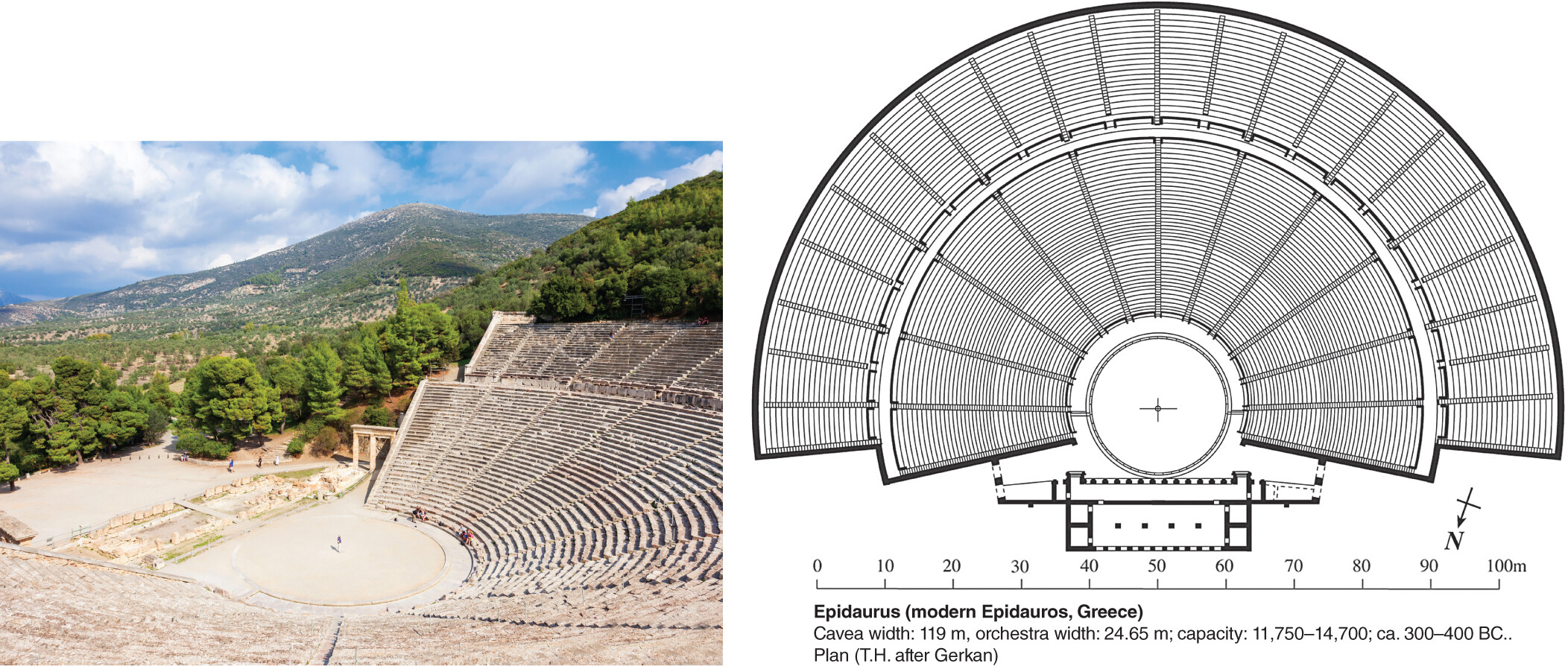
Although Aristotle would later declare that the purpose of tragedy was to inspire pity and fear and so purge these emotions through a process called katharsis (“purification”), this definition does not capture either the variety or impact of Athenian tragedy. Tragedies were almost always set in the distant or mythical past, but they were intended to address the cutting-edge issues of their day. Indeed, the very earliest of all surviving tragedies, Aeschylus’ Persians, dramatizes events of the playwright’s own lifetime; we know for certain that he fought at Marathon, because he had this fact proudly recorded on his tomb. Performed for the first time in 472 B.C.E., this contemporary tragedy tells the story of the great Athenian victory at Salamis—but through the eyes of the defeated Xerxes, who thus becomes its tragic hero.
Even when the subject matter was derived from the epics of Homer, the fundamental themes of tragedy—justice, the conflicting demands of personal desire and public duty, the unforeseen consequences of human actions, the brutalizing effects of power—addressed problems of immediate concern to all Athenians. For example, Aeschylus’ trilogy the Oresteia (458 B.C.E.) is ostensibly about the legendary family of the Mycenaean king Agamemnon and traces the long-term consequences of the king’s sacrifice of his daughter Iphigenia; his subsequent murder at the hands of his grieving wife, Clytemnestra; and the vengeance of the couple’s son, Orestes, who kills his own mother. But the court of law that eventually tries Orestes is actually that of Periclean Athens, and the plays’ debates over the rational application of law resonated with Aeschylus’ contemporaries.
Oedipus at Colonus, one of Sophocles’ later tragedies, used the story of the mythical king of Thebes to comment bitterly on Athens’ disastrous war with Sparta (see page 104). Similarly, The Trojan Women of Euripides (485–406 B.C.E.), presented in 415 B.C.E., marks the Athenians’ tragic march toward defeat in this war. By looking back at the capture, rape, and enslavement of Troy’s defeated women, Athenians were forced to look at the dreadful consequences of their own imperial policies.
Comedy was even more obviously a genre of political commentary and social satire, and could also deal openly with the absurdities and atrocities of current events. Not only was it unconstrained by any formal poetic framework, but comedy—then as now—could be effectively and safely deployed to deal with issues that were too hot to handle in any other medium: sexual scandals, political corruption, moral hypocrisy, popular fads. Aristophanes (EHR-ih-STOFF-ah-nees; c. 446–386 B.C.E.), the greatest of the Athenian comic playwrights, lampooned everything from the philosophy of Socrates to the tragedies of his contemporary Euripides, and he was an especially outspoken critic of Athenian warmongers and their imperialist aims. He regularly savaged the powerful figures whom he saw as leading Athens to its doom, and he was repeatedly dragged into court to defend himself against the demagogues he attacked. But the power and popularity of comic theater was such that politicians never dared to shut it down for long. It was too much an expression, and outcome, of Athenian ideals.
Past and Present
Political Satire
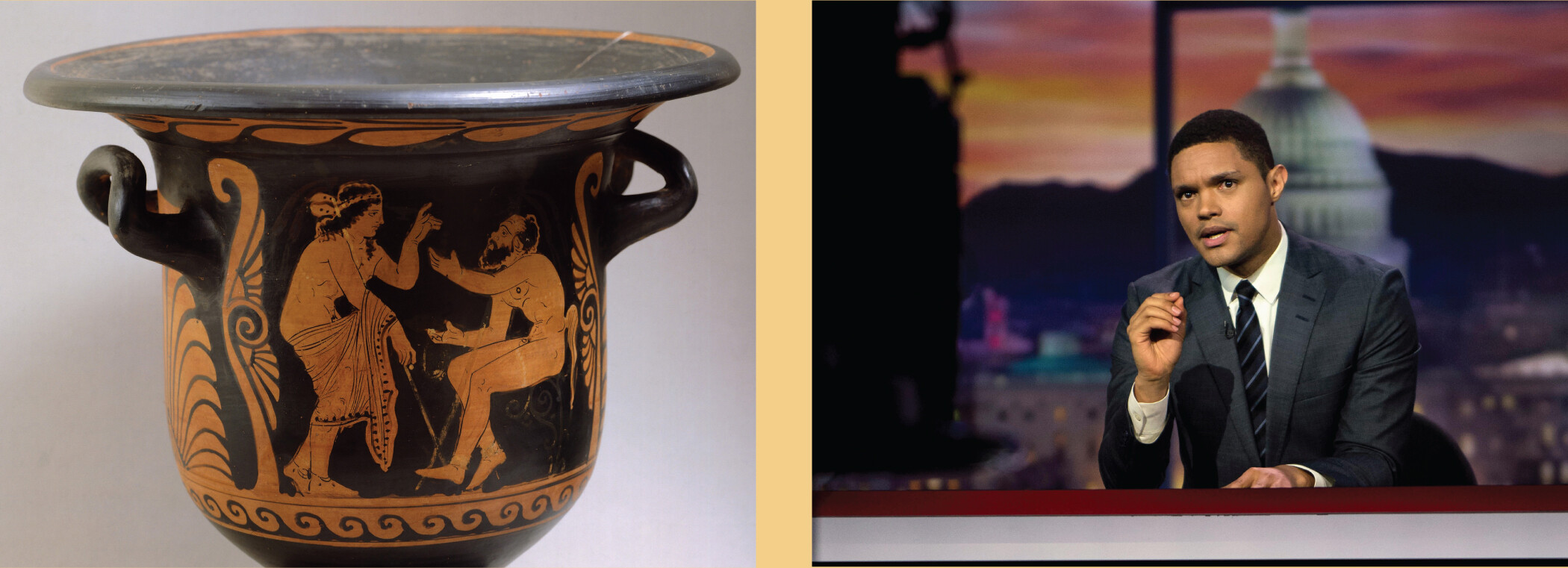
More information
A red-figure pottery with a scene of Dionysus talking with a seated satyr.
Mister Noah sits at the Daily Show desk facing the audience.
In the fifth century B.C.E., the playwright Aristophanes took an older form of comedy, the satyr play, and turned it into a vehicle for what we still call satire. Instead of gently mocking the gods, he lampooned the politics, popular culture, and current events of his own day—and so made his fellow citizens take a fresh look at themselves. If he were alive today, he might be writing for The Daily Show, Stephen Colbert, or Saturday Night Live.
 Video: Political Satire
A New Science of History
Periclean Athens was also fertile ground for the development of other new literary forms. Even though the Greeks of this age were becoming more dependent on writing for legal and commercial transactions, they valued highly the arts of memory and oral debate; and intellectuals had long been used to expressing themselves through poetry, which was always intended to be sung and enjoyed in performance, not to be read. (The Milesian philosophers had conveyed their ideas in verse, and Solon had used poetry in justifying his political reforms.) In the course of this century, though, the rise of functional literacy in Athens encouraged the emergence of prose as a distinct literary form. Herodotus found a ready market for his histories in Athens. His younger contemporary Thucydides (thoo-SID-ih-dees) followed suit, using his time in exile to write a masterful—and scathingly critical—history of the war between his polis and Sparta, in which he himself had fought.
Between them, these two historians developed a new approach to the study of the past, emphasizing the need to collect and interpret multiple sources and focusing on human agency as the driving force of history (rather than divine intervention or divine will). Although in different ways, both conceived the historian’s role as distinct from that of a storyteller. The word historia would continue to mean both “story” and “history,” but for Herodotus and Thucydides the historian’s task was to investigate and critically reflect on the events of his own time, as well as to illuminate those of the past. These methods and goals would increasingly come to inform other prose genres, including the philosophical writings of Plato and Aristotle (see Chapter 4).
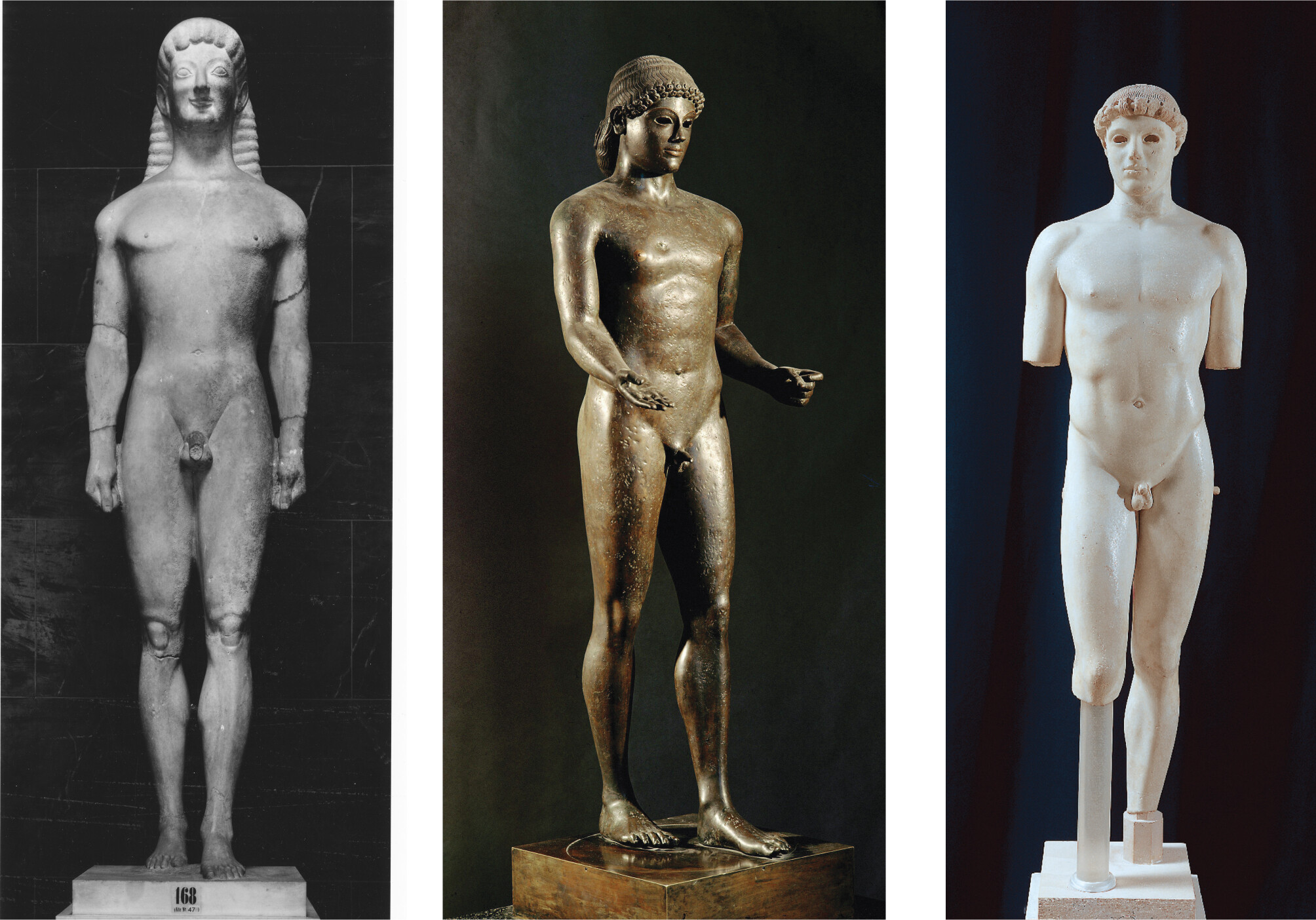
More information
A sculpture of Apollo of Tenea is carved from marble and stands stiffly with both hands at his sides in loose fists and a smiling stare with carved eyeballs.
He wears a solemn expression, his eyes are holes, and his hair is elaborately braided.
His body is softer and has more realistic muscle and bone structure. His eyes are filled with holes.
Art and Architecture
The visual artists of classical Greece revealed the same range of talents in the visual arts as poets did in their dramas. Their comic gift is exhibited in vessels made for festive use at symposia, which often depict the delights of sensuality and scenes from bawdy tales. By contrast, the heroic but humane mode of tragedy corresponds to the marble statues and sculptured reliefs made for temples and public places. Athenian sculptors in particular were drawn to the challenges of representing the human form accurately while celebrating an ideal of physical beauty.
Perhaps the most striking development in fifth-century Greek sculpture was the new attention paid to the crafting of naturalistic figures, both clothed and nude. This happened first in Athens. Nothing like it had ever been seen before, although it is a trend already discernible in the figure of the funerary statue of Phrasikleia (page 84), and in the successive refinements of the sculptor’s art made in the previous century. What hastened the acceptance of naturalism in art is a matter of intense debate, but scholars have long wanted to link this innovation to the victories over the Persians in those key decades. Greeks tended to regard the Persian male’s modesty of dress, preference for trousers, fondness for jewelry, and luxurious long hair as proofs of effeminacy (see the bowl on page 96). By contrast, Greek men took pride in sculpting their physiques, exercising, and participating in athletic contests in the nude. A Greek might have said that only barbarians bowed down to their rulers like base suppliants and covered their shameful bodies in constricting clothes; free men celebrate their individuality not only in politics but in the care of the body and its representation.
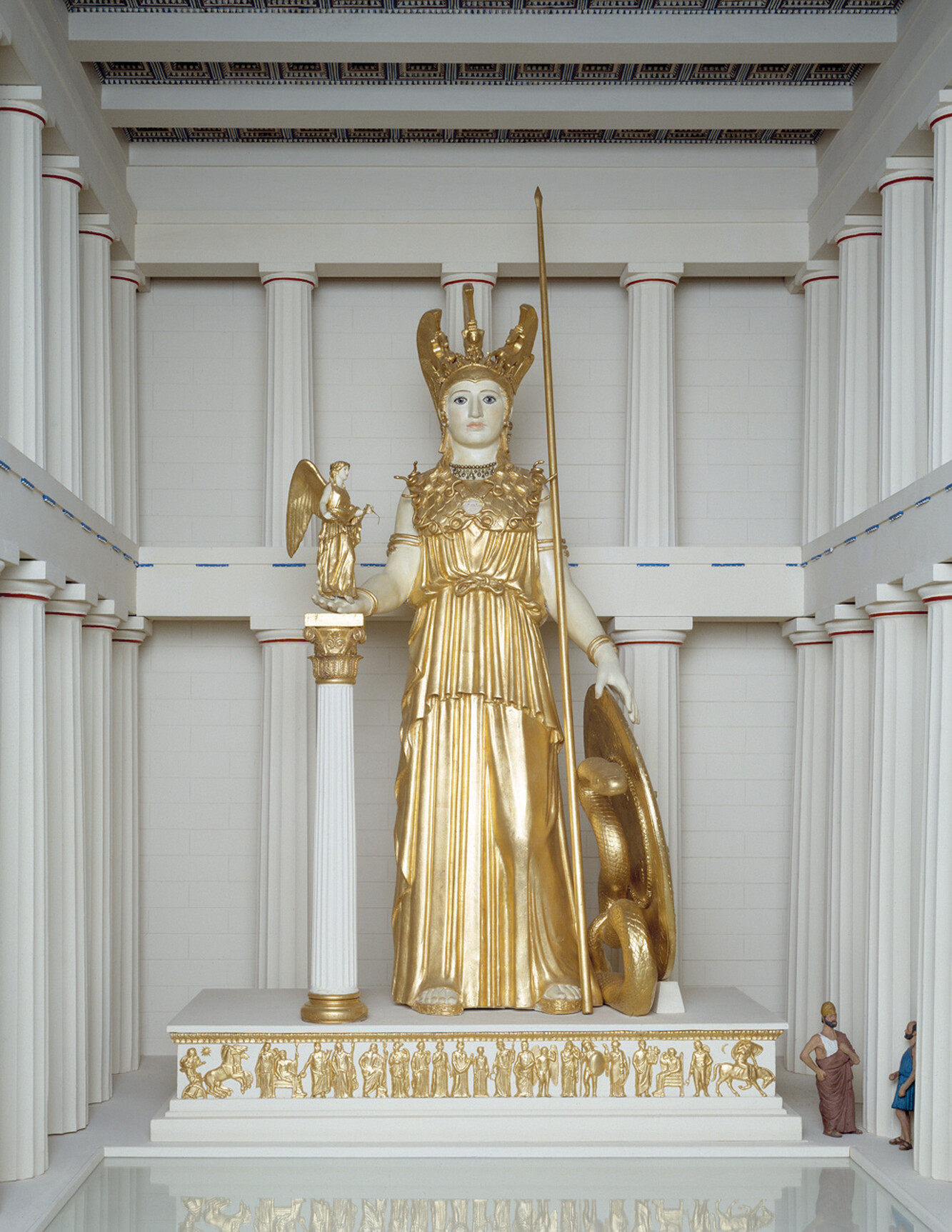
More information
The statue of Athena is on a rectangular platform with figures of people and horses carved into it. She holds a shield in one hand, and a god in the other. On the left, a column rises up to her waist. On the right, she has a long spear and a cobra next to her. A shallow pool of water is in front of the sculpture, reflecting her image.
The Athenians also made exceptional contributions to architecture in this period. All Greek temples sought to create an impression of harmony, but the Parthenon of Athens, built between 447 and 438 B.C.E., is generally considered the finest example. Construction of this stunning, expensive, and structurally ambitious building was urged on the Athenians by Pericles as a tribute to their patron goddess, Athena Parthenos (“Athena the Virgin”), and as a symbol of their own power, confidence, and genius.
The Daily Life of Athens: Men, Women, and Slaves
Toward the end of his famous funeral oration, which Thucydides quotes in his history, Pericles addresses only a few brief remarks to the women of Athens who mourn their fallen fathers, husbands, and sons at the end of the first year of the disastrous war with Sparta. He urges them to do three things: rear more children for the support of Athens and its wars, show no more weakness than is “natural to their sex,” and attract no attention to themselves. For as he says, the greatest glory of a woman is not to be spoken about at all, whether for good or ill. His remarks reveal widely held attitudes toward women in classical Greece, although they may not reflect complex historical realities.
The growth of democracy did not lead to greater equality between the sexes; in fact, it had the opposite result. In the Bronze Age of Mycenaean Greece, women were viewed as possessing extraordinary funds of courage and wisdom, as well as beauty and virtue. They were prized for their shrewd advice on political and military matters, and they played an active role in the world. Sometimes, elite women ruled kingdoms in their own right. Indeed, this was still the case in the northern territories of Macedonia and Epirus, as we will see (Chapter 4), as well as in some Ionian poleis.
But as aristocratic ideals gave way to more democratic ones, Greek women increasingly spent their lives in the confinement of the home. On the one hand, the importance of the hoplite infantry and its spirit of shared purpose encouraged men to train together and to develop close relationships, something that was also sanctioned by the political system. On the other hand, that spirit of equality discouraged the political agency of women. Instead, the production of children to supply the infantry became the female imperative. Public spaces were largely restricted to male activities, whereas domestic spaces were reserved for female endeavors, such as child care and weaving. Respectable women lived largely in the seclusion of a house’s inner courtyard, rarely venturing forth from their homes.
In Athens, girls could be legally married at age fourteen, usually to husbands more than twice their age. (Younger men were supposed to devote themselves to war.) A girl’s father arranged her marriage and provided a dowry that her husband could use for her support. Shortly after a wife entered her new home, a regular schedule of childbirth would begin. Typically, the interval between births was two to four years, meaning that the average young wife would bear between four and six children before she died, usually around the age of thirty-five. Her place might then be taken by another, younger woman.
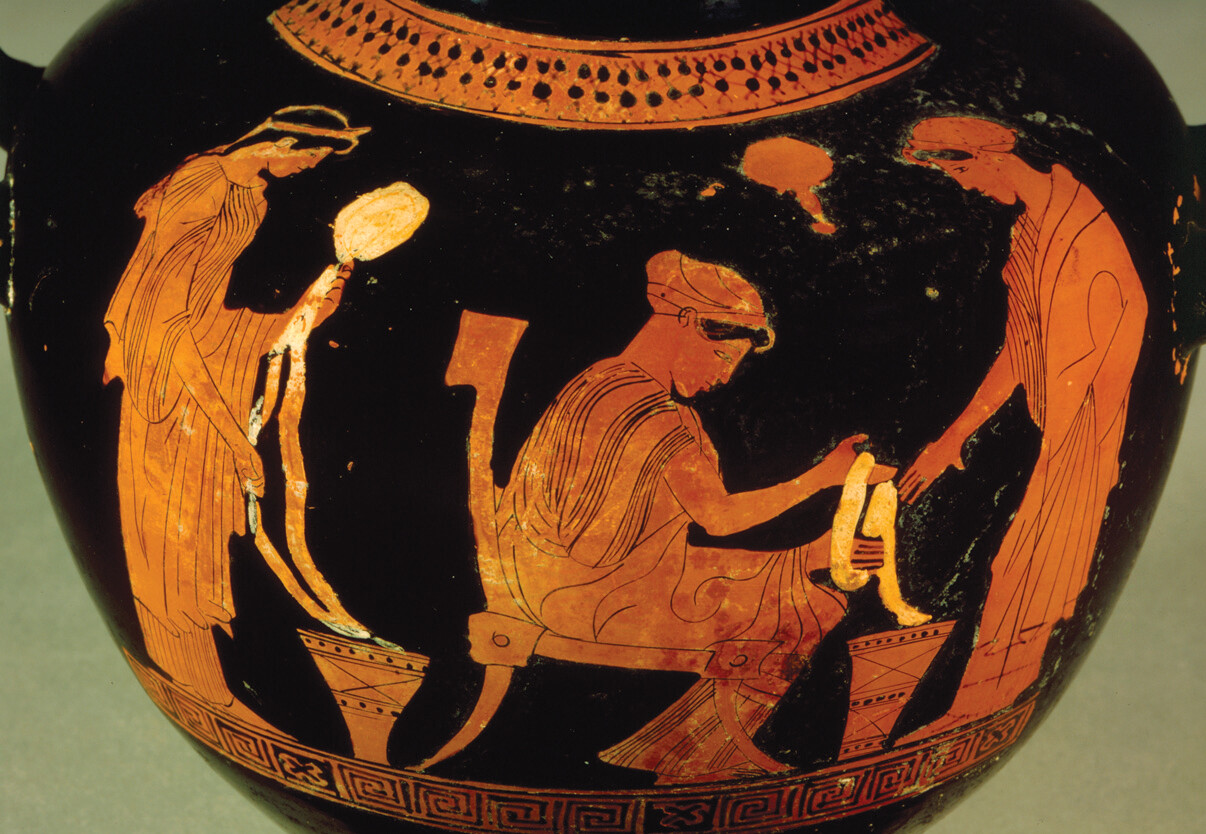
More information
The woman on the left works alone, pulling long ropes of wool out of a vessel. The two women on the right pull cloth from another vessel.
Because women seldom went out of doors or ventured beyond their immediate neighborhood—it was thought immodest for them to be seen by men other than those in their families—enslaved people did whatever shopping or marketing a household required. Even at home, women were expected to withdraw into private rooms if visitors arrived. But they were not supposed to sit around idly, and their main occupation—true of all women, from royalty to those in bondage—was the spinning and weaving of cloth. And since women’s work was basically menial, men looked down on them for it, even though their own livelihoods and comfort depended on it.
Some evidence even suggests that husbands were not encouraged to form emotional attachments to their wives, although many certainly did. In a revealing passage, Herodotus talks of a certain Lydian king who “fell in love with his own wife, a fancy that had strange consequences.” By contrast, an Athenian orator remarked that “we have prostitutes for pleasure, concubines for daily physical needs, and wives to bear us legitimate children and be our faithful housekeepers.” However, these perspectives are offset by a range of archaeological and material evidence that testify to women’s valued social roles, the affection of their husbands and children, and even their wider economic and legal powers.
In addition to depending on the labor and fertility of women, Athenians were as reliant on enslaved labor as Spartans were on helots. Without slavery, none of the Athenian accomplishments in politics, thought, or art would have been possible. The Athenian ideal of dividing and rotating governmental duties among all free men depended on enslaved people, who worked in fields, businesses, and homes. In fact, the Athenian democratic system began to function fully only with the expansion of Athenian mining and commerce around 500 B.C.E., which enabled Athenians to buy laborers in larger numbers. Estimates vary, but it seems likely that there were about 100,000 Athenians who belonged to families with male members eligible for citizenship. Nearly as many of the city’s residents were enslaved, perhaps up to 80,000 in the time of Pericles, with an additional population of some 10,000 resident foreigners, known as metics, who had no political representation. This means that only a fraction of the entire population—somewhere between 30,000 to 60,000 men—could take part in political life.
The dependence on slavery, like the denial of women’s participation in political life, was thus an inescapable contradiction of this democracy—much as it would be many centuries later in the United States. But it is also important to note that slavery in antiquity had no connection to notions of ethnic or racial difference. Anyone could be enslaved, for a variety of causes: men captured in battle could be enslaved or sold by their captors, as could women and children seized by commercial slave traders, while those in debt or financial need could sell their dependents or even themselves into slavery. In Athens and other Greek poleis, most enslaved people were owned in small numbers by a wide range of families, including the relatively poor; concubines and sex workers (of all genders) were often drawn from among this class of enslaved individuals. And yet those who were enslaved could never be dehumanized as they were in modern racialized societies, precisely because it was a potential misfortune threatening even the wealthy, and because no one group of people was marked out as enslaved by any distinctive biological characteristics. Indeed, the real possibility of being enslaved by war or poverty became a widespread consequence of Athens’ overreaching ambitions.
Glossary
- Periclean Athens
- Following his election as strategos in 461 B.C.E., Pericles pushed through political reforms in Athens that gave poorer citizens greater influence in politics. He promoted the Athenians’ sense of superiority through ambitious public works projects and lavish festivals to honor the gods, thus ensuring his continual reelection. But eventually, Athens’ growing arrogance and aggression alienated it from the rest of the Greek world.