Scholars associate the Archaic (“early”) Period of Greek history with the emergence of the polis and the renewed use of writing, which the Greeks would put to a wide variety of practical, artistic, intellectual, and political uses. The Athenians, in particular, used writing as a way of establishing their cultural dominance over other Greek poleis by controlling the inscription of the Homeric canon, promoting the work of poets and dramatists, and fostering the writing of prose histories in which they themselves played the central role. It is therefore important to bear in mind that much of what we know about this early period derives from the work of later authors who wrote from this Athenian perspective: these include the Ionian-born Herodotus, who spent much of his later life in Athens; the historians Thucydides (c. 460–395 B.C.E.) and Xenophon (430–354 B.C.E.); and the philosophers Plato (c. 428–348 B.C.E.) and his pupil, Aristotle (384–322 B.C.E.).
Colonization and Panhellenism
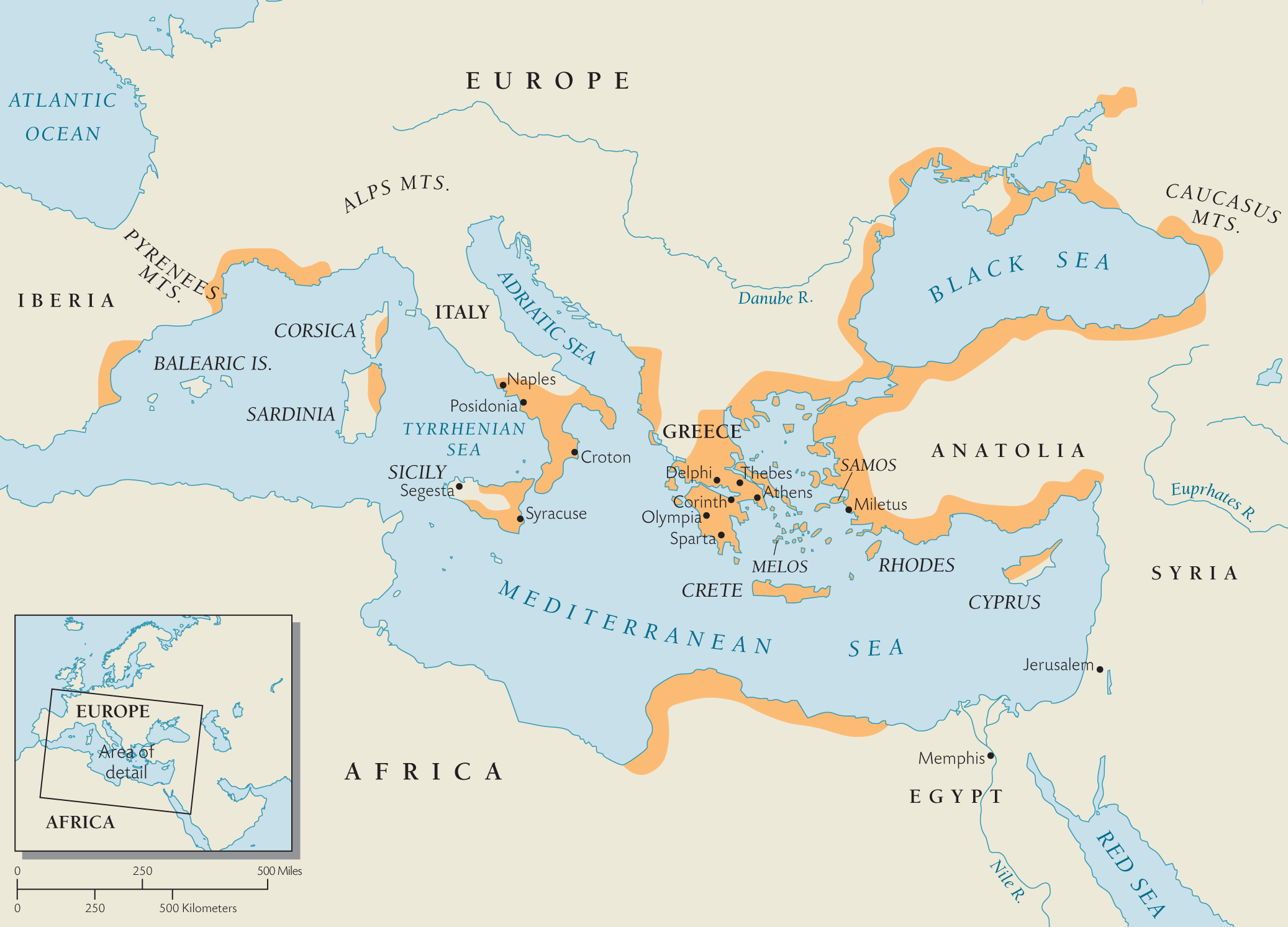
During the eighth and seventh centuries B.C.E., small-scale Greek trading ventures and settlements gradually developed into full-fledged mercantile enterprises that followed the example set by the Phoenicians. Many larger poleis competed to establish colonies that functioned as trading posts, with Athens and Corinth being particularly successful. Although each new colony was technically an independent entity, it sustained strong kinship and cultural ties to its mother polis; so even if it had no formal obligations to that city, it was often called to support it and could become entangled in the political and military affairs of its founders. At the same time, these new Greek colonies were loosely unified by a shared Panhellenic identity that now stretched from the Black Sea to the coasts of Europe.
More information
A smaller inset map in the corner shows that the larger map covers parts of central Europe and the northern coast of Africa. It includes the shores of the Black Sea, the shores around Asia Minor, Cyprus, Rhodes, Melos, Crete, some shores of Northern Africa near Egypt, all of Greece and the shores of the Aegean Sea, the Southern shores of Italy and Sicily, eastern parts of Corsica and Sardinia, and some eastern shores of Iberia, and present-day France. Major cities include Naples, Posidonia, Croton, Syracuse, Delphi, Corinth, Olympia, Sparta, Thebes, Athens, and Miletus.
GREEK COLONIZATION, C. 550 B.C.E. Compare this map with that on page 57. ■ How do you account for the differences in Greek and Phoenician patterns of colonization? ■ Were Greek colonies likely to compete with Phoenician colonies? ■ Where were such conflicts most likely to erupt?
This process of Greek colonization permanently altered the cultural geography of the Mediterranean world. The western shores of Anatolia (modern Turkey) would remain a stronghold of Greek culture for the next 2,000 years. So many Greeks migrated to southern Italy that the Romans called the region Magna Graecia, “Greater Greece”; Greek-speaking enclaves would survive there into the twentieth century. By the fourth century B.C.E., more Greeks lived in Magna Graecia than in Greece itself.
The motives for these colonial ventures varied. Corinth was blessed by its strategic location on the land bridge between Attica and the Peloponnesus (pel-oh-poh-NEE-suhs), the large peninsula of mainland Greece, but cursed by the poverty of its land. Trade therefore became the lifeblood of its citizens and the source of its ruling aristocracy’s power. Other poleis, confronted by the pressures of growing populations and social unrest, sponsored new colonies as outlets for undesirable elements or unwanted multitudes.
Colonial expansion also intensified Greek contacts with other cultures. Phoenician pottery brought new artistic motifs and mythological figures into Greece, while Egyptian artists profoundly influenced early Greek sculptural representations of the human form (see Interpreting Visual Evidence on page 84). However, these contacts also sharpened Greeks’ awareness of their own identity as Hellenes. While this did not usually lead to greater political or military cooperation, it did encourage the celebration and assertion of that identity at Panhellenic festivals like the Olympic Games, or the establishment of shared sacred sites.
Interpreting Visual Evidence
The Colors of Classical Civilization
TUTORIAL
AVAILABLE
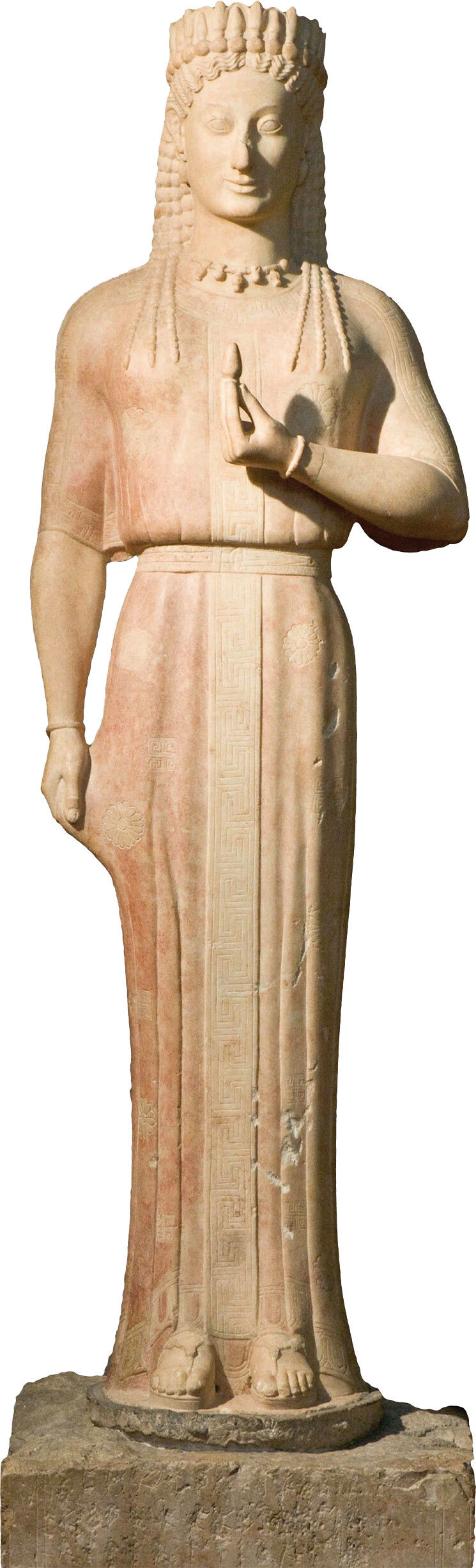
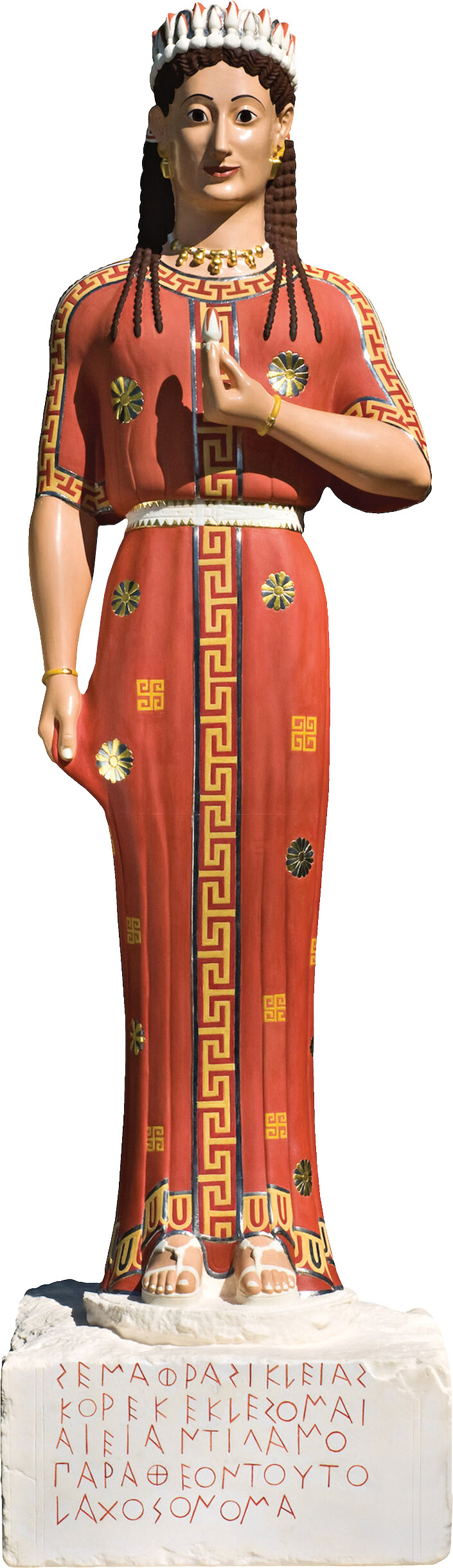
In the past decade, new scientific methods of historical analysis have revealed what many scholars of ancient art and architecture have long believed: that the buildings and sculptures of the ancient world were not austerely white. Instead, they were monumental canvasses for the lavish application of colors perceived as garish by some modern tastes. Traces of these pigments are sometimes detectable by the naked eye, but new imaging techniques and chemical analyses have revealed just how bright they were. What does this discovery reveal about ancient culture and society? It teaches us about the ideas of beauty and grandeur that the peoples of ancient civilizations shared. It reveals the backdrop against which the events of ancient history were played out, including the spaces where Athenian democracy, philosophy, and theatre emerged. And importantly, it counters a modern myth of antiquity’s alleged whiteness and homogeneity, challenging the idea that Western civilizations were inherently different from those of Asia or Africa, where “barbarous” tribes’ love of color has been interpreted as another sign of their racial inferiority. This idea is not an ancient one, but a product of modern theories of race that were being developed in the sixteenth and seventeenth centuries and “scientifically” advanced in the eighteenth and nineteenth (see Chapters 12, 14, 17, and 20). For the proponents of these racial constructs, the seeming preference for gleaming, unpainted white marble was taken as another proof of ancient Europeans’ inherent racial purity.
A. A marble funerary statue dated to c. 540 B.C.E., discovered in 1972 during excavations on the Attic peninsula and known as the Phrasikleia Kore: “the maiden Phrasikleia.”B. A reconstruction of the statue’s original polychromy, based on the evidence of surviving pigmentation. The restored inscription on the base reads: Tomb of Phrasikleia:/ Maiden must I be called / forever, since instead of marriage / – by the gods’ will – / that name became my fate.
Questions for Analysis
What aspects of this statue are emphasized through the application of color? How might this color palette have been intended to affect the viewer? Without the restored pigmentation, what would we not be able to learn about the young woman depicted here?
What are the potential implications of our new awareness that polychromy (multicolored paint) would have covered most statues and buildings in classical Greece and Rome?
With these images in mind, look again at the views of the Parthenon on pages 78 and 90, the statue of Athena on page 102, and the statues on page 101. How does your own understanding of Athenian society and its contributions change in response to this knowledge? How might future representations of classical culture—in film, video games—be adjusted to reflect this recovered reality?
The most important of these was the Temple of Apollo at Delphi, home to the oracle of the sun god and situated on the slope of the sacred Mount Parnassus. People from all over the Greek world (and beyond) came to seek advice from the prophetic spirit embodied in Apollo’s priestess, who lived in a state of trance induced by fumes rising from a fissure in the earth and enhanced by the chewing of eucalyptus leaves. Suppliants who sought to have their questions answered by the oracle would offer gifts to the shrine and then wait while the god spoke through the priestess, whose mysterious answers would be translated by an attending priest into enigmatic Greek verse. The resulting advice was essentially a riddle that called for further interpretation on the part of the recipient—who often misconstrued it. As we noted in Chapter 2, King Croesus of Lydia thought that he was following the advice of the oracle when he attacked the Persians, but the great nation he destroyed turned out to be his own.
At the Olympic Games, Greeks honored the king of the gods, Zeus, near the giant temple dedicated to him at Olympia. The Greeks took great pride in these athletic competitions, and Greek historians dated events by olympiads, the four-year periods between games, traditionally believed to have begun in 776 B.C.E. Only Hellenes were permitted to participate in these sacred contests, and all wars among Greeks ceased while they took place. A victory in the games brought great prestige to the victor, who could be catapulted to a position of social and political power within his polis. These games did little to alleviate rivalry among the poleis; in fact, they often increased it. Yet they further strengthened the Greeks’ belief in their common superior culture: an awareness that they could call on when they faced a common threat.
Harnessing the Power of the Horse
Horses are now common on all continents except Antarctica, but in antiquity they were found only on the steppes of eastern Europe and central Asia. From this relatively circumscribed area, wild horse populations were gradually domesticated and interbred to yield the modern horse (Equus caballus). This animal’s global spread testifies to its extraordinarily close relationship with the humans who tamed it, and who in turn became utterly dependent on its strength, intelligence, beauty, and utility: as a source of milk and meat and hides, as a draft animal, as the swift engine that powered the terrifying chariots of the Bronze Age, and finally as a mount. Horses were first harnessed for riding on the plains of western Asia, and (as we will see) they became crucial components in the armies of the Persian Empire.
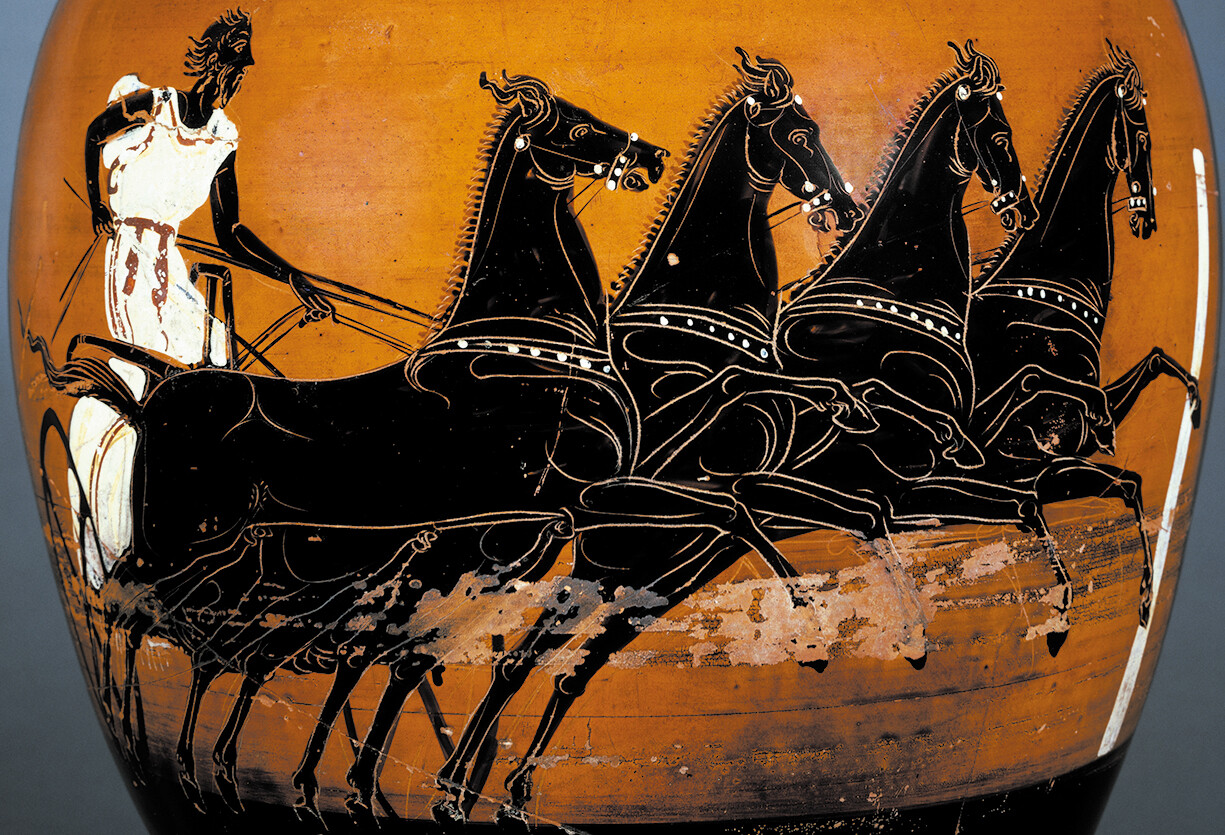
A CHARIOTEER AND HIS TEAM RACING AT THE OLYMPIC GAMES. Chariot racing was the most prestigious and expensive event at the Olympics, since only the very wealthy could afford to maintain and transport a racing team. All the glory of a win accordingly went to the owner, not to the charioteer or trainer. Since women were forbidden to compete at the Olympics, sponsoring a team was the only way that a woman could claim an Olympic victory.
They also became essential markers of the new Greek aristocracy in the course of the eighth century. Whereas Homeric heroes had ridden into battle on chariots, dismounting to fight hand to hand only after they had thrown their javelins, their later aristocratic imitators were hippeis (“horsemen”), constituting the first cavalries of the ancient world. Chariots, which were virtually useless on the rocky, mountainous terrain of Greece, were still beautifully adapted to become the engine of a new type of sporting event. The first four-horse chariot race is attested at Olympia in 680 B.C.E., and chariot racing would become wildly popular in the Roman Empire, too. And since breeding, raising, feeding, training, and arming horses was extraordinarily expensive, owning a horse—or a team of horses, broken to pull a racing chariot—was the ultimate sign of wealth and status.
Hoplite Warfare: A Military and Political Revolution
Hoplite Warfare and Its Effects on the Development of Democracy
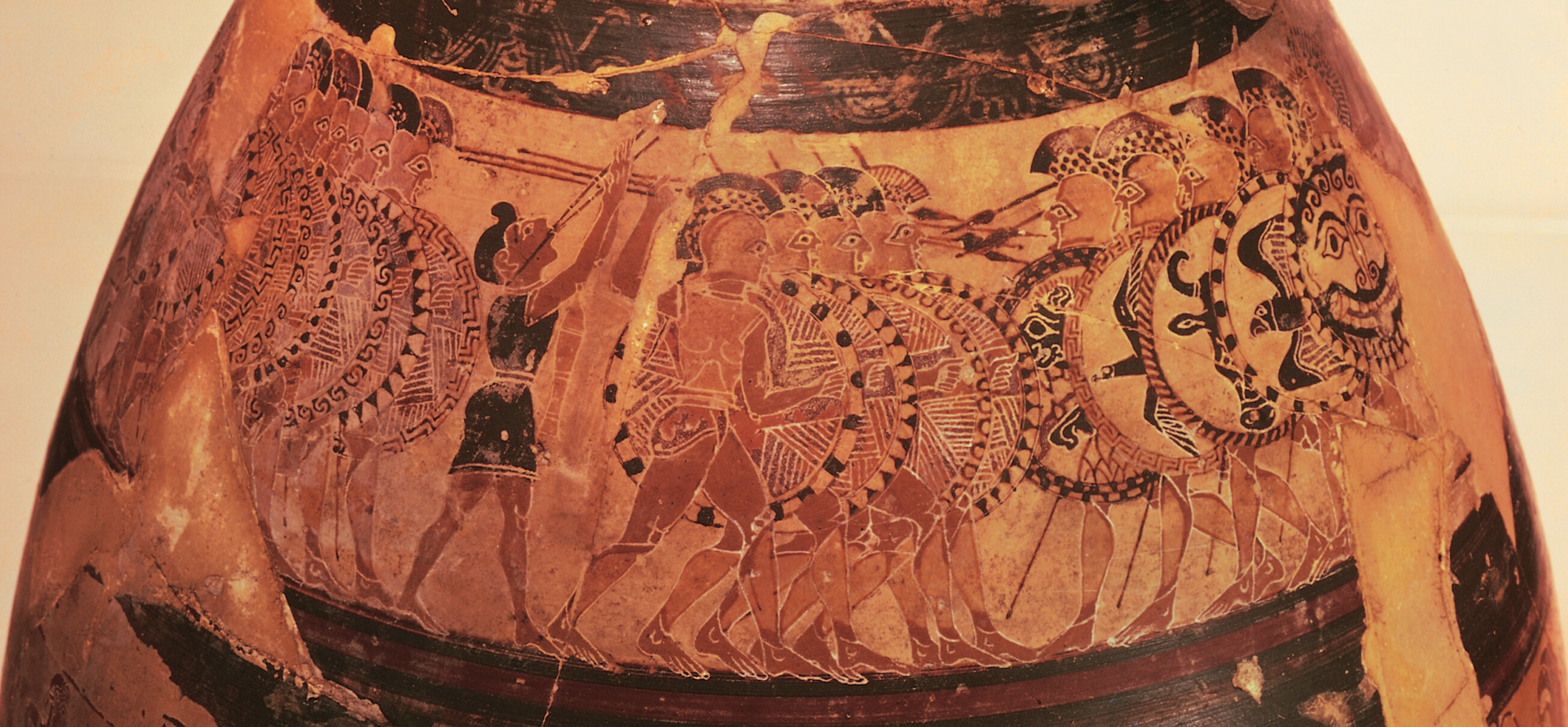
Commoners fighting on foot had long played a very minor role in ancient warfare. But, ironically, just as small cavalry contingents were being formed by the aristocracy, a revolution in military tactics was making their dominance obsolete. The effective defense of a polis increasingly required a standing militia, not just an ad hoc band of elite warriors. Accordingly, able-bodied citizens began to equip themselves for battle and train alongside each other. These citizen-soldiers became known as hoplites, from the large round shield (hoplon) each one carried. The shield was the chief element in a panoply (complete hoplite outfit) weighing as much as seventy pounds and consisting of a spear, short sword, breastplate, helmet, and sometimes leather greaves and wrist-guards.
HOPLITE INFANTRY ADVANCING INTO COMBAT. This Corinthian vase, dating from around 650 B.C.E., displays the earliest-known depiction of hoplites fighting in a phalanx formation.
In battle, hoplites stood shoulder to shoulder in a close formation called a phalanx, several columns across and several rows deep, with each hoplite carrying his shield on the left arm to protect the unshielded right side of the man standing next to him. In his right hand, each hoplite carried a thrusting weapon—spear or sword—so that an approaching phalanx presented a nearly impenetrable wall of armor and weaponry to its opponents. If a man in the front rank fell, the one behind him stepped up to take his place; indeed, the weight of the entire phalanx was literally behind the front line, with each soldier aiding the assault by leaning with his shield into the man in front of him.
This tight formation relied on a shared skill: the ability to stay together. As long as the phalanx remained intact, it was nearly unbeatable. But like the polis itself, it could fall apart if its men were not committed to a common goal. The “hoplite revolution” was therefore bound up with a parallel revolution in politics. As a polis came increasingly to draw on the resources of more and more citizens, it was forced to offer them a larger share in political power. Since every polis needed a hoplite force to protect its independence, any free man who could afford the requisite panoply became a man with political and social standing. Together, these citizen-soldiers formed a new hoplite class, which demanded a share in decision making. Sometimes, though, they could be co-opted by an aristocratic faction or persuaded to throw their support behind an aspiring tyrant.
Aristocracy, Tyranny, and Democracy
For the better part of the seventh and sixth centuries B.C.E., aristocratic classes of wealthy and influential men continued to control most Greek poleis. Struggles for influence among competing families were therefore commonplace, and factions often attempted to checkmate rivals by passing new laws that favored their own interests, or by sponsoring building projects or colonial expeditions. These rivalries affected polis government at every level, not least because aristocrats were the only members of society who could afford to hold unpaid and time-consuming political offices.
The aristocrats not only pursued wealth and power—they also cultivated a distinctive lifestyle. Participating in politics and holding elected office was part of this lifestyle. So too was the symposium, literally a “drinking party,” an intimate gathering at which elite men would enjoy wine, poetic competition, performances by trained dancers and acrobats, and the company of hetaeras (courtesans) who provided witty conversation, music, and the promise of sex. Respectable women were excluded from such meetings as they were from most other aspects of social and political life (see page 102). So too were non-aristocratic men. The symposium was thus an arena for the display of aristocratic masculinity.
The glorification of male sexuality was another important aspect of this homosocial aristocratic culture. Typically, a man in his late twenties to late thirties, who had just begun to make his career in political life, would take as his lover and protégé an aristocratic youth in his early teenage years. The two would form an intimate bond that included sexual intercourse. This personal and social intimacy could benefit both partners and their families, and it allowed the younger partner to learn the workings of politics while making valuable connections and alliances. Many later philosophers, including Plato, argued that true love could exist only between two such men, because only within this relationship could a man find an equal partner worthy of his affection. Other types of sexual relationships were considered illicit, including those between men of unequal social status.
A complex system of values, ideas, practices, and assumptions thus shaped aristocratic identity in this era. As a result, it was difficult for those outside this elite world to participate fully in the public life of the polis. Eventually, in many poleis, the circle of the aristocratic elite tightened further, as smaller and smaller groups came to dominate higher offices. This meant that even many aristocrats were left on the outside of their own culture, looking in. For these men, one remedy lay close at hand: they could form an alliance with the rising class of hoplites, who resented their exclusion from political power. And occasionally, a single aristocrat with the backing of the hoplites would succeed in setting up an alternative form of government, a tyranny.
In Archaic Greece, a tyrant was not necessarily an abusive ruler. Indeed, tyranny often led the way to wider political enfranchisement. A tyrant who had sought the support of the hoplite class would have to appease that class by extending it further rights of political participation while all the time striving to keep the reins of power in his own hands. This was an inherently unstable state of affairs, because after the original tyrant had fulfilled the wishes of the hoplites, the continuance of tyranny became an obstacle to even greater power for this segment of the population, which would then work to overthrow it. For this reason, tyrannies rarely lasted for more than two generations and could drive a transition from aristocracy to a more broadly participatory form of government: democracy.
It is important to stress that our idealized notion of democracy is quite different from that of the Greeks. In fact, Aristotle dismissed this form of government as “mob rule,” because it gave too much power to the demos, a word meaning “neighborhood” or “tribe.” He saw it as a system too easily controlled by a particular faction or family. Our ideal of democracy is closer to what Aristotle would have called a polity, governance by the polis as a whole.
The Power of Poetry
Although aristocrats were deeply invested in the heroic ideals of an earlier age, they also expressed their unique culture in newer poetic forms. The most characteristic of these is the lyric, a series of rhythmic verses sung to the music of the lyre. Because these songs were composed orally, or even improvised, few of them survive. Those that do are valuable historical sources because they concentrate on themes of immediate interest to their audiences: beauty, love, sorrow, ambition, or important life events. And because they were the focus of entertainment at gatherings, lyrics are often politically charged, sexually explicit, or daringly subversive of accepted norms. For example, the poet Archilochus of Paros (c. 680–640 B.C.E.) flouts the conventions of epic poetry by mocking his own failures on the battlefield: “Some barbarian hefts my shield, since I had to abandon it / . . . but I escaped, so it scarcely matters / . . . I can get another just as good.” So much for the heroic ideal of returning either with one’s shield or on it! In another lyric, Archilochus berates his faithless (female) lover and his even more faithless (male) lover, with whom she has an affair.
Given the male domination of Greek culture, it is surprising that the most famous poet of this age was not a man. Rather, it was Sappho (SAF-foh; c. 620–550 B.C.E.), who lived in the polis of Mytilene on the island of Lesbos. Sappho composed songs for a wide array of occasions and moods: songs of courtship and marriage, longing and desire, loss and old age. Sometimes her lyrics seem to be addressed to men, but more often they are passionately dedicated to women: both the women whom Sappho loved and the historical women who occupy the margins of masculine epic.
In one song, Sappho compares herself with Agamemnon, who was able to return from Troy only after he prayed to Hera, a goddess worshiped at Lesbos; Sappho now prays that her beloved will arrive safely with the goddess’s help. In another, she imagines a scene not included in the Iliad, the joyous wedding of the Trojan Hector and his bride, Andromache. Like later tragedies, the poignancy of this bridal song (such as those Sappho herself would have sung at the marriage feasts of friends) derives from the listeners’ foreknowledge of the legendary couple’s terrible fate: Hector’s death at the hands of Achilles, Andromache’s rape and enslavement at the hands of the victorious Greeks, and the murder of their infant son. The intimacy of lyric reveals something that few other sources from antiquity are able to convey: the distinctive feelings and desires of individuals who were often at odds with the dominant culture of their time.
Analyzing Primary Sources
Songs of Sappho
Although Sappho of Lesbos (c. 620–550 B.C.E.) was a prolific poet and skilled musician, we know very little about her life, and only a few examples of her extraordinary verse survive. Of the nine books collected in the third century B.C.E., we now have just one complete lyric and a series of fragments, some consisting of only two or three words, often preserved because they were quoted admiringly by other authors. In an astonishing discovery, though, a papyrus scroll containing a previously unknown part of a poem was identified as recently as 2004 (and is included here). Another papyrus fragment, discovered in 2014, contains parts of two more lyrics: one on unrequited love, addressed to Aphrodite, and another that mentions Sappho’s two brothers.
Fragment 16
Some say thronging cavalry, some say foot soldiers,
others call a fleet the most beautiful of
sights the dark earth offers, but I say it’s whatever you love best.
And it’s easy to make this understood by
everyone, for she who surpassed all human
kind in beauty, Helen, abandoning her husband—that best of
men—went sailing off to the shores of Troy and
never spent a thought on her child or loving
parents: when the goddess seduced her wits and left her to wander,
she forgot them all, she could not remember
anything but longing, and lightly straying
aside, lost her way. But that reminds me now: Anactória,
she’s not here, and I’d rather see her lovely
step, her sparkling glance and her face than gaze on
all the troops in Lydia in their chariots and glittering armor.
Source: Jim Powell, trans., The Poetry of Sappho (New York: 2007), pp. 6–7.
A Newer Fragment (2004)
Live for the gifts the fragrant-breasted Muses
send, for the clear, the singing, lyre, my children.
Old age freezes my body, once so lithe,
rinses the darkness from my hair, now white.
My heart’s heavy, my knees no longer keep me
up through the dance they used to prance like fawns in.
Oh, I grumble about it, but for what?
Nothing can stop a person’s growing old.
They say that Tithonus was swept away
in Dawn’s passionate, rose-flushed arms to live
forever, but he lost his looks, his youth,
failing husband of an immortal bride.
Source: Lachlan Mackinnon, trans., Times Literary Supplement, July 15, 2005.
Questions for Analysis
How does Sappho use stories from the older tradition she has inherited to address her own concerns? How does the perspective of this female poet transform masculine ideas about heroism, beauty, warfare, aging?
What are the challenges of working with such fragmentary sources as these? If these were the only pieces of evidence to survive from Archaic Greece, what conclusions could you draw about this society and its values?
In ancient Greece, this form of government allowed a class of propertied male citizens to participate in the governance of their polis; but it excluded women, slaves, and citizens without property from the political process. As a result, the ruling class amounted to only a small percentage of the entire population.
A Greek foot-soldier armed with a spear or short sword and protected by a large round shield (hoplon). In battle, hoplites stood shoulder to shoulder in a close formation called a phalanx.