13Worlds Entangled
1600–1750
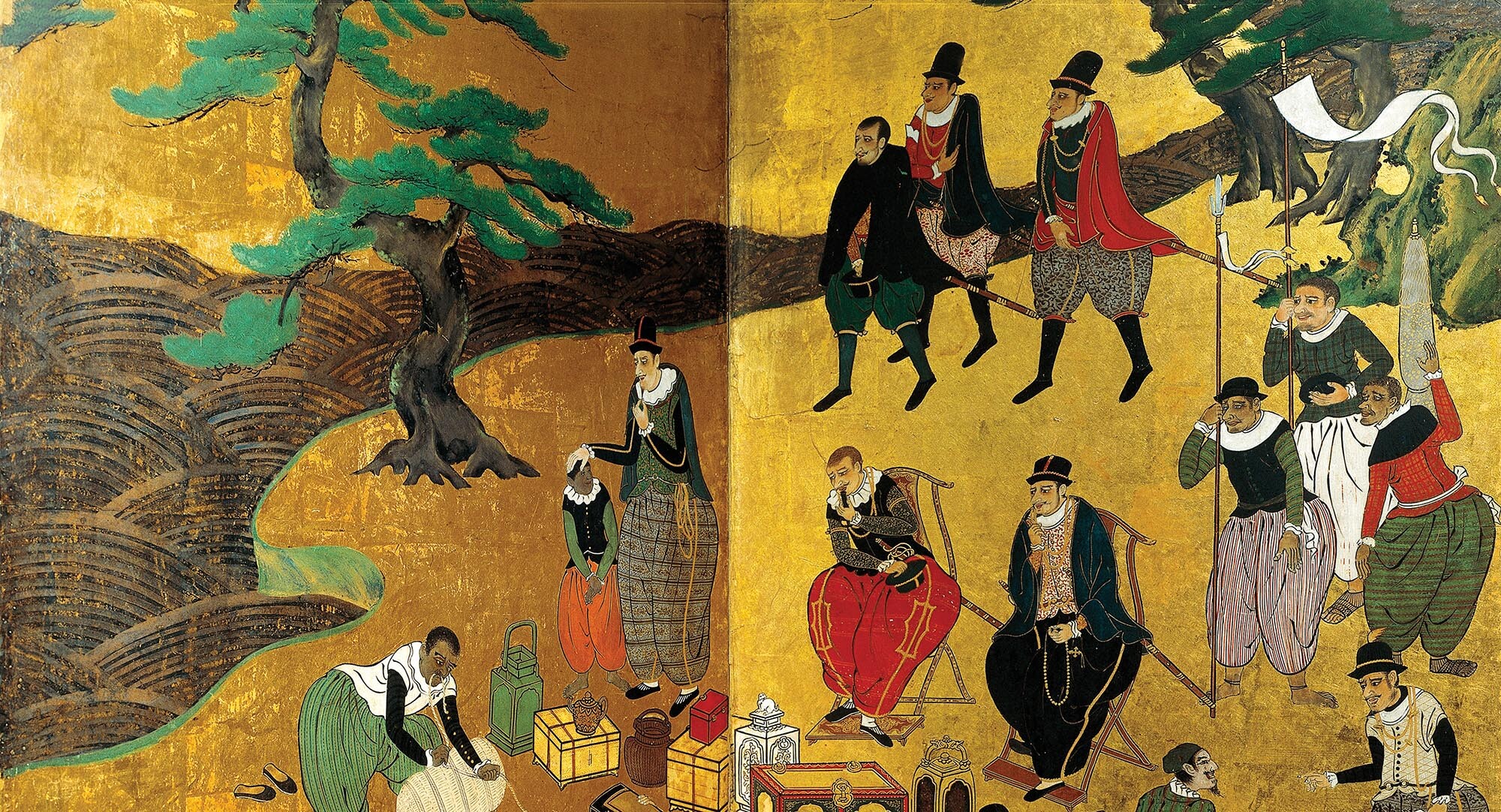
More information
A painting of Portuguese traders with goods on the coast of Japan. Several traders watch a Japanese man unwrap goods on the ground in front of them. A group in the background watches the ocean while another group to the side holds spears and watches the goods being unwrapped. Two men in the bottom right corner face each other in conversation. There is a tree right on the edge of the coast and several in the background on the right side.
Before You Read This Chapter
GLOBAL STORYLINES
The Emergence of Global Trade
- Transoceanic trade networks create vast wealth, new kinds of inequality, and fundamentally alter the lives of Indigenous peoples.
- A sharp drop in global temperatures produces the Little Ice Age, which leads to warfare, disease, famine, and dying on a scale comparable in some areas to that of the Black Death.
- New World sugar also accelerates the shift of power in the Atlantic world from the Spanish and Portuguese to the British and French.
- Silver begins to tilt the balance of wealth and power from Asia toward Europe.
- European merchants and African leaders radically increase the volume and violence of the slave trade, destabilizing African societies.
- Rulers in India, China, Japan, and Russia enlarge their empires, while Muslim empires struggle.
CHAPTER OUTLINE
FOCUS QUESTIONS
- What were the major steps in the integration of global trade networks in the seventeenth and eighteenth centuries?
- How were Indigenous peoples’ lives altered by the increased integration of global trading networks?
- What effects did the Little Ice Age have on different parts of the world?
- How did the Atlantic slave trade change African societies socially and politically?
- What effect did New World silver and increased trade have on Asian empires?
- How was the impact of trade and religion on state power in various regions alike and different?
- What was the significance of European consumption of goods (like tobacco, textiles, and sugar) for the global economy?
The leading Ottoman intellectual of the sixteenth century, Mustafa Ali, was a gloomy man. He lived during difficult times and became convinced that the Ottoman Empire had slipped into an irreversible decline. Islam was approaching its 1,000th year (1000 After Hijra, AH, or 1591–1592 in the Julian calendar). Many ulama and high-level bureaucrats warned of a pending apocalypse, a day of judgment that would reward the virtuous and condemn the evil. Although Mustafa Ali regarded doomsayers skeptically, he did think that the time was ripe for assessing all of human history. As far as he was concerned, the fate of humanity was at stake in an era of upheaval and crisis, much of it driven by ecological and economic pressures. He began his magnum opus, The Essence of History, in the year when many thought that the world would end (1591). The first half of that century had brought triumphs for the sultans. After that, a slump set in. By century’s end, the empire was losing territory to its rivals, the Hapsburgs, the Venetians, and the Russians; soldiers had rioted when they were paid in debased silver coinage imported from New World mines; and agrarian uprisings had ripped across eastern Anatolia. After the glory days, Ottoman rulers, like many others, had to grapple with the longer-term consequences of fusing two biomes, the New World and Afro-Eurasia, and a wave of environmental shocks to their agrarian systems. Entangling these worlds brought bounty and opportunity, but also competition and disruption. How different parts of the world responded to the upheavals of “the long seventeenth century” (the period running from the 1590s to the early 1700s) would have deep, long-term consequences. It was these transformations that Mustafa Ali was struggling to explain.
As we become more aware of how decisive climate change has been on human evolution, we have learned how it stamped the global seventeenth century. Many of the problems of this period stemmed from a severe cold and arid spell that swept the entire world. Now known as the Little Ice Age, the era saw a plunge in global temperatures lasting from 1620 to 1680 (and in some regions dragged into the next centuries). The decline in precipitation, increase in early frosts, and shortened growing seasons laid waste to agricultural and pastoral lands. Hunger, famine, and misery went global.
The result was a double-edged crisis. Just as world empires ramped up their competition and warfare after the conquest of the Americas and the resurgence of Asian empires, they squeezed their peasants for resources to pay for the fighting. At the same time, global cooling meant that peasants produced less food and surpluses and could ill afford the exactions of their rulers. Across much of Afro-Eurasia, the result was mass suffering and a wave of peasant unrest and political upheaval.
Mustafa Ali captured the sentiments of this age well: “Prosperity had turned to famine, the government careers had become confused, venality was rampant, and the military class was being overrun by re’aya [tax-paying subjects].” Even more apocalyptic were his poems. Here his view was that “in the social sphere the world is upside down; the ulama are no longer learned or pious; the pillars of the state are fiends and lions; the truly learned are disdained and dismissed and government service now brings pain and poverty rather than pride and wealth. The plague destroying the world is moral as well as physical, for bribery and corruption are the order of the day.”
What a paradox! In spite of the turmoil, the period 1600–1750 saw the world’s oceans give way to booming sea-lanes for global trading networks. Sugar flowed from Brazil and the Caribbean, spices from Southeast Asia, cotton textiles from India, silks from China, and silver from Mesoamerica and the Andes. New World silver was crucial to these networks: it gave Europeans a commodity to exchange with Asians, and it tilted the balance of wealth and power in a westerly direction across Afro-Eurasia.
Imperial expansion and transoceanic trade, like climate change, spread across the entire globe. Europeans conquered and colonized more of the Americas, the demand for enslaved Africans to work New World plantations leaped upward, and global trade intensified. Conquest, colonization, and commerce created riches for some but also provoked bitter rivalries. In the Americas, Spain and Portugal faced new competitors—primarily England and France. With religious tensions added to the mix, the stage was set for decades of bloody warfare in Europe and the Americas. At the same time, rulers in India, China, and Japan enlarged their empires, while Russia’s tsars incorporated Siberian territories into their domain. Meanwhile, the Ottoman, Safavid, and Mughal dynasties, though resisting most European intrusions, faced shocks from an increasingly entangled world.