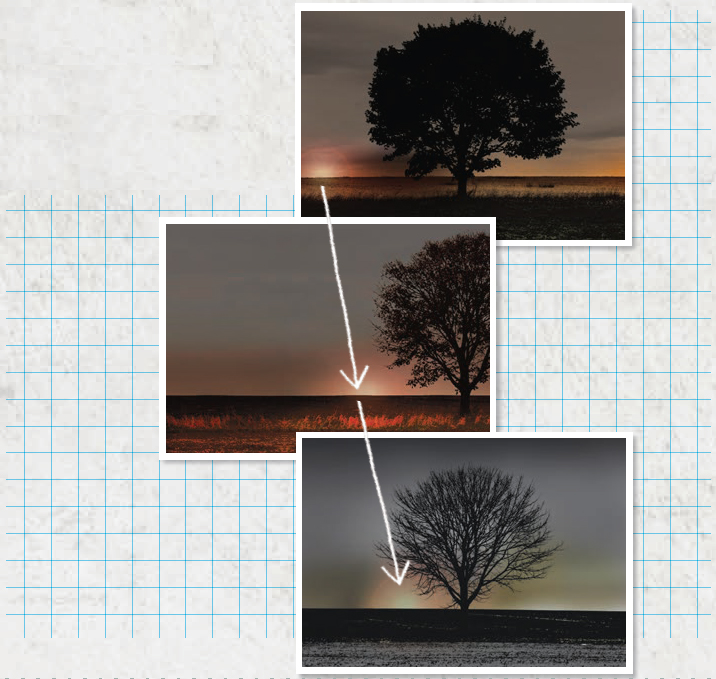
The location of the sunrise changes throughout the year. Observations of this pattern can be used as part of the scientific method—which you will learn about in this chapter—to investigate Earth’s orbit.
Three times throughout this course (at the beginning, near the middle, and at the end), go outside to the same location and take a picture of the western horizon just after sunset. Before you begin, write down what you expect to see when you compare these images. When you are finished, compare the images and see if you were right!
EXPERIMENT SETUP
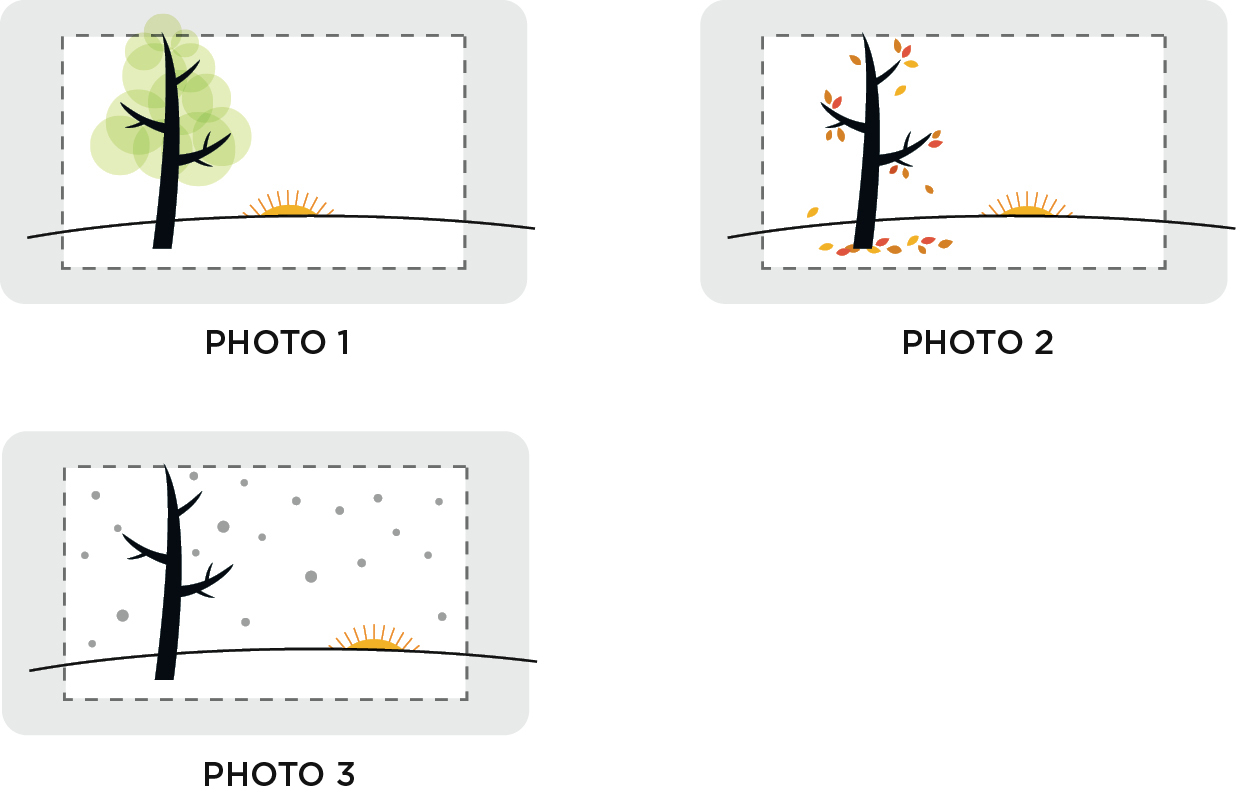
Go to the same location and take three photos of the horizon at a time of day when the Sun is just below the horizon. Be sure that you have a stationary object (like a tree) in each photo. Take a photo at:
1 beginning of semester
2 middle of semester
3 end of semester
PREDICTION
When I compare the three images, I expect to see:
SKETCH OF RESULTS
Loosely translated, the word astronomy means “patterns among the stars.” But modern astronomy—the astronomy we talk about in this book—is about far more than looking at the sky and cataloging the visible stars. The contents of the universe, its origin and fate, and the nature of space and time have become the subjects of rigorous scientific investigation. All of these subjects are related to questions humans have long had about our origins. How and when did the Sun, Earth, and Moon form? Are other galaxies, stars, planets, and moons similar to our own? The answers that scientists are finding to these questions are changing our view of both the cosmos and ourselves.
LEARNING GOALS
In this chapter, we will begin studying astronomy by exploring our place in the universe and the methods of science. By the end of Chapter 1, you should be able to: