2Innate Immunity: The First Lines of Defense
As stated in Chapter 1, most microbial invaders can be detected and destroyed within minutes or hours by the body’s defense mechanisms of innate immunity, which do not rely on expansion of antigen-specific lymphocytes. The innate immune system uses a limited number of secreted proteins and cell-associated receptors to detect infection and to distinguish between pathogens and host tissues. These are called innate receptors because they are inborn; they are encoded by genes directly inherited from an individual’s parents and do not need to be generated by the gene rearrangements used to assemble antigen receptors of lymphocytes described in Section 1-11. The importance of innate immunity is illustrated by several immunodeficiencies that result when it is impaired, increasing susceptibility to infection even in the presence of an intact adaptive immune system, as we will discuss in Chapter 13.
As we saw in Fig. 1.5, an infection starts when a pathogen breaches one of the host’s anatomic barriers. Some innate immune mechanisms start acting immediately (Fig. 2.1). These immediate defenses include several classes of preformed soluble molecules that are present in extracellular fluid, blood, and epithelial secretions and which can either kill the pathogen or weaken its effect. Antimicrobial enzymes such as lysozyme begin to digest bacterial cell walls; antimicrobial peptides such as the defensins lyse bacterial cell membranes directly; and a system of plasma proteins known as the complement system targets pathogens both for lysis and for phagocytosis by cells of the innate immune system, such as macrophages. If these fail, innate immune cells become activated by pattern-recognition receptors (PRRs) that detect molecules called pathogen-associated molecular patterns (PAMPs) that are typical of microbes (see Section 1-5). The activated innate cells can engage various effector mechanisms to eliminate the infection. By themselves, neither the soluble nor the cellular components of innate immunity generate long-term protective immunological memory. If an infectious organism breaches these first two lines of defense, mechanisms will be engaged to induce an adaptive immune response—the third phase of the response to a pathogen. This leads to the expansion of antigen-specific lymphocytes that target the pathogen specifically and to the formation of memory cells that provide long-lasting specific immunity.
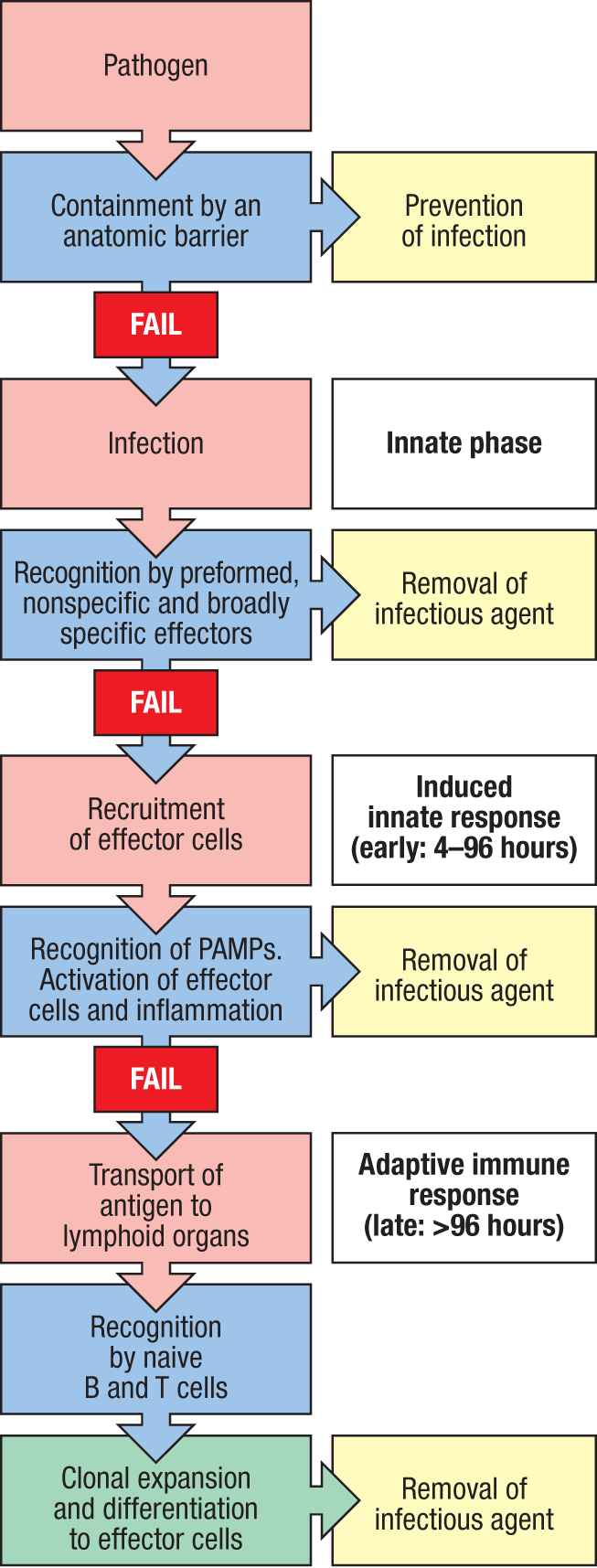
This chapter considers the first phase of the innate immune response. We first describe the anatomic barriers that protect the host against infection and examine the immediate innate defenses provided by various secreted soluble proteins. The anatomic barriers are fixed defenses against infection and consist of the epithelia that line the internal and external surfaces of the body, along with the phagocytes residing beneath all epithelial surfaces. These phagocytes act directly by engulfing and digesting invading microorganisms. Epithelia are also protected by many kinds of chemical defenses, including antimicrobial enzymes and peptides. Next we describe the complement system, which directly kills some microorganisms and interacts with others to promote their removal by phagocytic cells. The complement system together with other soluble circulating defensive proteins is sometimes referred to as humoral innate immunity, from the old word ‘humor’ for body fluids. If these early defenses fail, the phagocytes at the site of infection help recruit new cells and circulating effector molecules, a process called inflammation, which we will discuss in Chapter 3.
Glossary
- innate immunity
- The various innate resistance mechanisms that are encountered first by a pathogen, before adaptive immunity is induced, such as anatomical barriers, antimicrobial peptides, the complement system, and macrophages and neutrophils carrying nonspecific pathogen-recognition receptors. Innate immunity is present in all individuals at all times, does not increase with repeated exposure to a given pathogen, and discriminates between groups of similar pathogens, rather than responding to a particular pathogen. Cf. adaptive immunity.
- antimicrobial enzymes
- Enzymes that kill microorganisms by their actions. An example is lysozyme, which digests bacterial cell walls.
- complement system
- A set of plasma proteins that act together as a defense against pathogens in extracellular spaces. The pathogen becomes coated with complement proteins that facilitate its removal by phagocytes and which can also kill certain pathogens directly. Activation of the complement system can be initiated in several different ways. See classical pathway, alternative pathway, lectin pathway.
- humoral
- Referring to effector proteins in the blood or body fluids, such as antibodies in adaptive immunity or complement proteins in innate immunity.
- antimicrobial peptides, antimicrobial proteins
- Amphipathic peptides or proteins secreted by epithelial cells and phagocytes that kill a variety of microbes nonspecifically, mainly by disrupting cell membranes. Antimicrobial peptides in humans include the defensins, the cathelicidins, the histatins, and RegIIIγ.