PART I
AN INTRODUCTION TO IMMUNOBIOLOGY AND INNATE IMMUNITY
1Basic Concepts in Immunology
Immunology is the study of the body’s defense against infection. We are continually exposed to microorganisms, many of which cause disease, and yet become ill only rarely. How does the body defend itself? When infection does occur, how does the body eliminate the invader and cure itself? And why do we develop long-lasting immunity to many infectious diseases encountered once and overcome? These are the questions addressed by immunology, which we study to understand our body’s defenses against infection at the cellular and molecular levels.
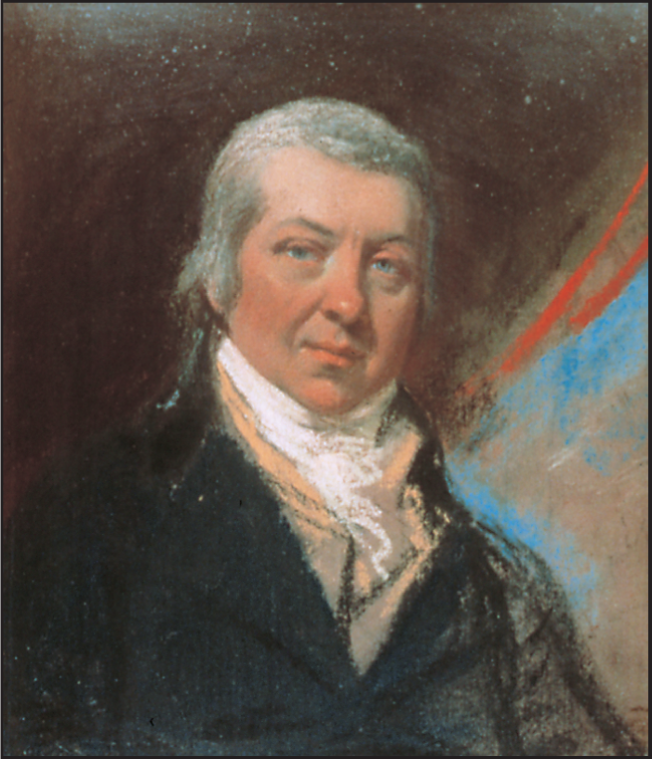
The beginning of immunology as a science is usually attributed to Edward Jenner for his work in the late 18th century (Fig. 1.1). The notion of immunity—that surviving a disease confers greater protection against it later—was known since ancient Greece. Variolation—the inhalation or transfer into superficial skin wounds of material from smallpox pustules—had been practiced since at least the 1400s in the Middle East and China as a form of protection against that disease and was known to Jenner. Jenner had observed that the relatively mild disease of cowpox seemed to confer protection against the often fatal disease of smallpox, and in 1796, he demonstrated that inoculation with cowpox protected the recipient against smallpox. His scientific proof relied on the deliberate exposure of the inoculated individual to infectious smallpox material 2 months after inoculation. This scientific test was his original contribution.
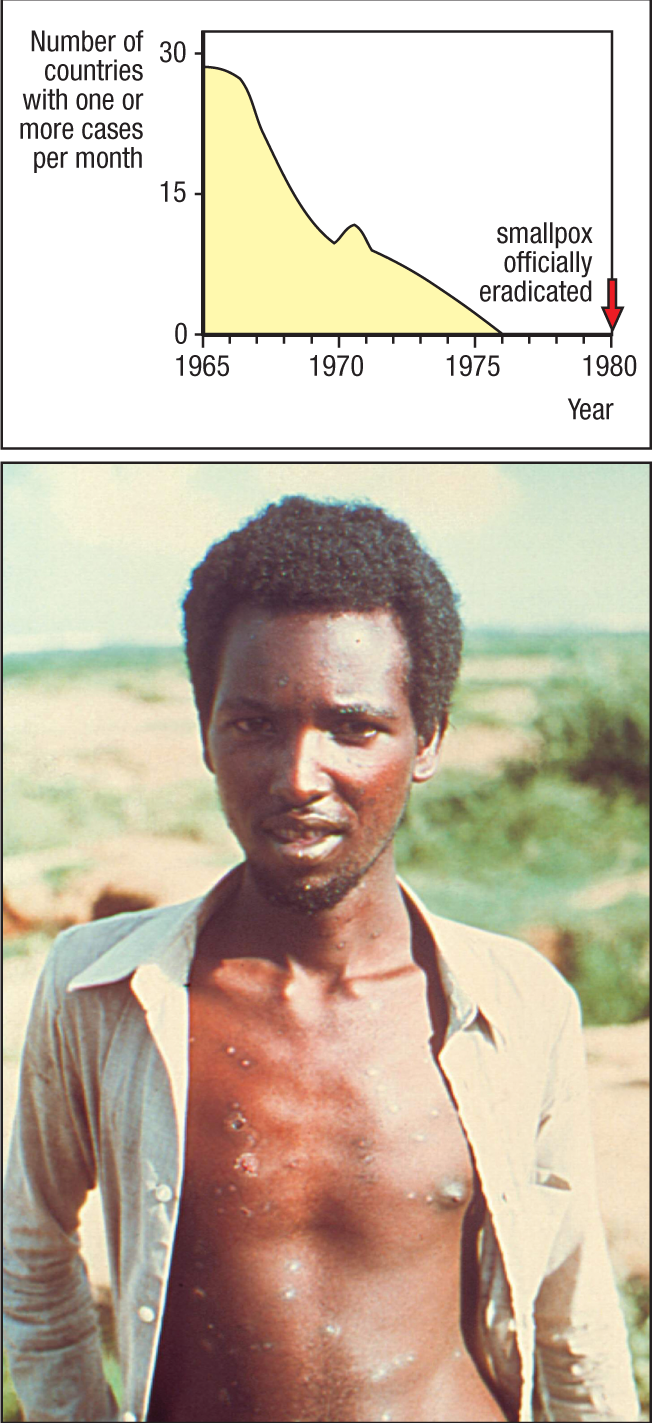
Jenner called the procedure vaccination. This term is still used to describe the inoculation of healthy individuals with weakened or attenuated strains of disease-causing agents in order to provide protection from disease. Although Jenner’s bold experiment was successful, it took almost two centuries for smallpox vaccination to become universal. This advance enabled the World Health Organization to announce in 1980 that smallpox had been eradicated (Fig. 1.2), arguably the greatest triumph of modern medicine.
Jenner’s strategy of vaccination was extended in the late 19th century by the discoveries of many great microbiologists. Robert Koch proved that infectious diseases are caused by specific microorganisms. In the 1880s, Louis Pasteur devised a vaccine against cholera in chickens and also developed a rabies vaccine that proved to be a spectacular success upon its first trial in a boy bitten by a rabid dog.
These practical triumphs led to a search for vaccination’s mechanism of protection and to the development of the science of immunology. In the early 1890s, Emil von Behring and Shibasaburo Kitasato discovered that the serum of animals immune to diphtheria or tetanus contained a specific ‘antitoxic activity’ that could confer short-lived protection against the effects of diphtheria or tetanus toxins in unimmunized animals and people. This activity was later determined to be due to the proteins we now call antibodies, which bind specifically to the toxins and neutralize their activity. That these antibodies might have a crucial role in immunity was reinforced by Jules Bordet’s discovery in 1899 of complement, a component of serum that acts in conjunction with antibodies to destroy pathogenic bacteria.
A specific response against infection by potential pathogens, such as the production of antibodies against a particular pathogen, is known as adaptive immunity, because it develops during the lifetime of an individual as an adaptation to infection with that pathogen. Adaptive immunity is distinguished from innate immunity, which—at the time von Behring was developing serum therapy for diphtheria—was already known chiefly through the work of the great Russian immunologist Élie Metchnikoff, who discovered that many microorganisms could be engulfed and digested by phagocytic cells, which thus provide defenses against infection that are nonspecific. Whereas these cells—which Metchnikoff called ‘macrophages’—are always present and ready to act, adaptive immunity requires time to develop but is highly specific.
It was soon clear that specific antibodies could be induced against a vast range of substances called antigens because they could stimulate antibody generation. Paul Ehrlich advanced the development of an antiserum as a treatment for diphtheria and developed methods to standardize therapeutic serums. Today the term ‘antigen’ refers to any substance recognized by the adaptive immune system. Typically antigens are common proteins, glycoproteins, and polysaccharides of pathogens, but they can include a much wider range of chemical structures; for example, metals such as nickel, drugs such as penicillin, and organic chemicals such as the urushiol (a mix of pentadecylcatechols) in the leaves of poison ivy. Metchnikoff and Ehrlich shared the 1908 Nobel Prize for their respective work on immunity.
This chapter introduces the principles of innate immunity and adaptive immunity, the cells of the immune system, the tissues in which they develop, and the tissues through which they circulate. We then outline the specialized functions of the different types of cells by which they eliminate infection.
Glossary
- immunology
- The study of all aspects of host defense against infection and also of the adverse consequences of immune responses.
- variolation
- The intentional inhalation of or skin infection with material taken from smallpox pustules of an infected person for the purpose of deriving protective immunity.
- vaccination
- The deliberate induction of adaptive immunity to a pathogen by injecting a dead or attenuated (nonpathogenic) live form of the pathogen or its antigens (a vaccine).
- antibody
-
A protein that binds specifically to a particular substance—called its antigen. Each antibody molecule has a unique structure that enables it to bind specifically to its corresponding antigen, but all antibodies have the same overall structure and are known collectively as immunoglobulins. Antibodies are produced by differentiated B cells (plasma cells) in response to infection or immunization and bind to and neutralize pathogens or prepare them for uptake and destruction by phagocytes.
- complement
-
A set of plasma proteins that act together as a defense against pathogens in extracellular spaces. The pathogen becomes coated with complement proteins that facilitate its removal by phagocytes and that can also kill certain pathogens directly. Activation of the complement system can be initiated in several different ways. See classical pathway, alternative pathway, lectin pathway.
- adaptive immunity
- Immunity to infection conferred by an adaptive immune response.
- innate immunity
-
The various innate resistance mechanisms that are encountered first by a pathogen, before adaptive immunity is induced, such as anatomical barriers, antimicrobial peptides, the complement system, and macrophages and neutrophils carrying nonspecific pathogen-recognition receptors. Innate immunity is present in all individuals at all times, does not increase with repeated exposure to a given pathogen, and discriminates between groups of similar pathogens, rather than responding to a particular pathogen. Cf. adaptive immunity.
- antigen
- Any molecule that can bind specifically to an antibody or generate peptide fragments that are recognized by a T-cell receptor.
- antiserum (pl. antisera)
- The fluid component of clotted blood from an immune individual that contains antibodies against the antigen that was used for immunization. An antiserum contains a mixture of different antibodies that all bind the antigen, each of which has a different structure, its own epitope on the antigen, and its own set of cross-reactions. This heterogeneity makes each antiserum unique.