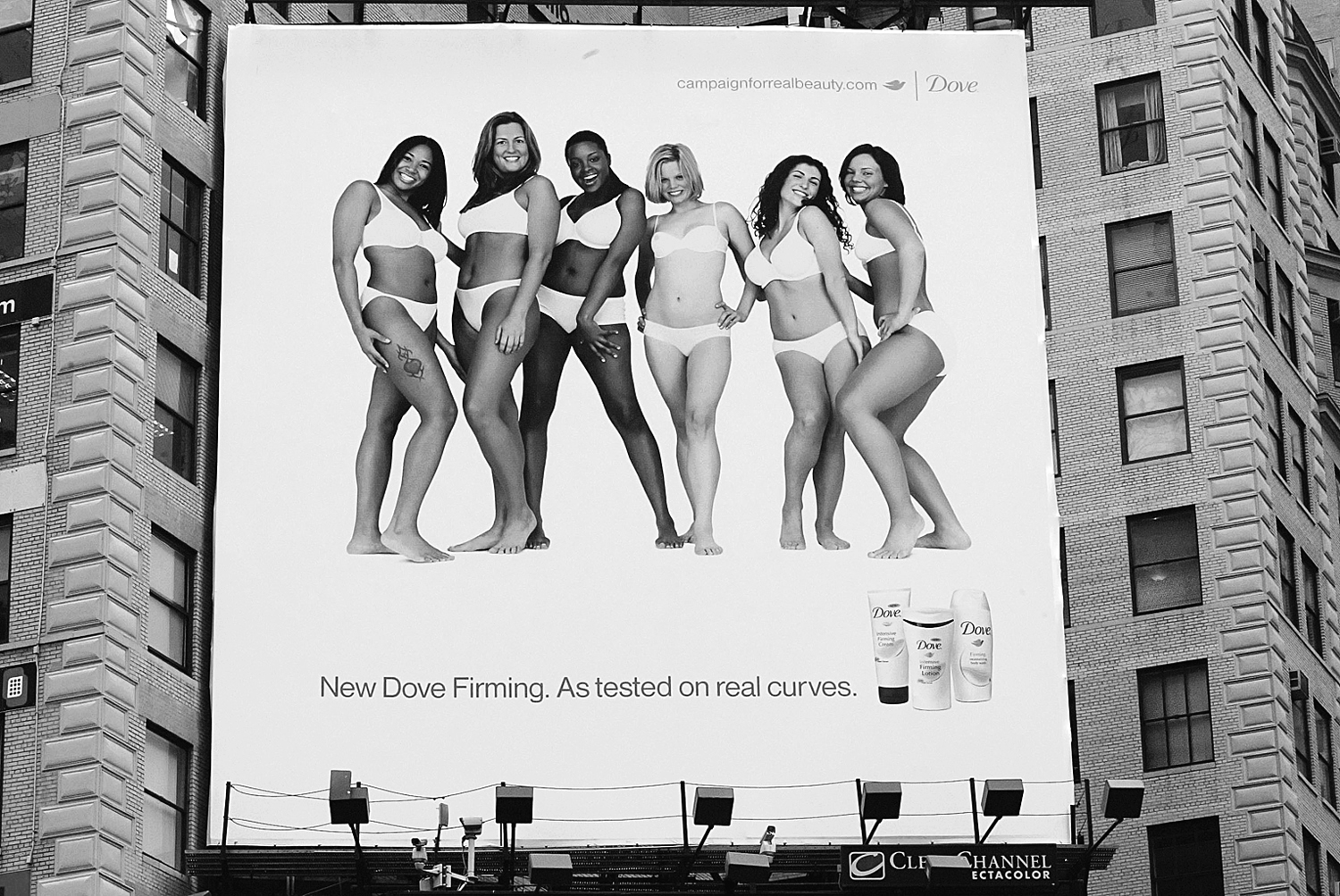
IN 2004, DOVE, INC., launched its Campaign for Real Beauty, in which billboard, print, and television advertising featured images of “real” women. Many of the ads showed several women in a row wearing simple white underwear. Viewers, therefore, could see the women’s diversity—their different sizes, different body shapes, different skin tones. On the surface, this campaign seemed progressive because it featured a diverse array of “real” women instead of traditional models. It certainly was a striking change from the usual portrayal of women in the media (e.g., young, thin, White). However, while many people praised the campaign as being empowering for women, it was also criticized and can be considered an example of empowertising (as discussed in Chapter 1).
Image Description
The billboard features photos of six women of different ethnicities, sizes, body shapes, and skin tones standing and posing together. The women are shown wearing white underwear. The tagline reads “New Dove Firming. As tested on real curves.”
This billboard, pictured in New York City in 2005, features one of the iconic lineup images at the heart of Dove’s Campaign for Real Beauty. What messages, both positive and negative, do ads like this send?
One reason this ad campaign may have been empowering was that it prompted increased discussion about media portrayals of women and female beauty. The campaign, and the underlying idea that beauty isn’t about any one specific look, received significant media attention with coverage on shows such as Good Morning America, The View, and Ellen. The fact that an array of body types not typically seen in advertising was at the heart of this campaign was compelling. Moreover, the ads didn’t just show different bodies—the ads portrayed them positively. For example, a dark-skinned woman wasn’t shown trying to lighten her skin, a woman with small breasts wasn’t shown trying to increase her cup size, and a curly-haired woman wasn’t shown trying to straighten her hair. Many people would argue that, because of the positive portrayal of diverse bodies, the campaign was empowering to women.
Yet some elements generated a lot of criticism. First, while some of the ads showed women “who were wrinkled, freckled, pregnant, had stretch marks, or might be seen as fat” as compared to traditional media images of women (Johnston & Taylor, 2008, p. 942), the women in the ads still didn’t reflect the average woman. For example, the women in the lineup ad wore U.S. clothing sizes 6–12. This is larger than the typical commercial model (size 4; Mears, 2011) but smaller than the average American woman (size 16/18; Christel & Dunn, 2016). Also, the women in the ads generally didn’t have tattoos, scars, or visible disabilities, and they had smooth skin and were mostly young. In this way, Dove seemed to be encouraging body positivity while featuring women who still largely conformed to traditional beauty standards. In fact, the original campaign was centered on advertising a line of “skin firming” products. So the ads indirectly said that women can be beautiful as long as they aren’t too heavy, aren’t disabled, have styled hair, and have firm skin (presumably because they’ve bought and used Dove products).
your turn
Do a quick image search on “Dove Campaign for Real Beauty.” What do you think of it? Based on what you’ve read here, what aspects of it do you like, and why? Do any aspects of it trouble you? If so, which ones, and why? Ask at least three friends or family members to do the same image search. How do they react to this campaign? Do their responses vary by age? Do they vary by gender? Given the company’s economic goals, can you think of any type of advertising campaign that wouldn’t result in at least some of the criticisms you’ve read about here?
Of course, Dove is in business to sell products, and this campaign definitely helped its bottom line. Previously best known for its bar soap, the company raised its brand awareness and increased its market share largely as a result of this campaign (Jeffers, 2005). Ironically, Dove’s parent company, Unilever, markets SlimFast, a diet supplement; the Axe product line, known for ads featuring sexualized images of women; and Fair & Lovely, a brand of skin-lightening products sold in many countries. Thus, while Dove was sending the message that women should accept their bodies, the parent company’s other products send messages that women’s bodies are unacceptable as they currently are. The Dove campaign represents some of the mixed messages women receive about their bodies.
In this chapter, we’ll talk about the cultural focus on women’s bodies. Women spend a great deal of time thinking about their bodies from the outside (how they look). This is largely because the female body is generally portrayed as something to be looked at. We’ll discuss the messages girls and women receive about what is beautiful, and we’ll explore the impact of accepting these views. One consequence of girls and women spending a lot of time focusing on their bodies from the position of an observer is that they tend to pay less attention to what their bodies actually do. Therefore, we’ll also discuss some of the functions of women’s bodies (e.g., menstruation) and examine why these functions are often shrouded in secrecy. Finally, we’ll explore some ways that girls and women can shift their focus away from how their bodies look to an appreciation for all of the things that their bodies can do.