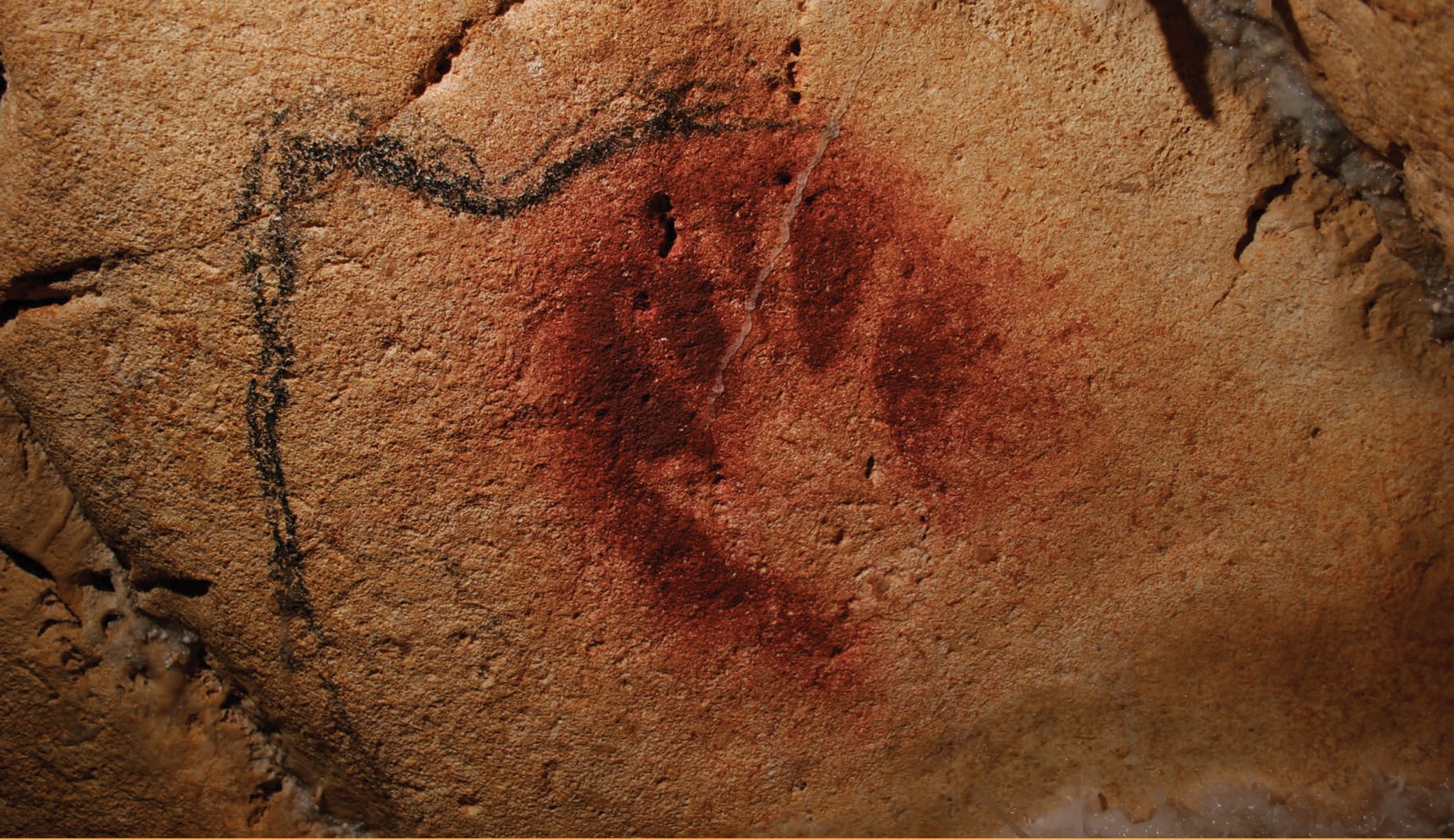
Human Culture A human hand outlined in red pigment decorates the wall of a cave in France, alongside vivid images (not shown) of animals such as mammoths and rhinos. Perhaps serving as the artist’s signature, the hand image dates from 36,000 years ago—evidence of the explosion in culture that humans throughout the world experienced during the late Paleolithic period.CHRONOLOGYOPENCLOSE
ca. 66 million years agoAsteroid hitting Yucatán Peninsula causes massive extinction event
ca. 6 million–4.5 million years agoBipedalism evolves
3.2 million years agoLifetime of the hominin Lucy
2.6 million years agoPaleolithic period begins
ca. 2.5 million years agoFirst evidence of tool use
Between 2 million and 120,000 years agoLanguage emerges
ca. 1.5 million years agoHomo erectus emerges
Between 1.5 million and 500,000 years agoHominins first control fire
ca. 400,000 years agoNeanderthals emerge
ca. 300,000–200,000 years agoHomo sapiens emerges
ca. 190,000 years agoHomo erectus goes extinct
ca. 130,000 years agoLast ice age begins
ca. 100,000–65,000 years agoHomo sapiens migrates out of Africa
ca. 90,000 years agoFlores Island “Hobbits” appear; late Paleolithic cultural revolution begins
ca. 75,000 years agoMount Toba erupts
ca. 50,000–30,000 years agoNeanderthals, Denisovans, Flores Islands “Hobbits” go extinct
ca. 50,000–12,000 years agoMassive megafauna extinctions
ca. 45,000 years agoHomo sapiens enters Europe
ca. 40,000 years agoHomo sapiens reaches Australia and Tasmania
ca. 30,000 years agoHomo sapiens reaches China and Japan
ca. 23,000–14,000 years agoHomo sapiens reaches the Americas
13,000 years agoPaleolithic period ends
12,000 years agoLast ice age ends
In 1974 in Ethiopia, a pair of paleontologists (scientists who find and interpret fossil remains) decided to take an unusual route back to their camp. Walking through a gully, they spied what looked like an arm bone resting on the ground. A moment’s inspection told them they had happened upon a relative, perhaps an ancestor, of the human race. In camp that evening, the paleontologists celebrated the find with their French and American teammates, and because the Beatles song “Lucy in the Sky with Diamonds” was playing on their tape machine, they named the skeleton to which the arm bone belonged “Lucy.”
Lucy was a marvelous discovery. Paleontologists and other specialists hunting for early human remains generally count themselves lucky to find a tooth or a finger bone. But after two weeks of digging and scratching, the paleontologists who found Lucy’s arm bone uncovered hundreds of bone fragments, amounting to about 40 percent of her skeleton.
Lucy was a young adult female who died of unknown causes about 3.2 million years ago. She stood about 3′7″ (1.1 m) tall and weighed about 65 lbs. (30 kg). Her feet, pelvis, and spine were astonishingly human-like, but her cranium,teeth, and jaw more ape-like. She walked upright and probably ate mostly fruits, vegetables, and leaves. Her hands suggest she was good at climbing trees. Her braincase was in the average range for modern chimps, only one-third the size of your brain. She is classified as an Australopithecus afarensis, a species of hominin that lived in what is now Ethiopia and Kenya about 4 million to 3 million years ago. (The term hominins refers to humans, all extinct branches of humans, and all our ape-like ancestors over the last 7 million years.) After touring the world’s museums for several years, Lucy now makes her home in a climate-controlled vault in a museum in Ethiopia’s capital city of Addis Ababa. Lucy’s bones provided more new information about human origins and evolution than any previous find, but her skeleton contained only fragments of the human story.
It’s disconcerting to admit it, but we are, all of us, descended from a very ancient mammal that looked something like a modern tree shrew—a small, slender, furry creature. And like all earthlings, our ancestry ultimately extends back to single-celled creatures resembling pond scum. It was highly unlikely that the course of biological evolution should have produced modern humans. If, somehow, the epic could start up again, it almost certainly would turn out differently—just as human history, if magically replayed, would almost certainly not produce Aztecs or Buddhism or the Constitution of the United States. Biological evolution, like human history, was and is full of chance. Nonetheless, biological evolution did produce us, and it’s instructive to think about how that unlikely turn of events happened.
This chapter deals with the story of human origins, the migrations of people from their original African home to the far corners of the Earth, and the fabric of life during the period scholars call the Paleolithic. It ends with the burst of cultural change that occurred near the end of the Paleolithic, roughly 70,000 to 15,000 years ago. During the Paleolithic, even though people were few and widely scattered, they retained connections that spanned the inhabited world. As we will see, there is reason to suppose that even when transportation meant walking and communications technology consisted only of speech, a slender and faint web embraced all our ancestors.
The term used to describe all humans, extinct human branches, and ape-like human ancestors who have lived in the last 7 million years. Fossil hunters have discovered 18 species of hominin so far.