OLD WORLDS AND NEW
★
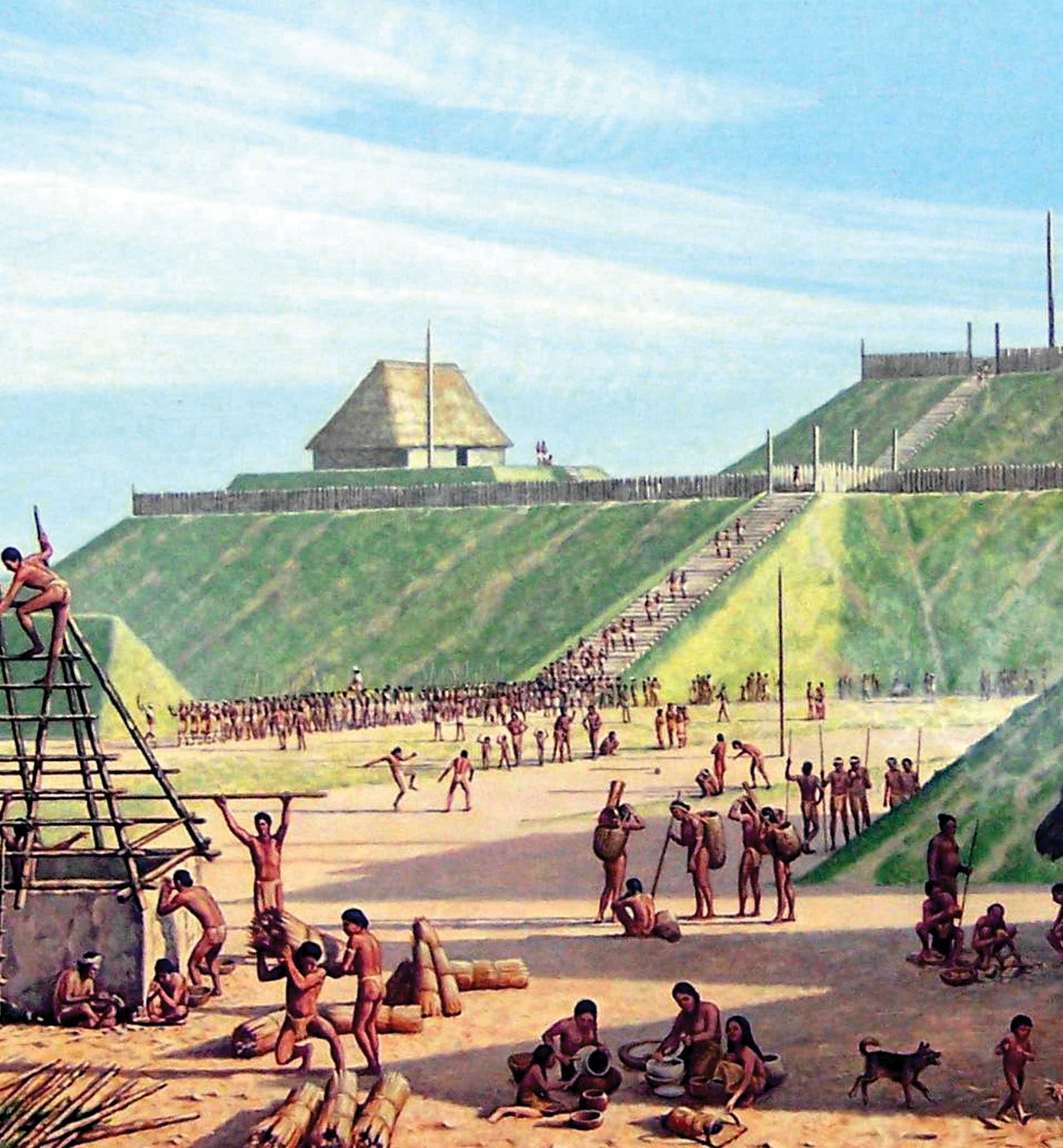
This mural painted by Michael Hampshire in the twentieth century depicts how life may have looked in the city of Cahokia in the twelfth century. Houses and work spaces were clustered around a central plaza. In the background is the city’s largest pyramid mound, with three tiers for buildings and ceremonies.
FOCUS QUESTIONS
- What were the major patterns of Native American life in North America before Europeans arrived? p. 3
- How did Native American and European ideas of freedom differ on the eve of contact? p. 10
- What impelled European explorers to look west across the Atlantic? p. 12
- What happened when the peoples of the Americas came in contact with Europeans? p. 15
- What were the chief features of the Spanish empire in the Americas? p. 20
- What were the chief features of the French and Dutch empires in North America? p. 30
In 1534, Mi’kmaq Indians rowed a fleet of canoes out into the Gulf of St. Lawrence to meet Frenchman Jacques Cartier’s ship. Cartier was frightened until he realized that the pointed sticks the Mi’kmaqs were waving at his men had animal skins attached to them. They were signaling that they wanted to trade. Everywhere in the Americas that Europeans went, Native people met them with their own diplomatic rituals and invitations to make trading and military alliances. Although Europeans sometimes called the Americas a “New World” that Christopher Columbus “discovered,” the nations and peoples of the Americas composed a world just as fully developed as those in the “Old World.” Fortunately for Europeans, trade with these newcomers was exactly what many of them wanted.
Human communities have always interacted. For centuries before the conquest of the Americas, Europeans had intersected with Muslim populations in North Africa and Eurasia; indeed, the very idea of Europe as a distinct community arose out of such encounters. But since the voyages of Columbus, the interconnection of cultures and peoples has taken place on a global scale. Crops new to each hemisphere crossed the Atlantic and Pacific, reshaping diets and transforming the natural environment. Building on long-standing trade with North Africa and beyond, West Africans traded with Europeans who came to their Atlantic coasts. But in Africa, Europeans built a slave trade that gave them a supply of unfree labor with which they exploited the fertile lands of the Western Hemisphere. Indeed, of the approximately 10 million men, women, and children who crossed to the Americas between 1492 and 1820, the vast majority, about 7.7 million, were enslaved Africans.
Europeans saw the Americas as a land of abundance. Here, many believed, would arise unparalleled opportunities for riches, or at least liberation from poverty. Europeans envisioned America as a religious refuge, a society of equals, a source of power and glory. They searched for golden cities and fountains of eternal youth. Some sought to establish ideal communities based on the lives of the early Christian saints or other blueprints for social justice.
Some of these dreams of riches and opportunity would indeed be fulfilled. To many European settlers, America offered a far greater chance to own land and worship as they pleased than existed in Europe. Yet the conditions that enabled millions of settlers to take control of their own destinies were made possible by many forms of unfree labor, including indentured servitude, forced labor, and one of the most brutal and unjust systems ever devised, plantation slavery. The conquest and settlement of the Western Hemisphere opened new chapters in the long histories of both freedom and slavery.
There was a vast human diversity among the peoples thrown into contact with one another in the Americas. Exploration and settlement took place in an era of almost constant warfare among European nations, each racked by internal religious, political, and regional conflicts. Native Americans and Africans were members of numerous nations and other polities with their own languages and cultures. They were as likely to fight one another as to unite against the European newcomers. All these peoples were changed by their integration into the new Atlantic economy. The complex interactions of these old worlds—Western Europe, North America, and West Africa—would make a new world that would change them all.
TIMELINE
ca. 7000 BCE Agriculture develops in Mexico and Andes
ca. 900 CE Ancestral Publoans and Huhugam begin to build planned towns
ca. 1000–1400 Height of the Huhugam
1050–1200 Height of Cahokia
ca. 1200 Rise of Mali and Benin
ca. 1400 Haudenosaunee (Iroquois) League established
1434 Portuguese explore sub-Saharan African Coast
1492 Reconquista of Spain completed
Spain expels Muslims and Jews
Columbus’s first voyage to the Americas
1502 First African slaves transported to Caribbean islands
1517 Martin Luther’s Ninety-Five Theses
1519 Hernán Cortés arrives in Mexico
1528 Las Casas writes the first volume of his History of the Indies
1530s Pizarro’s conquest of Peru
1542 Spain proclaims the New Laws, abolishing Indian slavery
1608 Champlain establishes Quebec
1609 Hudson claims New Netherland
1610 Santa Fe established
1680 Pueblo Revolt