3 Art of Mesopotamia and West Asia
5000–2000 BCE
CHAPTER OUTLINE
5000–2000 BCE
CHAPTER OUTLINE
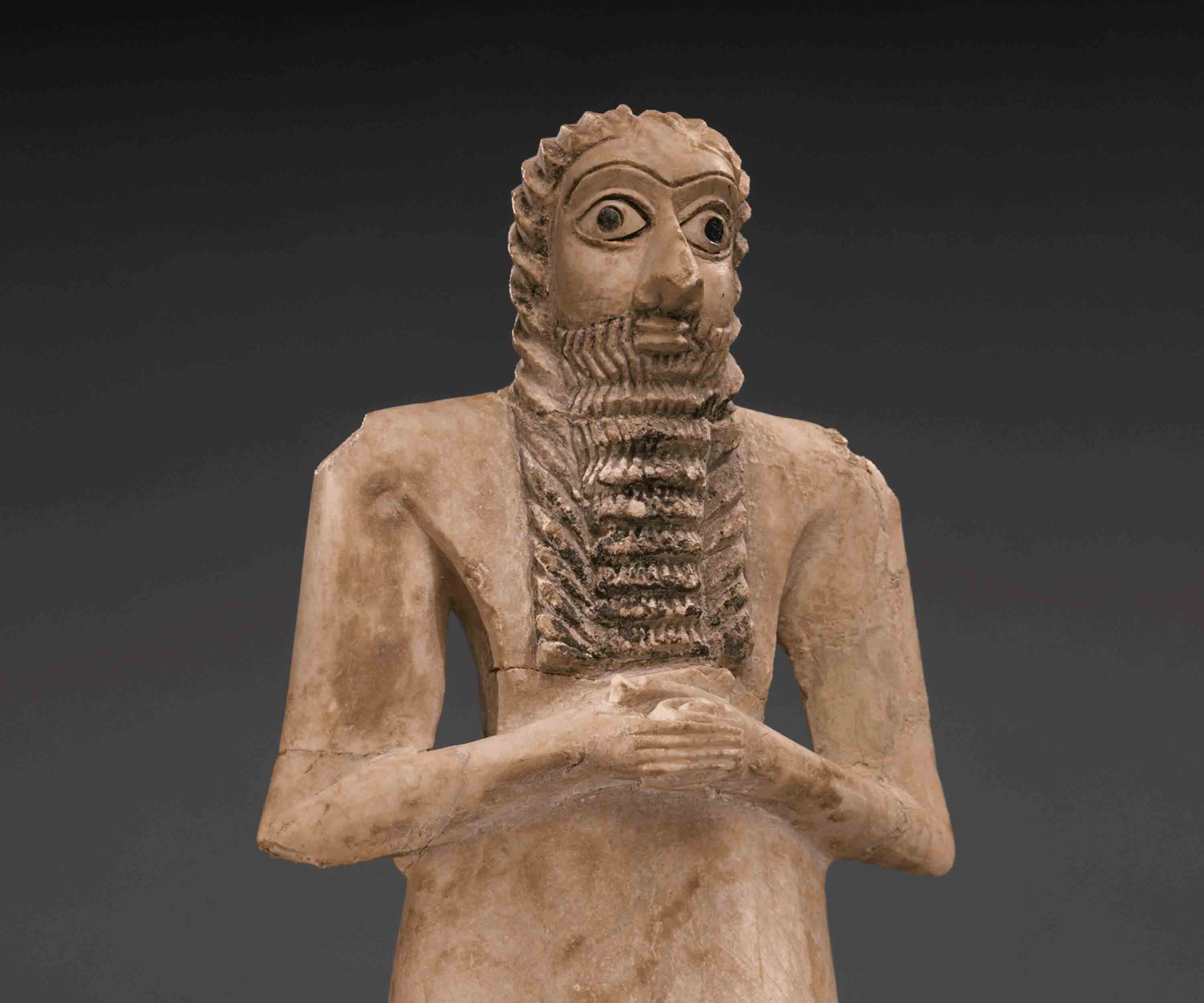
The figure has a long, wavy beard and long, center-parted wavy hair. The eyes are inlaid. The hands are clasped at waist level.
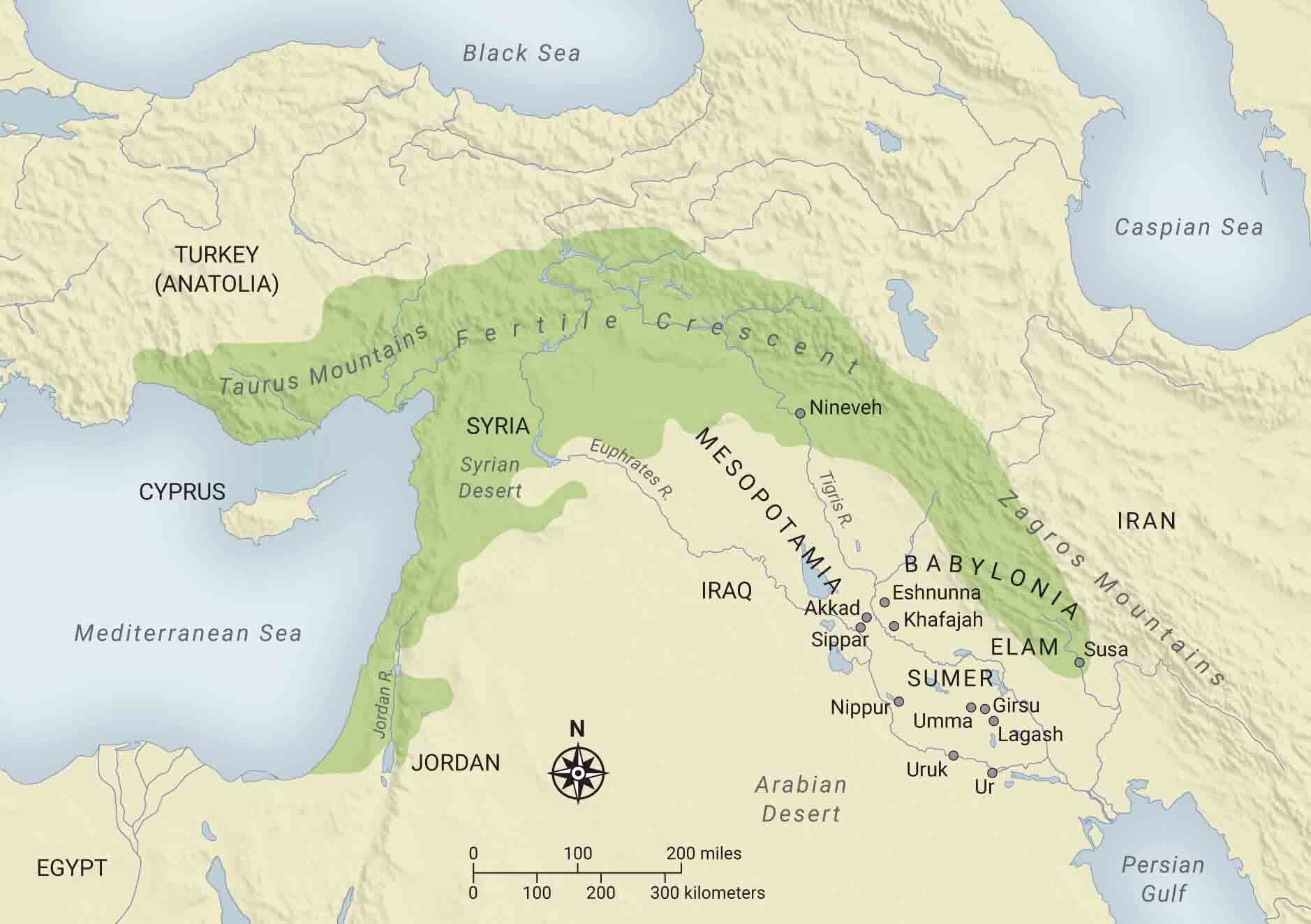
The Fertile Crescent follows the coast of present-day Israel, Lebanon and Syria, curves eastward across the headwaters of the Euphrates and Tigris Rivers, and then curves downward along the Zagros Mountains into Babylonia, just north of the Persian Gulf. It also includes the Taurus Mountains in southern Anatolia. The city of Nineveh lies within the Crescent, on the Tigris River. Other Mesopotamian city-states lie farther south, where the Tigris and Euphrates approach each other. Roughly from north to south, these are Eshnunna, Akkad, Sippar, Khafajah, Susa, Nippur, Umma, Girsu, Lagash, Uruk, and Ur.
Tigris
Euphrates
The earliest West Asian cultures prospered in a region sometimes called the Fertile Crescent: an arc-shaped area that stretches from the foothills of the Zagros Mountains across the Tigris and Euphrates Rivers, along the borderlands between present-day northern Iraq and Syria and southeastern Turkey, and all the way to the eastern coast of the Mediterranean Sea (Map 3.1). (West Asia has also been called the Near East in the past.) The abundance of wild wheat, barley, sheep, and goats in the Fertile Crescent made it ideal for agriculture and the domestication of animals, and the advancement of agriculture and irrigation techniques enabled people to settle in one location rather than follow the seasonal migrations of wild animals. Living in stable communities allowed people to engage in activities other than farming. They built permanent houses in small settlements and began to trade with other communities and regions.
The alluvial plain of Mesopotamia (Greek for “between the rivers”), the region between the Tigris and Euphrates Rivers, is a southern extension of the Fertile Crescent. Several powerful and influential city-states and empires developed in Mesopotamia between the Tigris and Euphrates Rivers from roughly 5000 to 2900 BCE. Following the first development of cities, long-distance trade and complex state bureaucracies also developed in the region. In the course of these three thousand years of history, 5000–2000 BCE, two major urban economic institutions (the temple and the palace) were formed, writing was invented, and an urban elite class flourished, contributing to a highly developed lineage of craftsmanship and the arts, and new ways to use art in support of political and religious power and systems of belief. Specialists emerged, including engineers, architects, and artists, who contributed to the flourishing of complex, innovative, and technically skilled art.
Akkadian
Sumerian
This stability allowed for the accumulation of surplus of food and wealth not only in cities but also in the hands of an elite class. Much of the monumental art produced in West Asia during this period, sponsored by rulers and temples, was designed to emphasize the city-state’s power and belief systems. Devotion to the gods was paramount in art of all sizes, from small votive sculptures to massive temple complexes. Modest works by ancient artisans in households are also of interest to the history of art, because they provide crucial information about the life of ordinary people. These objects allow us to study the material culture of different communities, their technologies of production, their identities, and belief systems. The images that appeared in public monuments and private objects also reflected shifts in the perception of rulers. These shifts appeared dramatically when the Akkadian Empire—the world’s first empire—rose to power, overthrowing the Sumerian-speaking states that preceded them. The innovations during this time have led many modern and contemporary scholars to see the achievements of Mesopotamia as representing a turning point in the long development of human history. Mesopotamian and wider Western Asian cultures are therefore often considered ancestors to the later Mediterranean and European societies in broader historical narratives.